Firing you for reporting a construction injury in Texas is illegal retaliation. Your employer cannot terminate your job, cut your shifts, or force a resignation simply because you documented a hazard or filed a workers’ compensation claim.
The site superintendent and corporate office are already coordinating your exit: they treat your doctor-mandated light-duty restrictions as poor performance, your safety report as a sudden disciplinary violation, and your termination as a routine workforce reduction. According to OSHA, the federal agency received 2,309 docketed whistleblower cases nationwide in 2023 alone. Behind those numbers are corporate defendants who eliminate injured workers to hide safety failures and escape liability.
What Could Your Construction Accident Case Be Worth?
Answer a few quick questions about your accident. Takes about 60 seconds.
See What My Case Might Be WorthThe insurance company offered less than $20,000. I ended up with over $1 million. — Jackie Galindo
Internal emails and unaltered safety logs vanish within days of your firing. A Spoliation Letter, a legal demand that prevents the property owner from destroying evidence, must be issued immediately to secure the evidence exposing their true motives. You have thirty days to formally report the injury. Missing it hands the company the perfect excuse to deny your claim.
Trevino Injury Law construction accident lawyers will dismantle the corporate playbook and lock down the evidence before it disappears. Call 210-TREVINO now for a free case review. You pay nothing unless we win. Se Habla Español.
Is It Illegal to Fire a Construction Worker for Reporting an Injury in Texas?
Yes, it is illegal in Texas to fire a construction worker in retaliation for reporting a job site injury in good faith. Under Texas Labor Code Chapter 451, employers cannot terminate, demote, or punish you for documenting a hazard or filing a workers’ compensation claim, as doing so would directly violate your rights.
While Texas operates as an “at-will” employment state, retaliating against an injured worker for reporting a hazard at a site along I-35 or Loop 1604 directly violates the law. These local project zones are particularly dangerous, as shown by the 3,684 work zone crashes reported across Bexar County in a single year, giving employers ample motive to hide their safety failures (TxDOT, 2024).
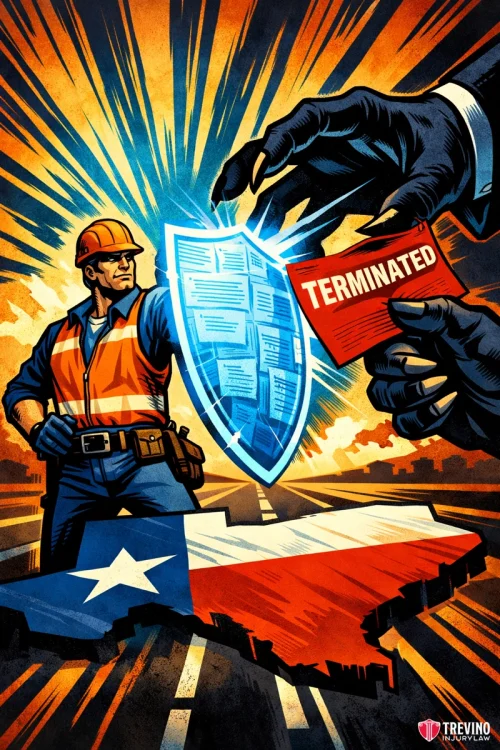
Negligent corporate defendants frequently attempt to disguise these retaliatory firings as routine “layoffs” to avoid liability. When you are hurt at work, your primary focus should be on medical recovery, not fighting a massive corporation attempting to erase its negligence. We know their playbook, and we shut it down.
What Actions Constitute Illegal Employer Retaliation?
Illegal employer retaliation extends far beyond outright termination, encompassing any adverse employment action, subtle demotion, or punitive schedule change that is specifically designed by management to secretly punish you for reporting a dangerous construction site hazard to your corporate supervisors. To force victims out without explicitly firing them, employers may utilize several deceptive tactics:
- Ignoring doctor-mandated light-duty restrictions to intentionally force your resignation is a highly illegal tactic known as Constructive Discharge.
- Drastically cutting your hours or assigning you to punitive, inherently dangerous shifts that jeopardize your safety.
- Demoting you from a foreman position immediately after you require a hospital visit to a Level 1 trauma facility like University Health System.
Because employers use these deceptive tactics to hide their motives, it is essential that you aggressively secure documentation to prove their true intent.
How to Prove Wrongful Termination After a San Antonio Construction Accident
To prove wrongful termination, you must establish a causal link between your injury report and your firing. Texas courts allow you to prove this retaliatory motive through circumstantial evidence. This means your trial lawyer can show illegal intent by highlighting a suspiciously close timeline between your injury report to the Site Superintendent and your sudden termination, or by exposing a corporation’s sudden failure to follow its own disciplinary policies.
Negligent trucking companies and major general contractors operating in Bexar County rarely admit to retaliation. Instead, they invent performance issues to justify termination. Our San Antonio plaintiff trial lawyers combat this by preserving evidence early.

We immediately send Freedom of Information Act (FOIA) requests and demand internal communications to establish a causal link between your injury report and the retaliatory firing. We litigate to a verdict to expose these cover-ups.
What Evidence Shows a Contractor’s True Motive for Termination?
To expose a negligent contractor’s illegal motive, your dedicated trial attorney will aggressively seek internal company incident reports, private email correspondence, and sworn witness testimony that directly contradict the employer’s stated, fabricated reason for abruptly firing you from the project. This process frequently requires gathering:
- Statements and photographs from a coworker proxy who documented the hazard before the employer could clear the scene.
- Evidence of sudden, highly negative performance reviews issued immediately after an injury report on a San Antonio commercial build.
- Safety logs that the corporation attempted to alter or destroy after the incident.
Because those records can overlap with the proof needed for the underlying accident claim, use a construction accident evidence checklist to identify the photographs, witness information, incident reports, and company records worth preserving.
Once you secure this evidence, it provides the foundation for filing a formal lawsuit against the offending corporation.
Can I Sue My Employer for Firing Me After a Workers’ Comp Claim in Texas?
Yes, you can sue a San Antonio construction company for wrongful termination if evidence shows you were fired for filing a claim, reporting an unsafe working condition, or reporting a severe occupational injury. Taking legal action holds the responsible parties accountable and secures the financial compensation your family may be entitled to receive.

Trevino Injury Law is a plaintiff trial firm that litigates to verdict. We resolutely refuse to accept lowball offers from settlement mills or corporate adjusters who try to intimidate injured workers. We are committed to helping you fight for economic justice.
Does Your Employer’s Workers’ Comp Status Affect Your Retaliation Claim?
If your employer operates as a Texas non-subscriber without traditional workers’ compensation insurance, they cannot use standard administrative protections to shield their negligence and will face direct, aggressive personal injury lawsuits for retaliating against you after a catastrophic job site accident.
Labor Code Chapter 451 governs standard compensation claims and provides specific statutory remedies for retaliation. Conversely, fighting a non-subscriber often yields higher overall compensation because the company’s gross negligence is fully exposed in court without restrictive statutory caps.
What Damages Can You Recover in a Retaliation Lawsuit?
In a successful workplace retaliation lawsuit, you can fight to recover maximum financial compensation for your past lost wages, future reduced earning capacity, and severe mental anguish. Furthermore, as established by the landmark ruling in Azar Nut Co. v. Cionics, 818 S.W.2d 330 (Tex. 1991), Texas law allows you to pursue substantial punitive damages levied directly against the negligent corporation to aggressively punish them for their illegal actions and malicious retaliatory conduct.
We fight for economic justice to level the playing field between your family and powerful corporations. Your recovery typically includes:
- Full restitution for wages lost due to the retaliatory termination.
- A comprehensive Life Care Plan that ensures long-term financial stability following catastrophic injuries, independent of the firing.
- Compensation for the extreme mental anguish caused by losing your income while injured.
Pursuing these comprehensive damages requires an attorney who knows the insurance company’s playbook and is unafraid of the courtroom.
Why Do You Need a Trial Lawyer to Fight a Retaliatory Firing?
You need a proven plaintiff trial lawyer immediately to prevent negligent corporate employers from hiding critical hazard logs and using your at-will employment status to illegally bully you into abandoning your rightful financial compensation claim following a severe job site accident. Understanding the mechanics of workplace retaliation is only the first step; fighting back against a massive construction company requires elite, aggressive legal representation.
Attorney J.R. Trevino brings the formidable experience of over 80 cases taken to trial across South Texas courts. When you hire a law firm with a documented history of courtroom victories, the dynamic instantly shifts. Insurance adjusters from massive corporations like USAA and State Farm frequently settle for significantly higher amounts when they know the opposing counsel is fully prepared to litigate a case to a jury verdict rather than operate as a high-volume settlement mill.
We know their playbook, and we aggressively dismantle their attempts to blame you for their safety failures. Securing aggressive legal representation immediately ensures you do not miss the strict statutory deadlines surrounding workplace retaliation claims.
How Long Do You Have to File a Retaliation Claim in Texas?
You must formally report your devastating workplace injury to your corporate employer within 30 days to protect your baseline legal rights, while formal retaliation claims and severe personal injury lawsuits are bound by strict statutes of limitations that your trial attorney must carefully navigate. At the federal level, protections follow a similarly strict timeline, as workers have exactly 30 days to file a formal OSHA whistleblower complaint regarding retaliation (U.S. Department of Labor – OSHA, 2026).
Those timing concerns are part of the broader post-accident steps for San Antonio construction workers, including emergency care, reporting, scene documentation, and evidence preservation.
Delaying action allows the general contractor to purposefully erase physical evidence of their gross negligence on the active site. Following an accident on a bustling project near the Medical Center or The Pearl, you cannot wait for the company to “do the right thing”. You must act decisively to preserve critical evidence before it disappears or is destroyed by defense teams.
Understanding your rights within this timeline directly impacts how you interact with insurance adjusters and your employer.
Can an undocumented worker sue for retaliation in Texas?
Yes, Texas courts have ruled that undocumented construction workers have the explicit right to sue employers who illegally retaliate against them for reporting severe job site injuries.
Your immigration status does not erase a massive corporation’s legal duty to maintain a safe environment, nor does it shield them from liability when they punish you for exposing their gross negligence.
Can I be fired for an injury if I am an independent contractor?
Yes, but if a construction company illegally misclassified you as an independent contractor, our trial lawyers can prove your true employee status to pursue wrongful termination.
Employers frequently misuse 1099 classifications to illegally avoid paying benefits and skirt safety regulations, a tactic we aggressively dismantle during litigation.
Do I have to give a recorded statement to my employer’s insurance after being fired?
No, you are never legally obligated to provide a recorded statement to adversarial insurance adjusters from companies like Progressive without your trial attorney present. Insurance adjusters actively use your silence against you and will twist your words to blame you for the safety failures. Speak with your attorney before engaging with them.
Internal Company Reports vs. Official OSHA Whistleblower Complaints
While an internal company incident report merely notifies your corporate employer about a hazard, filing an official OSHA whistleblower complaint rapidly triggers a thorough federal safety investigation that can yield undeniable independent proof of gross negligence and illegal workplace retaliation. Understanding this distinction is vital for protecting your economic recovery. The necessity of these federal protections is clear given the sheer volume of disputes; in fact, OSHA received 2,309 docketed whistleblower cases nationwide during a single recent fiscal year (OSHA, 2023).
| Feature | Internal Company Report | OSHA Whistleblower Complaint |
| Filing Authority | Corporate HR or Site Safety Director | Federal Government (OSHA Investigators) |
| Protection Level | Subject to limited state-level interpretations | Robust federal whistleblower protection statutes |
| Third-Party Impact | Easily buried or altered by defense teams | Creates a permanent public record for liability claims |
Relying solely on an internal report leaves your fate in the hands of the negligent contractor who hurt you. Because official documentation is your strongest weapon, failing to report the hazard initially will devastate your claim.
What Happens If You Don’t Report the Safety Violation Immediately?
If you fail to document your construction injury immediately, the insurance company will aggressively argue that your catastrophic injuries occurred off-site, effectively destroying your legal ability to definitively prove your negligent employer fired you in direct retaliation for reporting the hazard.
By remaining silent, you let corporate adjusters control the narrative. Without a formal initial report, the employer can legally claim that your sudden termination was purely performance-based, using your lack of evidence against you as a weapon to avoid paying for your medical care. This lack of documentation severely limits our ability to leverage early evidence preservation to force a fair settlement. Conversely, even if you report everything perfectly, employers can still terminate employment in specific, lawful scenarios.
When Is an Employer Legally Allowed to Fire an Injured Worker?
An employer may legally fire an injured worker if it can definitively prove the termination was based on a widespread company layoff, documented severe misconduct before the injury, or the permanent elimination of the worker’s specific role. The law does not grant injured workers absolute immunity from legitimate business decisions.
However, corporate defendants frequently fabricate these excuses to mask their illegal retaliatory motives. Trevino Injury Law meticulously dissects these employer “excuses” during the discovery phase to uncover the hidden truth. By proving that the so-called “layoff” disproportionately targeted injured workers, our plaintiff trial lawyers force them to pay full value for their deception and your catastrophic injuries.
Why Hire a San Antonio Construction Accident Lawyer?
You must hire proven personal injury attorneys in San Antonio immediately to prevent negligent corporate employers from destroying critical hazard logs and using your at-will status to illegally bully you into abandoning your rightful financial compensation after a severe job site accident.
Want to Protect the Full Value of Your Claim?
You’ve seen how this affects your case — but this is only one piece of the puzzle. Our Construction Accident Lawyer page breaks down what a trial-ready firm does differently.
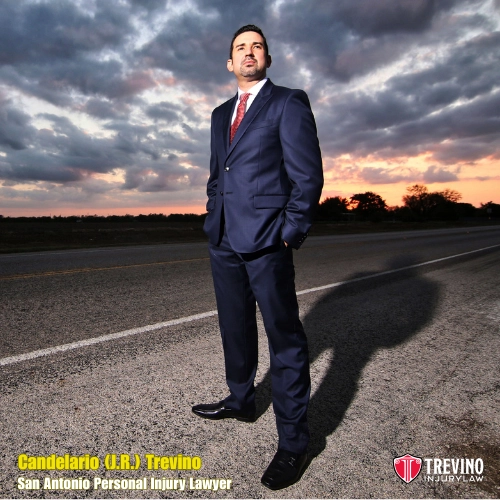
Our authority is proven at the Bexar County Courthouse, backed by results like a $7.9M recovery for work injuries. We immediately issue aggressive spoliation letters to preserve critical hazard logs when you retain a construction accident lawyer.
We know their playbook, and we litigate to a verdict to expose their cover-ups and force them to pay. Do not give an insurance adjuster a recorded statement. Contact Trevino Injury Law at 210-TREVINO for a free consultation to discuss your case. Se Habla Español.