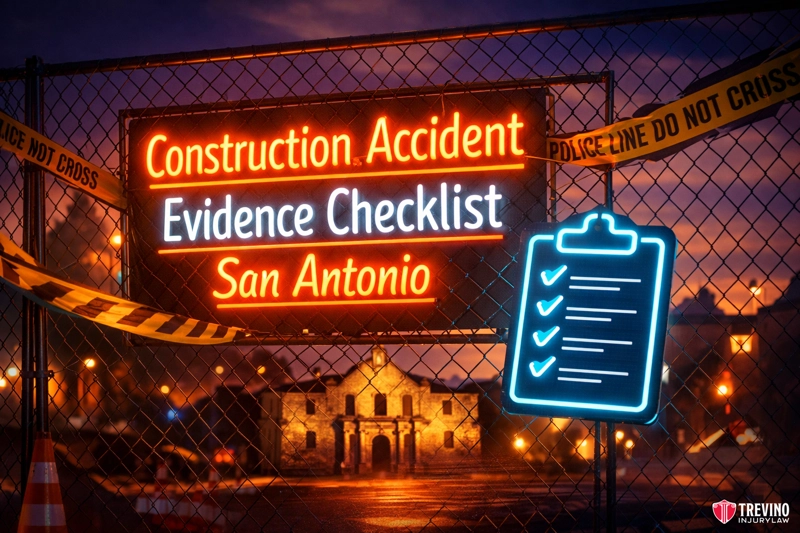
The site superintendent is already clearing the debris and repairing the defective machinery that caused your catastrophic injury. They are prioritizing their corporate safety record over the objective truth. Every hour that passes allows the general contractor to erase the physical conditions of the San Antonio job site crash.
Corporate Insurance Adjusters are actively sanitizing official incident reports to reclassify severe regulatory violations as your personal negligence. According to the Bureau of Labor Statistics, Texas recorded 125 fatal occupational injuries in the construction industry in 2024. Behind that metric is an employer who deferred equipment maintenance, ignored a known hazard, or bypassed safety protocols to protect their bottom line.
What Could Your Construction Accident Case Be Worth?
Answer a few quick questions about your accident. Takes about 60 seconds.
See What My Case Might Be WorthThe insurance company offered less than $20,000. I ended up with over $1 million. — Jackie Galindo
Critical video surveillance and heavy machinery black-box data overwritten within forty-eight hours. You must immediately send a Spoliation Letter, a legal demand that stops the property owner from destroying evidence, to lock down the hazard logs. Texas gives you exactly two years to file a lawsuit before your right to financial recovery disappears completely.
Trevino Injury Law construction accident lawyers will enforce strict preservation orders to secure the evidence before it vanishes. Call 210-TREVINO now for a free case review. You pay nothing unless we win. Se Habla Español.
What Should Be on Your Construction Accident Evidence Checklist?
A comprehensive checklist must systematically categorize the physical scene data, damaged equipment, and digital media your coworker proxy must secure before the general contractor alters the San Antonio job site.
The core checklist includes time-stamped photographs of specific unsafe or hazardous conditions, the physical preservation of damaged Personal Protective Equipment (PPE), such as snapped harnesses, the contact information of eyewitness subcontractors, and the official Computer-Aided Dispatch (CAD) incident numbers from the San Antonio Police Department (SAPD) and SAFD EMS.
Executing this checklist within the first hours of the crash is critical because the severity of the injuries sustained usually means the victim is incapacitated and en route to a medical facility like University Health System. Relying on an employer’s internal safety investigation is dangerous, as they prioritize their corporate safety record over the objective truth.
Evidence preservation is only one part of the immediate response. For the broader sequence of emergency care, reporting, scene documentation, and early claim protection, follow what to do after a construction accident in San Antonio.
A designated union representative or trusted proxy must gather these specific tangible items to establish a clear timeline before the site superintendent halts production and begins clearing the debris along fast-paced commercial builds near Loop 1604 or I-35.

This rapid response is crucial given the high number of accidents locally; for context, Bexar County recorded 3,684 total work zone crashes in 2024, resulting in 49 suspected serious injuries and 12 fatalities (TxDOT, 2024).
The 4-Part Job Site Documentation Checklist
To build a strong third-party liability claim, your proxy must methodically document the physical scene, environmental conditions, and any defective piece of equipment. This precise documentation is critical for proving the general contractor retained control over safety protocols and oversight, a legal standard established by the landmark Texas Supreme Court case Lee Lewis Construction, Inc. v. Harrison, 70 S.W.3d 778 (Tex. 2001).
This ruling holds general contractors liable for negligence, and potentially gross negligence, when they fail to exercise their retained safety control with reasonable care.
- Category 1: Environmental & Scene. Wide-angle photos of missing guardrails, lack of safety signage, and weather/mud conditions that contributed to the accident.
- Category 2: Defective Equipment & PPE. Close-up photos of fluid leaks, frayed cables, and securing the victim’s damaged hard hat or boots.
- Category 3: Subcontractor ID. Photos of company logos on commercial trucks, license plates, and a subcontractor’s cell phone numbers.
- Category 4: Official Data. SAPD/SAFD CAD report numbers and initial ER triage discharge papers outlining medical care.
How do you secure video surveillance of a job site crash?
Your trial lawyer must immediately send formal preservation demands to secure site security cameras, adjacent business surveillance, and dashcam footage from passing commercial vehicles. The video provides strong evidence and acts as the ultimate objective witness. On large multi-contractor sites, multiple cameras may capture the event, but footage is often overwritten every 24 to 48 hours. Early attorney involvement is critical to legally demand this footage to preserve evidence quickly before it disappears.
Because gathering this physical and digital data establishes the immediate circumstances of the crash, you must simultaneously legally lock down the corporate documentation that proves historical negligence.
How Do Attorneys Get Construction Company Safety Records in San Antonio?
Our board-certified trial lawyers obtain hidden construction company safety records by issuing formal Freedom of Information Act (FOIA) requests and by leveraging aggressive discovery during litigation to compel the release of hazard logs. We systematically demand daily site inspection sheets, pre-shift equipment maintenance records, and internal safety meeting minutes from the general contractor.
These documents routinely reveal that the company knew about a severe hazard, such as a collapsing trench or defective crane, but failed to halt production to fix it.
General contractors and their corporate Insurance Adjusters actively attempt to hide or heavily sanitize these past safety violations to protect their bottom line. With experience handling complex litigation, our team preemptively secures these documents before settlement mills even begin their investigation.
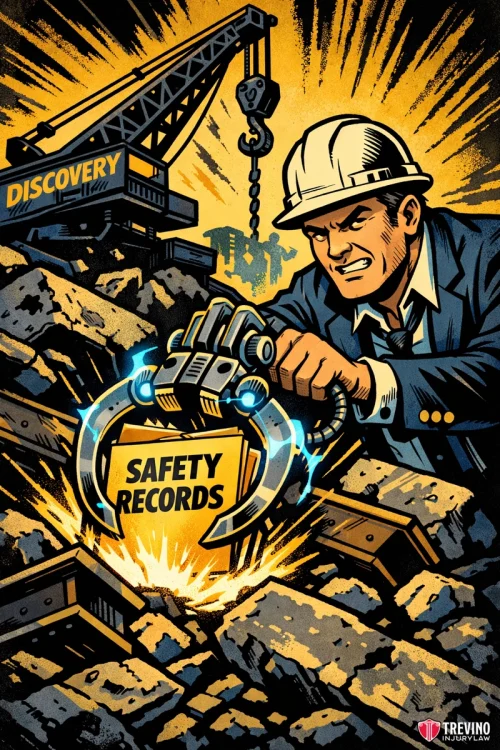
We force uncooperative employers to hand over this paperwork because it forms the foundation of proving gross negligence in Bexar County courts.
What is a spoliation letter in construction accidents?
A spoliation letter is a powerful legal demand issued by a trial lawyer that strictly prohibits a general contractor or corporate defendant from deleting, altering, or destroying critical evidence, such as hazard logs and electronic data. This letter legally locks down the site and equipment. If the company destroys evidence after receiving the letter, the court can impose a severe penalty at trial.
Once corporate records are legally preserved, this internal data must be compared against federal regulations and safety standards to prove violations.
Can You Use OSHA Records as Evidence in a Texas Lawsuit?
Yes, official records and citations from an Occupational Safety and Health Administration (OSHA) investigation can be introduced as independent evidence to demonstrate that a general contractor violated federal safety standards and caused your catastrophic injury.
Unlike an internal company incident report, an OSHA complaint triggers a federal safety investigation that yields objective, third-party proof of negligence. These federal citations strip the employer of their ability to claim the site was safe or that the hazard was unforeseeable, increasing the likelihood of a successful claim.
OSHA records are highly admissible in Texas state courts and carry immense weight with juries. Furthermore, a company’s historical OSHA violations can establish a pattern of blatant disregard for worker safety. If a contractor operating in South Texas has been cited multiple times for the exact same scaffolding violation that caused your fall, this documented history is leveraged to maximize the financial value of your third-party liability claim.
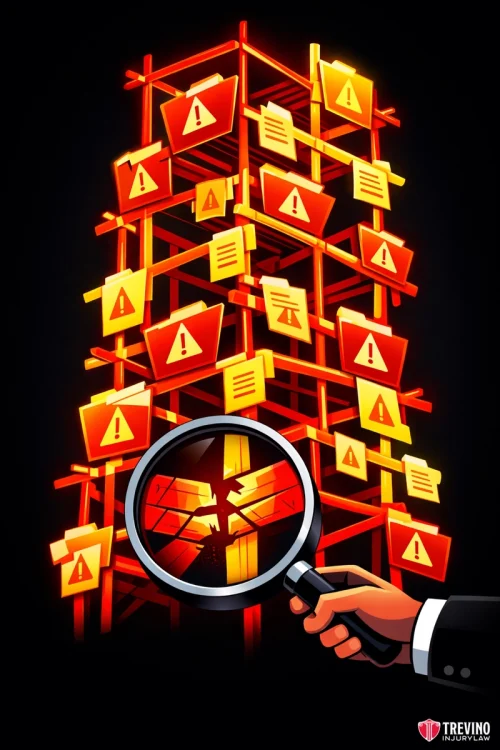
The danger of these specific physical hazards is well-documented, as 77 fatal occupational injuries were attributed to falls, slips, and trips across Texas in 2024 alone (BLS, 2024).
Steps to request OSHA inspection histories
To uncover a pattern of corporate negligence, your legal team will systematically request and analyze the general contractor’s complete OSHA inspection history to prove they knowingly maintained a dangerous site.
- Identify the specific corporate entities and subcontractors operating on the multi-employer job site to determine each party’s responsibility.
- Submit formal FOIA requests to the regional OSHA office for all past citations and settled violations, especially in cases involving severe falls or machinery failures.
- Cross-reference past safety failures with the specific physical hazard (e.g., lack of fall protection) that caused the current crash.
Gathering this comprehensive matrix of physical, corporate, and federal evidence naturally shifts the focus to how this data translates into financial recovery.
How Does a Trial Lawyer Use This Evidence to Maximize Your Compensation?
A San Antonio plaintiff trial lawyer uses this meticulously gathered physical and digital evidence to expose deceptive insurance company tactics. This data can significantly impact the outcome of your case, conclusively proving third-party negligence and forcing corporate defendants to pay full financial compensation rather than allowing you to accept a lowball settlement offer.
At Trevino Injury Law, our team transitions this technical evidence gathering into aggressive legal application. As a trial-first firm with 80+ jury trials, we know exactly how to leverage this data to establish both liability and damages.
By securing airtight evidence, our legal team prepares every claim for trial from day one. This aggressive posture forces corporate insurers to offer maximum value, ensuring injured workers receive compensation covering the full extent of damages. For example, we secured a $7.9 Million verdict for a worker’s crushed foot injury after the insurance company’s initial offer was only $1,300,000.

When defendants know we have the physical and digital proof to win before a Bexar County jury, they are forced to provide the compensation they deserve for severe injuries.
How do you document heavy equipment malfunctions on a Texas job site?
You must legally mandate the preservation of the machinery’s electronic data and immediately photograph the equipment in its exact condition before the general contractor removes it from the San Antonio job site. Documenting these failures requires a thorough understanding of commercial machinery.
Victims often ask: What are heavy equipment black boxes? These are electronic event data recorders that capture critical operating metrics, such as speed, braking, and operational hours, leading up to a crash. Securing them immediately is vital, as they record undeniable proof of mechanical failure or operator error, which could even lead to a product liability claim.
To properly document machinery malfunctions before the evidence vanishes, your legal team must secure the following:
- Capturing hydraulic fluid leaks pooling around the machinery.
- Documenting worn or bald tire tread conditions on commercial loaders.
- Securing the machinery’s internal maintenance logbook before it is altered.
Can I take photos of a Texas construction site after an accident?
Yes, you or your proxy have the absolute right to photograph the specific hazard and surrounding scene immediately following a crash to preserve evidence.
Do construction companies have to release their safety logs?
Yes, construction companies are legally compelled to release hazard reports and safety logs when a trial lawyer formally requests them during the litigation discovery process.
While visual and digital data provide objective proof, human testimony presents a different evidentiary challenge when building your case.
Witness statements vs. official company incident reports
While official company incident reports are heavily sanitized to protect the corporate employer from liability, independent witness statements from sub-contractors provide unfiltered, objective accounts of the physical hazard that caused your catastrophic injury on the South Texas commercial job site.
| Feature | Independent Witness Statements | Official Company Incident Reports |
| Source Bias | Independent peer observation with no financial incentive to lie. | Heavily sanitized for corporate protection and OSHA avoidance. |
| Admissibility in Court | Highly admissible as objective third-party testimony under Texas law. | Often challenged; heavily curated by corporate risk managers. |
| Impact on Third-Party Claims | Strengthens your case by confirming the exact sequence of events. | Usually attempts to shift blame onto the injured worker. |
Because independent evidence is so damaging to corporate interests, companies often resort to unethical tactics to eliminate the proof.
What Happens If a Construction Company Destroys the Evidence?
If a construction company willfully destroys evidence after receiving a formal spoliation letter from our firm, proving their fault initially becomes more difficult, but the presiding judge can issue a ‘spoliation instruction.’ Governed by the landmark Texas Supreme Court ruling in Brookshire Bros., Ltd. v. Aldridge, 438 S.W.3d 9 (Tex. 2014), this severe trial sanction legally directs the Bexar County jury to presume that the destroyed evidence would have proven the company’s negligence, provided we demonstrate the corporate defendant acted with the specific intent to conceal the truth.
Negligent contractors will quickly fix broken scaffolding or repair a collapsed trench to erase the physical evidence of their regulatory failures. By issuing preservation demands immediately, swift legal intervention penalizes these corporate cover-ups.
When Is Evidence Inadmissible in a Construction Injury Case?
Evidence becomes inadmissible in a Texas personal injury case if it relies on unverified hearsay, was obtained illegally, or if the catastrophically injured worker provides a recorded statement to an adversarial insurance adjuster without their trial lawyer present to protect their rights.
Corporate insurance companies like State Farm or Progressive will actively attempt to manipulate unrepresented statements to render the victim’s own words as damaging, inadmissible evidence. They use leading questions to twist the facts regarding liability and your medical condition.
Recorded statements create a separate risk from physical evidence loss. Before speaking with a company representative or insurer, review what not to say after a construction accident for practical guidance on avoiding speculation, apologies, and other statements that can complicate the claim.
To ensure your claim remains airtight, you must contact Trevino Injury Law immediately to manage all evidentiary submissions on behalf of injured workers and protect your financial recovery.
Why Should You Hire a Construction Accident Lawyer Immediately?
You must hire trial-ready personal injury wreck attorneys immediately to legally force the general contractor to preserve the accident scene, secure heavy machinery black box data before it is deleted, and protect your family from corporate Insurance Adjusters trying to deny your claim. While you may be entitled to workers’ compensation benefits, a third party could be held liable for additional damages, ensuring your compensation covers future medical care and lost wages.
Want to Protect the Full Value of Your Claim?
You’ve seen how this affects your case — but this is only one piece of the puzzle. Our Construction Accident Lawyer page breaks down what a trial-ready firm does differently.
We back this authority with a $7.9 Million jury verdict for a crushed foot at the Bexar County Courthouse. Before heavy machinery, black-box data vanishes; we issue strict spoliation letters. This is the expert leverage you secure with a dedicated construction accident lawyer.
Do not let them destroy the proof of their negligence or manipulate you into giving a recorded statement. Call 210-TREVINO right now for a free consultation to lock down your evidence and build your case. Se Habla Español.