Fault in a Texas pedestrian collision belongs to the party who violated right-of-way rules or failed to exercise reasonable care before the impact. Even if you crossed a street like Culebra Road outside a marked intersection, an approaching driver bears liability if they were speeding or distracted.
The Insurance Adjuster is already deploying the jaywalking defense, twisting the initial crash report to assign you the majority of the blame and completely bar your financial recovery under state comparative fault laws. According to the Texas Department of Transportation, the state recorded 6,077 pedestrian crashes in 2024. These victims face a coordinated corporate defense designed to trick them into unknowingly admitting they darted into traffic during a recorded statement.
What Could Your Pedestrian Accident Case Be Worth?
Answer a few quick questions about your accident. Takes about 60 seconds.
See What My Case Might Be WorthThe insurance company offered less than $20,000. I ended up with over $1 million. — Jackie Galindo
You must override the biased police narrative by securing commercial black box data and nearby surveillance video. A Spoliation Letter, a legal demand that stops the property owner from destroying evidence, forces defendants to preserve this digital footprint. The legal window to file suit eventually closes, but physical footage can be overwritten in days.
Trevino Injury Law’s pedestrian accident lawyers subpoena this physical proof immediately and lock the liability exactly where it belongs. Call 210-TREVINO for a free case review. You pay nothing unless we win. Se Habla Español.
Who Has the Right of Way at a Texas Crosswalk?
Under the Texas Transportation Code, a pedestrian has the absolute right of way when already in the crosswalk at a marked or unmarked intersection. Texas law requires drivers to yield and fully stop to prevent catastrophic injuries. Everyone must follow traffic laws to keep pedestrians safe throughout San Antonio.
Specifically, state law mandates that anyone operating a vehicle shall stop and yield to a pedestrian in a crosswalk when no signal is operating, and the pedestrian is on the vehicle’s half of the roadway or approaching closely enough to be in danger (Texas Legislature, Current).
While the main hub covers general pedestrian accident cases, understanding specific intersection laws in Bexar County adds an additional layer of protection for victims facing aggressive defenses from auto insurance carriers.
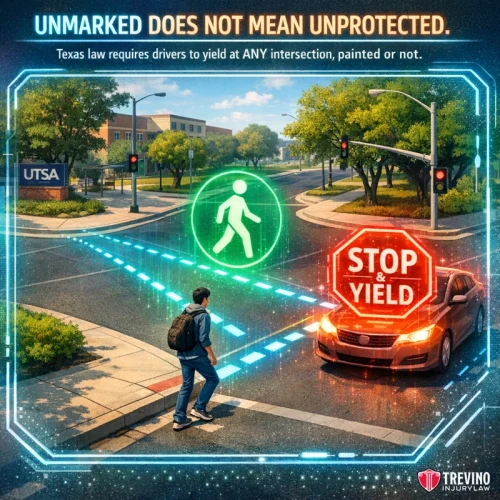
Victims must navigate the strict differences between marked and unmarked intersections, especially in dense pedestrian areas like Downtown San Antonio or near the UTSA Area. If a driver strikes a pedestrian legally in a crosswalk, the driver is at fault. It is formally considered “negligence per se,” meaning the motorist is held liable for 100 percent of the damages.
Quick Reference: Who Is Liable in Common Pedestrian Scenarios?
The determination of legal fault for a pedestrian accident relies heavily on the injured person’s physical location on the roadway. Liability depends on whether the pedestrian was in a crosswalk and whether the approaching driver strictly followed traffic laws at the moment of impact.
| Scenario | At-Fault Party | Deciding Legal Factor | How We Prove It |
| Marked Crosswalk | Driver | The pedestrian has the absolute right of way | Dashcam, surveillance video |
| Unmarked Intersection | Driver | Intersections legally connect lateral sidewalks | Police report, scene photos |
| Mid-Block Crossing | Shared / Driver | Duty to exercise reasonable care | Black box data, skid marks |
| Active “Walk” Signal | Driver | Signal supersedes turning vehicle rights | Traffic camera FOIA request |
How Do Unmarked Crosswalks Affect the Determination of Fault?
An unmarked crosswalk legally exists at almost every standard intersection where lateral sidewalk lines meet. If a pedestrian entered this space, they still have the absolute right of way to cross safely, even if white visibility lines are not painted on the asphalt.
Insurance Adjusters from companies like State Farm or Fred Loya Insurance frequently and incorrectly assign fault to pedestrians crossing at suburban intersections without painted lines. We use the statutory definition of an intersection to prove the pedestrian acted legally.
This proves the driver is responsible for the accident and protects the claim’s financial value against these predatory insurance tactics designed to minimize your rightful settlement.
Does a Pedestrian Have the Right of Way with a Walk Signal?
Yes, a pedestrian facing a designated “Walk” signal has the absolute legal right of way to proceed across the roadway. The pedestrian may cross safely, completely superseding the driving privileges of any turning vehicles that must yield to prevent severe pedestrian collisions at busy intersections.
When a driver making a right turn on a red light strikes a pedestrian in the crosswalk, liability is incredibly clear. Even if the driver had a green light to turn, the pedestrian’s walk signal takes precedence under the law. This firmly establishes the driver’s legal liability for hitting them. We litigate to a verdict against negligent drivers who ignore these critical traffic control signals.
Understanding who has the right of way at controlled intersections lays the legal foundation for navigating the more complex mid-block collision scenario.
Who Is Liable If a Pedestrian Is Hit Crossing Mid-Block in Texas?
If a pedestrian is hit crossing mid-block, liability is determined by carefully weighing the facts. The law weighs the failure to yield the right of way when a pedestrian steps into the street against the approaching driver’s overarching common-law duty. The law requires drivers to use reasonable care to avoid the collision entirely.
Expanding on the foundational right-of-way rules established in our main hub, we must directly address the most common liability dispute adjusters raise. They love to use the “jaywalking” defense. Texas law clearly states that pedestrians must yield to vehicles when crossing a roadway outside of a marked or unmarked crosswalk. Pedestrians must also follow these rules.
By statute, a pedestrian shall yield the right-of-way to a vehicle when crossing anywhere other than a marked crosswalk, an unmarked crosswalk at an intersection, or where a pedestrian tunnel or overhead crossing is provided (Texas Legislature, Current).
However, this statutory requirement does not give drivers a free license to strike pedestrians in the street. The law requires drivers to maintain a continuous, overarching legal duty to sound their horn and apply their brakes to avoid a collision if a pedestrian is visible on high-traffic roads like Bandera Road or Marbach Road.
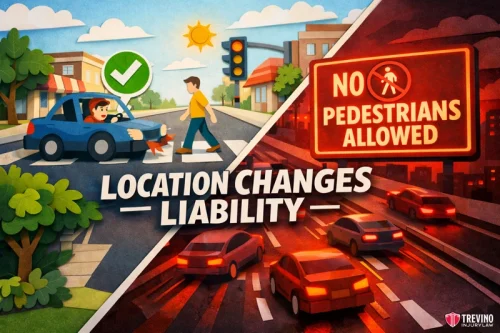
At the same time, people must exercise care for their own safety. We carefully distinguish mid-block suburban crossings from high-speed interstate collisions on corridors like I-35 or Loop 1604, where pedestrian access is strictly prohibited by law, drastically altering the driver’s duty of care.
Is the Pedestrian Always at Fault for “Jaywalking”?
No, a pedestrian is not automatically at fault for crossing mid-block if the approaching driver was actively committing a major traffic violation. Actions like speeding or reckless driving that directly caused the accident will supersede the pedestrian’s crossing location.
- Speeding: A driver drastically exceeding the posted speed limit automatically loses their right-of-way privileges on the road.
- Distraction: A texting or inattentive driver cannot legally use the defense that a pedestrian “suddenly darted out” into traffic.
- Impairment: Driving under the influence of drugs or alcohol drastically shifts legal liability away from the pedestrian’s specific crossing location and onto the intoxicated motorist.
For a focused breakdown of the statutes and right-of-way rules that apply when a pedestrian crosses mid-block, see whether you can sue after being hit while jaywalking in Texas.
How Do We Prove Driver Negligence When You Crossed Outside a Crosswalk?
We officially prove driver negligence in complex mid-block crashes by aggressively securing forensic evidence. We use commercial black box data and surveillance video to build a strong case. This visually demonstrates the driver had ample time and physical distance to stop but negligently failed.
We immediately execute Freedom of Information Act (FOIA) requests and systematically retrieve Electronic Control Module (ECM) data and nearby security camera footage.
This irrefutable physical evidence legally proves the driver’s dangerous distraction or excessive speed. It firmly establishes that their negligence, not the pedestrian’s location in the street, was the proximate cause of the severe injuries. These accidents often result in catastrophic harm, making this evidence vital.
Once we officially establish the specific negligent actions of the driver, the next critical question becomes how Texas courts legally weigh that negligence against the pedestrian’s actions.
How Does Texas Proportionate Responsibility Divide Pedestrian Accident Fault?
Texas uses proportionate responsibility to legally allocate fault for accidents. This requires a judge or a Bexar County jury to formally assign a specific mathematical share of fault to both the injured pedestrian and the negligent driver, based solely on their respective negligent actions.
While earlier sections explored how basic fault is established on the street, we must delve into how juries actually assign comparative negligence in San Antonio trials. If a pedestrian crosses a street outside a crosswalk (negligence) but the driver was speeding 20 mph over the legal limit (greater negligence), a Bexar County jury will apportion a specific percentage of fault to each party.
We explain to clients how this complex math applies even to highly disputed scenarios. For instance, if a pedestrian is walking while intoxicated, they are partially at fault. However, a severely distracted driver may still bear a large portion of the legal liability.
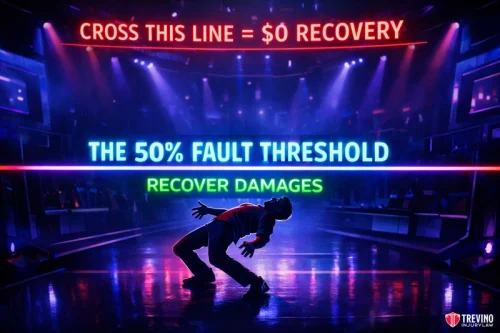
As long as the pedestrian’s officially assigned fault is 50 percent or less, the pedestrian can recover damages, but their final financial compensation is mathematically reduced by their specific percentage of blame.
To see how fault fits alongside other case-value factors, review what determines a San Antonio pedestrian accident settlement’s value.
What Happens If You Are Assigned More Than 50 Percent of the Blame?
If a pedestrian is found to be 51 percent or more to blame for the accident, strict state law completely bars them from recovering any financial compensation. Texas follows a modified comparative responsibility threshold. It explicitly states that a claimant is barred from recovery if their percentage of responsibility exceeds 50% (Texas Legislature, Current).
This strict legal standard is known as the 51% Bar Rule. It fully explains how liability in Texas works and why Insurance Adjusters from settlement mills and major carriers fight so aggressively from day one to pin just over half the blame directly on the injured victim. They deploy recorded statements to twist your words, desperately trying to force your liability past that critical 50 percent threshold to shut down your claim entirely.
How Do We Minimize Your Percentage of Fault Against Corporate Defendants?
As your dedicated personal injury attorney, we systematically minimize your legal percentage of fault. We heavily prepare your injury case for a jury trial from day one, using specialized accident reconstruction experts to definitively prove the corporate driver’s reckless actions were the primary cause of the collision.
When facing well-funded commercial Trucking Companies, we consider factors such as vicarious liability. We leverage our extensive trial experience of over 80 jury trials and elite expert testimony to force the jury to place the overwhelming majority of the liability precisely where it belongs, on the negligent corporate driver. In cases with disputed liability, our fierce readiness to take your case to court often forces carriers to cave before trial.
Establishing and defending your legal percentage of fault is critical, but knowing exactly how insurance companies actively work to distort these rules determines whether your financial claim actually survives.
How Do Insurance Companies Try to Manipulate Pedestrian Liability Rules?
Adjusters handling liability insurance claims for massive companies like State Farm or Fred Loya Insurance aggressively manipulate Texas liability rules. They secure early recorded statements from injured pedestrians, specifically designed to legally trick unrepresented victims into unknowingly admitting they failed to yield the proper right of way before a crash.
This adversarial reality is why we fiercely litigate to a verdict on behalf of injured families. While Texas statutes strictly dictate how legal fault should be officially assigned in a Bexar County courtroom, highly trained corporate adjusters immediately try to distort the ground-level facts.
They aggressively exploit the initial crash report (CR-3) taken at the chaotic scene while the victim was physically incapacitated or riding in an ambulance. By speaking only to the uninjured motorist, the adjuster builds a completely false, one-sided narrative that the pedestrian suddenly “darted out” into traffic.

To learn exactly how adjusters twist your words and how we defeat their defenses, read our full guide on Insurance Tactics and Defenses in Pedestrian Claims. Understanding how corporate adjusters actively manipulate your claim file naturally leads to the forensic process of securing the physical proof needed to definitively establish the truth.
How Do You Officially Prove Fault in a Texas Pedestrian Accident?
You officially prove legal fault in a complex Texas pedestrian accident by aggressively gathering independent physical evidence to override the at-fault driver’s narrative. To present an undeniable case to an insurance adjuster or a Bexar County jury, we immediately secure:
- Commercial video footage and eyewitness testimony.
- Freedom of Information Act (FOIA) requests to capture police body cameras and dispatch logs before they disappear.
- Spoliation Letters sent to commercial defendants to legally force the preservation of critical data.
When an uninjured driver falsely claims an injured pedestrian suddenly jumped into traffic, securing this objective physical evidence is the only way to establish the truth.
If evidence is tampered with, we take aggressive legal action. In Texas, the landmark ruling in Brookshire Brothers, Ltd. v. Aldridge, 438 S.W.3d 9 (Tex. 2014) established strict parameters for evidence spoliation. If a corporate defendant intentionally deletes or overwrites crucial dashcam or surveillance video after receiving our preservation demand, we can ask the judge to impose severe penalties during trial.
While detailed evidence checklists are reserved for our dedicated guide on proving fault, understand that moving quickly is the only way to stop an insurer from controlling the narrative.
Do Police Determine Final Liability in a Crash Report?
No, a police crash report is simply the investigating officer’s preliminary field opinion; final legal liability is ultimately determined by a judge or jury during civil litigation.
Can Independent Video Evidence Overturn a Fault Determination?
Yes, objective video evidence from dashcams or nearby business security cameras can successfully overturn an initial, biased fault determination made by a police officer.
Understanding how to officially gather physical evidence seamlessly transitions into recognizing which specific driving laws the motorist actually broke.
Statutory Violations vs. General Negligence: What Is the Difference?
The difference is that a statutory violation occurs when a driver breaks a specific written traffic law, such as explicitly failing to yield at a marked crosswalk. General negligence occurs when a driver follows written laws but fails to exercise the reasonable, common-sense care needed to avoid causing harm to others on the road.
Breaking the strict black-and-white rules of the Texas Transportation Code, such as running a red light or failing to stop at a stop sign, makes establishing liability straightforward. However, a driver can still be found liable under general common-law negligence even if they were not ticketed. For example, a driver traveling exactly the speed limit may still be acting negligently if they are driving too fast for the dark, rainy conditions on a poorly lit San Antonio street in Southtown or along Austin Highway.
While understanding the legal differences between these two types of negligence is vital, recognizing what happens when you fail to act quickly to prove either of them is even more critical for your recovery.
What Happens If You Do Not Gather Evidence of Driver Fault Immediately?
If you do not aggressively gather critical physical evidence of driver fault immediately after a severe crash, essential proof like commercial dashcam footage will be permanently deleted, allowing the corporate defense team to successfully shift legal liability entirely onto your shoulders.
Without prompt legal intervention from a dedicated trial law firm to officially preserve evidence, the “he-said, she-said” nature of the accident heavily favors the uninjured driver. Because the pedestrian is often incapacitated and transported to a trauma center like the Medical Center, the driver gives the only clear statement to the police at the crash scene. Allowing the insurance company to rely solely on that biased police report is a fatal mistake that destroys claim value.
Failing to secure this crucial physical evidence immediately results in the devastating reality of missing your final legal window to fight back.
When Is It Too Late to Challenge a Texas Fault Determination?
It is permanently too late to officially challenge a biased fault determination once you sign a binding release of liability from the at-fault driver’s insurance company or after the strict two-year Texas statute of limitations for personal injury claims officially expires.
If an injured pedestrian, desperate to pay mounting medical bills, accepts a lowball settlement check from an insurer early on, they legally agree with the insurer’s liability assessment. By cashing that check, you are permanently barred from seeking further financial compensation you may be entitled to, even if the driver was entirely at fault for striking you near US-90. You must never sign any documents or provide recorded statements to an insurance adjuster without a trial-ready attorney aggressively defending your rights.
Why Should You Hire a San Antonio Pedestrian Accident Lawyer?
You should hire a San Antonio pedestrian accident lawyer to aggressively defeat insurance adjusters who falsely blame you for darting into traffic. We force negligent drivers to pay maximum compensation by proving liability with undeniable physical evidence and complex crosswalk laws. The risks on our local roads are severe, causing many pedestrian accidents. In fact, there were 170 total motor-vehicle traffic crash fatalities in San Antonio in 2024 alone (TxDOT, 2024).
Want to Protect the Full Value of Your Claim?
You’ve seen how this affects your case — but this is only one piece of the puzzle. Our Pedestrian Accident Lawyer page breaks down what a trial-ready firm does differently.
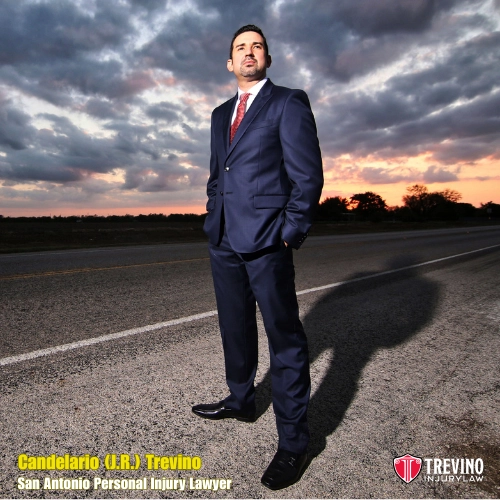
We back this authority with a 107x verdict against lowball offers at the Bexar County Courthouse. Before critical evidence vanishes, we execute strict FOIA requests and spoliation letters. This is the expert leverage you secure with a dedicated personal injury accident attorney.
Call Trevino Injury Law at 210-TREVINO for a free consultation. Se Habla Español. We advance all litigation costs, and you pay nothing unless we win your case.