A negligent driver struck you, leaving you with catastrophic physical trauma, massive hospital bills, and a sudden inability to return to work.
The insurance adjuster assigned to your claim is already executing a swoop and settle strategy, offering an immediate lowball payout before the full extent of your physical trauma is officially known. According to TxDOT, Texas recorded 1,452 suspected serious pedestrian injuries in 2024. Behind these statistics are corporate insurers actively working to twist recorded statements and shift the blame to you for walking outside a crosswalk on Culebra Road.
What Could Your Pedestrian Accident Case Be Worth?
Answer a few quick questions about your accident. Takes about 60 seconds.
See What My Case Might Be WorthThe insurance company offered less than $20,000. I ended up with over $1 million. — Jackie Galindo
Intersection camera footage and witness accounts disappear in the first week. A Spoliation Letter, a legal demand that prevents the opposing party from destroying evidence, must be issued immediately to lock down the facts. Texas gives you two years to file suit before your legal right to pursue compensation is extinguished forever.
A Trevino Injury Law pedestrian accident lawyer will force the insurance company to pay the true value of your case. Call 210-TREVINO now for a free case review. You pay nothing unless we win. Se Habla Español.
Real San Antonio Pedestrian Accident Settlement Values and Verdicts
While many people search for the average settlement for a pedestrian or settlement amounts in Texas, there is no exact calculator because every pedestrian accident is different. In fact, this lack of a standardized baseline is reflected in public records, as no official government or quasi-government source publishes a verified average pedestrian settlement (Official Public Records, 2024). Beyond the standard estimates, victims must navigate third-party liability, available insurance coverage, and gross negligence factors specific to pedestrian impacts.
Settlement mills might quickly process hundreds of claims involving minor injuries for small amounts. As a trial law firm, our settlement averages are heavily skewed by our willingness to litigate cases involving severe injuries, such as 18-wheelers or commercial fleets. A pedestrian hit by a car at high speed on Loop 410 requires a massive financial recovery for spinal cord damage, traumatic brain injuries (TBIs), or amputations.

The severity of these impacts is staggering; in 2024 alone, Texas saw 1,452 suspected serious injuries to pedestrians stemming from 1,395 serious injury crashes across the state (TxDOT, 2024).
Examples of Multimillion-Dollar Recoveries for Severe Injuries
Trevino Injury Law secures maximum compensation by proving the true extent of catastrophic damages, achieving real case values that reflect our 80+ jury trials and aggressive litigation strategy.
- $7.9 Million Jury Verdict: Secured for Mario Trevino Mendoza, who suffered a crushed foot and amputated toe in a work-related accident, after the defense originally offered only $1.3 million.
- $4 Million Settlement: Recovered for a victim who sustained severe spine and back injuries in a car accident.
- $1.4 Million Settlement: Secured for a victim who suffered spinal injuries after being struck by a drunk driver.
- $536,007 Jury Verdict: Won for Jose Simon Arriaga Jr. for a low back injury when the insurance company’s final offer was a mere $5,000.
Settlements for Pedestrians Injured While on the Job
If you’ve been injured by a negligent driver while working, such as a delivery driver, a construction worker on I-35, or a utility worker, you are not limited to just workers’ compensation. An experienced personal injury attorney pursues a “third-party liability claim” against the at-fault driver’s insurance, allowing you to recover full pain and suffering damages that workers’ compensation strictly prohibits.
These proven multimillion-dollar recoveries establish the foundation for understanding how the specific mathematical factors of the injuries sustained will dictate your own final settlement.
Key Factors That Determine a Pedestrian Settlement Amount
Our lawyer can help you understand that the final financial value of a pedestrian accident settlement is calculated using three primary variables:
- Total Economic Damages (Objective Costs):
- Medical expenses and hospital bills (e.g., University Health System, Methodist Hospital).
- Forensic Life Care Plans for future surgeries and rehabilitation.
- Lost wages and loss of future earning capacity.
- Total Non-Economic Damages (Human Losses):
- Pain and suffering.
- Physical impairment and disfigurement.
- Reduced quality of life and mental anguish from catastrophic trauma.
- Reductions and Constraints:
- Insurance Policy Limits: The maximum amount the at-fault driver’s policy will pay (unless we force maximum value with a Stowers Demand).
- The 51% Bar Rule: Texas reduces your fair settlement by your percentage of fault under comparative negligence if you failed to yield the right of way.
- Medical Liens: Subrogation claims from hospitals that must be paid from your gross settlement to determine your final net payout.
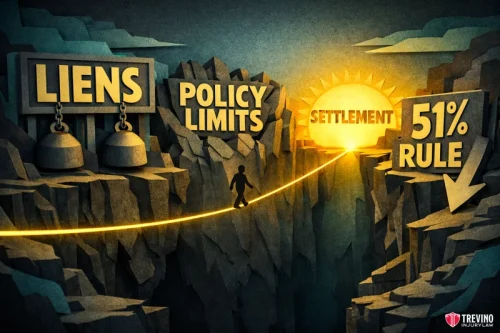
Calculating these exact damages and defeating the insurance company’s attempts to devalue your personal injury case cannot be rushed. Forcing an adjuster to pay maximum value requires executing a precise legal and medical strategy over a specific timeframe.
Calculating Economic vs. Non-Economic Damages
Economic damages reimburse you for objective, out-of-pocket losses like medical bills and lost wages, while non-economic damages compensate for subjective human losses such as pain, suffering, mental anguish, and physical impairment based on the severity of your injuries.
In catastrophic pedestrian cases, non-economic damages often account for the largest portion of the settlement. The need for comprehensive financial recovery is underscored by the sheer volume of severe incidents, with Texas reporting 6,077 total crashes involving pedestrians in 2024, resulting in 768 tragic fatalities (TxDOT, 2024).
Gross vs. Net Settlement: How Medical Liens and Subrogation Affect Your Payout
The gross settlement is the total amount the insurance company pays, but calculating your true economic damages requires forensic precision. Under Texas law, as established by the landmark case Haygood v. De Escabedo, 356 S.W.3d 390 (Tex. 2011), your recoverable medical damages are strictly limited to the amounts actually paid or legally incurred for medical treatment and medication, rather than the initial inflated hospital billing rates.
Your net settlement, what you actually keep, is determined after satisfying these legal medical liens from health insurance providers and hospitals.
By law, health insurance providers (like Medicare, Medicaid, or private insurers) and hospitals hold “liens” (subrogation rights) requiring them to be paid back from your settlement for the care they provided. As your Scholar Warrior legal team, we aggressively negotiate these medical liens down, ensuring the maximum amount of the net settlement stays in your pocket.
While calculating your gross and net damages protects your financial recovery on paper, understanding how insurance adjusters actively try to destroy these calculations prepares you for the fight ahead.
Insurance Company Tactics Designed to Minimize Your Settlement
Insurance adjusters actively protect their corporate profit margins by exploiting an injured pedestrian’s financial vulnerability. To secure maximum compensation, you must understand the aggressive playbook companies like USAA, Progressive, and Fred Loya use to devalue your life-altering injuries:
- The “Swoop and Settle”: Adjusters will offer a $1,000 to $5,000 check immediately after the crash. Cashing this check requires signing a Release of Liability, which permanently bars you from seeking more money when you discover you need surgery six months later.
- Weaponizing Recorded Statements: Adjusters will call you within days to get you on a recorded line before you seek legal advice. Their goal is to trick you into downplaying your pain or apologizing, creating a record they will use to deny your claim.
- Shifting the Blame: They will attempt to prove you were at fault (e.g., claiming you crossed S. Zarzamora Street outside a crosswalk on busy streets) to severely reduce their financial liability.

If you refuse their lowball offer, they will immediately attempt to weaponize Texas law against you. Here is exactly how we fight back and force them to pay the true value of your case.
The Impact of Texas’ 51% Proportionate Responsibility Rule on Payouts
Texas follows a proportionate responsibility model, meaning if an adjuster convinces a jury you were 20% at fault for crossing San Pedro Avenue outside a crosswalk, your settlement is reduced by 20%. The reality is that local danger zones like these have long plagued the city, dating back to historical data showing 54 pedestrians killed on San Antonio roadways in a single year (City of San Antonio Transportation & Capital Improvements, 2014).
If they prove you were 51% or more at fault, you are barred from recovering a single dollar. We fight these allegations relentlessly with crash reconstruction and preserved evidence.
Forcing Maximum Value with Stowers Demands and Trial Preparation
We force maximum value by leveraging a Texas legal mechanism called a Stowers Demand, which is a formal demand requiring the insurance company to pay their policy limits. If they refuse a reasonable Stowers Demand and we take the case to a Bexar County jury, and win a verdict higher than the policy limit, the insurance company can be forced to pay the entire verdict. This threat of litigation is what drives high settlement offers.
Knowing how to defeat insurance company tactics is critical, but without understanding the legal and medical timelines involved, you risk jeopardizing your health and your financial recovery.
How Long Does It Take to Settle a Pedestrian Accident Claim in San Antonio?
The timeline to settle a pedestrian injury claim in San Antonio is dictated by your medical recovery and the insurance company’s willingness to pay the true value of the claim. Generally, timelines fall into three categories:
- 3 to 6 Months (Clear-Cut Cases): Applies when liability is uncontested, injuries are fully healed, and we issue a demand for clear insurance policy limits.
- 6 to 12 Months (Severe Injuries): Required when victims must reach Maximum Medical Improvement (MMI) before we can accurately calculate future medical complications.
- 12+ Months (Complex Litigation): Necessary for catastrophic commercial vehicle impacts (e.g., 18-wheelers) where we must file a lawsuit, preserve forensic evidence, and take the case to a Bexar County jury to secure maximum compensation.
For the full sequence from early evidence preservation through medical recovery, negotiation, and litigation, see the pedestrian accident claim timeline in San Antonio.
We never rush a settlement at the expense of your health.

While navigating this medical and legal timeline effectively ensures you don’t leave money on the table, it naturally raises critical financial and legal questions about how the rest of the process will unfold, including how you’ll afford a trial lawyer to fight this battle.
How Does Trevino Injury Law’s Contingency Fee Structure Work?
Trevino Injury Law operates strictly on a contingency fee basis, meaning “no win, no fee”, you owe us nothing upfront for your Bexar County pedestrian accident claim, and we only collect a predetermined percentage if we successfully secure your settlement or trial verdict.
We front all heavy litigation costs on your behalf, which includes hiring crash reconstructionists, deposing witnesses, and paying medical experts to build your forensic Life Care Plan.
If we successfully secure a settlement or trial verdict, our attorney fee is taken as a predetermined percentage of the final recovery. If we do not win, you owe us nothing, allowing you to focus entirely on your physical recovery without the stress of mounting legal bills. Understanding how we fund your fight against powerful corporations is crucial, but another common financial concern involves the IRS and uninsured drivers.
Is My Pedestrian Accident Settlement Taxable in Texas?
No, the IRS rules that compensatory damages for physical injuries are tax-free, though punitive damages are not.
Can I Get a Settlement if the Driver Was Uninsured?
Yes, if the driver who hit you was uninsured or fled, we can pursue compensation through your own Uninsured Motorist coverage.
However, as established by the Texas Supreme Court in Brainard v. Trinity Universal Ins. Co., 216 S.W.3d 809 (Tex. 2006), your UM/UIM insurer’s contractual duty to pay is not triggered until we legally establish the at-fault driver’s liability and the full extent of your damages. This means securing maximum compensation often requires aggressive litigation, even against your own insurance company.
Settlement Agreements vs. Jury Trial Verdicts
A settlement is a guaranteed, private financial agreement reached outside of court, while a trial verdict is a binding decision publicly handed down by a jury in a South Texas courtroom after we present exhaustive evidence of the at-fault driver’s negligence. Settlements resolve cases faster and without the risk of an unpredictable jury.
However, if an insurance company refuses to pay the true value of a permanent injury, our willingness to take the case to trial, backed by 80+ jury trials, is what ensures the settlement offer is fair, or results in a massive jury award. Securing either a high-value settlement or a winning verdict requires flawless evidence, and this entire outcome is jeopardized if you make critical mistakes early on.
What Happens if You Fail to Document Your Injuries Immediately?
If you delay seeking immediate medical attention or fail to properly document your pain and physical limitations right after the crash, the insurance company will aggressively argue a “gap in treatment,” allowing them to claim your injuries were pre-existing to severely devalue your settlement. Seeking immediate medical attention is crucial in a pedestrian accident. Even if you initially believe your condition is not severe—a common scenario, considering Texas recorded 2,475 suspected minor pedestrian injuries in 2024 (TxDOT, 2024)—that medical documentation is critical.
They will claim your injuries were pre-existing or caused by a subsequent event. This absence of a clear, continuous medical record creates a massive vulnerability in your case, giving adjusters the exact justification they need to devalue or deny your settlement entirely. Furthermore, while an absence of medical evidence destroys case value, delaying your legal action triggers strict statutory deadlines that will permanently end your claim.
When Is It Too Late to Negotiate a Pedestrian Settlement?
It is permanently too late to negotiate a higher pedestrian settlement offer once you sign the insurance company’s official Release of Liability, or the moment the strict Texas two-year statute of limitations expires, which completely and forever extinguishes your legal right to pursue compensation.
Once that document is signed, or the two-year anniversary of the crash passes, your legal right to pursue further compensation from the at-fault driver is extinguished forever, regardless of how many future surgeries you require.
Why Hire a San Antonio Pedestrian Accident Lawyer?
Insurance companies will actively weaponize the 51% Bar Rule and “Swoop and Settle” tactics to devalue your life-altering injuries. Hiring a personal injury lawyer ensures your gross damages and Life Care Plan are forensically calculated and fiercely protected in court.
Want to Protect the Full Value of Your Claim?
You’ve seen how this affects your case — but this is only one piece of the puzzle. Our Pedestrian Accident Lawyer page breaks down what a trial-ready firm does differently.
When an insurer offered just $5,000, we went to the Bexar County Courthouse and secured a $536,007 verdict. You need personal injury wreck lawyers who immediately issue spoliation letters to preserve crucial intersection camera footage. We fight for families.
Force them to pay what you truly deserve by calling Trevino Injury Law today at 210-TREVINO. Se Habla Español. We front all costs, and you pay absolutely nothing unless we win.