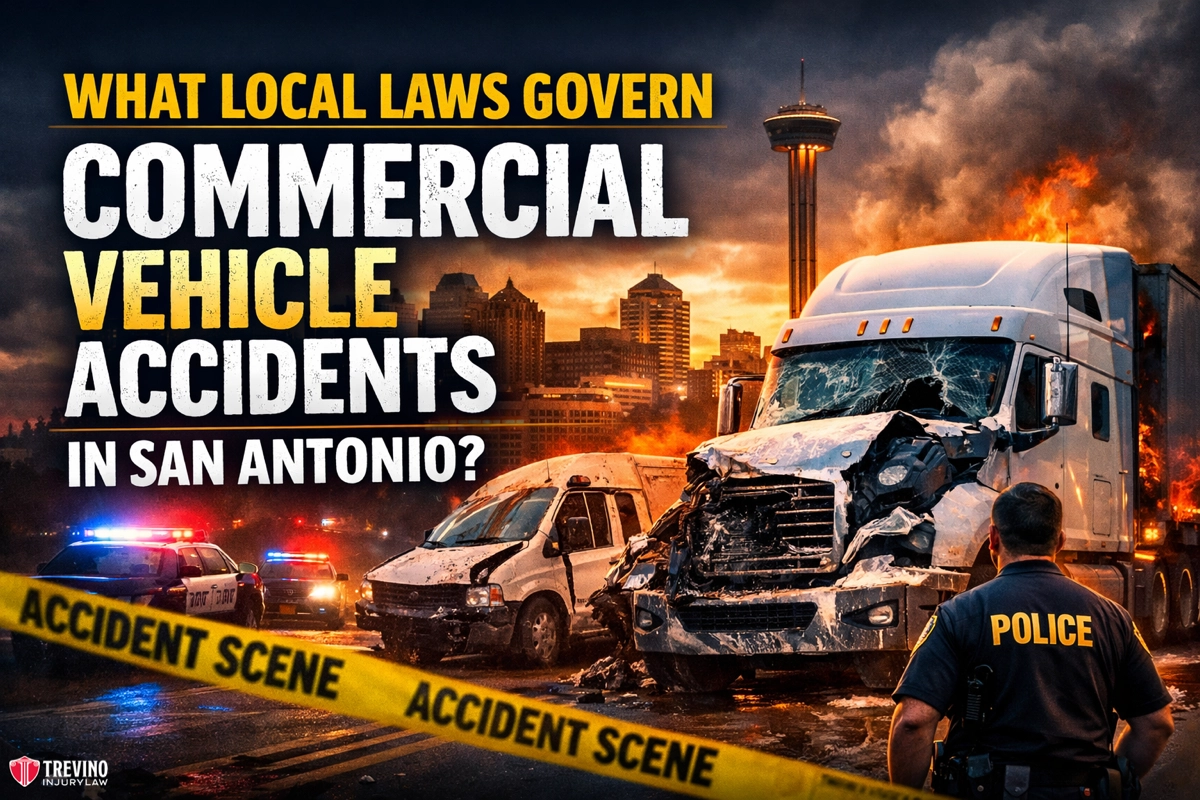
Local commercial vehicle laws combine the Texas Transportation Code, San Antonio City Ordinances, and federal FMCSA regulations to dictate liability standards in Bexar County. Unlike standard traffic collisions, commercial crashes are subject to distinct statutory overlays that govern everything from filing deadlines to compensation limits.
Victims often incorrectly assume standard traffic laws apply universally. However, strict frameworks such as the Texas Tort Claims Act can bar recovery if you don’t follow them. Our San Antonio commercial vehicle accident lawyers know these cases require more than proving fault; they require strict adherence to procedural deadlines that insurance companies hope you miss.
What Could Your Commercial Vehicle Accident Case Be Worth?
Answer a few quick questions about your accident. Takes about 60 seconds.
See What My Case Might Be WorthThe insurance company offered less than $20,000. I ended up with over $1 million. — Jackie Galindo
Trevino Injury Law, our San Antonio commercial vehicle accident lawyer team, tracks every filing deadline and notice requirement so a procedural technicality never costs you your claim. Call 210-TREVINO for a free case review. You pay nothing unless we win. Se Habla Español.
Key Takeaways – What Local Laws Govern Commercial Vehicle Accidents in San Antonio?
- Texas generally gives you two years from the crash to file a personal injury lawsuit, and missing that deadline can end your claim.
- Crashes with City of San Antonio vehicles require a written Notice of Claim within 90 days under the City Charter.
- Under Texas proportionate responsibility, you recover nothing if you are more than 50% at fault, and any award is reduced by your share.
- Federal FMCSA rules set safety standards for interstate trucks and can show a commercial driver or carrier was negligent.
- Sovereign immunity and the Texas Tort Claims Act limit when, and how much, you can recover from a government entity.
How Does the Texas Statute of Limitations Apply to Commercial Vehicle Accidents?
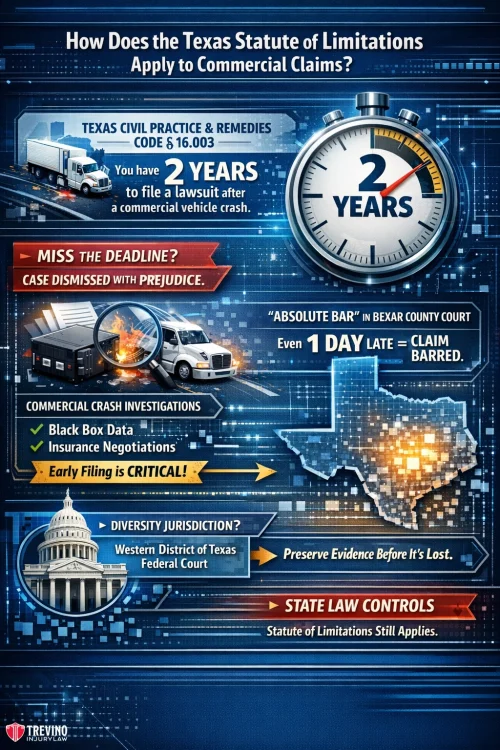
Under Texas Civil Practice & Remedies Code § 16.003, you have only two years from the date of the commercial vehicle crash to file a lawsuit against the operator or trucking company; after that, your claim is permanently barred regardless of fault.
This two-year window is an “absolute bar” in Bexar County District Courts, meaning that missing the deadline by even a single day will result in your case being dismissed with prejudice.
While two years may seem like a long time, commercial investigations often require months to access black box data and negotiate with corporate insurers, making early filing critical. With over 2,000 commercial crash investigations initiated in Bexar County every year, preserving evidence before it is lost in the shuffle of insurance bureaucracy is the single most important step you can take.
If the accident involves diversity jurisdiction, you may need to file in the Western District of Texas federal court, but the state statute of limitations remains the controlling law.
When Does the ‘Discovery Rule’ Extend the Filing Deadline?
The ‘Discovery Rule’ is a narrow legal exception that pauses the statute of limitations only when the injury is both inherently undiscoverable and objectively verifiable. The Texas Supreme Court clarified this strict standard in S.V. v. R.V., 933 S.W.2d 1 (Tex. 1996), establishing that a traumatic event, like a vehicle collision, typically puts a reasonable person on immediate notice of their injury, thereby triggering the two-year clock regardless of whether the full extent of the damage is known yet.
Courts generally hold that a collision is a traumatic event that puts a reasonable person on immediate notice of potential injury. However, a distinct tolling rule applies to minors: if the victim is under 18, the two-year clock does not begin until their 18th birthday.
While understanding the strict filing timelines is essential to preserve your right to sue, understanding how the court calculates your final payout requires analyzing how Texas law assigns blame to each party.
How Does Texas Proportionate Responsibility Affect Your Payout?
Texas follows a Modified Comparative Negligence standard, often referred to as the ‘51% Bar Rule.’ As affirmed in Dugger v. Arredondo, 408 S.W.3d 825 (Tex. 2013), the Texas Proportionate Responsibility Act (CPRC Chapter 33) mandates that a claimant may not recover damages if their percentage of responsibility is greater than 50%. This statutory framework replaced absolute contributory negligence, allowing recovery only if your share of the blame does not exceed that of the defendants.
Under Civil Practice & Remedies Code Chapter 33, your total damages are reduced by your percentage of assigned fault—for example, if you are awarded $100,000 but found 20% at fault for speeding on Loop 410, you would receive only $80,000.
Defense attorneys for commercial fleets aggressively utilize this statute, attempting to pin just enough fault on you, often arguing you made an unsafe lane change or were distracted, to push your liability over that critical 51% threshold and pay you nothing.
You can still recover damages as long as your share of responsibility does not exceed 50%, and your final settlement check will be reduced accordingly. In cases involving multiple defendants, such as a truck driver and a separate logistics broker, Joint and Several Liability (CPRC § 33.013) may apply; if a single defendant is found more than 50% responsible, they can be held liable for the entire judgment, ensuring you get paid even if the other defendants are insolvent.
For a full breakdown of how fault is divided among drivers, employers, and fleet owners, read Who Bears Liability for a Commercial Vehicle Accident in Texas.
Navigating shared fault is complex enough in private litigation, but the rules become even more restrictive when a local municipality or government entity owns the commercial vehicle.
What Laws Apply If You Are Hit by a City or Government Vehicle?
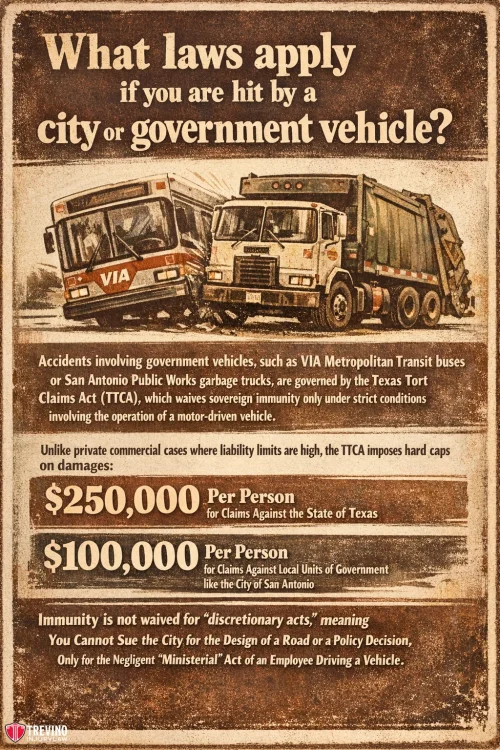
Accidents involving government vehicles, such as VIA Metropolitan Transit buses or San Antonio Public Works garbage trucks, are governed by the Texas Tort Claims Act (TTCA), which waives sovereign immunity only under strict conditions involving the operation of a motor-driven vehicle.
Unlike private commercial cases with higher liability limits, the TTCA imposes hard caps on damages: $250,000 per person for claims against the State of Texas and $100,000 per person for claims against local units of government like the City of San Antonio.
Immunity is not waived for “discretionary acts,” meaning you cannot sue the city for the design of a road or a policy decision, only for the negligent “ministerial” act of an employee driving a vehicle.
What Is the Notice Deadline for Suing the City of San Antonio?
Critically, the City of San Antonio City Charter (Art. XII, Sec. 150) requires you to file a formal Notice of Claim within just 90 days of the accident, far shorter than the standard two-year statute of limitations.
This notice must detail the time, place, and manner of the accident and the damages claimed; failing to file it correctly and on time essentially grants the city total immunity from your lawsuit.
See our guide on calculating commercial accident settlements for more on how government caps affect final values.
While these local ordinances strictly control liability for city vehicles, accidents involving interstate commerce introduce federal regulations that can override state traffic laws.
Do Federal FMCSA Regulations Override Texas Traffic Laws?
Yes, under the doctrine of Federal Preemption (49 U.S.C. § 31141), federal safety regulations generally supersede state laws if the state law is less stringent or incompatible with safe commercial operation, meaning a driver cannot hide behind local traffic flow to violate federal safety mandates.
This hierarchy is critical because commercial drivers often cite “following the flow of traffic” on I-35 or I-10 as a defense for speeding or aggressive driving. However, the Federal Motor Carrier Safety Administration (FMCSA) sets a “floor” for safety standards that state law cannot lower. If a truck driver speeds to meet a delivery deadline, they violate federal Hours of Service regulations, regardless of whether the local speed limit on Loop 1604 technically allowed their speed.
In court, this allows us to hold drivers to a higher professional standard than a typical motorist. Courts often treat violations of these federal statutes as “negligence per se,” meaning the violation itself constitutes proof of negligence without further proof.
While federal law often dictates the standard of care in court, the initial battle over liability begins with the specific codes an officer enters at the scene of the crash.
How Do You Interpret San Antonio Police Crash Report Codes?
Texas Peace Officer’s Crash Reports (CR-3) use specific numerical codes in the “Factors and Conditions” section to assign preliminary fault, requiring you to cross-reference numbers like “22” or “24” with the state’s code sheet to understand the officer’s conclusion.
When reviewing your report from the San Antonio Police Department or Bexar County Sheriff, the most critical data points are the “Unit” designations and the contributing factors. In the context of commercial vehicle accident report codes, “Unit 1” is typically the vehicle the officer believes caused the crash, while specific codes reveal the violation: Code 22 indicates “Failed to Control Speed,” Code 24 means “Faulty Evasive Action,” and Code 36 denotes an “Oversized Vehicle.”
While these codes provide a starting point, they rarely tell the whole story. For instance, an officer might not immediately spot internal vehicle maintenance failures or violations of size and weight limits set by the Texas Department of Transportation. An accident in Texas involving a commercial rig often requires a deeper forensic investigation than a standard patrol officer can provide.
This is why obtaining the full CR-3 crash report and the raw data, beyond the codes, is essential to demonstrating that drivers must be held accountable for safety failures that aren’t immediately visible in the crash report.
Quick Answers About Commercial Vehicle Accident Laws in Texas
Is Texas a No-Fault State for Commercial Accidents?
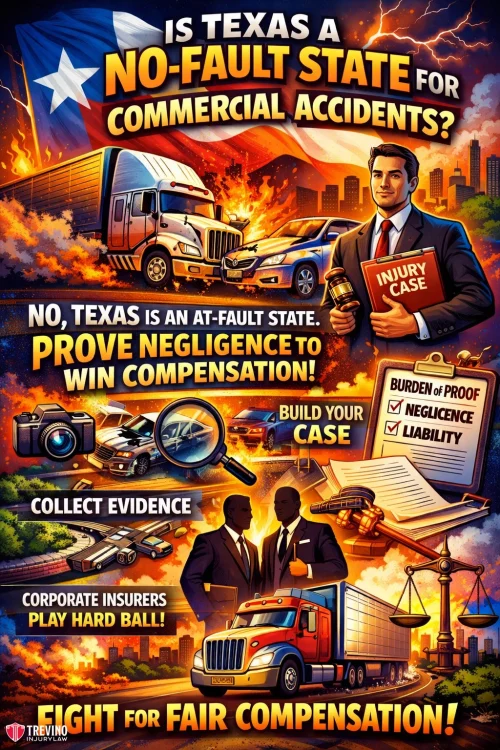
No, Texas is an at-fault state, meaning you must prove the commercial driver’s negligence to recover damages from their insurance policy rather than relying on your own coverage.
This distinction matters for accident victims who may be used to the straightforward claims process for standard car accidents. In a motor vehicle collision involving a commercial fleet, the burden of proof is higher, and corporate insurers are more aggressive.
Because you must prove fault to get paid, hiring a reputable personal injury law firm is often the only way to secure fair compensation. Unlike passenger vehicles, where liability is often clear-cut, truck accident cases require a strategic approach to protect your rights under state law.
Does a Traffic Ticket Prove Liability in Civil Court?
No, a traffic ticket is generally inadmissible as evidence of negligence in a civil trial unless the commercial driver pleads guilty or “no contest” to the citation in open court.
However, the absence of a ticket does not absolve the driver. In Texas, commercial drivers are held to a higher standard of care than drivers of private cars.
An experienced injury lawyer can often prove negligence by showing the driver violated federal regulations, such as federal weight limits or hours-of-service rules, even if no citation was issued at the scene.
In many accident cases, the law also allows us to use these regulatory violations as evidence of “negligence per se,” which significantly strengthens your claim compared to a typical car accident.
What Differentiates Commercial Liability From Personal Auto Liability?
Commercial liability involves vicarious liability and federally mandated policy limits of at least $750,000, whereas personal auto liability rests solely on the individual driver, with state minimums as low as $30,000.
The legal “duty of care” is also stricter for commercial operators. While a standard driver on Bandera Road is expected to act as a “reasonable person,” a CDL holder driving a semi-truck is held to the higher standard of a “professional driver,” meaning errors that might be forgiven for a commuter are considered negligence for a trucker.
Because these cases involve high-stakes corporate policies, hiring a San Antonio commercial accident vehicle lawyer is essential to navigate the aggressive defense tactics used to protect those limits.
What Happens If You Miss the Statute of Limitations Deadline?
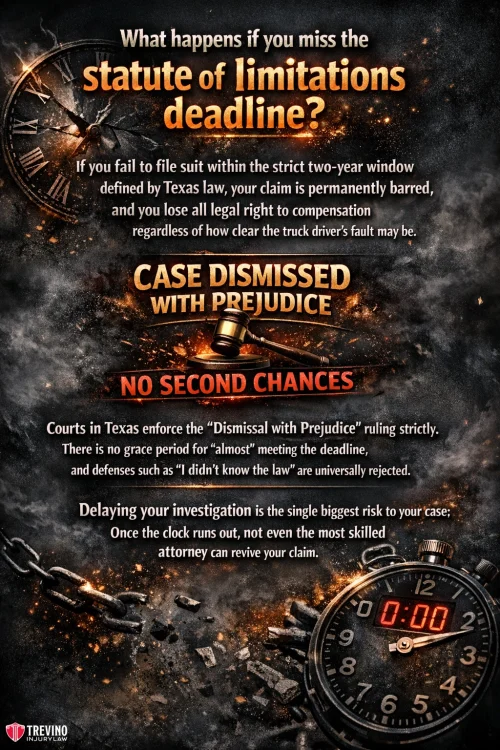
If you fail to file suit within the strict two-year window defined by Texas law, your claim is permanently barred, and you lose all legal right to compensation, no matter how clear the truck driver’s fault may be.
Texas courts enforce the “Dismissal with Prejudice” ruling strictly. There is no grace period for “almost” meeting the deadline, and defenses such as “I didn’t know the law” are universally rejected. This finality is why delaying your investigation is the single biggest risk to your case; once the clock runs out, not even the most skilled attorney can revive your claim.
When Does Sovereign Immunity Block Your Claim Completely?
Sovereign immunity blocks your claim if the accident involved a “discretionary act,” such as a policy decision on route planning, rather than a “ministerial act” like the vehicle’s operation, or if you did not file proper notice.
Additionally, the “Emergency Exception” can preclude recovery if a government vehicle, such as a fire truck or police car responding to a call near the South Texas Medical Center, is responding to an emergency with lights and sirens activated.
In these scenarios, the Texas Tort Claims Act prioritizes the government’s ability to respond to crises over the rights of motorists injured in the process, making these cases among the hardest to win.
Why Hire a San Antonio Commercial Vehicle Accident Lawyer?
Government entities and corporate insurers use ‘sovereign immunity‘ and ‘discretionary acts‘ as shields to avoid paying for the devastation they cause. To them, the 765 injuries recorded in Bexar County in 2022 are just data points to be managed. To us, you are a neighbor who deserves justice.
While high-volume settlement mills fold when faced with these complex defenses, Trevino Injury Law attacks them head-on. We don’t just file paperwork; we ensure they pay.
Want to Protect the Full Value of Your Claim?
You’ve seen how this affects your case — but this is only one piece of the puzzle. Our Personal Injury Lawyer page breaks down what a trial-ready firm does differently.
Our firm leverages trial-tested strategies to secure maximum recoveries, including a $17,000,000 gross settlement in a head-on collision case involving three fatalities. We litigate aggressively in Bexar County courts and immediately send preservation letters to stop defendants from destroying critical evidence. Hire a San Antonio commercial vehicle accident lawyer who knows how to break through their immunity defenses.
Call 210-TREVINO for a free case review. Se Habla Español. We fight on a strict No-Win, No-Fee basis.