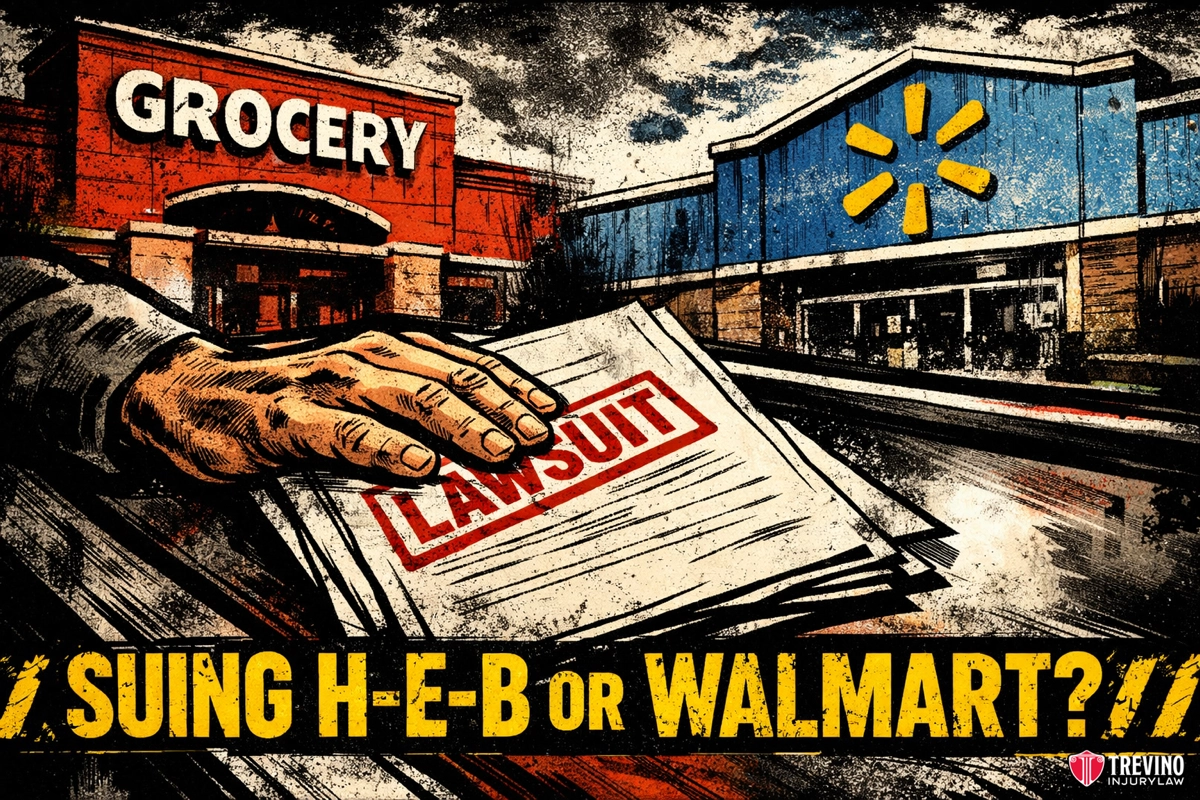
Yes, you sue H-E-B or Walmart in San Antonio by filing a premises liability claim against a self-insured corporate giant rather than a standard insurance policy.
Their internal risk management teams are already reviewing store sweep logs to build a constructive notice defense against you. They argue their employees lacked a reasonable opportunity to discover the hazard before they hit the floor. These cases often come down to where most slip and fall accidents happen in San Antonio.
These corporate failures destroy livelihoods, with the Bureau of Labor Statistics recording 479,480 falls, slips, and trips resulting in days away from work in 2024. That is not personal clumsiness. That is a retailer deferring maintenance and failing its legal duty to maintain a reasonably safe environment
What Could Your Slip and Fall Accident Case Be Worth?
Answer a few quick questions about your accident. Takes about 60 seconds.
See What My Case Might Be WorthThe insurance company offered less than $20,000. I ended up with over $1 million. — Jackie Galindo
Store surveillance video of the aisle is overwritten in the normal course of business. A Spoliation Letter, a legal demand that stops the property owner from destroying evidence, must go to corporate headquarters immediately to lock down the footage from the hour before your fall.
Trevino Injury Law slip and fall attorneys subpoena this critical footage and forces the retailer to pay for your injuries. Call 210-TREVINO for a free case review. You pay nothing unless we win. Se Habla Español.
What Are the Steps to File a Slip and Fall Accident Claim Against Walmart in Texas?
The filing process against a retail giant is an adversarial battle from the moment you hit the floor. While the store management at a location like the Walmart Supercenter at Loop 1604 and Culebra Road may appear helpful, their primary goal during the incident report is to gather evidence to defend the store, not to help you.
To protect your rights against self-insured retailers like H-E-B in Texas and Walmart, you must follow these four critical steps:
- Report the incident immediately to a store manager to create an official record.
- Preserve evidence by taking photos of the spill, the floor conditions, and any lack of warning signs that caused your fall.
- Demand surveillance footage by sending a Spoliation Letter to Claims Management, Inc. (for Walmart) or the corporate risk manager before it is deleted.
- Decline recorded statements from adjusters like Sedgwick or Gallagher Bassett until you have consulted with an experienced attorney.

Do not give a recorded statement to the claims adjuster who calls you days later. These adjusters are trained to extract statements that shift the blame to you. Instead, you need a knowledgeable Texas trial lawyer to send a formal letter of representation and demand that the retailer’s third-party administrator preserve evidence before the administrator can deny liability or destroy key evidence.
How to Prove Negligence in a Texas Premises Liability Case
Under premises liability law, you must prove the store had “actual or constructive notice” of the hazard, meaning the employees either knew about the spill or should have discovered it through reasonable inspection policies.
This legal standard is defined by the ‘Time-Notice Rule,’ firmly established by the Texas Supreme Court in Wal-Mart Stores, Inc. v. Reece, 81 S.W.3d 812 (Tex. 2002). In this landmark decision, the Court ruled that mere proximity of an employee to a hazard is not enough; the plaintiff must provide ‘some proof of how long the hazard was there’ before liability attaches.
If a customer drops salsa at H-E-B and you slip ten seconds later, Reece protects the store. However, if that spill remains for 45 minutes, providing the retailer with what the courts call a ‘reasonable opportunity to discover and remedy’ the defect, they have failed their duty to maintain the premises in a reasonably safe condition.
Proving this timeline often requires analyzing “sweep logs” and video footage to establish exactly how long the hazard existed.
Why You Must Send a Spoliation Letter Immediately
You must send a formal Spoliation Letter to the corporate headquarters immediately, as surveillance video is often deleted within 30 days in the “normal course of business” unless a legal demand requires preservation.
A Spoliation Letter is a critical legal tool that puts H-E-B or Walmart on notice that a lawsuit is likely. Once received, they are legally obligated to save specific evidence, including video footage from the hour before your fall, cleaning logs, and employee witness lists. If they destroy this evidence after receiving the letter, a judge can instruct the jury to assume the missing evidence would have hurt the store’s case.
Without this letter, the proof you need to build a strong case often vanishes forever. Filing the claim and preserving evidence is only the first step; to secure a fair recovery, you must also understand how these corporations calculate the value of your injuries.
Average Settlement for Slip and Fall with Broken Bones at H-E-B
While there is no universal “average,” settlements for broken bones at H-E-B typically range significantly based on medical costs, lost wages, and whether the case is prepared for trial in Bexar County or settled early with a claims adjuster.
H-E-B is self-insured, meaning every dollar they pay comes directly from their own profits, making them notoriously aggressive in negotiations. A “settlement mill” law firm that avoids court might recommend accepting a low offer of $15,000 to $25,000 to close the file quickly.
In contrast, an experienced attorney fights for the full value, which includes past and future medical bills, physical impairment, and pain and suffering. The impact on a victim’s livelihood is often severe; recent federal data shows that falls, slips, and trips resulted in approximately 479,480 cases involving days away from work in a single reporting period (BLS, 2024).

We use the same logic that secured a $7.9 million verdict for a workplace injury to maximize value in premises liability cases: we prove the long-term impact of the resulting injuries on your life. If a broken hip or fractured ankle leads to chronic arthritis or limits your ability to work, the claim value increases substantially.
How Pre-Existing Conditions Affect Your Claim
Corporate defense attorneys will often argue your injury is from “age-related degeneration” or a prior condition rather than the fall, requiring a biomechanical expert to causally link the acute trauma of the accident to your current pain.
This tactic is particularly aggressive against older victims. Given that unintentional falls resulted in over 41,000 deaths among those aged 65 and older in 2023 alone, insurance adjusters frequently attempt to categorize acute injuries as inevitable age-related decline (CDC, 2025). They will scour your medical history for any mention of back pain or arthritis.
However, Texas law follows the “Eggshell Skull Plaintiff” doctrine, which holds that a defendant must take the victim as they find them. Even if you had a bad back before, if the slip-and-fall at H-E-B made it worse or required new surgery, they are liable for the resulting injuries.
We use medical experts to clearly distinguish your old baseline from your new injuries.
The value relies on clean facts and expert medical testimony, but even the strongest case can be destroyed if you miss the strict filing deadlines.
What Is the Statute of Limitations for Slip and Fall in San Antonio?
In Texas, the statute of limitations for a slip and fall claim is generally two years from the date of the accident, after which you permanently lose your right to sue H-E-B or Walmart for damages.
While two years may seem like a long time, waiting is dangerous. Evidence degrades, witnesses move away, and video footage is overwritten. Furthermore, building a winning case takes time. Your lawyer needs months to investigate the scene, depose store managers, and consult with medical experts before filing a lawsuit against H-E-B or other retailers. If you wait until month 23 to contact an attorney, many will decline the case because there is not enough time to prepare properly.
There is also a critical exception: if your fall happened on government property—such as a city-owned sidewalk outside the store or a public bus stop near the entrance, the deadline to provide notice of a claim is much shorter, often just 90 days or 6 months. Because the property setting can change the parties and procedural issues involved, see where slip-and-fall accidents commonly happen in San Antonio for a location-by-location breakdown.
Knowing the deadline is key, but having the right representation is vital to navigating these time limits and fighting corporate legal teams.
Why “Settlement Mills” Cannot Win Against H-E-B or Walmart
The vast majority of San Antonio injury firms operate as “settlement mills”, high-volume practices that rely on quick, pre-litigation payouts from auto insurance companies. However, this business model fails against stores across Texas like H-E-B and Walmart.
Because these retail giants are self-insured, every dollar they pay comes directly from their own profits rather than an insurance policy. Consequently, their dedicated claims departments, such as Claims Management, Inc., are instructed to deny liability aggressively rather than offer “nuisance value” settlements.
A lawyer who is afraid of the courtroom has no leverage in these negotiations, and trials are increasingly rare events. In fact, official court activity reports indicate that only 73 civil juries were selected in Bexar County District Courts during the 2025 fiscal year (Texas Judicial Branch, 2025).
These corporations keep detailed records on opposing counsel; they know which attorneys fold on low offers and which, like Trevino Injury Law, have a documented history of being among the few to take cases to verdict in Texas state court.

To fight for the compensation you deserve, you need a trial attorney who prepares the case for a jury from day one, forcing the retailer to recognize the financial risk of a trial.
How “Constructive Notice” Rules Protect Retailers
Constructive notice protects retailers by requiring you to prove the hazard existed long enough for a diligent store employee to have found and removed it. That timing issue is especially important in Texas wet-floor slip-and-fall claims, where the dispute often turns on how long the liquid was present before the fall.
This legal standard places a heavy burden on the injured customer. You cannot simply say “there was a spill”; you must prove time. Retailers like Walmart utilize “T-logs” or “sweep logs”, electronic records that supposedly document employees inspecting aisles every 15 to 30 minutes.
If their log shows an employee swept the produce section at the H-E-B on South Zarzamora Street ten minutes before your fall, the defense will argue they were diligent. We counter this by analyzing surveillance video to see if the “sweep” actually happened or if the employee merely “pencil-whipped” the log without looking at the floor.
Does an Incident Report Prove Fault?
No, filing an incident report documents that an event occurred, but it is not an admission that the store was at fault.
Will H-E-B Pay My Medical Bills Upfront?
No, H-E-B and Walmart are self-insured and will generally not pay any medical bills until the entire case is resolved through a final settlement or judgment.
While establishing notice is the primary hurdle, defense attorneys also frequently blame the victim for not seeing the danger.
How Does the “Open and Obvious” Defense Work?
The “Open and Obvious” defense asserts that property owners owe no duty to warn invitees of hazards that are objectively visible to a reasonable person, such as a large pallet of water or restocking cart.
In San Antonio litigation, defense attorneys frequently utilize this doctrine to shift blame onto the victim for failing to navigate around static obstacles. To defeat this, plaintiffs’ attorneys employ the “Distraction Theory,” arguing that retailers intentionally divert shopper attention toward eye-level displays and “sale” signs, effectively blinding them to floor-level hazards.
Proving the store created an environment that prevented you from seeing the danger neutralizes the defense, pivoting the case back to the store’s constructive knowledge of the risk.
What if I Cannot Prove the Store Knew About the Spill?
If you cannot prove the store had actual or constructive knowledge of the hazard, your premises liability claim will likely be dismissed on Summary Judgment before it ever reaches a jury.
This is the “negative space” of personal injury law. Without evidence like dried, sticky edges on a spill (proving it had been there a while) or dirty cart tracks running through it, the law assumes the store is innocent. A “clean” spill that just happened offers no grounds for a lawsuit anywhere in Texas, no matter how severe your injury is. This is why preserving video evidence immediately is not just helpful—it is the difference between a valid claim and a dismissal.
Beyond the lack of notice, certain weather-related conditions can also shield property owners from liability entirely.
When Does the “Natural Accumulation” Doctrine Apply?
The “Natural Accumulation” doctrine is an exception that protects business owners from liability for slips caused by naturally occurring conditions, such as rain tracked into a store entrance, unless the accumulation becomes “unnatural.”
During heavy storms in San Antonio, water naturally tracks into store vestibules from customers and carts. Texas courts protect business owners under the ‘Natural Accumulation’ doctrine, most notably affirmed in M.O. Dental Lab v. Rape, 139 S.W.3d 671 (Tex. 2004).
In this case, the Texas Supreme Court held that owners generally have no duty to remove naturally accumulating mud or water throughout Texas, as doing so during a storm is practically impossible.
Liability attaches only if the accumulation becomes ‘unnatural’ due to the owner’s negligence, such as a broken gutter or a graded entrance that artificially pools water, turning a weather event into a premises defect.
However, liability can attach if the store allowed water to pool excessively or failed to place stiff-bristled mats to capture it, turning a natural occurrence into an unreasonable hazard.
Hire a San Antonio Slip and Fall Lawyer Who Fights Retail Giants
Slip-and-fall cases against H-E-B and Walmart are won or lost in the first few days. While you recover from your injuries, their risk management teams are already working to delete surveillance footage and build a defense to blame you for the accident.
Want to Protect the Full Value of Your Claim?
You’ve seen how this affects your case — but this is only one piece of the puzzle. Our Slip and Fall Lawyer page breaks down what a trial-ready firm does differently.
We proved this at the Bexar County Courthouse by securing a $7.9 million jury verdict. To build this leverage, your San Antonio personal injury claim lawyer immediately issues a spoliation letter to preserve vanishing video evidence before the defense destroys it.
Call 210-TREVINO today for a free consultation. Se Habla Español.