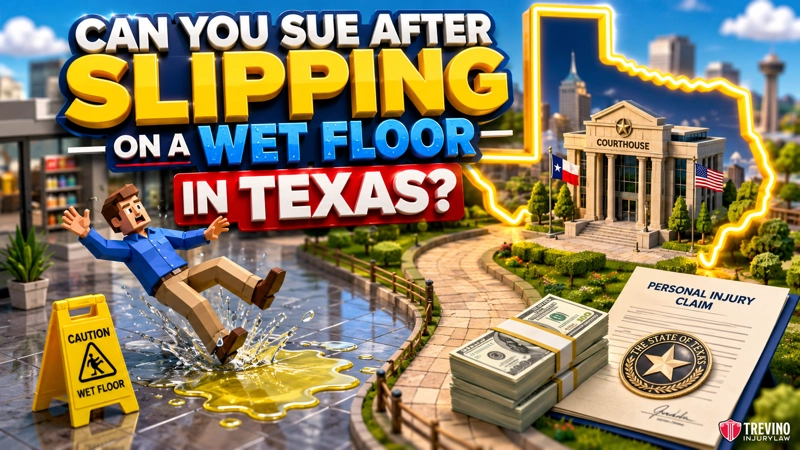
A wet-floor slip-and-fall claim in Texas is a premises liability action that requires proving the property owner knew, or reasonably should have known, of the dangerous liquid before the fall. A business is not automatically liable simply because someone slipped on a wet floor.
Actual notice means the business knew about the spill. Constructive notice means the liquid remained long enough that a reasonable inspection would have discovered it. Insurance adjusters attack this element by arguing the spill appeared only moments before the accident or that the injured person caused the fall through distraction or footwear.
The danger is significant. Between 2018 and 2022, Texas recorded 1,957 fatal same-level falls caused by slipping, tripping, or stumbling, according to the Texas Department of State Health Services (2024). Trevino Injury Law protects wet-floor claims by securing photographs, surveillance footage, incident reports, inspection records, and witness testimony that can establish notice before critical evidence disappears.
At Trevino Injury Law, our San Antonio slip and fall lawyers preserve evidence and build the notice record needed to pursue a Texas wet-floor claim. Call 210-TREVINO for a free case review. You pay nothing unless we win. Se Habla Español.
Texas Slip and Fall on Wet Floor: Key Takeaways
- As your San Antonio slip and fall lawyer, we aggressively protect victims injured on corridors like Loop 410 across Bexar County.
- The legal team issues formal spoliation demands to compel corporate defendants to preserve vital surveillance footage of your accident.
- Trevino Injury Law defeated deceptive insurance adjusters and secured a $536,007 Jury Verdict following a meager $5,000 defense offer.
- Our trial attorneys relentlessly fight negligent companies to recover maximum financial compensation for your medical bills and lasting economic damages.
How Much Is Your Injury Case Really Worth?
Fast response. Free & Confidential.
“The insurance company offered less than $20,000. I ended up with over a million.” – Jackie Galindo
How Do You Prove the Store Knew About the Wet Floor?
To successfully file a lawsuit against a San Antonio business after you are injured in a slip and fall, you must legally prove that the property owner or their employees either knew about the dangerous spill or should have reasonably discovered it through routine safety measures and inspections before your fall occurred.
Winning a slip-and-fall case against a massive retailer on Loop 410 or at a downtown hotel requires overcoming the burden of proof on notice. Texas law does not automatically hold the business liable simply because you fell on liquid. We must prove negligence. When the fall happens at a major grocery or big-box retailer, the same notice analysis shapes whether you can sue H-E-B or Walmart for a slip and fall.
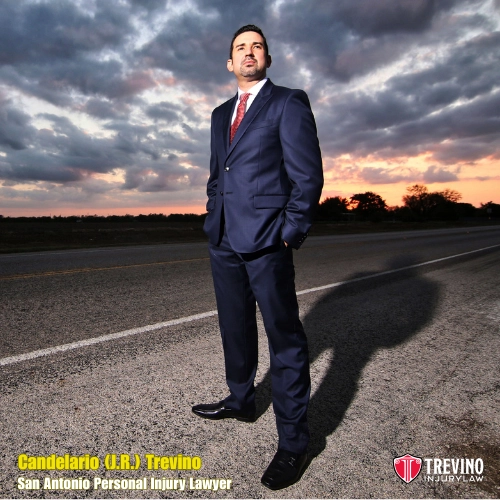
Trevino Injury Law litigates premises liability cases by forcing defendants to produce maintenance logs and internal communications. Trial Attorney Candelario (J.R.) Trevino has taken more than 80 personal injury cases to trial. By securing legal representation from an experienced attorney, you ensure your rights are protected.
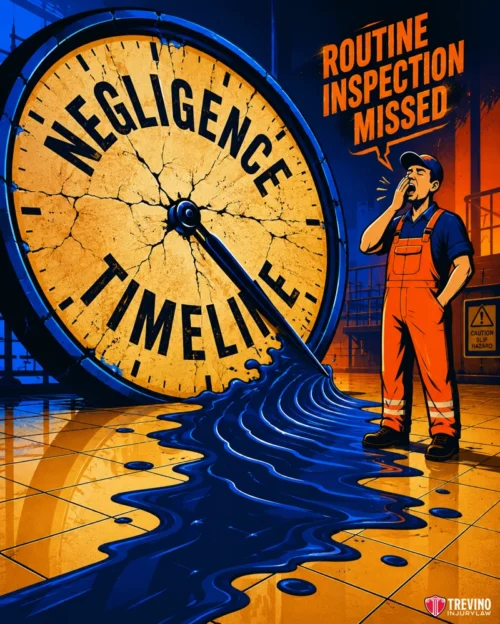
We know that insurance companies immediately look to defeat a slip and fall lawsuit by denying they had any knowledge of the hazard. In Texas, the statute of limitations for these personal injury claims is generally two years, making immediate investigation critical before evidence disappears.
What Is the Difference Between Actual and Constructive Notice?
Texas courts recognize two distinct forms of notice: actual notice occurs when an employee directly observed or caused the spill, while constructive notice applies when the hazard existed long enough that a reasonable, timely inspection would have discovered it.
| Notice Type | Legal Definition | Evidence Required |
| Actual Notice | The business was explicitly aware of the danger. | Employee testimony, incident reports, video of an employee dropping the liquid. |
| Constructive Notice | The business should have known through reasonable care. | Dirty water, track marks through the spill, dried edges around the puddle. |
Achieving contextual coverage means identifying exactly which type of notice applies to your specific Bexar County lawsuit.
How Does the “Time-on-Floor” Rule Determine Liability?
The time-on-floor rule is the most critical element in constructive notice cases because if a sudden spill occurred only seconds before your slip-and-fall accident, Texas courts generally will not hold the business liable for your injuries due to a lack of time to respond.
We aggressively pursue internal sweep logs and employee testimonies to corroborate the fact that the business failed to follow its own maintenance schedule. If a busy supermarket along I-35 abandons its scheduled 30-minute floor inspections, that failure to monitor the premises establishes their liability for the hazardous condition.
Proving the store knew about the spill is critical, but the insurance company will immediately attempt to use an inadequate warning sign as their ultimate defense to avoid paying a fair settlement.
What Happens If There Was a Yellow “Wet Floor” Sign?
The fact that a wet floor sign present at the scene does not automatically absolve a business from a personal injury lawsuit if the warning was unreasonably placed, hidden from view, or otherwise failed to adequately convey the true extent of the danger.
A favorite tactic of insurance adjusters and negligent corporations is to point to a single, poorly placed caution sign as an absolute defense. However, Trevino Injury Law routinely defeats this defense in court.
A property owner owes a strict legal duty to either fix the hazard or adequately warn of it. However, as the Texas Supreme Court established in TXI Operations, L.P. v. Perry, 278 S.W.3d 763 (Tex. 2009), a warning is only effective as a legal defense if it reasonably and adequately notifies the patron of the specific danger.
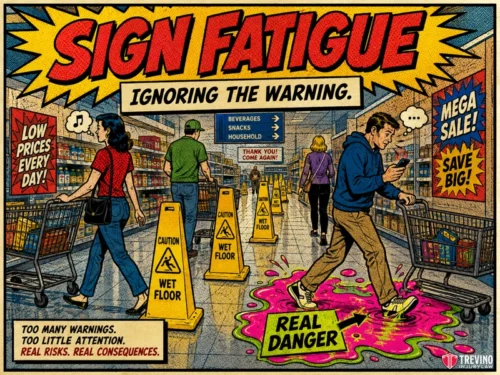
If a sign is left up permanently, ignored by staff, or placed around a blind corner in a crowded retail center like The Quarry, the warning fails this legal standard and is fundamentally insufficient to shield the corporation from liability.
How Do Texas Courts Evaluate Inadequate or Misplaced Caution Signs?
Texas courts rigorously analyze the adequacy of a wet floor sign based on its visibility to patrons, its proximity to the hazard, and whether the business habitually left the caution sign out even when the floor was completely dry. Wet floor signs may be deemed inadequate based on the following:
- Visibility: Signs obscured by merchandise displays or placed in poorly lit corridors fail to warn invitees.
- Proximity: Placing the sign 30 feet from a spill provides no protection to a walking customer.
- Sign Fatigue: Businesses that permanently display wet floor signs lose their defense because the warning becomes meaningless to the public.
Understanding these property defenses lays the foundation for navigating the entirely different legal landscape you face if you slip on a wet floor at work.
Can You Sue if You Slipped on a Wet Floor at Work in Texas?
Slipping on a wet floor while working in San Antonio fundamentally changes your legal strategy because your financial recovery depends entirely on whether your specific employer subscribes to the Texas workers’ compensation system or operates as a non-subscriber who can be sued directly for their negligence. The frequency of these workplace accidents cannot be overstated; in fact, Texas recorded 47,650 nonfatal occupational injuries involving falls, slips, or trips that required days away from work or job restriction between 2021 and 2022 (Texas Department of Insurance / U.S. Bureau of Labor Statistics, 2022).
If you suffer a spinal injury from falling in an industrial warehouse or commercial center near Joint Base San Antonio (JBSA), you are not pursuing a standard premises liability claim. Texas law allows employers to opt out of the state’s workers’ compensation system. If your employer is a non-subscriber, they lose crucial legal defenses, meaning you can sue your employer directly for failing to maintain a safe work environment.
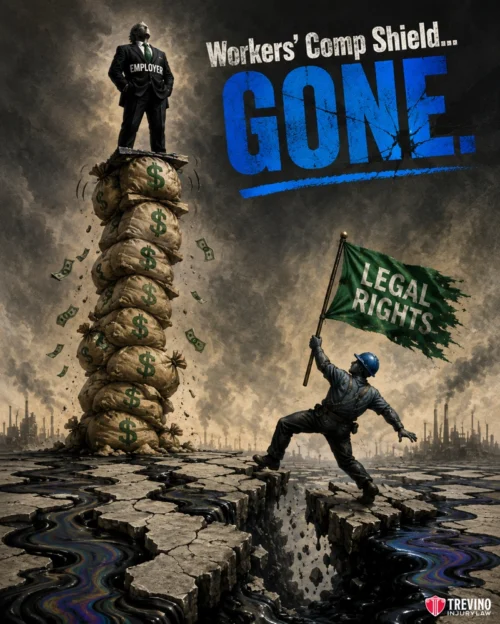
Trevino Injury Law fights for injured workers by establishing absolute employer negligence in Texas state courts. Our trial-first approach forces negligent companies to take these workplace hazards seriously. These conditions frequently prove deadly, as falls, slips, and trips accounted for 14% of all fatal occupational injuries in Texas in 2024, tragically claiming 77 lives (Texas Department of Insurance, 2024). For example, we secured a $7.9 Million Verdict for a crushed foot and amputated toe when the initial settlement offer from the defense was only $1,300,000.
Whether you are injured on a commercial property or at your workplace, shifting from legal theory to practical execution requires securing the exact evidence needed to win your slip and fall accident case.
How Do You Get Store Camera Footage of a Wet Floor Accident?
Securing crucial surveillance footage requires your San Antonio personal injury attorney to immediately draft and serve a formal spoliation letter that legally forces the corporate defendant to preserve the video evidence before their system automatically overwrites it and destroys your claim.
- Immediate Attorney Involvement: During your first week at Trevino Injury Law, an attorney reviews your case and identifies the required CCTV footage to prove notice.
- Spoliation Demand: We send a legal notice demanding the strict preservation of all digital and physical evidence related to your fall.
- Court Intervention: If they destroy the footage, we ask the judge for a spoliation inference, meaning the jury must assume the deleted video proved their negligence.
Securing this visual evidence provides the foundation needed to tackle complex scenarios involving third-party vendors and unpredictable elements.
Can You Sue a Commercial Cleaning Company for a Wet Floor?
Yes, if a cleaning contractor created the hazard without placing warnings as a precaution, you can file a claim against that third-party vendor directly for active negligence.
Do You Have a Case If Another Customer Just Spilled the Liquid?
No, if another patron spills liquid and you slip seconds later, the store is generally not liable because it lacked constructive notice of the slip-and-fall incident.
Is a Store Liable for Rain Tracked in by Customers?
No, Texas law generally treats rainwater tracked inside during an active storm as a natural hazard, unless the business actively worsens the dangerous condition.
Does Wearing Inappropriate Footwear Destroy Your Wet Floor Claim?
Wearing high heels or smooth-soled shoes does not destroy your claim, but the insurance adjuster will aggressively use your footwear to argue comparative negligence and attempt to drastically reduce the final financial compensation you and your family deserve.
Texas operates under proportionate responsibility laws. The defense will argue your footwear caused the fall, not their puddle. We litigate to a verdict to shift the focus back to their failure to maintain the premises. In the case of Jose Simon Arriaga Jr. v. Emily Montemayor, the defense offered a mere $5,000. We took it to trial and secured a $536,007 Jury Verdict, proving that aggressive trial presentation overcomes defense blame-shifting.
While overcoming attacks on your footwear is entirely possible with strong advocacy, failing to document the actual hazard creates much steeper obstacles when seeking compensation.
What Happens If You Cannot Identify the Liquid You Slipped On?
Failing to identify the specific liquid or hazard that caused your catastrophic injury severely damages your claim because it prevents your San Antonio fall attorney from proving how long the substance was present on the floor or exactly where it originated.
If you fall and later state to the insurance adjuster that you do not know what you slipped on, they will immediately file a motion to dismiss your case. Identifying the substance—whether it was a spilled drink, a leaking refrigeration unit, or freshly applied floor wax—is the foundational requirement for establishing the plaintiff’s contextual vector of liability. You must take photos of your clothes and the floor immediately after the fall to preserve evidence, and seek immediate medical attention for your injuries.
Proving the origin of a man-made spill is essential, but you must also understand how the law shifts when dealing with weather-related dangers brought indoors.
When Are Stores Exempt from Liability for Naturally Occurring Hazards?
Texas law generally protects commercial property owners from premises liability when customers track rainwater or mud into a store during active storms, treating the moisture as a naturally occurring hazard that is considered open and obvious to the general public.
However, this exception has strict legal boundaries. If a business located on the San Antonio River Walk places absorbent floor mats at their entrance but allows them to become entirely saturated and dangerous, they cross the line from a natural accumulation into active negligence. The River Walk is one of several common slip-and-fall locations in San Antonio where the setting affects the hazards, property control, and evidence that may matter after a fall. Trevino Injury Law explores every exception to these limitations to hold property owners accountable and secure maximum compensation for our clients across South Texas.
Understanding these critical limitations ensures your legal strategy is fully prepared to challenge negligent corporations and demand the justice you deserve.
Why Hire a Slip and Fall Lawyer?
Insurance Adjusters use your silence against you. Do not give a recorded statement to the insurer first. You need to file a slip-and-fall lawsuit with a Bexar County personal injury lawyer who actually tries cases, exposes insurance company tactics, and forces them to pay full value for catastrophic injuries.
At Trevino Injury Law, we fight for families and litigate to verdict. We level the playing field between injured families and powerful corporations. Our team has taken over 80 personal injury law cases to trial across South Texas courts. We use this deep trial experience to secure maximum compensation, including a $536,007 Jury Verdict achieved when the defense’s last offer was only $5,000. We fight for both your economic damages and non-economic damages, ensuring your medical bills are fully covered.
Want to Protect the Full Value of Your Claim?
You’ve seen how this affects your case — but this is only one piece of the puzzle. Our Slip and Fall Injury Lawyer page breaks down what a trial-ready firm does differently.
We operate strictly on a contingency fee basis. This is a “no win, no fee” guarantee, under which clients owe nothing if the case is unsuccessful. Call us today for a free consultation to preserve evidence and protect the case.