You prove constructive notice with a definitive timeline and physical evidence. Dried liquids, cart tracks through a puddle, and blackened banana peels show that a Texas property owner ignored a hazard long enough that a reasonable inspection would have caught it.
The corporate defense attorney assigned to your claim is already invoking the Time-Notice Rule, arguing that the spill was a sudden emergency and that their employees had no opportunity to discover it. But slip-and-fall liability often depends on proving that the property owner had enough time to find the hazard and fix it before someone got hurt. According to the Texas Department of State Health Services, state trauma registries recorded 1,957 fatal injuries attributed to slipping and tripping on the same level between 2018 and 2022. Behind these incidents are property owners who falsify sweep logs, ignore inspections, and blame the victim.
What Could Your Slip and Fall Accident Case Be Worth?
Answer a few quick questions about your accident. Takes about 60 seconds.
See What My Case Might Be WorthThe insurance company offered less than $20,000. I ended up with over $1 million. — Jackie Galindo
Surveillance footage proving how long that spill existed vanishes within days. A Spoliation Letter, a legal demand that stops the property owner from destroying proof, must be sent immediately. Texas enforces a strict two-year deadline to file your lawsuit. Once the video is erased, your strongest proof of corporate negligence disappears forever.
A Trevino Injury Law slip-and-fall lawyer investigates the timeline and locks down the security footage before the store deletes it. Call 210-TREVINO for a free case review. You pay nothing unless we win. Se Habla Español.
What Counts as “Constructive Notice” Under Texas Premises Liability Law?
Constructive notice occurs when a dangerous condition has existed for such a length of time that the property owner’s failure to exercise ordinary care means they should have discovered and removed it. This ‘Time-Notice Rule’ was firmly established in Wal-Mart Stores, Inc. v. Reece, 81 S.W.3d 812 (Tex. 2002).

The court held that to establish notice, there must be proof of how long the hazard was present so that the premises owner had a reasonable opportunity to discover it. This standard defines whether the property owner owed a duty to an invitee to fix the defect.
What Is the Difference Between Actual and Constructive Notice?
Actual notice requires proof that an employee saw or created the hazard, while constructive notice of the hazard relies on the duration the danger was present. Users often confuse these concepts, but the distinction between these two types of notice is the pivot point for litigation strategy in Bexar County courts.
Actual notice happens if a manager stands next to a spill and ignores it, a rare admission, whereas actual or constructive knowledge is argued when a spill is sticky, dried, or tracked through, implying it was present long enough that a reasonable inspection would have found it.
Why Is the “Time-Notice Rule” Critical for Your Texas Slip and Fall Case?
The Time-Notice Rule dictates that without proof of how long a hazard existed, a plaintiff cannot survive a summary judgment motion in Texas courts. Mere proof that a substance was on the floor is not enough; you must prove that the property owner had a reasonable opportunity to discover and remedy the defect.
Without specific evidence of the time of the fall relative to the spill’s creation, the judge will dismiss the case before it ever reaches a jury, regardless of the severity of your injuries.
This strict legal standard applies even in the most tragic circumstances; between 2018 and 2022, Texas trauma registries recorded 1,957 fatal injuries specifically attributed to falling on the same level from slipping, tripping, and stumbling (Texas DSHS, 2024).
Understanding this complex area of law is useless without knowing how to prove it, which leads us to the specific mechanisms of proof: time and physical evidence.
What Evidence Proves a Hazard Existed Long Enough for Discovery?
To prove duration, we must present circumstantial evidence showing the hazard had aged or been traversed by others, indicating the store knew about the hazard for an unreasonable period.

A “clean” spill suggests it just happened, while a “dirty” spill suggests neglect, and we frequently localize this investigation to high-traffic areas like H-E-B produce sections or the North Star Mall food court where inspections should be frequent.
Can “Dirty” or “Tracked” Substances Prove the Hazard Was Old?
Yes, Texas courts have accepted evidence such as dried liquids, footprints left by a spill, or blackened banana peels as proof that employees were notified of the hazard.
This “forensic” detail is critical; for example, melted ice cream proves time has passed since it fell, while cart tracks through a puddle show that employees or other customers walked by the hazard without taking action to clean it or place a warning sign.
Do Sweep Logs and Inspection Sheets Prove Negligence?
Store “Sweep Logs” or “Z-Logs” are critical evidence because a missing or falsified entry proves the store failed its duty to inspect the premises. We aggressively audit these documents because:
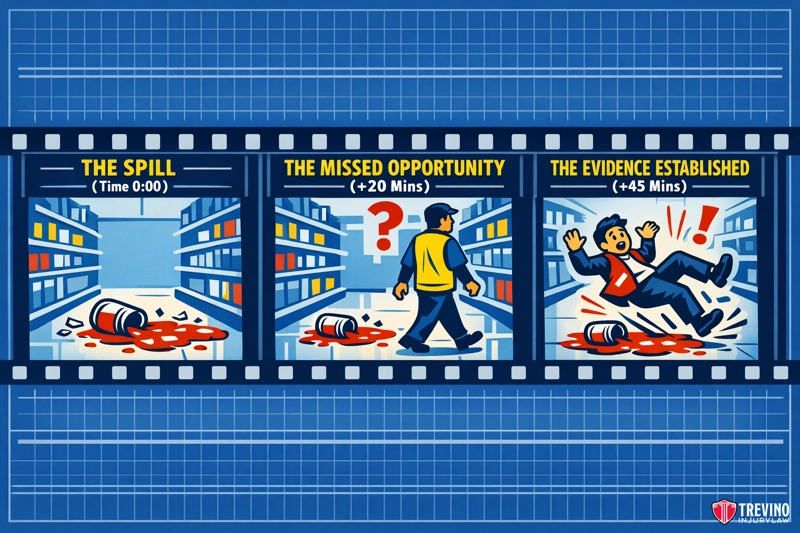
- The Gap: If the log says “Inspected at 2:00 PM” and you fell at 2:45 PM, that 45-minute gap is the battlefield where we argue the store knew or should have known about the danger.
- The Lie: We often find “safety sweeps” logged after the ambulance arrived—evidence of fraud we expose in deposition.
- The Policy: Proving the store violated its own internal inspection policies establishes a failure to exercise ordinary care.
Physical signs and paper logs are powerful, but they can be disputed; however, video evidence provides an objective timeline that is much harder for the defense to hide.
How Does Security Footage Establish a Constructive Notice Timeline?
Security footage is the gold standard of proof, allowing us to establish exactly when a spill occurred and how many employees passed it without taking action. In stores with heavy surveillance, like Target or Costco in San Antonio, this “Silent Witness” allows us to measure the exact minutes between the spill’s creation and the moment it caused your fall, effectively calculating the store’s window of opportunity to correct the defect.
Why Must You Send a Spoliation Letter Immediately?
A spoliation letter is a formal legal demand sent to the property owner requiring them to preserve specific evidence, including video footage, and to prevent them from “looping over” the data. This is an adversarial necessity because most commercial security systems automatically delete footage after 48 to 72 hours. Since notice often relies on video proof, if a store destroys the footage after receiving this letter, the court may sanction them or instruct the jury to presume the missing video showed their negligence.
While video evidence typically seals the case for actual or constructive notice, there are situations where we cannot prove exactly how long a hazard was present, requiring us to look for exceptions to the rule.
What If You Cannot Prove How Long the Hazard Was There?
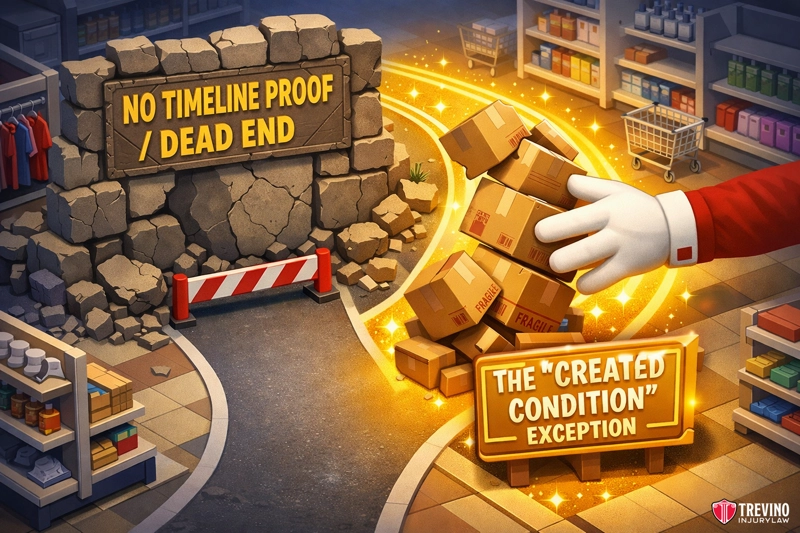
If you cannot prove the duration of the hazard, Texas law generally mandates dismissal of the claim unless we can utilize the “Created Condition” exception. This legal strategy shifts the burden from proving the store failed to find the hazard to proving the store actively created it, often vital in cases involving employee negligence, like using excessive water to mop or stacking merchandise in an unstable manner.
When we cannot establish a timeline through video or witness testimony, we must pivot our legal theory from “failure to inspect” to “active creation.” If an employee caused the dangerous condition, for example, by dropping a jar of salsa and walking away, or by knowingly operating a freezer that leaks every day, notice is presumed under Texas law.
This removes the requirement to prove that the property owner had notice for a specific period, because the employer is automatically aware of its own agents’ actions. This approach is vital in cases where “sweep logs” are missing or video evidence has been conveniently lost.
While proving the store created the hazard bypasses the time requirement, seeking compensation becomes significantly more complex when the negligent property owner is not a private business, but a government entity like the City of San Antonio.
Are the Rules Different for Government Buildings in San Antonio?
Yes, proving constructive notice against a governmental entity like the City of San Antonio or VIA Transit requires overcoming Sovereign Immunity and meeting stricter “Actual Notice” standards under the Texas Civil Practice and Remedies Code.
Unlike private businesses, suing a government entity like the City of San Antonio requires meeting the stricter standard set by the Texas Tort Claims Act. As ruled in City of Dallas v. Thompson, 210 S.W.3d 601 (Tex. 2006), you must prove that the government entity had actual knowledge of the specific dangerous condition at the time of the incident; proving that they merely ‘should have known’ (constructive notice) is insufficient to waive sovereign immunity.
Furthermore, damages in these cases are strictly capped at $250,000 per person, and the procedural deadlines for filing notice of a claim are much shorter than the standard two-year statute of limitations. This immunity is particularly devastating for our most vulnerable residents, given that the CDC reported 2,192 unintentional fall deaths among older adults in Texas in a single recent year (CDC, 2025).
Does a “Wet Floor” Sign Defeat a Constructive Notice Claim?
Generally yes, because the sign serves as an “adequate warning.” Although the property owner owes the highest duty of care to an invitee, a sign converts a hidden hazard into an open and obvious one, unless it is placed too far away to be effective.
Can I Win If I Didn’t See the Spill Before Falling?
Yes, in fact, not seeing the spill helps your case; if you saw it and walked into it anyway, the defense will argue you were more than 51% at fault. This is because Texas follows a modified comparative negligence standard.
Is Constructive Notice Required If an Employee Caused the Spill?
No, if an employee caused the dangerous condition (active negligence), notice is presumed because the employer is automatically aware of their own agents’ actions.
While understanding government immunity and signs is important, the most common battleground in private trip-and-fall cases remains the timing of the hazard.
How Does the “Temporal Proximity” Defense Work?
Defense attorneys use the concept of temporal proximity to argue that the store had insufficient time to react to the hazard, regardless of their inspection policies. They will present a timeline showing that the spill caused the fall so close to its creation that no reasonable employee could have cleaned it up, effectively shielding the store from liability.
Time Since Spill vs. Liability Likelihood:
| Time Since Spill | Liability Likelihood | Context |
| 0-5 Minutes | Low Liability | Often considered a “Sudden Emergency” with no time to cure. |
| 15-30 Minutes | Grey Area | Liability depends heavily on the store’s specific inspection policy. |
| 45+ Minutes | High Liability | Constructive notice is likely established due to neglect. |
If the timeline falls within that “Low Liability” window, the defense will almost certainly file a motion to dismiss for lack of opportunity to cure.
What Happens If the Hazard Was a “Sudden Emergency”?
The “Sudden Emergency” defense applies when a hazard arises so suddenly (e.g., a customer drops a jar of salsa seconds before you slip) that the store had no reasonable opportunity to clean it.
This is the most common defense used by major retailers like H-E-B and Walmart against slip-and-fall victims. It argues that the “negative space” of time, the absence of duration, means there was no negligence under Texas civil practice. If the spill lasted only a minute or two, the law generally holds that requiring immediate cleanup imposes an impossible burden on the property owner.
This defense relies on the lack of time, but there are specific physical defects where time is irrelevant because the danger is inherent to the property itself.
When Is Constructive Notice NOT Required?
Constructive notice is not required when the dangerous condition was created by the premises owner’s own activity or when the defect is structural in nature. A structural defect, such as a broken step at a VIA bus stop or an uneven ramp at a Medical Center clinic, did not “happen” by chance; it was built or maintained that way, meaning the owner is presumed to have knowledge.
Similarly, under the “Recurrent Condition Theory,” if a cooler leaks every single day, we do not need to prove notice for the specific puddle you slipped on, because the pattern itself establishes that the owner was aware of the ongoing danger.
Hire a San Antonio Slip and Fall Attorney to Fight for You
The insurance adjusters are already working to deny your injury claim; you need a trial-proven team ready to fight back immediately. We shut down their defenses, secure the critical evidence before it vanishes, and force negligent property owners to pay the full value of your injury.
Want to Protect the Full Value of Your Claim?
You’ve seen how this affects your case — but this is only one piece of the puzzle. Our Slip and Fall Lawyer page breaks down what a trial-ready firm does differently.
We prove this at the Bexar County Courthouse, securing results like a 107x verdict against lowball offers. To win, your San Antonio personal injury trial lawyer must immediately send spoliation letters to preserve security footage before defendants destroy it.
Call 210-TREVINO now for an experienced slip and fall lawyer. We handle your entire case on a contingency fee basis; if we don’t win, you don’t pay.