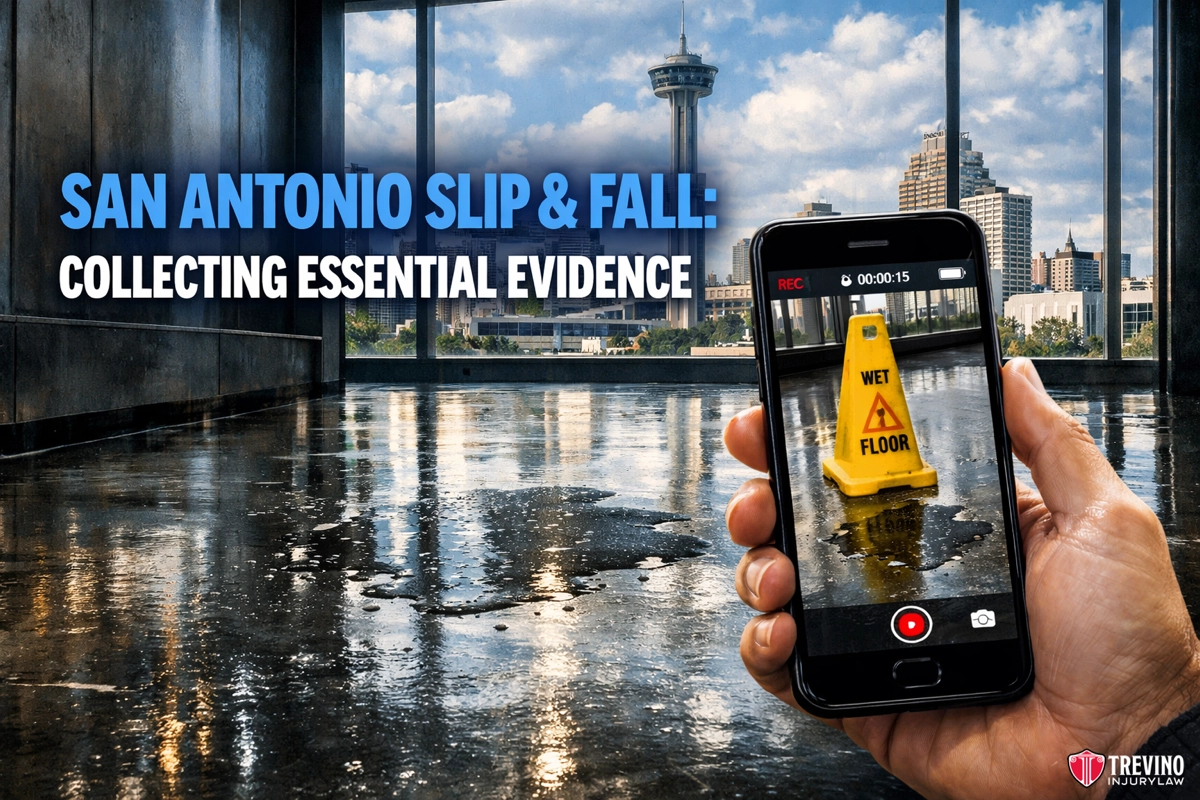
Wide-angle photographs of the hazard. The dirty cart tracks running through the spill. The exact shoes you wore at the time. The names and phone numbers of the fellow shoppers who actually saw you hit the floor. You must secure this physical proof immediately before the store manager mops up the danger.
The risk management team is currently running an auto-overwrite cycle on their commercial DVR systems to permanently delete the footage of your fall. Retailers systematically destroy this digital proof to avoid paying for their negligence. But slip-and-fall liability often comes down to whether the store had enough time to discover the hazard and failed to fix it. According to the U.S. Bureau of Labor Statistics, falls, slips, and trips in the private sector caused nearly 480,000 cases resulting in days away from work in 2024.
What Could Your Slip and Fall Accident Case Be Worth?
Answer a few quick questions about your accident. Takes about 60 seconds.
See What My Case Might Be WorthThe insurance company offered less than $20,000. I ended up with over $1 million. — Jackie Galindo
The surveillance video evidence evaporates in just a few short days. You must legally stop the loop recording cycle before the files are completely overwritten. A Spoliation Letter, a legal demand that prevents the property owner from destroying evidence, must be issued immediately.
Trevino Injury Law slip-and-fall lawyers force the retailer to surrender the sweep logs and lock down the security footage before it disappears. Call 210-TREVINO now for a free case review. You pay nothing unless we win. Se Habla Español.
What Physical Evidence Must Be Documented Before Leaving the Scene?
You must capture visual evidence through wide-angle and close-up photographs of the hazard, the surrounding area, and your own footwear immediately after the slip and fall. Store employees will likely clean the area within minutes to “fix” the defect and erase the proof. Documenting the specific mechanics of the fall is vital because state data indicates that falls on the same level resulting from slipping or tripping account for nearly 30% of fatal fall injury descriptions (Texas DSHS, 2024).
The moments immediately following a fall at North Star Mall or a local grocery aisle are known as the Golden Hour because the evidence to support your claim is fresh and unaltered. Once you leave the scene of the accident, you lose the ability to prove the nature of the hazardous condition that caused the fall.
It is critical to document not just the liquid or defect itself, but also its specific characteristics, such as “dirty” water or dried crusty edges, which can prove the substance was on the floor for a significant period.
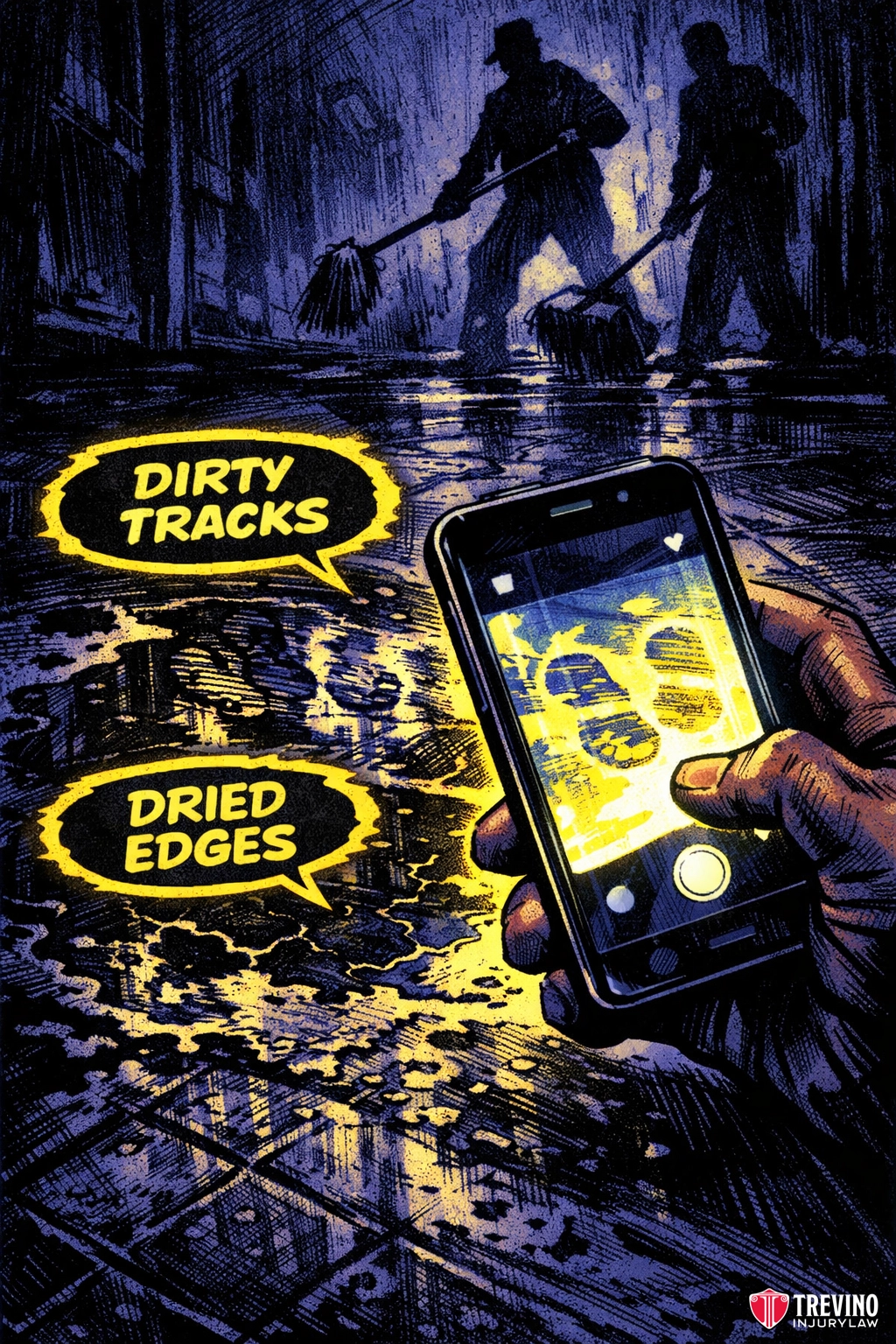
If the water appears clear and clean, the defense will argue it was a fresh spill; however, dirty tracks through a puddle provide strong evidence that the hazard existed long enough for employees to discover it.
How Do You Secure Effective Witness Statements?
Do not rely on the store manager to collect witness information; you must personally obtain the names and phone numbers of fellow shoppers who witnessed the fall or the hazard before the fall. This ensures you have an unbiased account of the accident rather than the store’s curated version of events.
Store managers often filter witness lists to favor the company, purposefully omitting anyone who might support your claim. Fellow customers are far more reliable than employees, who may fear being fired if they testify against their employer. We distinguish between Event Witnesses, who saw you fall, and critical Notice Witnesses, who may have seen the spill 20 minutes earlier but avoided it. These notice witnesses are invaluable to help establish that the store had ample time to clean up the danger but failed to do so.
Why Must You Preserve the Shoes You Wore During the Fall?
Defense attorneys will inevitably argue your footwear was “inappropriate” or “worn out” to assign more than 50% fault to you, so bagging and preserving your shoes prevents this argument and acts as important evidence.
Under the Texas 51% Bar Rule, if a jury finds you more than half responsible for your own injury, you recover zero dollars. Insurance adjusters frequently target flip-flops, high heels, or worn sneakers as the “real” cause of the accident to shift liability away from their premises.
By sealing your shoes in a bag immediately after the slip, before wearing them again, you preserve the tread and physical condition of the footwear as they were at the moment of impact. This kind of evidence allows our team to scientifically disprove claims that your shoes were defective.
We have photos of the puddle and preserved your footwear, but photos don’t talk, so next, we must understand how to navigate the store’s official reporting process without falling into their procedural traps.
What Should You Include in the Store’s Incident Report?
When filling out a Customer Incident Report at a store like Target or Walmart, state only the objective facts of what happened and where the fall occurred, avoiding any speculation about “why” it happened or any admission that you “didn’t see” the hazard.
The incident report is a tool designed for the store’s risk management department, not for your benefit. Managers are trained to ask leading questions that encourage you to admit fault or downplay the extent of your injuries while you are still in shock. Common items to include are:
- The exact time and location of the fall.
- A brief description of what caused you to fall (e.g., “slipped on clear liquid”).
- The names of any employees present.
- Your immediate physical symptoms.
- Debris or foreign objects noticed on the floor.
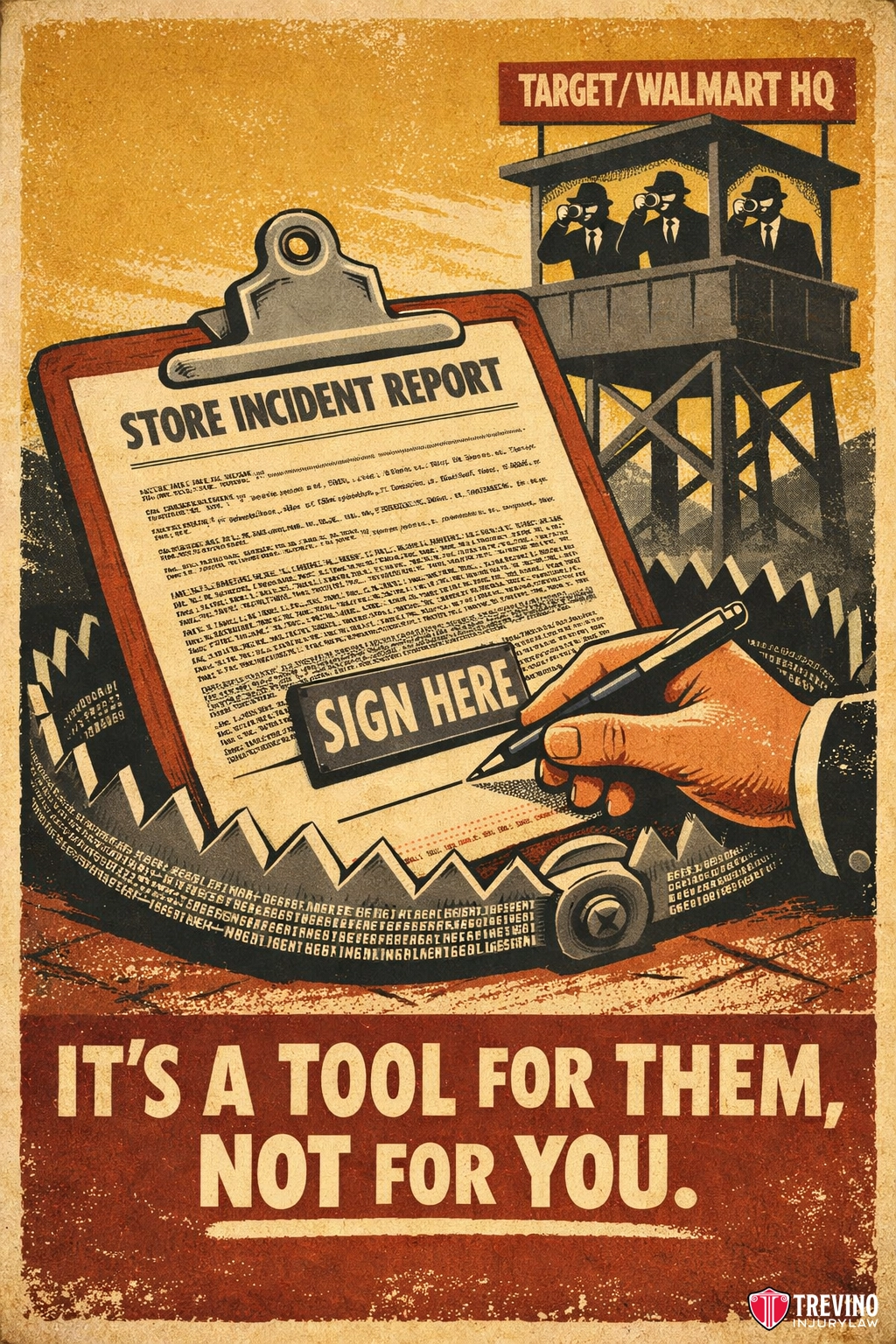
Never guess about the source of the spill or say “I’m fine,” as many slip and fall injuries often manifest hours later.
Should You Sign a Waiver or Medical Release at the Scene?
No, never sign any document other than the basic incident description, as risk managers often bury liability waivers or medical release authorizations within “standard” forms. You should seek medical attention immediately and avoid signing away your legal rights before you understand the full extent of the injuries you sustained.
Signing a medical release allows the insurance company to dig through your entire medical history to find “pre-existing conditions” they can blame for your current pain. Worse, a liability waiver could completely absolve the store of responsibility for a spinal injury or TBI that hasn’t even been diagnosed yet. Politely refuse to sign anything that requires more than your contact information and a brief statement of facts.
What If the Manager Refuses to Give You a Copy of the Report?
It is standard operating procedure for retailers to refuse to provide a copy of the incident report. In this scenario, take a photo of the completed report with your phone before handing it back to the manager. This is crucial evidence.
Stores treat these reports as internal “work product” to hide them from you, but you have a right to the information you just provided. If the manager physically blocks you from taking a photo, do not escalate a confrontation; simply write down the manager’s name and the time the report was filed. Our San Antonio personal injury lawyers will formally subpoena the document during the discovery phase of your lawsuit.
You filed the report, but the store won’t give you a copy, creating an adversarial relationship that requires us to aggressively pursue the video evidence they are likely hiding.
How Soon Must Surveillance Footage Be Requested to Prevent Deletion?
You must formally request surveillance footage as soon as possible, ideally within 24 to 72 hours, as many commercial security systems at places like The Rim or La Cantera are set to auto-overwrite data on a continuous loop. Gathering the right evidence quickly is vital, as local data reveals that falls accounted for 31% of all accidental deaths investigated in the county recently (Bexar County Medical Examiner’s Office, 2023).
Commercial DVR systems operate on a “loop recording” basis, meaning new footage constantly writes over the oldest files. If a preservation request is not received immediately, the video of your fall at a busy shopping center could be overwritten, destroying the right evidence to support your claim.

Once this digital file is gone, it is often impossible to retrieve, leaving you with a “he-said, she-said” argument against a corporate giant.
What Is a Spoliation Letter and Why Is It Critical?
A Spoliation Letter is a formal legal demand sent by your attorney that puts the property owner or manager on notice to preserve specific evidence, making it illegal for them to destroy video, sweep logs, or internal communications.
This is a core mechanism of our Scholar Warrior approach. By sending this letter via certified mail immediately upon our hiring, we trigger a legal duty on the defendant to stop their auto-delete cycles.
If a store destroys video after receiving this notice, we seek a Spoliation Instruction, requiring the jury to presume the missing footage showed negligence. However, securing this instruction is difficult; under Brookshire Bros., Ltd. v. Aldridge, Texas courts generally require proof that the store intentionally concealed evidence or that its loss irreparably prejudiced your case. 438 S.W.3d 9 (Tex. 2014). This makes immediate preservation demands legally vital to prove intent if they later hit ‘delete’.
Can You Demand “Sweep Logs” and Maintenance Records?
Yes, sweep logs are critical evidence you gather because they show whether employees actually inspected the aisle in accordance with company policy (usually every 30-60 minutes) or falsified the records. Proper maintenance is a major safety issue; in the private sector alone, there were nearly 480,000 cases of falls, slips, and trips resulting in days away from work in recent years (U.S. Bureau of Labor Statistics, 2024).
We frequently uncover evidence of “pencil whipping,” where employees fill out safety inspection logs for work they never actually performed. By comparing the timestamps on the security video to the times listed on the sweep log, we can prove your case by establishing fraud. If the log says an employee inspected Aisle 4 at 2:00 PM, but the video shows the aisle was empty from 1:30 PM to 2:30 PM, we can prove the store’s records are a lie and establish their liability.
The store won’t voluntarily hand over the video that proves their negligence, which brings us to the specific legal hurdles of proving they knew about the danger.
How Does This Evidence Prove “Constructive Knowledge”?
In Texas premises liability law, you must prove that the property owner knew or should have known about the hazard; physical evidence like “dried crusty edges” on a spill or “dirty cart tracks” through a puddle proves the defect existed long enough for employees to discover and fix it.
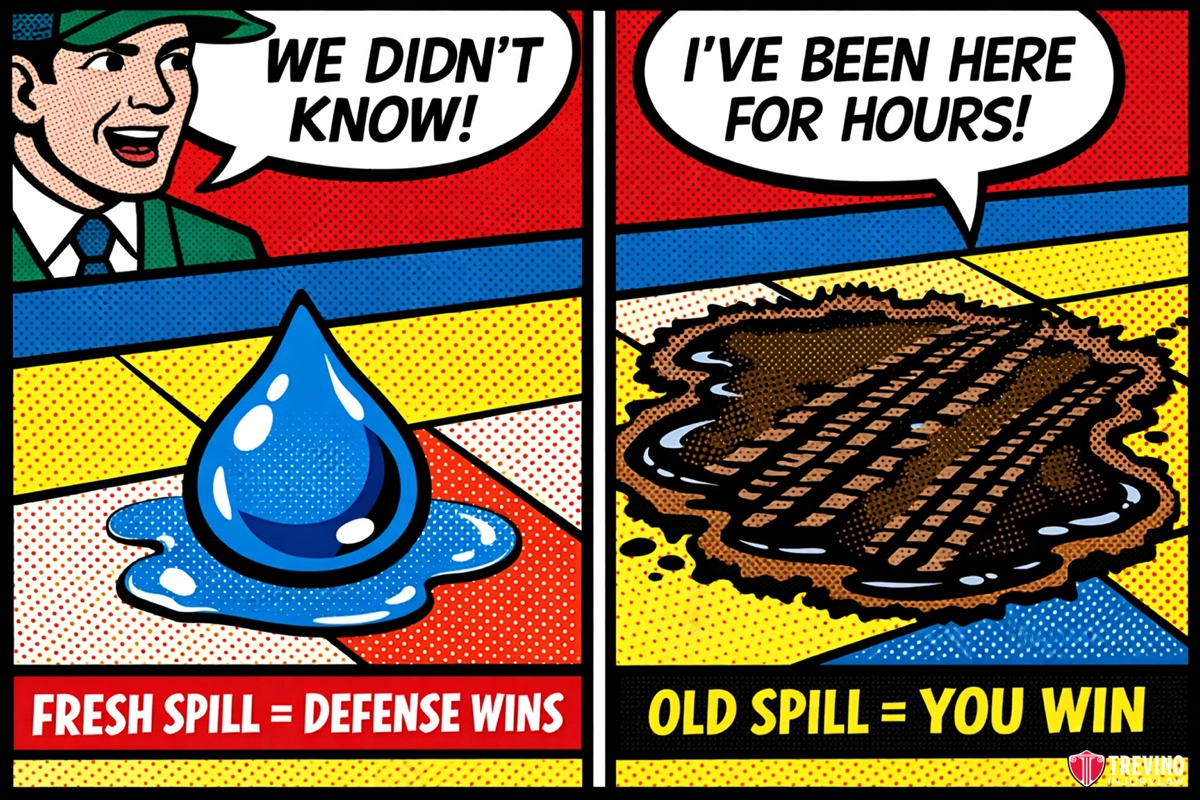
Without this ‘time-element’ evidence, retailers like H-E-B will successfully argue the spill occurred only seconds before your fall. Under the strict Time-Notice Rule established in Wal-Mart Stores, Inc. v. Reece, mere proximity of an employee to a hazard is not enough to prove negligence. You must provide evidence that the condition existed for a sufficient length of time to give the owner a reasonable opportunity to discover and remedy it. 81 S.W.3d 812, 816 (Tex. 2002).
Photographs showing a darkened, sticky residue imply a long-standing spill, whereas clear water might support the store’s defense. By securing witness statements and video footage that confirm the duration of the hazard, our San Antonio slip-and-fall lawyers undermine the store’s “we didn’t know” defense and establish its negligence in court.
We have the liability evidence to prove they were at fault, but to secure actual compensation, we must now connect that negligence directly to the financial cost of your injuries.
What Role Do Medical Records Play in Evidence Collection?
Immediate medical records serve as the irrefutable “causal link” connecting a slip and fall accident to specific treatment needs, preventing insurance adjusters from exploiting a “gap in treatment” to claim injuries are unrelated or exaggerated. Attorneys advise seeking emergency care at facilities like Methodist Hospital or local urgent care immediately; delaying treatment allows the defense to argue the injury occurred elsewhere or is non-severe.
Why Prompt Documentation is Critical:
- Defeating Defense Tactics: Detailed clinical notes documenting pain levels and trauma establish that the store’s negligence directly caused the suffering, blocking attempts to downplay the claim.
- Proving Severity: Robust evidence is essential as premises liability dangers trend upward; Texas DSHS (2024) data reports a sharp increase in fatal falls, rising from 1,060 in 2018 to 1,617 in 2022.
Can I Record Video Inside a Private Store in Texas?
Yes, generally you can record video in public areas of a store (like aisles) where there is no expectation of privacy, to document the hazardous condition.
Does a 911 Call Count as Evidence?
Yes, 911 call logs and recordings are government records that provide an immutable timestamp and often capture immediate descriptions of the scene and injury.
Is a Store Manager’s Apology Admissible as Evidence?
Yes, under the Excited Utterance or Admission by Party-Opponent exceptions to hearsay, a manager saying “I told them to clean that up!” is powerful evidence of actual knowledge.
How Do We Collect Evidence for Falls on Government Property?
Collecting evidence against government entities like VIA Metropolitan Transit or the City of San Antonio mandates establishing “actual notice” to overcome sovereign immunity protections under the Texas Tort Claims Act. Unlike private cases where constructive notice (“should have known”) is sufficient, the burden of proof requires demonstrating that the government explicitly knew of the specific hazard, such as a pothole or wet floor, yet failed to remediate it.
Required Documentation to Prove Actual Notice:
- Prior Maintenance Requests: Internal documents verifying the entity had previously been asked to repair the specific defect.
- 311 Logs: Public records confirming that citizens formally reported the hazard before the injury occurred.
- Bexar County Incident Reports: Historical files proving the government was warned about the danger through previous accidents at the same location.
What If There Are No Witnesses and No Cameras?
If direct evidence is absent, we build a case using “circumstantial evidence,” such as the size of the spill, the temperature of the substance, or the proximity of employees to the hazard. Your claim relies heavily on the evidence of the physics of the scene.
For example, a pool of melted ice cream in a frozen food aisle implies the mess has been there for at least 15 to 20 minutes—long enough for an employee to have addressed it. Our team works with forensic experts to analyze these physical clues, turning the characteristics of the spill itself into a timeline that establishes the property owner’s negligence through scientific deduction rather than eyewitness testimony.
What Common Mistakes Destroy Slip and Fall Evidence?
The most damaging mistake is washing the clothes you wore during the fall, which washes away the substance residue (grease/oil) that serves as chemical evidence of what caused the slip.
Beyond destroying physical evidence on your clothing, victims often damage their own claims by posting photos on social media that contradict their injuries or by giving recorded statements to insurance adjusters without an attorney present. Adjusters are trained to manipulate your words to make it sound like you weren’t paying attention. Silence is your best protection until you have legal representation to manage the flow of evidence to strengthen your case.
Why Hire a San Antonio Slip and Fall Lawyer?
While you deal with pain and medical bills, the store is waiting for the “Golden Hour” to pass so that video evidence is automatically deleted. Don’t let them erase the proof of your injury. With over 47,000 unintentional fall deaths reported nationally in a single year, these are life-altering events that require immediate legal protection (CDC, 2023).
Want to Protect the Full Value of Your Claim?
You’ve seen how this affects your case — but this is only one piece of the puzzle. Our Slip and Fall Lawyer page breaks down what a trial-ready firm does differently.
We proved this at the Bexar County Courthouse with a $536,007 jury verdict after a $5,000 defense offer. To build this leverage, your Bexar County injury attorney immediately issues a spoliation letter to lock down surveillance footage before the store destroys it.
Evidence disappears fast. Call 210-TREVINO today to speak with a Texas personal injury lawyer who can help you secure the compensation you deserve. Se Habla Español.