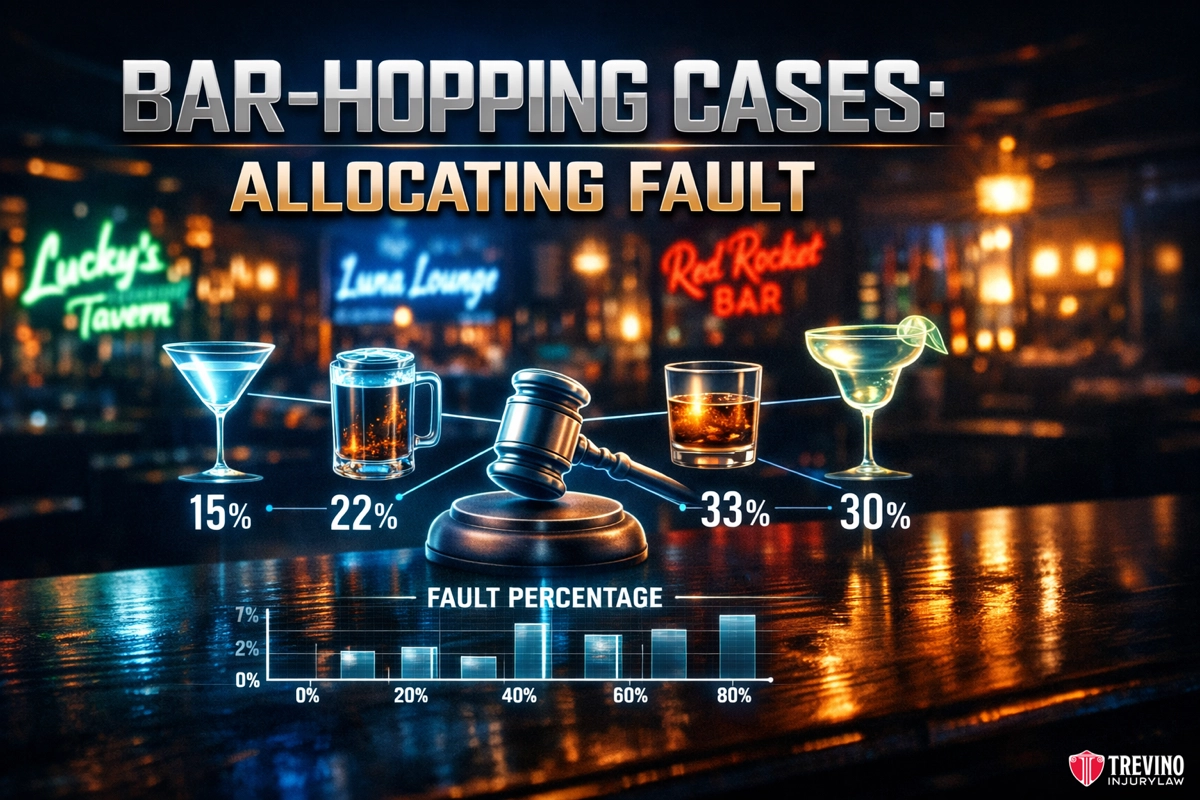
A drunk driver shatters your life after a night of bar-hopping across San Antonio, leaving you with catastrophic injuries, while the venues that overserved them point fingers at each other.
The Insurance Adjusters representing these establishments are already deploying blame-shifting tactics, claiming the driver was sober when leaving their specific facility to escape liability.
But compensation in a dram shop lawsuit often depends on proving which establishment contributed to the driver’s visible intoxication before the bars can shift blame to each other. Trevino Injury Law relies on its history of aggressive courtroom advocacy, including a $17 Million settlement in a wrongful death case, to force negligent companies to pay full value for the destruction they cause.
What Could Your Dram Shop Accident Case Be Worth?
Answer a few quick questions about your accident. Takes about 60 seconds.
See What My Case Might Be WorthThe insurance company offered less than $20,000. I ended up with over $1 million. — Jackie Galindo
Evidence disappears in the first week. You must send a Spoliation Letter, a legal demand that stops the property owner from destroying proof, before surveillance footage gets recorded over and digital receipts vanish. Texas gives you two years to file suit, but the forensic trail disappears in days.
Trevino Injury Law dram shop attorneys team will lock down the forensic timeline immediately to protect your claim. Call 210-TREVINO now for a free case review. You pay nothing unless we win. Se Habla Español.
How does Texas law allocate fault among multiple bars?
Under the Texas Dram Shop Act and the doctrine of comparative negligence, a jury must determine the percentage of responsibility for the driver and every bar that served them while they were obviously intoxicated. This allocation is mandated by Civil Practice & Remedies Code Sec. 33.003(a), which requires the trier of fact to assign a percentage of fault to each claimant, defendant, and even settling persons or alcohol providers.
Those percentages feed directly into how compensation is calculated in a Texas dram shop lawsuit, because the allocation of responsibility can affect the amount ultimately recoverable.
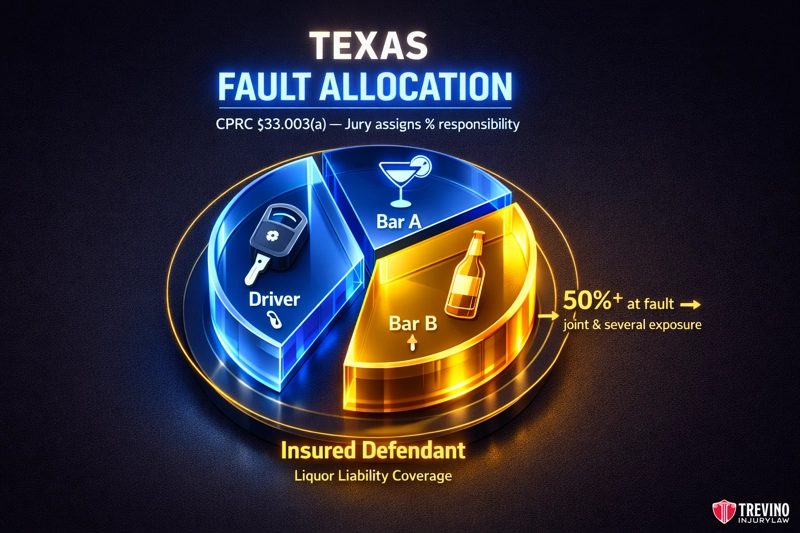
In Bexar County courts, defendants are often jointly and severally liable if they are found more than 50% at fault, allowing victims to collect the full judgment from a single deep-pocketed entity if others lack insurance.
What is “Joint and Several Liability” in a bar-hopping case?
Joint and several liability is a critical tool for victims when one establishment is ‘judgment-proof’ or lacks adequate insurance to cover the consequences of their negligence. This doctrine, anchored in Chapter 33 of the Texas Civil Practice and Remedies Code, allows a plaintiff to collect 100% of a judgment from a defendant found to be more than 50% responsible.
Under Texas law, fault in a bar-hopping dram shop case is allocated among the intoxicated driver and each negligent alcohol provider. In F.F.P. Operating Partners, L.P. v. Duenez, 237 S.W.3d 680 (Tex. 2007), the Texas Supreme Court confirmed that Texas proportionate-responsibility principles apply in dram shop litigation. And under Tex. Civ. Prac. & Rem. Code § 33.013, a defendant found more than 50% responsible may be held jointly and severally liable for the full recoverable damages.
This ‘50% rule’ ensures that the primary negligent party bears the financial risk of insolvent co-defendants. This principle is vital in bar-hopping scenarios because it ensures that if one venue is underinsured or “judgment-proof,” the primary negligent party can be held accountable for the entire multi-million dollar settlement resulting from a serious injury or fatality.
- Total Recovery: You can collect 100% of the compensation from a defendant found majority at fault.
- Protection for Victims: It shifts the financial risk of an insolvent defendant away from the injured person and onto the other negligent bars.
- Burden Sharing: The defendant who pays the full amount can later seek “contribution” from the other bars involved.
How do you prove multiple bars are liable for the same crash?
We utilize timeline reconstruction to map every drink served across multiple venues, from a restaurant in Stone Oak to a late-night club on Austin Highway, to establish exactly when and where the over-service occurred.
To overcome the Provider Liability Standard, we must prove that the alcohol service was provided to a patron who was already “obviously intoxicated” to the point of being a clear danger.
This forensic process requires identifying the “tipping point” where the patron transitioned from sober to visibly intoxicated, proving that subsequent servers ignored visible signs of impairment.
What evidence is needed to link multiple bars to a single injury?
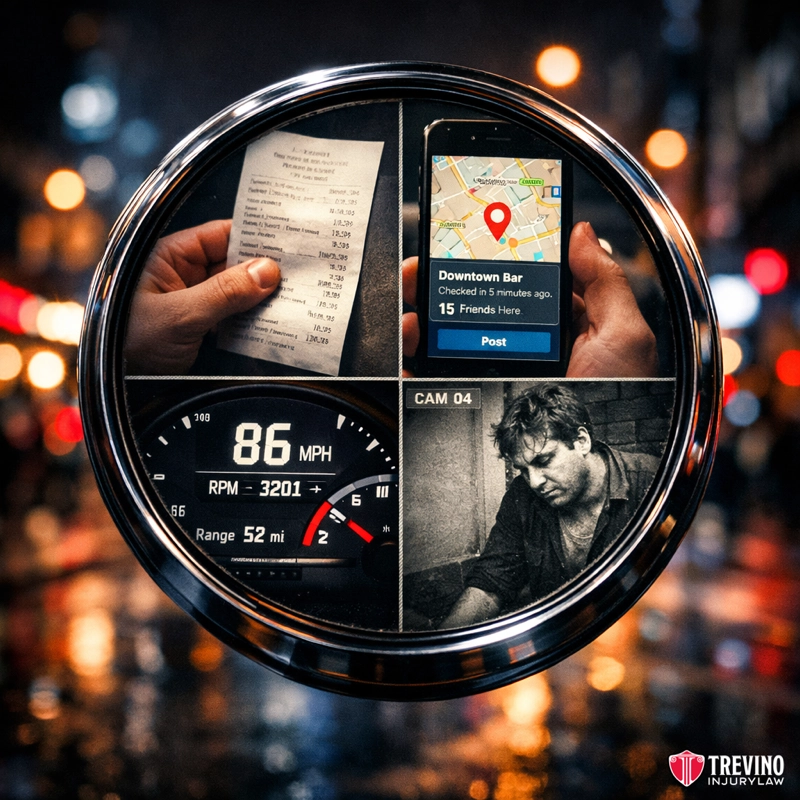
To successfully link multiple establishments to a single crash, we must gather specific forensic evidence that provides an unbroken chain of the driver’s consumption throughout the night. Our San Antonio personal injury lawyer team moves immediately to secure testimony and data including:
- Itemized Receipts: Digital bar tabs show the exact volume and frequency of alcohol served at each stop.
- EDR (Black Box): Vehicle ignition data can prove the precise time the driver spent at each location before they lost control of the vehicle.
- Social Media Geofencing: Photos, “check-ins,” and time-stamped posts help verify the driver’s presence and condition.
- Surveillance Footage: Video from venues in districts like Southtown or the Medical Center can show the driver stumbling, displaying glassy eyes, or acting impaired.
Is the last bar visited always the most responsible?
No, while the last bar often provides the “final” drinks before a crash, a previous venue may carry more weight if they provided a higher volume of alcohol (e.g., “10 shots in 60 minutes”) to a patron who was already stumbling.
Insurance Adjusters for the final bar will often argue the patron was already “dangerously drunk” upon arrival, attempting to shift 100% of the blame back to the first bar in the sequence.
How do expert toxicologists calculate intoxication levels at each stop?
Expert toxicologists use a scientific method called Retrograde Extrapolation to work backward from a blood-alcohol concentration (BAC) test taken after the crash to determine the driver’s impairment at each previous bar.
- Standard Rates: Experts apply standard elimination rates (typically .015 to .020 per hour) to the driver’s peak BAC.
- Contemporaneous Estimates: They calculate approximately the number of drinks in the system at Culebra Road versus when they arrived at a bar on Bandera Road.
- Jury Presentation: This toxicology data transforms complex biology into a visual timeline that helps Bexar County juries understand the negligence of each establishment.
Can you sue multiple bars for a single drunk driving accident?
Yes, you can sue every commercial establishment that served the driver while they were obviously intoxicated, provided their service was a proximate cause of the crash and subsequent injuries.
Trevino Injury Law targets the entire “chain of negligence” to ensure the $17 Million settlement levels of compensation required for catastrophic injuries like traumatic brain injuries or wrongful death are fully accessible to your family. It is critical to act quickly, as the Statute of Limitations requires a personal injury suit to be filed no later than two years after the accident occurs.

By naming every negligent venue in areas like Alamo Heights or Terrell Hills, we maximize the available insurance coverage and prevent individual bars from hiding behind the actions of others.
Can I sue three different bars for one accident?
Yes, you can sue three or more bars, including restaurants or even liquor stores if applicable, if you can prove each one violated the Texas Dram Shop Act by serving the driver while they were obviously intoxicated.
Do bars have enough insurance to cover a multi-bar lawsuit?
Yes, most commercial venues carry liquor liability insurance, and suing multiple bars often provides access to multiple policies to cover multi-million dollar verdicts.
How does the “Safe Harbor” defense work for multiple defendants?
Establishments in areas like Live Oak or Universal City often attempt to use the ‘Safe Harbor’ provision as an absolute shield. However, as established in 20801, Inc. v. Parker, the burden is on the bar to prove it did not ‘directly or indirectly’ encourage over-service. At Trevino Injury Law, we pierce this defense by uncovering evidence that management prioritized profits over responsible service of alcohol through ‘speed-drinking’ contests or high-volume quotas. We look for proof that serving patrons safely was secondary to sales.
What happens if one bar settles before the others?
When one bar enters into a settlement agreement before a trial, the remaining defendants are typically entitled to “settlement credits,” which reduce the final judgment by the amount already paid by the settling party.
As a Trial Authority, we ensure that under CPRC Sec. 33.015, payment responsibility is allocated in proportion to each defendant’s respective percentage of fault. This strategic approach prevents the remaining insurance companies from using a prior settlement as a way to escape their own financial responsibility for your injuries.
What if the driver started drinking at a private home?
If a driver began their night consuming alcohol at a private residence before visiting commercial venues, there is generally an absence of commercial liability for that first stop under the “Social Host” limitations of Texas law.
This is because Chapter 2 of the Alcoholic Beverage Code specifically states it does not impose liability on adults 18 or older for damages they suffer due to their own intoxication. This shifts the entire legal focus onto the first licensed establishment in the sequence, such as a tavern in Shavano Park, that served the patron after they reached the point of intoxication.
However, exceptions may exist if an adult provides alcohol to a minor who is not their child.
Why Hire a San Antonio Dram Shop Lawyer?
Evidence in bar-hopping cases, such as surveillance footage from St. Mary’s Strip or The Pearl, is often overwritten within days, and Insurance Adjusters will use that lost evidence to shift blame away from the bar that served your attacker. If you are reeling from a catastrophic crash caused by a driver who was over-served at multiple establishments, you cannot afford to let the insurance companies control the narrative of the timeline.
Want to Protect the Full Value of Your Claim?
You’ve seen how this affects your case — but this is only one piece of the puzzle. Our Dram Shop Lawyer page breaks down what a trial-ready firm does differently.
You need the best personal injury attorney to send spoliation letters and preserve forensic timeline data before it vanishes.
Do not wait for the video to be deleted or the receipts to disappear—hire a plaintiff trial lawyer who knows the insurance playbook and will force them to pay the full value of your claim.
Call 210-TREVINO today to preserve the evidence that proves your case. Se Habla Español.