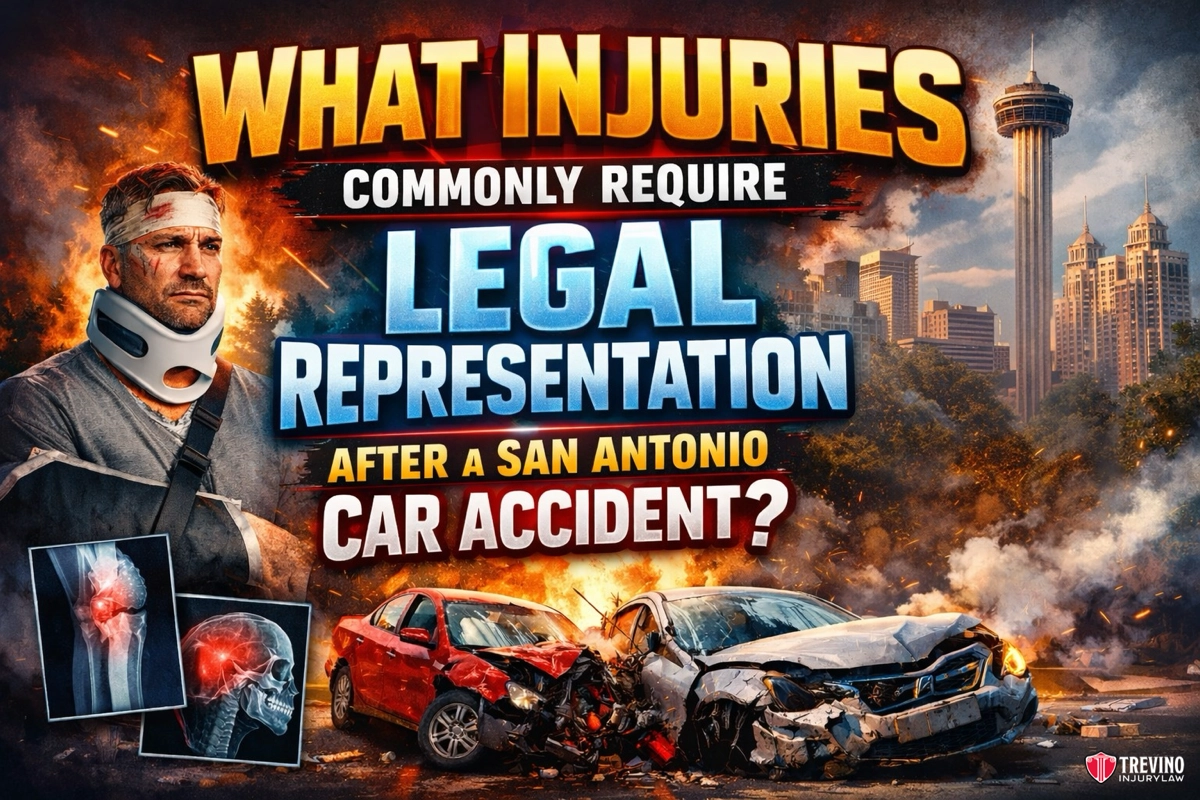
Proving medical causation for delayed crash injuries requires objective diagnostic imaging, not subjective complaints of pain. Adrenaline masks trauma like herniated discs and internal bleeding for days after a collision on Culebra Road. You feel fine at the scene, but the structural damage is done.
The insurance adjuster weaponizes this biological masking effect. They label any delay in seeking care a “causation break,” hiring defense doctors to argue that your discomfort stems from a pre-existing condition rather than from their driver’s negligence. According to TxDOT, San Antonio recorded 9,017 “possible injuries” in 2024, representing collisions where visible damage was absent but the physical pain was real.
You must defeat independent medical examinations with a timestamped clinical record. A Spoliation Letter, a legal demand that stops the negligent party from destroying proof, must be filed while you undergo an MRI. If you wait more than three days to seek emergency evaluation, the carrier can sever the liability link.
Trevino Injury Law’s car accident lawyers segregate acute trauma from degenerative findings and lock the evidence down. Call 210-TREVINO now for a free case review. You pay nothing unless we win. Se Habla Español.
What Could Your Car Accident Case Be Worth?
Answer a few quick questions about your accident. Takes about 60 seconds.
See What My Case Might Be WorthThe insurance company offered less than $20,000. I ended up with over $1 million. — Jackie Galindo
Trevino Injury Law, San Antonio car accident lawyers, documents your injuries, connects them to the crash, and fights back when the insurer blames a pre-existing condition. Call 210-TREVINO now for a free case review. You pay nothing unless we win. Se Habla Español.
What Qualifies as a “Serious” Injury for a Lawsuit in Texas?
In Texas law, a ‘serious’ injury is defined by ‘medical necessity’ and objective severity, distinguishing it from general road trauma. In 2024, while San Antonio saw over 8,000 ‘suspected minor’ injuries, only 686 ‘suspected serious injuries’ were officially reported by TxDOT.
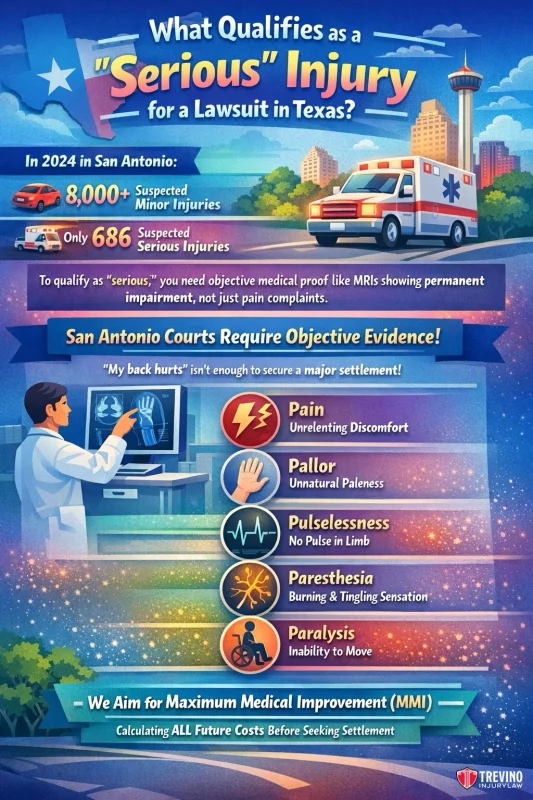
To place your claim in this higher-value category, you must provide objective diagnostics, like MRIs proving permanent impairment, rather than relying on subjective complaints of pain.
In San Antonio courts, subjective complaints like “my back hurts” rarely secure significant settlements without objective corroboration from medical professionals who can verify that the trauma meets the legal threshold for compensation beyond basic emergency room bills.
To evaluate whether an injury meets this threshold, attorneys and medical experts often look for specific clinical signs, sometimes referred to as the 5 P’s of injury: Pain (unrelenting discomfort), Pallor (unnatural paleness indicating blood flow loss), Pulselessness (lack of a pulse in the injured limb), Paresthesia (burning or tingling sensations), and Paralysis (inability to move).
These indicators help distinguish a temporary bruise from a significant neurovascular event that requires long-term litigation. We focus on reaching maximum medical improvement (MMI) to ensure we account for all future costs before we seek a settlement.
Why Do “Soft Tissue” Injuries Often Require More Legal Fight?
Soft tissue injuries like whiplash, sprains, or tendonitis are aggressively challenged by insurers as “minor” or “pre-existing,” requiring an attorney to prove the specific mechanism of injury and its functional impact on your daily life through consistent medical records.
Insurance adjusters aggressively fight soft-tissue claims because they account for the bulk of their exposure. In 2024 alone, TxDOT recorded 9,017 ‘Possible Injuries’ in San Antonio, cases where visible wounds might be absent, but pain is real.
Because these ‘invisible’ injuries are so common, carriers like State Farm or Allstate frequently use the ‘low impact, no injury’ defense to dismiss them, arguing that if your bumper wasn’t crushed, your body couldn’t be either.
To overcome this, we must build a wall of evidence by documenting your limitations in physical therapy logs day by day. While a broken bone is visible on an X-ray, a torn ligament or strained neck requires narrative reports from your treating doctor to prove existence and severity. Without this specialized documentation, “invisible” injuries are often dismissed, leaving victims in Stone Oak or Helotes to pay for their own therapy.
While understanding the medical definition of a serious injury is the first step, the biggest threat to your claim is often the dangerous time gap between the crash and when you actually feel the pain.
What Are Delayed Symptoms After a Car Accident?
Delayed symptoms are injuries like whiplash, internal bleeding, or concussions that do not present pain immediately due to the body’s adrenaline response, often appearing 24 to 72 hours or even longer after the crash occurs.
This biological “masking” effect is extremely common in high-stress collisions on fast-moving roads like I-10 or I-35, where your body’s “fight or flight” mechanism floods your system with endorphins that temporarily block pain signals.
Because of this delay, you must watch for specific warning signs in the days after the accident. Symptoms to watch for include persistent headaches (potentially indicating a Traumatic Brain Injury), abdominal pain or bruising (signs of “seatbelt syndrome” or internal bleeding), and numbness or tingling in the extremities (often signaling a herniated disc).
Telling a police officer “I’m fine” at the scene is a common mistake, but it is not fatal to your case if you seek a full medical evaluation at a facility like University Hospital or a Baptist Emergency Hospital as soon as these symptoms emerge.
Why Does Back Pain Show Up Days After a Rear-End Collision?
Back and neck pain often appears hours or days after a rear-end collision. The sudden back-and-forth motion strains muscles, ligaments, and discs, and inflammation builds over time. Adrenaline after a crash can also mask pain at the scene.
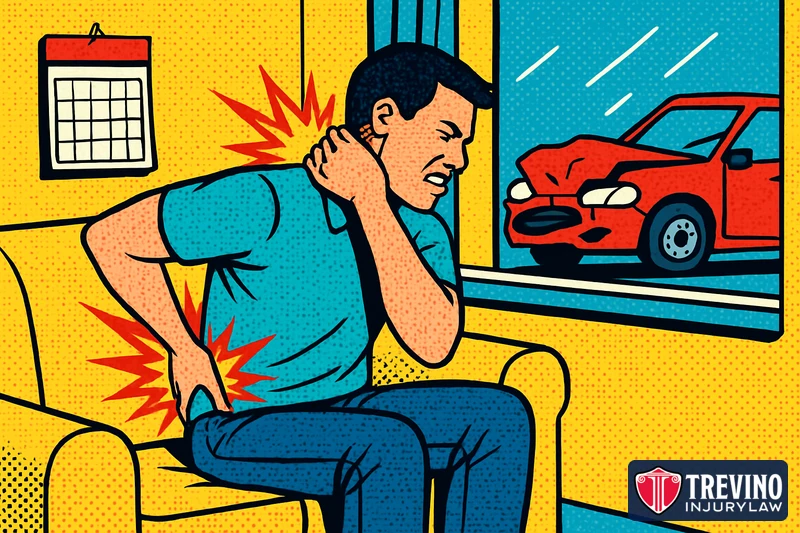
How long the pain lasts depends on the injury. Strains may improve within weeks, while disc or nerve injuries can cause pain for months or longer. Seeing a doctor promptly and following the treatment plan creates the record that ties your pain to the crash.
How Does a “Gap in Treatment” Hurt Your Claim?
A “gap in treatment” occurs when you wait days or weeks to see a doctor after symptoms appear, allowing the insurance adjuster to successfully argue that your injury was caused by an intervening event, like a workout or work incident, rather than the car accident.
This is the single most common reason valid injury claims are denied in Texas; the insurer uses the calendar against you to break the causal link between the crash and your medical condition.
To protect your rights, you must follow the “72-hour rule” whenever possible. Visiting an urgent care in Alamo Heights or your primary care physician within three days of the accident creates a timestamped medical record that “stops the clock” on this defense. If you wait two weeks to see a doctor because you were “hoping it would go away,” you hand the insurance company a powerful weapon to deny payment for your treatment.
Once you have secured your claim by seeking timely treatment, the focus shifts to the quality of your medical evidence and how specific diagnostic tests can dramatically increase the financial value of your case.
Why Can’t I Remember the Car Accident?
Not remembering the crash, or the minutes before or after it, can be a sign of a concussion or other traumatic brain injury (TBI). Doctors call this gap post-traumatic amnesia. It may cover events before the impact (retrograde amnesia) or trouble forming new memories afterward (anterograde amnesia). Memory loss is a symptom to report to a doctor right away, not something to wait out.
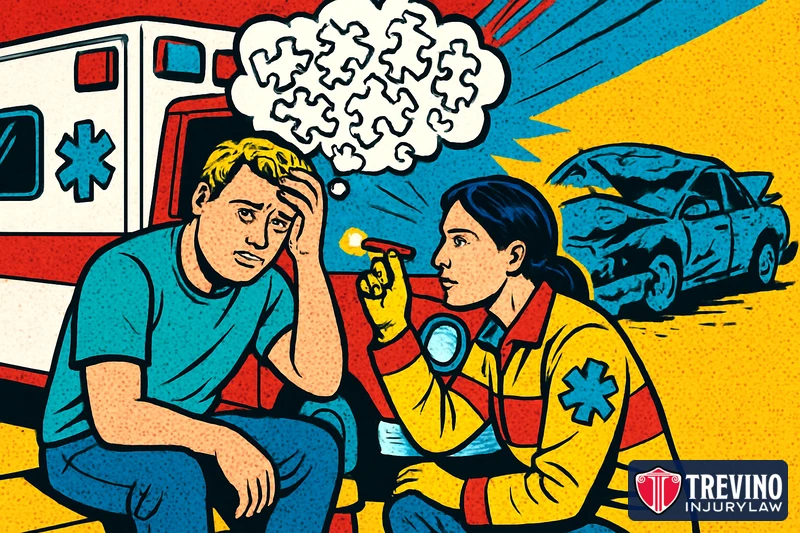
Memory loss also creates a legal problem: you cannot tell the insurance adjuster what happened, and the other driver may fill in the gap with their own version. When you cannot remember the crash, the case is built from other evidence:
- Medical records: An ER note documenting confusion or amnesia, and any CT or MRI findings, tie the memory loss to the crash.
- The crash report: The Texas Peace Officer’s Crash Report records the officer’s observations, witness names, and contributing factors.
- Video and vehicle data: Dashcam, traffic camera, and business surveillance footage, plus event data recorder downloads, can show speed and impact without your testimony.
- Witnesses: Other drivers, passengers, and first responders can describe what you cannot.
Do not guess or fill in details when talking to an insurance company. Saying “I don’t remember” is accurate, and a guess that later conflicts with the evidence can be used to challenge your credibility.
Does an MRI or Surgery Increase Settlement Value?
Yes, objective diagnostic testing, such as an MRI, can significantly increase settlement potential by providing irrefutable visual proof of internal damage that X-rays miss, forcing insurers to move beyond “subjective” pain evaluations and reserve higher amounts for your claim. To see how that evidence fits into the broader damages analysis, review how Texas car accident compensation is calculated and paid.
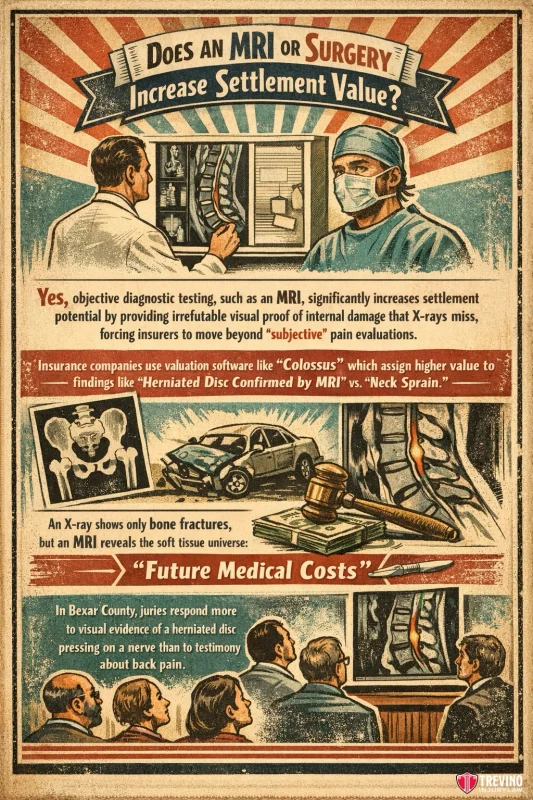
Insurance companies often use valuation software like “Colossus” to calculate settlement offers, and these programs assign specific value multipliers to objective findings, such as “herniated disc confirmed by MRI,” versus subjective codes, such as “neck sprain.”
An X-ray is limited to bone fractures, but an MRI reveals the soft tissue universe, ligaments, tendons, and discs, where most permanent car accident injuries live. When a surgeon reviews these images and recommends a procedure, even if you do not have the surgery immediately, the “future medical cost” of that recommendation is added to your claim’s value.
In Bexar County, juries respond far more to visual evidence of a herniated disc pressing on a nerve than they do to verbal testimony about back pain, making these diagnostics a critical investment in your case’s outcome.
How Does a Herniated Disc Affect a Car Accident Settlement?
A herniated disc usually raises a claim’s value because it shows up on an MRI and often leads to longer treatment. The injury happens when the soft center of a spinal disc pushes through its outer layer and presses on nearby nerves, causing pain, numbness, or weakness in the neck, back, arms, or legs.
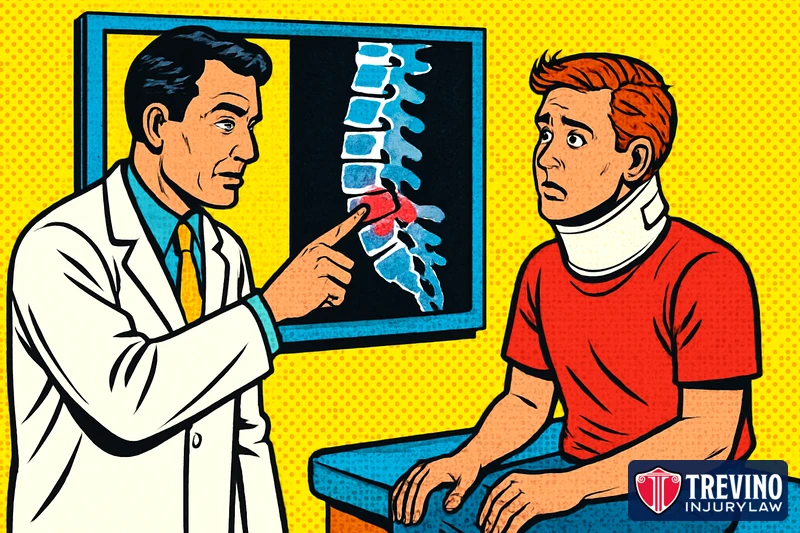
Treatment typically moves in steps: physical therapy, then pain-management injections, and surgery such as a discectomy or fusion when conservative care fails. Each step adds medical cost and documents how serious the injury is.
Insurers often argue that a herniated disc is age-related wear rather than crash damage. Texas law allows recovery when a crash aggravates a pre-existing condition, so comparing earlier imaging and records with post-crash findings becomes the central proof of your car accident compensation.
How Much Compensation Can You Get for Anxiety or PTSD?
Compensation for anxiety or PTSD in Texas typically requires a specific diagnosis from a licensed mental health professional and proof that the trauma has “substantially disrupted” your daily routine or ability to drive.
While general “nervousness” is not compensable, clinical Post-Traumatic Stress Disorder (PTSD) that requires therapy or medication is a valid damage model, especially in severe crashes involving rollovers or fatalities.
To recover these damages, we often pursue bystander claims if you witnessed a family member being injured in the same crash, or mental anguish claims if the accident has left you unable to drive on busy highways like Loop 1604 without panic attacks.
Documenting this requires consistency; a one-time visit to a counselor is rarely enough to prove long-term mental anguish to a skeptical insurance adjuster.
Do Pre-Existing Conditions Disqualify Your Injury Claim?
No, you are protected by the ‘Eggshell Skull’ doctrine. Texas law holds that a negligent driver takes their victim as they find them, meaning the driver is liable for any aggravation of a pre-existing condition.
As affirmed in cases like Coates v. Whittington, a defendant cannot escape responsibility simply because they were more susceptible to injury than the average person. 758 S.W.2d 749 (Tex. 1988). If the crash turned a manageable, dormant back issue into a debilitating injury, you are entitled to compensation for that increased impairment.
However, distinguishing between “degenerative” findings (aging) and “acute” trauma (the crash) is difficult. We work with medical experts to segregate these damages, showing exactly how the collision accelerated your condition or brought it out of remission.
This prevents the insurance company from dismissing your pain as “just getting older” and ensures you are paid for the change in your quality of life.
While objective testing and legal doctrines protect your claim’s value, they all rely on your ability to prove one central, difficult concept: that the accident, and nothing else, caused your injury.
Why Is “Medical Causation” the Hardest Part of an Injury Case?
Proving ‘medical causation’ is the most challenging hurdle in complex injury cases. Under the Texas Supreme Court’s ruling in Guevara v. Ferrer, lay testimony alone is insufficient to prove causation for injuries that are not immediately obvious, such as herniated discs or soft tissue trauma. 247 S.W.3d 662 (Tex. 2007).
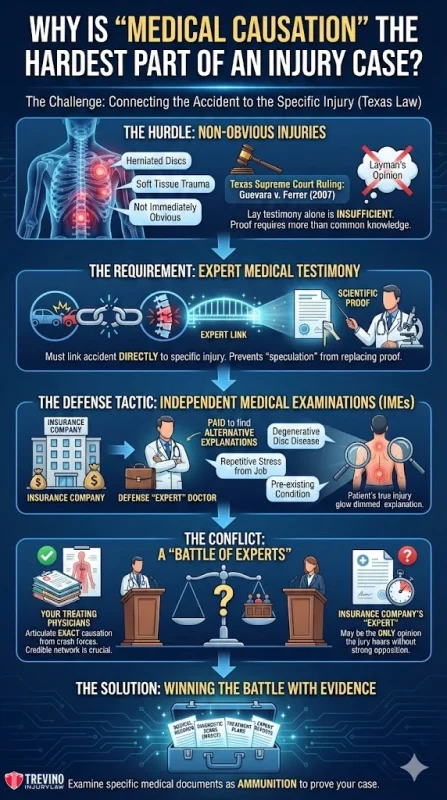
This landmark decision established that for conditions outside the common knowledge of a jury, you must present expert medical testimony to link the accident directly to your specific injury, ensuring that ‘speculation’ does not replace scientific proof.
In the Southtown and Medical Center areas, where we litigate many cases, insurance companies often hire their own doctors to perform Independent Medical Examinations (IMEs). These doctors are paid to find alternative explanations for your pain, such as “degenerative disc disease” or “repetitive stress” from your job.
This transforms your claim from a simple reimbursement request into a “battle of experts.” Without a credible network of treating physicians who can articulate exactly how the forces of the crash caused your specific injury, the insurance company’s “expert” opinion may be the only one the jury hears.
With the legal challenge of causation understood, we must next examine the specific medical documents that serve as the ammunition for winning this battle.
What Specific Medical Documentation Do You Need?
To substantiate your injury claim, you must gather a “clean” chain of records, including the initial ER intake forms, radiology reports (MRI/CT), and narrative letters from treating specialists that explicitly connect the trauma to the crash.
While simple medical bills show what you paid, they do not prove why the treatment was necessary, which is why your attorney focuses on securing the “operative reports” and “SOAP notes” (Subjective, Objective, Assessment, Plan) that detail your daily pain levels and functional limitations.
A critical piece of evidence often overlooked is the Texas Peace Officer’s Crash Report (Form CR-3), which establishes the mechanism of injury, such as “intrusion” or “rollover,” that matches your medical findings.
We often contrast these clinical records with your personal “pain journal,” but legally, the objective notes from a specialist in Leon Valley or Live Oak carry far more weight in court than your own handwritten diary.
Can I Claim for Injuries If I Didn’t Take an Ambulance?
Yes, taking an ambulance is not required for a claim, as long as you seek medical attention on your own within a reasonable timeframe (typically 24-72 hours) to document the injury.
Will My Health Insurance Pay for Car Accident Injuries?
Yes, your private health insurance will pay for immediate treatment, but they will likely place a ‘subrogation lien’ on your final settlement to be reimbursed for those payments once you recover damages. This financial complexity is often overwhelming for accident victims who are already managing a difficult recovery.
Relying solely on health insurance can complicate your insurance claim, as carriers may demand full repayment from your settlement funds. Without proper legal assistance, these liens can drain the compensation you deserve, leaving few resources to cover your pain and suffering.
If you were injured in a car accident, consulting a personal injury attorney is critical to ensure these liens are negotiated downward and to maximize the money that stays in your pocket.
Can I Switch Doctors If I Don’t Like My Treatment?
Yes, your private health insurance will pay for immediate treatment, but they will likely place a ‘subrogation lien’ on your final settlement to be reimbursed for those payments once you recover damages. This financial complexity is often overwhelming for accident victims who are already managing a difficult recovery.
Relying solely on health insurance can complicate your insurance claim, as carriers may demand full repayment from your settlement funds. Without proper legal assistance, these liens can drain the compensation you deserve, leaving few resources to cover your pain and suffering.
If you were injured in a car accident, consulting a personal injury attorney is critical to ensure these liens are negotiated downward and to maximize the money that stays in your pocket.
Whiplash vs. TBI: Comparing Settlement Timelines
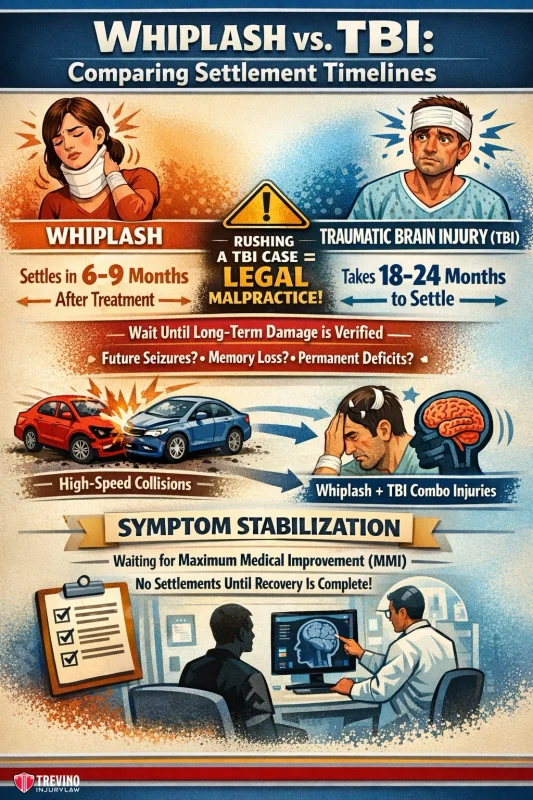
While soft tissue claims like whiplash may settle in 6 to 9 months once treatment concludes, Traumatic Brain Injury (TBI) cases often require 18 to 24 months because neurologists must verify that cognitive deficits are permanent before a demand can be made.
Settling a serious neuro-cognitive case too early is essentially legal malpractice; if you accept a check before you know whether you will suffer from future seizures or memory loss, you lose the right to ask for more money when those symptoms destroy your ability to work years down the road.
For residents commuting from Fair Oaks Ranch or Boerne, high-speed impacts often result in complex combinations of these injuries. In these scenarios, the “symptom stabilization” phase sets the timeline; we cannot negotiate with the insurance company until we reach “Maximum Medical Improvement” (MMI) for the slowest-healing injury, to ensure that no future medical needs are left unpaid.
Car Accident Injuries: Quick Answers
What Happens If You Don’t Seek Immediate Medical Attention?
If you fail to seek medical attention within the first week of the accident, insurance adjusters will almost universally deny your claim. Car accident victims often underestimate their trauma, not realizing that a serious injury may lie dormant for days due to adrenaline.
Whether you were in a massive collision or a standard vehicle accident, the injuries sustained must be documented immediately to prove causality.
Without immediate records, adjusters will argue that your injuries due to another driver’s negligence are actually unrelated, claiming the accident may have been a minor factor compared to a subsequent ‘weekend injury.’
Because car accidents can cause deceptive symptoms that evolve over time, you must seek professional care after injuries to protect your claim. This prevents the ‘causation break‘ that allows the defense to dismiss your pain.
When Is It Too Late to Add an Injury to Your Claim?
It is generally too late to add a new injury to your claim once you have signed a “Release of Liability” settlement form, which permanently closes your case regardless of what future symptoms arise. Insurance adjusters push for “quick check” settlements in the first weeks, specifically to trap you in this release before chronic issues like herniated discs or nerve damage are fully diagnosed.
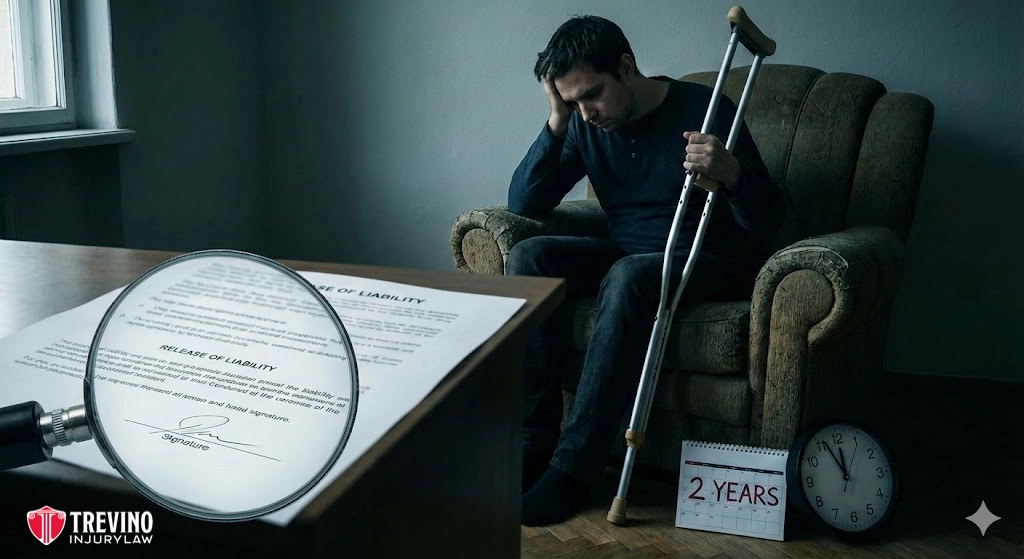
While the Texas statute of limitations gives you two years to file a lawsuit, the release form is an absolute bar to recovery; once signed, you cannot reopen the case, even if you require surgery next month.
Why Hire a San Antonio Car Accident Lawyer?
Do not let a dangerous adrenaline gap or an adjuster’s “quick check” after a crash on Loop 410 erase your right to fair financial compensation. Insurance giants and high-volume settlement mills want you to fold before your permanent injuries are fully diagnosed. Trevino Injury Law fights for victims and holds the responsible parties accountable for their long-term physical damage. We prepare every case for a Bexar County jury, and we secured a $17 million settlement in a head-on collision case involving three fatalities. Prior results do not guarantee a similar outcome.
Want to Protect the Full Value of Your Claim?
You’ve seen how this affects your case — but this is only one piece of the puzzle. Our Car Accident Lawyer page breaks down what a trial-ready firm does differently.
We aggressively preserve medical records and retain a San Antonio personal injury crash lawyer to secure objective diagnostic evidence that maximizes your recovery.
Call 210-TREVINO for a free case review. We operate on a strict no-win, no-fee basis. Se Habla Español.