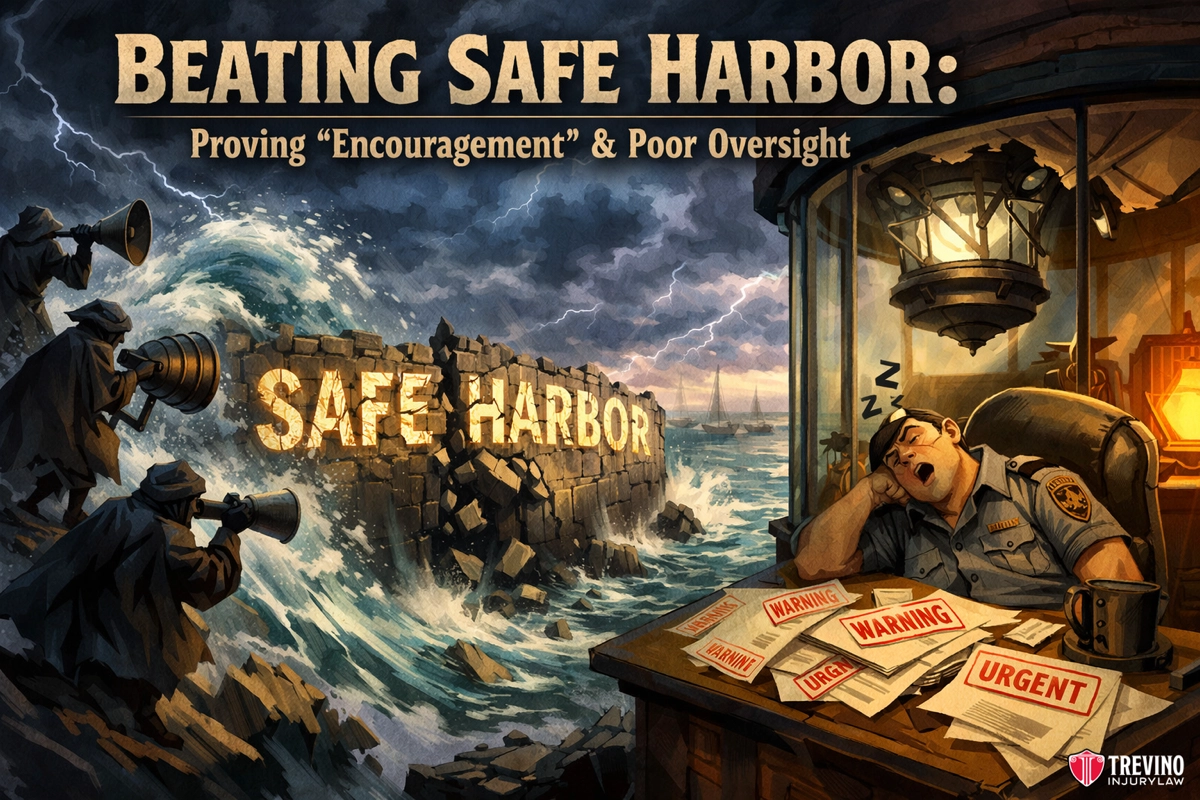
The drunk driver who caused your crash on Loop 1604 did not act alone. A San Antonio bar over-served them, prioritizing liquor volume over public safety, and now that establishment is liable.
The venue’s corporate defense team is already raising the Safe Harbor Defense, using formal training certificates to claim immunity while hiding the aggressive sales quotas that actually drove the over-service. But defeating the TABC Safe Harbor defense often starts with exposing the internal pressure and management decisions behind the over-service. According to TxDOT, San Antonio saw 47 DUI (alcohol) crash fatalities in 2024. Behind this tragedy is a business that pays its staff to push alcohol and ignore obvious intoxication.
What Could Your Dram Shop Accident Case Be Worth?
Answer a few quick questions about your accident. Takes about 60 seconds.
See What My Case Might Be WorthThe insurance company offered less than $20,000. I ended up with over $1 million. — Jackie Galindo
Evidence of their greed vanishes fast. Internal text messages get deleted. Point-of-sale data disappears. A Spoliation Letter, a legal demand that prevents the property owner from destroying evidence, must be issued immediately to lock down the digital footprint. Texas gives you two years. After that window closes, the claim permanently expires.
A Trevino Injury Law dram shop attorney team of lawyers subpoenas this hidden data and strips away their corporate immunity. Call 210-TREVINO for a free case review. You pay nothing unless we win. Se Habla Español.
How We Prove a Bar’s Safe Harbor Defense Relies on a “Sham” Policy
Proving a policy is a “sham” requires demonstrating a systemic lack of enforcement, where the bar has written rules but never disciplines employees for breaking them, effectively signaling that the rules are optional.
In the eyes of a Bexar County jury, having written policies in place that sit dusty on a shelf is meaningless if managers do not ensure staff follow them while pouring drink after drink; it is not a policy, it is a prop. We strip away the defense’s “paper shield” by contrasting their formal rules with the actual behavior condoned on the floor.
Before weighing that proof, it helps to understand the framework the evidence is being tested against. See Texas Dram Shop Safe Harbor Defense requirements and exceptions for the broader rules governing when the defense applies and when it may not.
In San Antonio’s high-volume districts like The Pearl or the busy corridors along Loop 1604, bars often maintain rigorous written manuals to satisfy insurance requirements, yet these rules are routinely ignored during the chaotic rush of a Friday night. To qualify for safe harbor protections against administrative action, the employer must have written responsible alcohol service policies and ensure each employee has read and understands them (TABC, 2026).
We look for the “disconnect” between the manual and the manager’s daily actions. If a bar claims to have a “zero tolerance” policy for over-service but cannot produce a single written reprimand for a server in five years, despite selling millions of dollars in alcohol, the policy is likely a sham designed only for the courtroom, not the barroom.
What Evidence Shows the Business Failed to Ensure Diligent Enforcement?
The strongest evidence of lack of enforcement includes personnel files devoid of write-ups, testimony from former servers confirming “zero consequences” for over-service, and surveillance footage showing managers ignoring obviously intoxicated patrons.
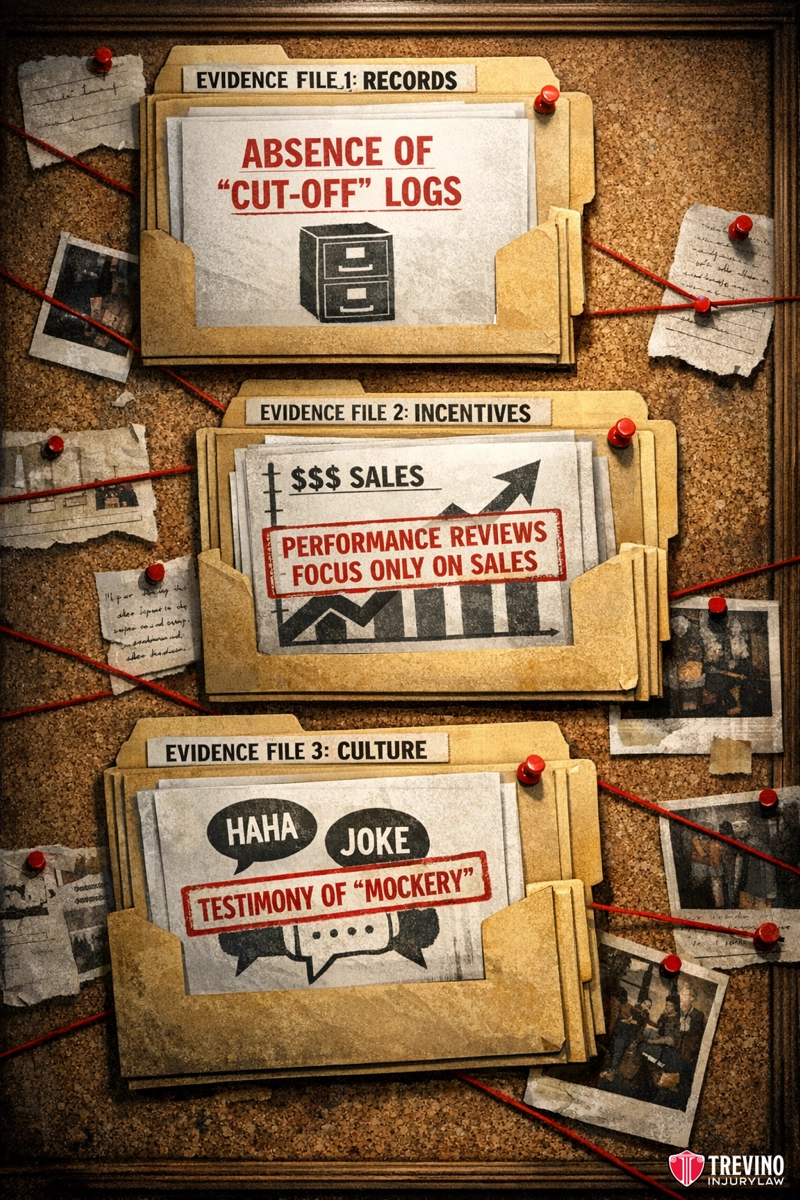
We treat the bar’s internal records as a crime scene, looking for what is missing as much as what is present.
When a bar generates massive profits from alcohol but records zero safety violations, it suggests that safety violations are being ignored rather than prevented.
- Absence of “cut-off” logs: A responsible bar tracks when patrons are cut off; a negligent one leaves no paper trail.
- Performance reviews focus only on sales: If servers are evaluated solely on high ring-outs and never on safety compliance, the bar is encouraging volume over caution.
- Testimony of “mockery”: Former employees often testify that TABC rules were treated as jokes or “suggestions” during pre-shift meetings.
Do prior TABC citations prove poor oversight?
Yes, a history of prior TABC citations or administrative notices acts as formal proof that the employer was on notice of their compliance failures yet failed to correct the behavior, directly supporting a claim of negligent oversight.
We pull the TABC public record history for the specific location to establish a pattern of negligence rather than a one-time mistake.
A “repeat offender” status destroys the defense’s argument that the over-service was an isolated “rogue” incident, as it proves management knew their oversight was failing and chose not to fix it. Administrative safe harbor criteria explicitly require that there be no more than 3 of these violations in a 12-month period (TABC, 2026).
Investigating enforcement failures exposes the bar’s passive negligence, but investigating their financial structure often reveals an active motivation to break the law.
Does a “Power Hour” or Sales Quota Constitute Encouragement?
Yes, ‘Power Hours,’ mandatory up-selling quotas, and contests that reward servers for the highest liquor sales volume are considered direct encouragement to over-serve. This financial pressure creates an alcohol-related conflict of interest that penalizes staff for slowing down to check for intoxication.
When a bar ties a server’s livelihood to the volume of alcohol they dispense, they create a direct conflict of interest between their wallet and the law. We argue that these financial structures constitute “corporate pressure” that overrides TABC training.
In nightlife hubs like Southtown or the St. Mary’s Strip, bars often run aggressive drink specials to compete for foot traffic. If a manager threatens to cut a server’s shifts due to low sales or, conversely, offers a cash bonus for selling the most shots, that is “encouragement” to violate the law.
We argue that the bar created a conflict of interest where the server is effectively paid to ignore signs of intoxication.
This financial “encouragement” is one of the few ways to pierce the Safe Harbor defense, as it proves the bar prioritized revenue over the safety of families traveling on I-35 or I-10.
How does a bar’s bonus structure create liability?
Bonus structures that tie a significant portion of a server’s income or job security to alcohol sales volume create liability by incentivizing the bypass of safety checks, effectively paying employees to break the law.
We demand payroll records and internal contest flyers to prove that the bar was paying its staff to aggressively push alcohol.
This evidence directly contradicts the “Safe Harbor” claim that the bar discourages over-service.
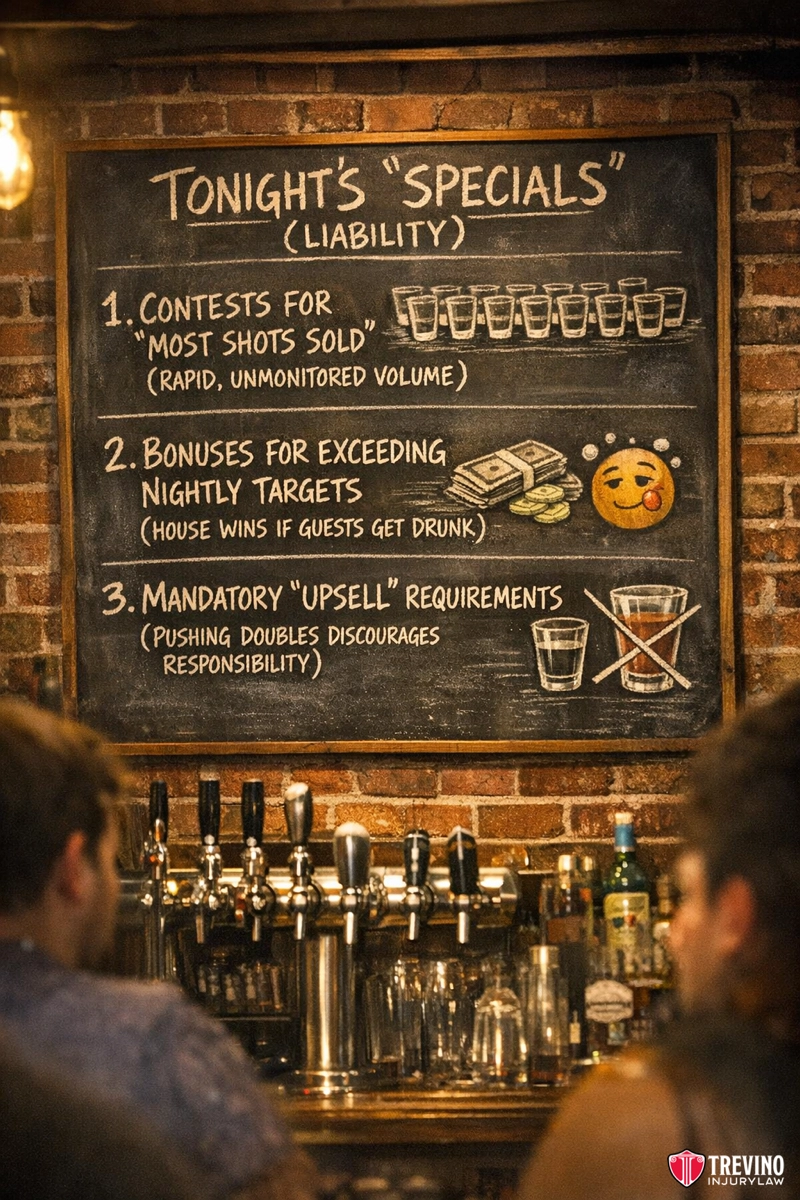
- Contests for “most shots sold”: These competitions explicitly reward rapid, high-volume service that makes monitoring intoxication impossible.
- Bonuses for exceeding nightly sales targets: When the “house” wins only if the guests get drunk, the house is liable.
- “Upsell” requirements: Mandatory rules to push doubles instead of singles discourage responsible serving practices.
Can you subpoena point-of-sale (POS) data to prove over-service?
Yes, we subpoena electronic Point-of-Sale (POS) data (such as Toast or Aloha systems) to analyze the timestamp frequency of drink orders, which can prove a server was pouring drinks faster than a human could responsibly consume them.
This data serves as “forensic accounting for alcohol,” allowing us to reconstruct the exact timeline of the night.
If the data shows “4 tequila shots” entered in 2 minutes for a single tab, it mathematically contradicts the bar’s claim of “monitoring consumption” and proves the server was rushing to run up the tab.
Financial incentives explain why staff over-serve, but managerial negligence explains how they get away with it right under a supervisor’s nose.
What Constitutes Negligent Oversight of Serving Staff?
Negligent oversight occurs when a manager is physically present but fails to intervene in obvious over-service, or when management fails to staff the venue adequately to allow for proper monitoring of patrons.
Under the ‘Vice-Principal’ doctrine, a manager’s failure to act is legally treated as the owner’s failure to act.
As defined by the Texas Supreme Court, a ‘vice-principal’ includes anyone with the authority to hire, fire, or manage a department.
When a manager stands by and watches over-service occur, they are not just a passive observer; the corporation itself is effectively ratifying the negligence in real-time.
In Bexar County District Courts, we often argue that a manager standing 10 feet away from a visibly drunk patron without acting is not just “passive”—it is ratification of the negligence.
We also analyze staffing ratios, arguing that scheduling one bouncer for 300 people at a venue on Culebra Road constitutes negligent oversight because it makes effective monitoring impossible.

By proving that the bar failed to provide the necessary supervision to enforce its own rules, we dismantle the “Safe Harbor” defense.
Is retaining a server with prior violations considered an act of encouragement?
Yes, negligent retention, keeping a server employed after they have been cited for over-service or involved in prior dram shop incidents, demonstrates that the bar does not take safety violations seriously, invalidating their Safe Harbor claim.
We demand the complete personnel file of the server in question. If “Server X” was involved in a fight or a prior over-service incident 6 months ago and was not retrained or fired, the bar “encouraged” the behavior by condoning it and signaling that dangerous service has no consequences.
Proving the bar’s management failed is critical, but the final hurdle is connecting that failure directly to the crash that injured your family.
Does Proving Encouragement Automatically Win the Case?
Proving encouragement completely defeats the Safe Harbor Defense, stripping the establishment of its immunity. Once this shield is removed, the bar is subject to the standard set in F.F.P. Operating Partners, L.P. v. Duenez, 237 S.W.3d 680 (Tex. 2007).
This landmark ruling holds that a dram shop is responsible for its proportionate share of the damages caused by the intoxication, meaning the jury will weigh the bar’s greed alongside the driver’s negligence.
This legal victory acts as the pivot point of the entire lawsuit. Once we prove encouragement, the bar loses its special protection and stands naked before the jury, judged like any other negligent defendant.
However, stripping the shield is not the same as winning the verdict. We must still demonstrate that the patron was “obviously intoxicated” to the extent that they presented a clear danger to themselves and others.
Whether the crash happened on the chaotic lanes of Loop 1604 or a quiet intersection in Alamo Heights, the burden remains on us to connect the bar’s greedy policies directly to the twisted metal.
We use the video footage, receipts, and witness statements not just to attack the policy, but to prove the crash was preventable.
Securing this critical evidence is the most important step in your case, as the result of waiting is often that the bar’s internal systems automatically delete the proof of their negligence.
That distinction is part of the larger defense analysis. Our guide to defeating the TABC Safe Harbor Defense in a Texas dram shop case explains how management conduct, TABC training records, and deposition evidence fit into the broader challenge to Safe Harbor.
How Do Spoliation Letters Preserve Evidence of Encouragement?
A Spoliation Letter is a formal legal demand sent immediately after an accident that puts the bar on notice to preserve all digital evidence, including POS data, surveillance video, and internal emails, preventing them from “accidentally” deleting proof of encouragement.
Without this immediate intervention, bars in San Antonio often claim that their security footage “auto-deleted” after 7 or 14 days, conveniently erasing the visual evidence of managers watching servers pour excessive shots.
We send these letters via certified mail to the bar’s registered agent to lock down the digital crime scene before the defense team can scrub it. By demanding preservation of “all communications regarding sales incentives,” we often catch management off guard.
They may preserve the video of the crash night, but forget to scrub the digital “shift notes” or group chat logs where they berated staff for low sales numbers weeks prior.
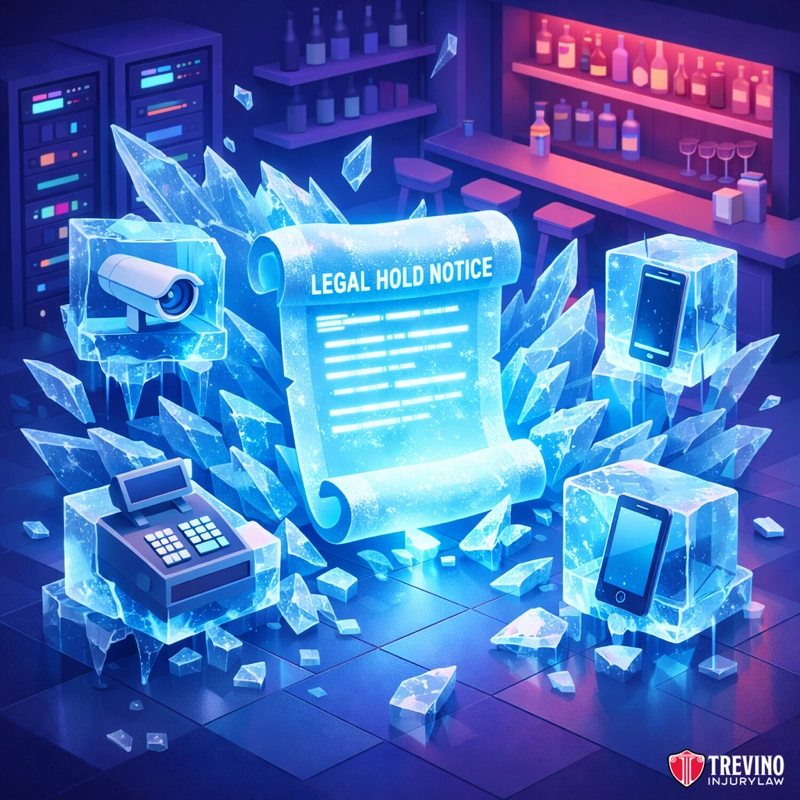
This preserved evidence allows us to build the timeline of negligence that juries in Bexar County expect to see before awarding damages.
How Do Internal Communications Reveal a Culture of Intoxication?
Internal communications, such as manager logs, group chats, and shift notes, reveal a “culture of intoxication” by providing written proof that staff prioritized high-volume alcohol sales over patron safety.
Through discovery, attorneys extract data from messaging apps like Slack and WhatsApp, scanning for keywords like “wasted,” “hammered,” or “record night” to expose the venue’s actual operational focus. These informal records act as devastating evidence during depositions; a manager’s sworn testimony that “safety is priority” is instantly invalidated by a timestamped message congratulating the team for “selling the most shots in Stone Oak history.”
This contradiction proves that the bar’s safety manual was merely a prop used to deceive Texas Dram Shop Law regulators, effectively dismantling attempts to scapegoat individual servers.
Can text messages be used to prove encouragement?
Yes, text messages between managers and staff (e.g., “Get those numbers up!”) are admissible and often serve as the “smoking gun” evidence of pressure.
These informal digital footprints frequently contradict the formal safety policies presented in court.
While digital records preserve the “what,” internal communications often reveal the “why”, a culture that celebrated intoxication rather than preventing it.
Is a written policy enough to stop an encouragement claim?
No, a written policy is insufficient if actual practice contradicts it; the “reality of the workplace” overrides the “theory of the manual.”
We prove that the manual was merely a “paper shield” ignored during actual operations.
Does “looking the other way” count as encouragement?
Yes, courts have ruled that a consistent pattern of silent acquiescence to policy violations constitutes “indirect encouragement” under the TABC code.
If a manager sees over-service daily and never corrects it, their silence is legally treated as permission.
Is It Encouragement If the Server Broke the Rules Secretly?
If a server violates the rules in secret and the employer has diligent monitoring systems in place that simply fail to catch a single instance, it may not constitute encouragement, potentially allowing the Safe Harbor Defense to stand.
This is known as the “Rogue Employee” defense. If a bar in Helotes can prove it held mandatory pre-shift meetings, used “secret shoppers” to test compliance, and actively monitored the floor, it might argue that the over-service was an isolated breach of its strict standards.
This is why proving a pattern is crucial. We must demonstrate that the server’s actions were not a secret exception but an open rule.
If we can show that “Server X” had over-served patrons openly for months without consequence, the bar loses the ability to claim they were deceived by a rogue employee. They cannot claim ignorance of behavior they chose not to see.
Even if the bar successfully destroyed their paper trails, we can still reconstruct the truth through the voices of those who witnessed the negligence firsthand.
What If There Are No Written Records of Encouragement?
Even without written “smoking gun” documents, encouragement can be proven through circumstantial evidence and sworn testimony from former employees who testify about the unwritten rules and pressure they faced.
We track down former staff, bartenders, barbacks, and door hosts who have left the establishment. These “disgruntled former employees” are often willing to speak the truth about “off the books” policies that current employees are too scared to admit, such as verbal instructions to ignore cut-off limits for VIPs.
In the absence of a written reprimand log, the testimony of three former servers that “we were never allowed to cut people off during happy hour” is powerful evidence of an unwritten policy encouraging customers.
This testimony, combined with the Safe Harbor Defense legal standards, allows us to construct a compelling narrative of negligence that relies on the “reality of the workplace” rather than missing paperwork.
Why Hire a San Antonio Dram Shop Lawyer?
The bar’s defense relies on a “paper shield” of training certificates, but your justice depends on exposing the ugly truth hidden in their deleted shift logs and aggressive sales quotas. Don’t let a “Safe Harbor” block the compensation your family deserves.
Want to Protect the Full Value of Your Claim?
You’ve seen how this affects your case — but this is only one piece of the puzzle. Our Dram Shop Lawyer page breaks down what a trial-ready firm does differently.
You need a San Antonio injury attorney to send spoliation letters and subpoena internal manager logs before the truth is permanently erased.
Call 210-TREVINO right now, before the evidence is destroyed, and let a trial-tested attorney fight for you. Se Habla Español.