A drunk driver shattered your life, and the San Antonio bar that over-served them is already claiming they hold no responsibility.
The insurance adjuster is weaponizing the Safe Harbor Defense, using perfect paper training logs to shield the bar from liability and deny your family compensation. They want you to believe a rogue bartender made a mistake. But defeating the TABC Safe Harbor defense often depends on showing that management approved, encouraged, or directly participated in the over-service.
According to TxDOT, Bexar County recorded 64 DUI alcohol-related fatalities in 2024. Behind these crashes is a negligent management team that prioritizes high-volume profits over public safety. Under Texas law, if a manager with hiring authority encouraged over-service or poured drinks, the defense collapses, and the corporation assumes full liability.
What Could Your Dram Shop Accident Case Be Worth?
Answer a few quick questions about your accident. Takes about 60 seconds.
See What My Case Might Be WorthThe insurance company offered less than $20,000. I ended up with over $1 million. — Jackie Galindo
Internal evidence vanishes fast. A Spoliation Letter, a legal demand that prevents the property owner from destroying evidence, must be issued immediately to preserve surveillance video, receipt timestamps, and employee text messages. Texas gives you exactly two years to file a lawsuit against the bar. After that deadline passes, the claim is gone forever.
A Trevino Injury Law dram shop lawyer will dismantle this defense, subpoena the internal records, and expose toxic bar cultures. Call 210-TREVINO now for a free case review. You pay nothing unless we win. Se Habla Español.
What Is the Safe Harbor Defense in the Texas Dram Shop Law?
The Safe Harbor Defense is an affirmative defense under Texas Alcoholic Beverage Code § 106.14(a) that shields employers from liability for their employees’ actions if they meet specific training criteria and have not encouraged the employee to violate the law.
Eligibility to claim employee “not attributable” protection is not available if the business has 3 or more alcohol-to-minor violations within a 12-month period (TABC, 2026).
This defense acts as a “carrot” designed by the Texas Legislature to encourage widespread server training across the state. Safe Harbor is an affirmative defense, meaning the bar bears the burden of proving the initial elements.
They must actively prove they complied with the law; it is not granted automatically. In the landmark case 20801, Inc. v. Parker, the Texas Supreme Court clarified the burden-shifting framework: the bar must prove the training elements, and then the burden shifts to the plaintiff (the victim) to prove the bar encouraged the violation.
In San Antonio litigation, this is the first standard defense commercial liability insurers raise to protect their policyholders from having to pay damages caused by intoxication.
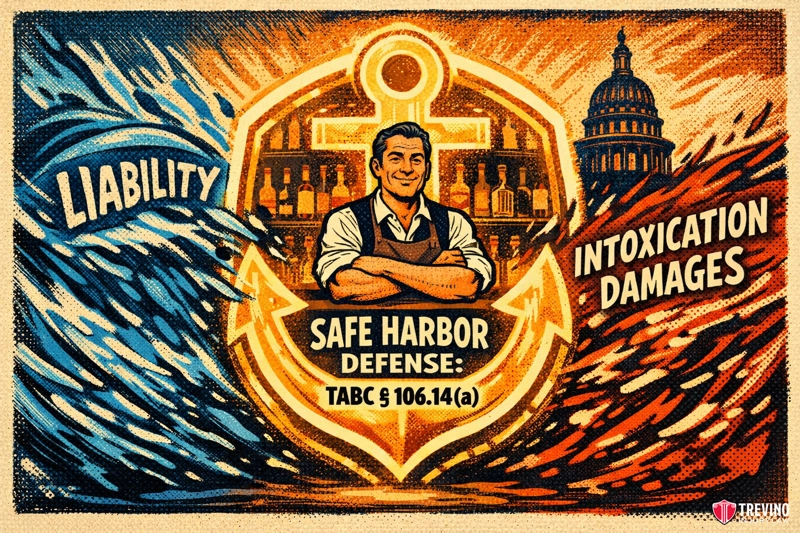
Once we understand the statutory definition of this defense, we must examine the three criteria the bar must prove to use it successfully in court.
What Are the Three Mandatory Elements of TABC 106.14(a)?
To qualify for protection under TABC § 106.14(a), the employer must prove three specific elements:
- It requires its employees to attend a Commission-approved seller training program.
- The specific employee actually attended the program,
- The employer did not directly or indirectly encourage the employee to violate the law.
All three elements must be present for the defense to hold; it is a “three-legged stool” that collapses if one leg is removed.
- Policy: The bar must have an official policy requiring certification.
- Compliance: The specific server involved in the over-service must have a valid, unexpired certificate. Employees must obtain seller-server certification within 30 days of hire date to support Safe Harbor claim (TABC, 2026).
- No encouragement: The bar must not have created a culture that pushes servers to ignore their training.
While the first two elements are objective paperwork issues, the third element regarding encouragement is subjective and often where the battle is won or lost.
Who Counts as an ‘Employee’ Under the Safe Harbor Defense?
The Safe Harbor Defense applies only to “employees” (servers, bartenders, waitstaff) and does not protect the bar from liability for the actions of its owners, officers, or managers, who are considered “vice-principals” of the corporation.
This distinction relies on the legal concept of the “Vice-Principal.” Under Texas law, a Vice-Principal, someone with management authority to hire, fire, or supervise, is considered the “mind” of the corporation itself. If a manager over-serves a patron, the bar cannot claim Safe Harbor, because the bar itself (acting through its management) committed the negligent act.
There is no “rogue employee” to protect against when the boss is the one pouring the drinks. This distinction matters in Bexar County litigation, especially during busy events like Fiesta San Antonio or nights at The Pearl, when managers often step behind the bar to manage high-volume crowds.
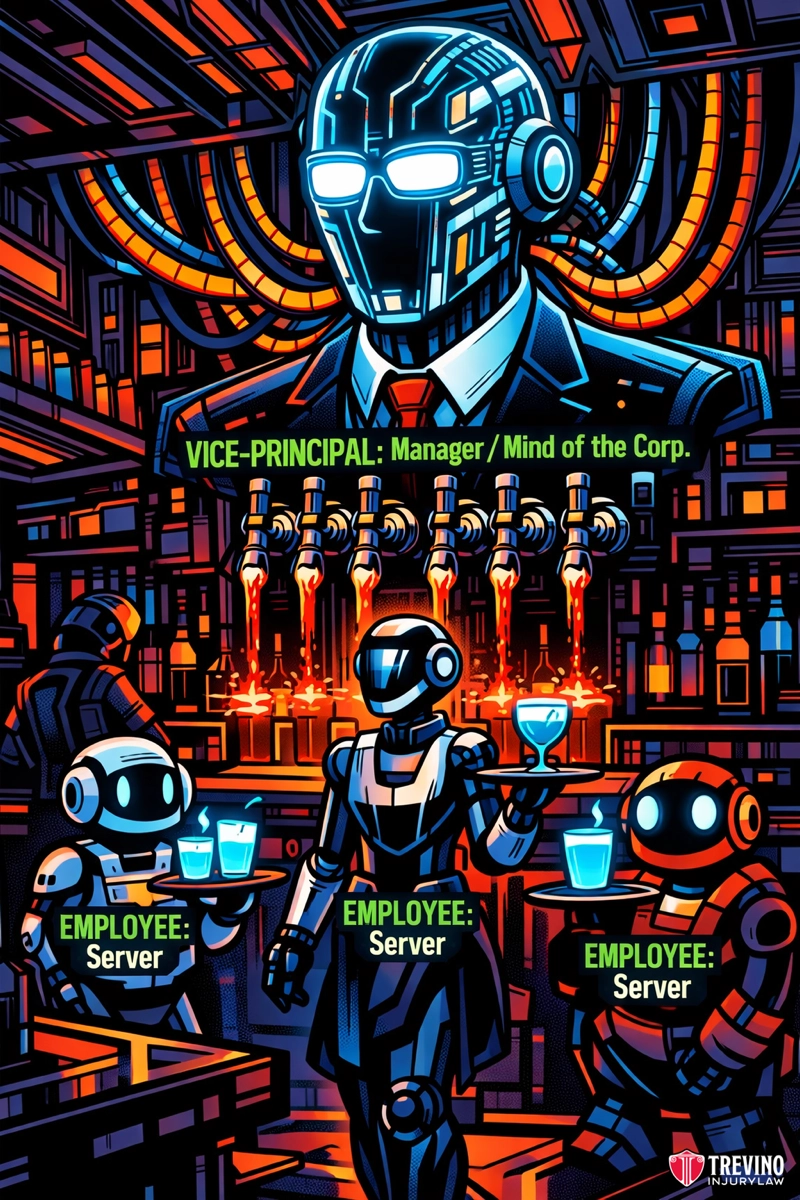
If the person serving the alcohol was a standard employee, the defense might apply, but if they held management authority, the defense is void. Even with regular employees, the bar loses protection if it encourages the violation.
Does the Defense Apply if a Manager Served the Alcohol?
No. If a manager, owner, or ‘vice-principal’ serves the intoxicated patron, the Safe Harbor Defense is automatically void.
Under Texas law, a manager’s actions are considered the corporation’s direct actions. There is no ‘rogue employee’ for the company to hide behind because the company itself (acting through its management) committed the negligence. This removes the ‘innocent employer’ shield entirely, exposing the bar to full liability for the damages it caused.
This applies to shift leads with the authority to hire/fire, or to supervise, not just the general manager. We frequently see this issue in smaller bars in Southtown or rural Bexar County venues where owners actively work the bar.
What Constitutes ‘Encouragement’ to Violate TABC Laws?
Texas courts define ‘encouragement’ broadly, extending beyond explicit orders to include negligent omissions and systemic failures. In 20801, Inc. v. Parker, the Supreme Court held that encouragement exists where a provider acts negligently, for example, by setting aggressive sales quotas or failing to discipline employees for over-service, thereby creating an environment that incentivizes violating the law.
There is a difference between Direct Encouragement (explicitly ordering a server to “keep pouring”) and Indirect Encouragement (creating a culture where profit outweighs safety). Proof often involves showing that the bar prioritized revenue over the law.
Once the bar proves training (elements 1 & 2), the plaintiff bears the burden of proving this “encouragement” (element 3). This requires deep discovery into the bar’s internal memos, meeting notes, and disciplinary records to find evidence of a toxic safety culture.
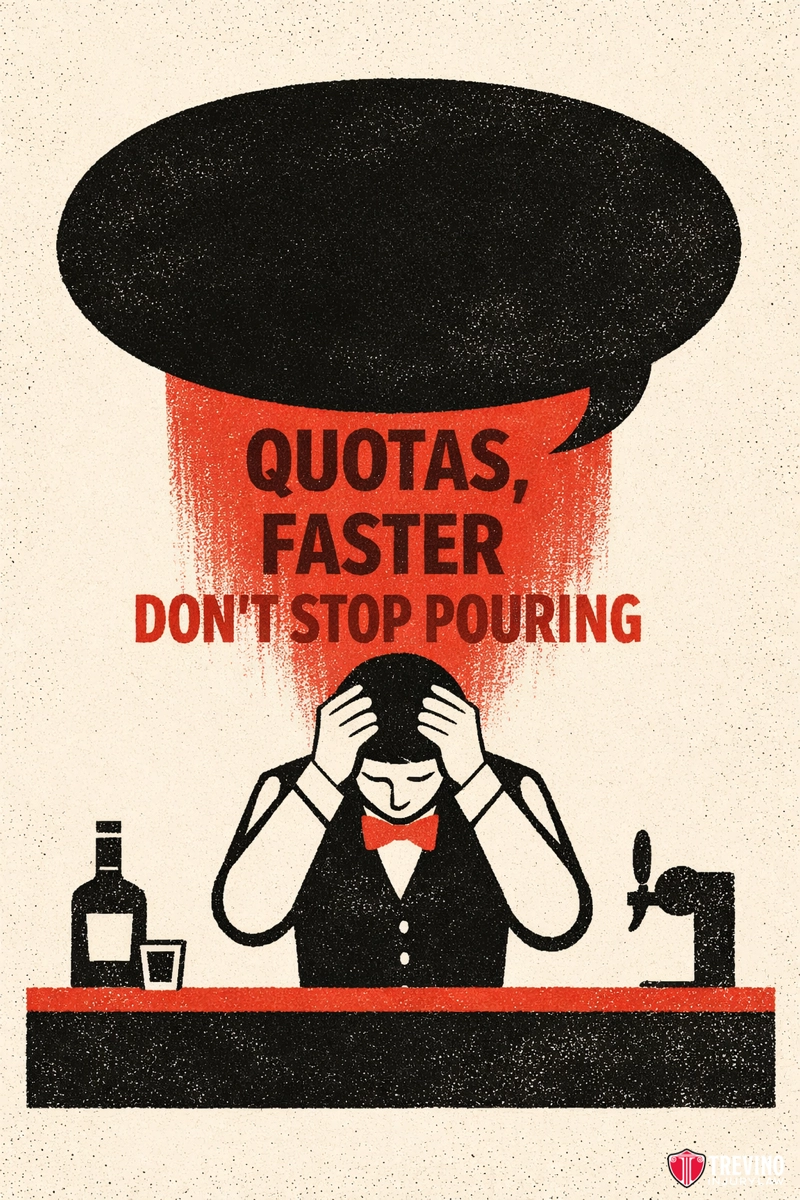
Once encouragement becomes the issue, the next question is how to prove it. See what evidence defeats the TABC Safe Harbor Defense in Texas for a focused analysis of the internal records and operational evidence used to test the bar’s claimed compliance.
Understanding these definitions leads to the practical question of how negligence is proven, which often manifests through specific operational policies that silently demand over-service.
Examples of Indirect Encouragement Under Texas Law
Indirect encouragement often manifests through negligent operational policies rather than explicit verbal commands, creating an environment where servers feel pressured to violate the law to keep their jobs.
Common examples of indirect encouragement include:
- Sales Quotas: Setting mandatory alcohol sales targets that require over-service to meet.
- Lack of Support: Refusing to back up servers who try to cut off intoxicated patrons.
- Drinking on the Job: Allowing employees to consume alcohol while working, which is common in some St. Mary’s Strip nightlife venues.
- Volume Bonuses: Bonus structures tied solely to alcohol volume (“Power Hours”).
- Lax Enforcement: Failing to punish servers who clearly violate TABC rules.
Does a Valid Safe Harbor Defense Mean the Case Is Over?
No, a valid Safe Harbor defense does not automatically end the case, because it only shields the bar from liability if they strictly followed every rule, and skilled attorneys can often dismantle this defense by proving the training was a sham, or that management silently encouraged the violation.
Transitioning from legal definitions to the reality of litigation is critical for victims in San Antonio. Even if a defense looks valid on paper, the operational reality inside the bar might be completely different. Insurance companies for bars along Culebra Road or I-10 often present perfect training logs, hoping we won’t look deeper. However, “valid on paper” does not mean “valid in court” if evidence shows the training was rushed, falsified, or ignored in practice.
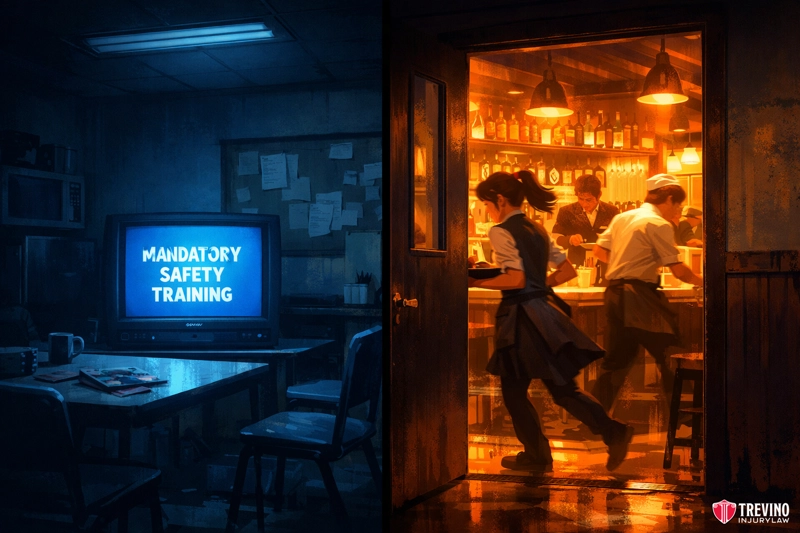
We often find that what is claimed to be a “comprehensive training program” is really a video playing in an empty break room while the employee works the floor.
This connects directly to the discovery phase of the lawsuit, where we scrutinize every text message, surveillance tape, and shift log to find the cracks in their armor. Once we peel back the layers of their “compliance,” the Safe Harbor defense often crumbles under the weight of their own negligence.
While understanding how we dismantle the defense is vital, it is equally important to clarify how Texas law compares with those of states with even stricter liability standards.
What Is the Difference Between Safe Harbor and Strict Liability?
Strict liability automatically holds an entity responsible for damages regardless of fault, whereas Safe Harbor is a specific affirmative defense under Texas law that shields bars from liability if they prove they required employees to attend TABC-approved training.
While strict liability jurisdictions force establishments to pay simply for serving the alcohol that caused an accident, Texas operates under a negligence-based framework that offers employers this statutory “escape hatch.” To defeat the Safe Harbor defense in Texas courts, particularly in Bexar County, plaintiffs must meet a higher burden of proof by demonstrating that the employer negligently enticed or encouraged the employee to violate liquor laws, rather than just proving service occurred.
Is the Safe Harbor Defense Automatic in Texas?
No, the Safe Harbor Defense is an affirmative defense, meaning the bar must actively plead it and prove the first two elements in court. A license/permit holder must provide an affidavit not later than 10 days after receipt of an administrative notice of violation to claim §106.14(a) non-attribution (TABC, 2022).
Do All Employees Need to Be Certified for Safe Harbor?
Yes, the statute generally requires the employer to require all employees who serve alcohol to attend the training, not just the specific one involved.
Is Safe Harbor a Federal Law?
No, Safe Harbor is a specific provision of the Texas Alcoholic Beverage Code (§ 106.14) and applies only to state claims within Texas jurisdiction.
While understanding the legal theory is helpful, the practical application often comes down to specific timelines, particularly regarding certification status.
How Often Must Servers Renew TABC Certification?
TABC certification is valid for strictly two years from the date of issuance, and servers must renew prior to expiration for an employer to maintain the “certified” status required for the Safe Harbor defense.
This timeline acts as a rigid binary switch: a lapse of even one day can legally invalidate the bar’s protection for that specific employee’s actions. In high-turnover hospitality zones like Stone Oak or La Cantera, management frequently fails to track these expiration dates.
Legal counsel routinely uncovers instances where a server’s certificate expired days before a crash, destroying the defense; however, a total absence of records signals an even deeper systemic failure in the bar’s compliance.
What Happens If a Bar Cannot Prove Training Attendance?
If a bar cannot produce physical proof, such as signed certificates or official training logs, showing the employee actually attended the program, they cannot claim the Safe Harbor protection and are exposed to standard negligence liability.
This represents the “absence” of the defense. Without the “paper shield” of Element 2, the bar cannot shift the burden of proof to the victim. In many cases involving smaller dive bars along Bandera Road or in Leon Valley, poor record-keeping becomes their downfall. A seller training school must electronically file a report not later than 7 calendar days after the class date (TABC, 2022).
If the defense cannot document that the specific server involved in the DWI accident was trained, the “Safe Harbor” effectively evaporates, leaving the bar directly liable for their employee’s negligent over-service.
However, even if they have the paperwork and the training is up to date, the defense can still fail if the workplace culture undermines the rules.
When Does Safe Harbor NOT Apply Even With Training?
Safe Harbor does not apply, even with a perfect training record, if the plaintiff proves that the bar’s management created an atmosphere that encouraged over-service to boost profits or systematically ignored safety protocols.
This is the ultimate limitation of the defense, the “Encouragement” exception (Element 3). It is the “checkmate” move against a bar that follows the rules on paper but breaks them in practice. If a manager at a club on Broadway or in Alamo Heights sets a policy that prioritizes speed of service over ID checks, or if they punish servers for cutting off wealthy patrons, that encouragement overrides any certificate the server holds.
We prove this by interviewing former employees and analyzing internal messages to show that the “training” was nothing more than a formality.
These exceptions fit into a broader litigation framework. Our guide to defeating the TABC Safe Harbor Defense in a Texas dram shop case shows how training records, management conduct, and deposition strategy fit together when the defense is challenged.
Why Hire a San Antonio Dram Shop Lawyer?
Don’t let a negligent bar hide behind a “Safe Harbor” paper shield while your family suffers from catastrophic injuries. Insurance companies use this defense as a standard weapon to deny responsibility, but at Trevino Injury Law, we know how to dismantle it.
You need a personal injury accident lawyer to send spoliation letters and subpoena TABC training logs before the truth vanishes. We aggressively investigate the bar’s internal culture, expose their failure to enforce safety rules, and prove they encouraged the violation to boost profits.
Want to Protect the Full Value of Your Claim?
You’ve seen how this affects your case — but this is only one piece of the puzzle. Our Dram Shop Lawyer page breaks down what a trial-ready firm does differently.
We fight on a strict contingency basis, meaning you pay nothing unless we win. We front all litigation costs to force them to pay what your family deserves. Call 210-TREVINO now to start your investigation. Se Habla Español.