The drunk driver who hit you did not get intoxicated in a vacuum. A bartender poured the drinks, a server swiped the credit card, and management watched an impaired patron stumble out to their car.
The establishment’s insurance adjuster is already exploiting the clock, arguing the driver drank elsewhere or that the temporal proximity between service and the crash prevents fault. According to the Texas Department of Transportation, Bexar County recorded 1,654 DUI crashes in 2024. Behind these collisions stands a negligent bar owner relying on data gaps to escape liability.
Crucial timeline data disappears fast. Security cameras loop over old footage, and point-of-sale timestamps vanish during routine system updates. That is why working with a San Antonio dram shop lawyer early can help secure the records needed to reconstruct the sequence before they are lost.
What Could Your Dram Shop Accident Case Be Worth?
Answer a few quick questions about your accident. Takes about 60 seconds.
See What My Case Might Be WorthThe insurance company offered less than $20,000. I ended up with over $1 million. — Jackie Galindo
A Spoliation Letter, a legal demand that requires the property owner to preserve evidence, must be issued immediately to lock down this proof. Texas gives you two years to file a lawsuit, but the digital footprint vanishes in days.
Trevino Injury Law synchronizes point-of-sale data with surveillance footage to secure the exact time of service before the bar erases it. Call 210-TREVINO for a free case review. You pay nothing unless we win. Se Habla Español.
San Antonio Last Drink Timeline: Key Takeaways
- As your San Antonio dram shop lawyer, we expose negligent bars on corridors like Loop 1604 using forensic timeline reconstruction.
- Trevino Injury Law secured a $1 million settlement in a wrongful death case by dismantling defense tactics and proving liability.
- We use retrograde extrapolation to scientifically link a driver’s BAC at the crash back to the exact time of service.
- Our team captures surveillance footage immediately to defeat the Safe Harbor defense before Bexar County evidence is erased.
How Is the Last Drink Time Proven in Court?
The time of the “last drink” is proven by triangulating Point-of-Sale (POS) timestamps, video surveillance, and witness testimony to create an undeniable chronological record of service that anchors the entire liability claim against the negligent provider.
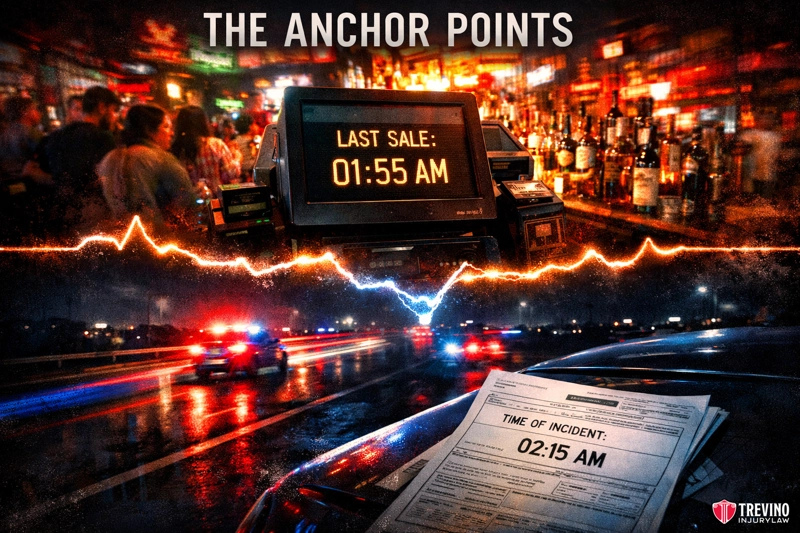
We build this timeline by establishing two critical “Anchor Points”: the precise time of the crash, as recorded by the police, and the time of the last sale, as recorded by the bar’s internal systems. In San Antonio, we often correlate timestamps from bars on St. Mary’s Strip or The Pearl with the crash time reported by SAPD on highways like Loop 1604.
We aggressively track venues with prior publicly documented enforcement actions. Defense lawyers often try to blur these lines, especially during the “Last Call” rush, where bars push drinks before the 2:00 AM cutoff, creating a cluster of service times that defines the timeline.
Our firm fights to expose these tactics, just as we did to secure a $1 million settlement in a wrongful death case involving dram shop liability.
What Time Is the Last Call for Alcohol in Texas?
In Texas, the legal “last call” is 2:00 AM for mixed beverage permit holders, and service after this time acts as per se evidence of a TABC violation, strengthening the timeline of negligence against the provider. This cut-off is critical because state data reveals that the hour between 2:00 AM and 2:59 AM sees the highest volume of alcohol-related crashes, with 5,922 incidents recorded in 2024 (TxDOT, 2024). National data further confirms the danger of this late-night window, showing that 51.3% of alcohol-impaired fatal crashes occur between 9:00 PM and 3:00 AM (NHTSA, 2024).
While recent laws have adjusted rules for “to-go” alcohol sales, the strict on-premise service cutoff remains a hard boundary in dram shop litigation. Service documented after this hour not only extends the liability timeline but also demonstrates a reckless disregard for the law. We use this regulatory boundary to box in defense arguments; if the receipt shows 2:15 AM, the timeline immediately shifts in favor of the injured victim.
Once we establish when the drink was served, we must understand the rules that apply to that time.
How Long After the Last Drink Is Proximate Cause Shown?
Proximate cause is typically shown when the crash occurs within a “temporal proximity” of one to two hours after the last drink, demonstrating that the alcohol served was still active in the driver’s system at the time of injury. Forensic guidelines support this timeframe, noting that alcohol absorption can continue for up to two hours after the last drink is consumed (OSAC, 2020).
Under the Texas Dram Shop Act, establishing this “Temporal Proximity” is essential for holding the correct bar responsible. If a driver stops at three different venues, the timeline helps us target the last bar if the crash occurred shortly after leaving that venue.
Unlike our broader discussions on “signs of intoxication,” this specific forensic analysis focuses strictly on the elapsed time between the establishment’s door and the crash site. The local impact of this window is severe, with University Hospital’s trauma team treating an average of 250 patients annually strictly for drunk driving injuries (University Health Trauma Services, 2025).
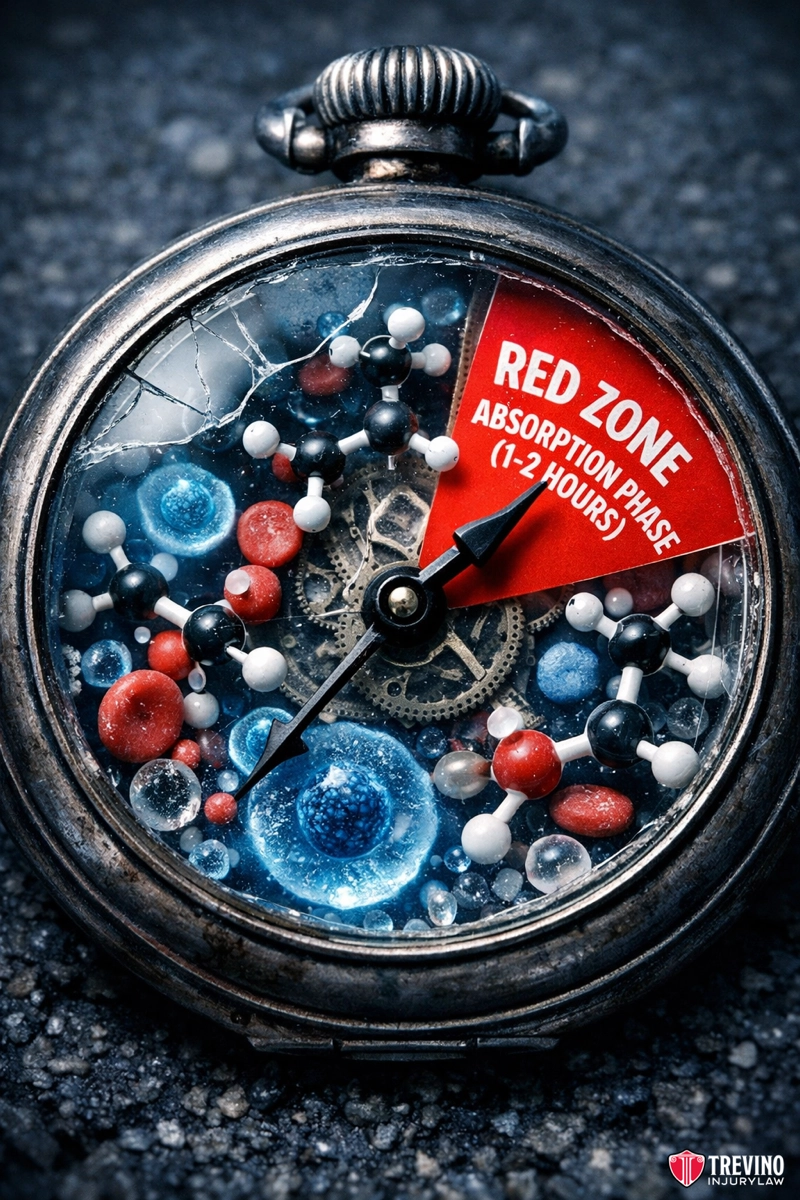
To scientifically link the crash time back to the service time, we need more than just a clock; we need chemistry.
How Do Police Reports and BAC Tests Affect Last Drink Timing Decisions?
Police reports provide the verified “Crash Time” anchor, while BAC tests allow forensic toxicologists to perform retrograde extrapolation, mathematically calculating what the driver’s alcohol level was at the exact moment of the last service.
Retrograde extrapolation is the scientific process of working backward from the blood draw, often taken at University Hospital or by a mobile testing unit, to the specific time of service at the bar. To perform these calculations accurately, toxicologists utilize an average elimination rate of approximately 0.015 g/dL per hour to trace the alcohol level back to the time of service (OSAC, 2020).
However, this calculation requires more than simple math; it demands legal reliability. This data is critical because high enforcement alone does not stop over-service; during Fiesta 2024, San Antonio saw 139 DWI arrests in just 11 days despite heavy police presence (University Health/SAPD, 2025).
For instance, if a driver has a .20 BAC at 3:00 AM, we use these Mata factors to prove they were significantly above the limit at 1:45 AM, establishing they were ‘obviously intoxicated’ at the exact moment of service. We use the San Antonio Police Department crash reports as the indisputable “End Time” data point to anchor these calculations.
This scientific timeline is powerful, but it relies on data; the most visual data point is surveillance video.
What is the Role of Surveillance Footage in Dram Shop Timelines?
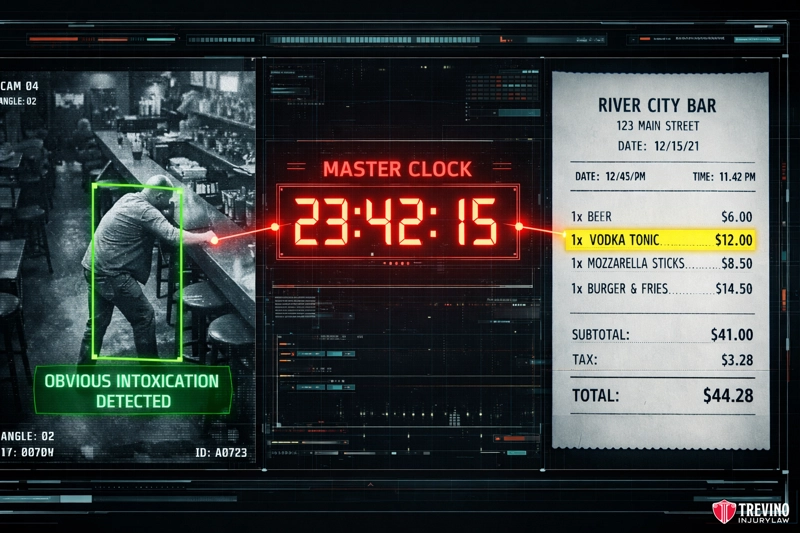
Surveillance footage serves as the visual “master clock” for the case, allowing us to synchronize the driver’s physical signs of intoxication, such as stumbling or slurring, with the specific timestamp of each drink served to prove the provider knew the patron was intoxicated.
In San Antonio dram shop litigation, raw video is only half the battle; the true power lies in synchronization. We map the visual data from security cameras in districts like Southtown against the digital timestamps on the bar’s receipts.
This visual proof is often critical; in Raoger Corp. v. Myers (2025), the Texas Supreme Court ruled that a high BAC alone may be insufficient without evidence of “obviously intoxicated” behavior. While obtaining the footage is the first hurdle, accurately syncing it creates the “Point of No Return” evidence that insurance adjusters fear most, transforming a financial transaction into visible proof of negligence.
That timeline depends on keeping the source records available long enough to analyze them. Preserving bar surveillance and POS evidence protects the video and transaction data needed for later synchronization.
Ideally, we have this footage, but what rules dictate the legal deadlines for using this timeline in court?
How Is Fault Proven in a Dram Shop Case Using Timelines?
Fault is proven by constructing a forensic Timeline of Consumption overlaid with a Timeline of Behavior to demonstrate that a provider served alcohol after intoxication became legally obvious to a reasonable person.
In Bexar County courts, attorneys identify the “Point of No Return,” the specific moment when a server should have stopped service but failed to act. For instance, evidence may establish that while a patron was sober at 10:00 PM, they exhibited clear impairment by 11:30 PM, yet the establishment continued serving them until midnight.
These detailed timelines are essential to dismantle “Safe Harbor” defenses by proving staff ignored visual cues despite training, a widespread issue given that 2024 data shows service to minors accounts for nearly 50% of TABC administrative violations (San Antonio Express-News). Crucially, even a perfect timeline fails if you miss the strict statute of limitations.
Can You Still Sue Someone After 2 Years?
No, generally you cannot sue after two years; the Statute of Limitations for personal injury and dram shop claims in Texas expires strictly two years from the date of the crash.
What Is the 51% Rule in Texas?
In Texas, the 51% Rule means that if you are found to be 51% or more responsible for an accident, you get exactly zero dollars in compensation. Here is how the math works in the eyes of the law:
If you are 0% at fault: You can recover 100% of your financial compensation.
If you are 1% to 50% at fault: You can still recover money, but your compensation is reduced by your exact percentage of blame. (For example, if you are 20% at fault for a $100,000 crash, you will only receive $80,000).
If you are 51% or more at fault: Your case is dead. You are legally barred from recovering anything.
What Is the Statute of Limitations on a Dram Shop Case in Texas?
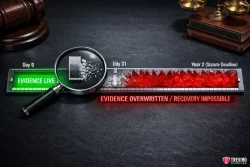
The statute of limitations for filing a Dram Shop lawsuit in Texas is strictly two years from the date of the injury-causing accident. While TABC Rule 16 TAC §41.4 technically mandates that retailers retain business records for this duration, relying on the legal deadline is dangerous because critical security footage is frequently overwritten within just 14 to 30 days due to high-definition storage limits (SIA, 2024).
This reality creates a dual deadline: an immediate urgency to secure video evidence and a formal two-year window to file the claim. Families in communities like Alamo Heights often jeopardize their recovery by waiting, only to find that the evidence timeline has expired long before the legal statute runs out.
What If There Are “Gaps” in the Drinking Timeline?
If there are gaps in the timeline, such as the driver drinking at multiple locations or in their car, we use forensic circumstantial evidence and witness statements to fill the void and attribute the intoxication to the liable provider.
“Tailgating” or drinking in a parking lot between venues is a common defense strategy used to break the causal chain. If a driver leaves a bar on Culebra Road and isn’t seen again for an hour before the crash, the defense will claim they drank elsewhere.
We close these gaps by pulling credit card timestamps from nearby businesses or toll tag data to prove the driver did not stop anywhere else, effectively shifting liability back to the original provider.
Gaps are one challenge, but what if the timeline simply doesn’t support the claim?
When Is a “Last Drink” Timeline Not Enough to Prove Liability?
A “Last Drink” timeline alone is insufficient to prove liability if the patron showed no visible signs of intoxication at the time of service, even if their BAC was high, because the Texas Dram Shop Act requires proof of observable behavior.
The timeline is a supporting tool, not a replacement for the “Obvious Intoxication” standard. If the timeline proves a drink was served at 1:50 AM, but the surveillance video shows the patron walking and talking perfectly, the case becomes difficult. The timeline must support the narrative that the signs of intoxication were visible and ignored.
A timeline becomes more useful when read alongside other evidence of service and visible impairment. Our guide to proving a bar served an obviously intoxicated patron in Texas explains how receipts, surveillance, witnesses, police records, and expert testimony can fit together.
This distinction is why we focus so heavily on synchronizing the clock with the video; without the visual behavior to match the timestamp, the timeline alone cannot force a bar to pay for the damages they caused.
Why Hire a San Antonio Dram Shop Lawyer?
The clock is ticking on your case, and the bar knows it. Every day you wait is another chance for negligent establishments to overwrite critical surveillance footage, “lose” time-stamped receipts, and erase the timeline of your injury. Don’t let them hide behind a “safe harbor” defense or a data gap.
Want to Protect the Full Value of Your Claim?
You’ve seen how this affects your case — but this is only one piece of the puzzle. Our Dram Shop Lawyer page breaks down what a trial-ready firm does differently.
You need the San Antonio accident attorneys to send immediate spoliation letters and preserve Point-of-Sale data before your timeline is permanently erased.
At Trevino Injury Law, we move immediately to preserve the “last drink” evidence, synchronize the video with the sale, and scientifically prove the link between their service and your crash. Call us right now at 210-TREVINO to lock in the liability before it fades. Se Habla Español.