Liability for a Texas drunk driving crash extends far beyond the intoxicated driver. Employers, negligent vehicle owners, and the bars that overserved them all share the financial blame when their actions put an impaired motorist on the road.
The insurance adjuster representing the driver is already shielding those deep-pocket third parties, pushing you to accept a minimum policy payout from a judgment-proof defendant. The Texas Department of Transportation recorded 1,654 alcohol-related crashes across Bexar County in 2024. Behind the worst of these wrecks is a corporate entity or a licensed provider that prioritized profit over public safety.
What Could Your Drunk Driving Accident Case Be Worth?
Answer a few quick questions about your accident. Takes about 60 seconds.
See What My Case Might Be WorthThe insurance company offered less than $20,000. I ended up with over $1 million. — Jackie Galindo
A Spoliation Letter, a legal demand that stops the property owner from destroying evidence, must be issued immediately to force bars to preserve security footage and employers to surrender dispatch logs. Texas gives you exactly two years to add these secondary defendants to your lawsuit. Miss that deadline, and they become permanently immune from financial responsibility.
A DUI Accident Lawyer at Trevino Injury Law will identify every liable party and lock the evidence down before it vanishes. Call 210-TREVINO for a free case review. You pay nothing unless we win. Se Habla Español.
Is the Drunk Driver in Texas Always the Only Party Accountable?
No, the drunk driver is rarely the only person liable in a catastrophic car accident. This distinction is vital in Texas, where, according to TxDOT’s 2024 Motor Vehicle Traffic Crash Facts, drivers under the influence of alcohol accounted for over 25% of all traffic deaths in the state.
While the person operating a motor vehicle is the primary defendant, the sheer severity of a drunk driving collision often exceeds the driver’s insurance limits. While the state focuses on criminal proceedings and a potential criminal conviction, our personal injury claim strategy focuses on your financial recovery.
We prove that the driver was intoxicated and that their alcohol impairment was the direct cause of the crash. However, Texas law allows us to look beyond the driver. You need an experienced attorney to identify all parties who can be held accountable.
The wreck is real. The liability is bigger. In San Antonio, many drunk drivers are “judgment proof,” meaning they have no assets and carry only minimum insurance. Focusing solely on the driver often leaves victims with a fraction of what they need for long-term care.
By identifying secondary defendants, like a parent in Stone Oak who lent a high-powered truck to a reckless teen, or a delivery company that ignored a driver’s alcoholism, we trigger commercial insurance policies with much higher limits. This strategy is essential for covering the true cost of traumatic brain injuries or wrongful death.
How Gross Negligence Affects Punitive Damages in Serious Texas Cases
Gross negligence is a distinct legal finding under Tex. Civ. Prac. & Rem. Code § 41.001(11) states that the driver had “actual subjective awareness” of an extreme risk but proceeded with “conscious indifference” to the safety of others. The risk is undeniable: NHTSA reported in 2023 that alcohol-impaired driving claims a life approximately every 42 minutes nationwide.
These damages are designed to punish reckless behavior and deter similar conduct in the future. When a driver allows alcohol to impair their judgment and gets behind the wheel on roads like Culebra Road, we use that conscious indifference to pursue exemplary damages under Tex. Civ. Prac. & Rem. Code § 41.003, which are designed to punish the wrongdoer rather than just compensate the victim.
This rigorous two-pronged standard was firmly established by the Texas Supreme Court, requiring us to prove that the driver not only created an objectively extreme degree of risk on roads like Culebra Road, but also knew of that risk and chose to ignore it.
This case requires compelling evidence in the courtroom to prove that the driver not only created an objectively extreme degree of risk. Meeting this standard is the gateway to securing punitive damages, which are designed to punish the wrongdoer rather than just compensate the victim.
Adding a gross negligence count to a lawsuit fundamentally changes the insurance company’s risk calculation. Adjusters know that Bexar County juries, angered by the reckless disregard for human life, may award uncapped or high-cap punitive damages.
This threat often forces the defense to offer a significantly higher settlement to avoid a public verdict. For example, we secured a $1.4 million settlement in a drunk driving spinal injury case by leveraging this exact pressure.
Once you understand how the driver’s own extreme recklessness opens the door to more serious damages, the next critical question becomes who gave them the keys in the first place.
Am I Liable for a Drunk Driving Crash If Someone Else Drives My Car?
Yes, under the doctrine of negligent entrustment, a vehicle owner can be held independently liable for an automobile accident if they knowingly allowed an incompetent driver to use their car. Owners have a duty of care to the public; lending keys to a drunk driver is a breach of that duty. In a drunk driving crash, this legal theory allows many victims to sue the owner directly.
This applies whether the owner is a parent in San Antonio or a trucking company managing assets across Texas. This scenario plays out frequently in San Antonio, whether it is a parent in Alamo Heights handing keys to a teenager with a history of reckless driving, or a friend at a River Walk bar letting an intoxicated buddy drive their car home.
The law does not require the owner to be in the car at the time of the crash; the act of negligence occurred the moment they entrusted the vehicle to someone they knew, or should have known, was unfit to drive.
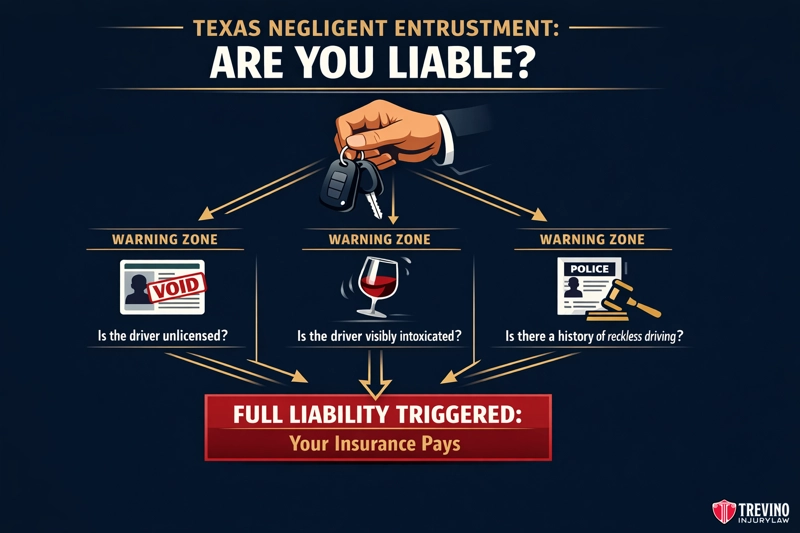
Handing over the keys can hand over the blame. This “deep pocket” strategy is often the difference between a minimum policy settlement and full compensation.
What Document Evidence Proves the Owner Should Have Known?
To win a negligent entrustment claim, we must present evidence establishing that the owner had “constructive knowledge” of the driver’s incompetence or intoxication at the time the keys were handed over. Direct knowledge is easy to prove if the owner saw the driver stumbling.
We review police reports and interview police officers to document slurred speech, failed field sobriety tests, or breathalyzer results.
Constructive knowledge requires a deeper forensic investigation. We use Freedom of Information Act (FOIA) requests and subpoena power to pull the driver’s history, looking for past DWIs, suspended licenses, or a pattern of reckless behavior that the owner should have been aware of.
If a trucking company or parent ignored a driver’s suspended license or history of substance abuse, they are liable for the wreck on Bandera Road. Establishing this knowledge is the key to unlocking the owner’s liability coverage.
Establishing who is liable for the car’s use lays the foundation for understanding the even stricter liability that applies when that driver is on the clock for an employer.
When Are Employers Liable for Texas Drunk Driving Accidents?
Employers are liable for Texas drunk driving accidents caused by their employees under the doctrine of Respondeat Superior. We represent clients across the state, from Houston personal injury matters involving commercial fleets to wrecks on I-45 and I-35.
Whether the crash happened on a local road or a major highway, if a delivery driver causes a wreck while performing a job duty, the company is liable. We use our years of experience to hold these corporations accountable. The prevalence of fleet vehicles on freight corridors like I-35 and I-10 makes this a critical avenue for recovery.
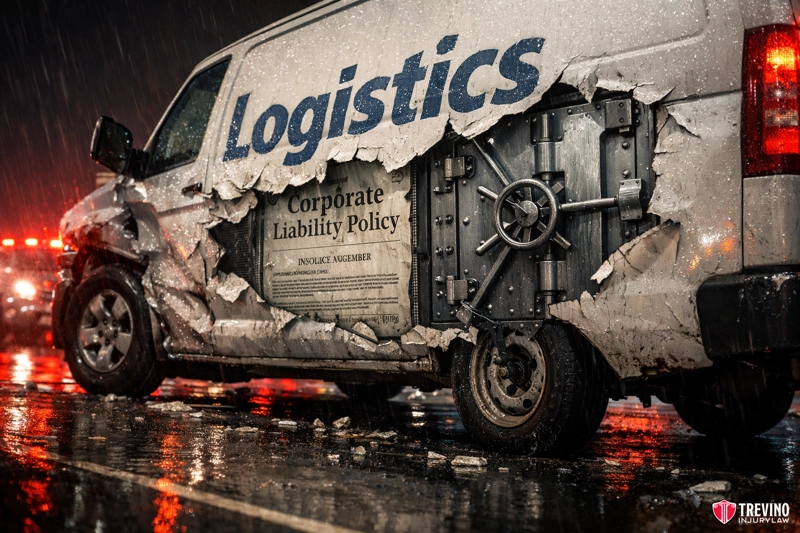
The legal battle often centers on defining “course and scope.” While driving to work is usually not covered, driving between job sites, running a work errand, or driving a company truck with the boss’s permission can trigger liability.
Companies will fight aggressively to claim the driver was on a “personal frolic,” but we use GPS data, logs, and employment contracts to prove they were on the clock.
Does the “Independent Contractor” Label Protect Companies?
Companies frequently attempt to avoid liability by misclassifying drivers as ‘independent contractors,’ but Texas courts look beyond the contract label to the actual ‘right of control.’ In Painter v. Amerimex Drilling I, Ltd., the Texas Supreme Court held that even if a contract says a driver is independent, the company can still be vicariously liable if it retains the right to control the details of the driver’s work, such as the driver’s route, schedule, or safety protocols. We use Painter to strip away these defenses and hold commercial operators accountable.
This distinction is massive in the gig economy and trucking sectors. For example, federal regulations often deem commercial truck drivers “statutory employees,” preventing trucking companies from hiding behind the contractor defense. In San Antonio, where rideshare and delivery services are ubiquitous, we rigorously analyze the specific insurance periods (such as Period 1 vs. Period 2/3 for rideshare apps) to determine which corporate policy applies. We successfully argued this in a case involving a $17 million wrongful death settlement arising from a commercial vehicle accident, proving that the corporate entity could not outsource its safety obligations.
While employers face strict liability for their drivers, the rules change significantly when the alcohol was served at a private home rather than a workplace.
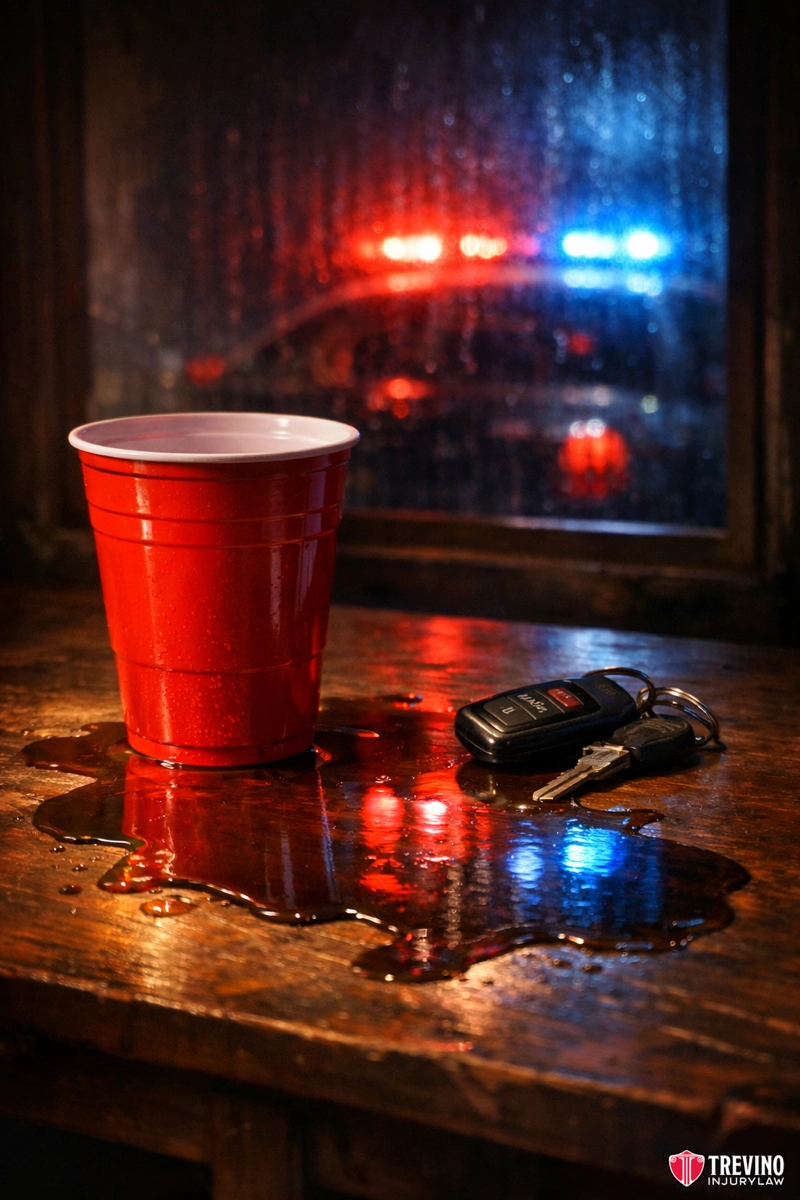
Generally, Texas social host liability rules protect social hosts from liability for serving alcohol to adults, regardless of how intoxicated the guest becomes, but strict liability applies if the host serves alcohol to a minor under age 18. This is a critical distinction from Dram Shop liability, which applies to licensed providers like bars and restaurants.
If you are injured by a drunk driver who was over-served at a friend’s BBQ in Terrell Hills, you typically cannot sue the host for the adult driver’s actions. However, the law is unforgiving when it comes to minors. Under Tex. Alco. Bev. Code § 106.06, furnishing alcohol to a minor, is a criminal offense that can establish negligence per se.
If a parent allows a teenage drinking party and an intoxicated minor drives off and causes a crash on Loop 1604, that adult host is fully liable for the damages. This exception is designed to force adults to prevent underage drinking, and it provides a vital avenue for justice when the victim is an innocent motorist hit by a teen driver.
Understanding these specific immunities sets the stage for asking the broader question: how do we connect the dots when the liability isn’t obvious?
Who Qualifies as Liable for Wrongful Death Under Texas Dram Shop Laws?
Any licensed provider, such as a bar, restaurant, or stadium like the Frost Bank Center, qualifies as liable under Tex. Alco. Bev. Code § 2.02 if they served a patron who was “obviously intoxicated” and a clear danger to themselves and others. This negligence frequently occurs at “last call,” aligning with 2023 TxDOT records showing the peak hour for DUI alcohol crashes is between 2:00 a.m. and 2:59 a.m.
In San Antonio, this often applies to establishments that prioritize profit over safety, continuing to sell drinks to patrons who are already stumbling or slurring. However, these cases are not automatic; we must prove the provider saw, or should have seen, the clear signs of intoxication at the point of sale.
When bar liability is being investigated, where the drunk driving accident originated in San Antonio can help frame the evidence trail from the venue where alcohol was served to the eventual crash.

In Raoger Corp. v. Myers, the Texas Supreme Court made clear that Dram Shop liability turns on what was apparent when the alcohol was served. The Court explained that a provider is liable only when “at the time the provision occurred it was apparent to the provider” that the customer was “obviously intoxicated to the extent that he presented a clear danger to himself and others.”
That matters because a high BAC after the crash is not enough on its own. We must build the case around visible warning signs at the bar, such as slurred speech, stumbling, aggressive behavior, repeated over-service, or witness testimony showing the staff kept serving a dangerous patron.
This establishes a direct line of fault from the bartender’s hand to the collision on I-35. When the driver has no insurance, establishing this liability against a commercial establishment is often the only way to secure the compensation necessary for catastrophic injuries.
How Proportionate Responsibility Affects Your Damage Recovery
Under Texas law, you are barred from recovering damages if a jury finds you more than 50% at fault for an accident.
However, the Proportionate Responsibility statute safeguards your financial recovery through Joint and Several Liability (Tex. Civ. Prac. & Rem. Code § 33.013): if a defendant is found more than 50% responsible for your injuries, they are liable for 100% of the damages.
This prevents solvent defendants from evading payment; for example, if a penniless drunk driver is 40% at fault but a bar is 60% at fault, the bar must pay the entire judgment, ensuring you are not left empty-handed.
Uncovering hidden liability requires a thorough and immediate forensic investigation. We utilize expert testimony and secure temporary restraining orders (TROs) to prevent the destruction of evidence. Our litigation strategy depends on it. We have fought hard to ensure that while the police focus on criminal charges, we focus on civil liability, which often requires evidence that disappears within days of the crash.
We send Spoliation Letters, legal demands that force trucking companies and bars to preserve evidence, and file Freedom of Information Act (FOIA) requests to obtain 911 calls and dashcam video. Without this aggressive evidence gathering, critical proof of “course and scope” or “obvious intoxication” can be legally deleted, allowing liable parties to escape responsibility.
Can I sue if the drunk driver was in a stolen car?
No, you usually cannot sue the vehicle owner if the drunk driver stole the car, as the owner did not grant permission or entrust the vehicle to them.
Are parents liable for their adult children’s drunk driving?
Generally no, parents are not liable for their adult children’s actions unless they specifically entrusted their vehicle to the adult child knowing they were incompetent or intoxicated.
Can I sue the city for safe road defects in a DWI crash?
Yes, you can sue the city if a premises defect like a missing stop sign contributed to the crash, but sovereign immunity waivers are strict and difficult to prove.
What Happens If the Crash Involves a Hit-and-Run Driver?
If the liable driver flees the scene and is never identified, your primary avenue for “full liability” shifts from a third-party lawsuit to your own Uninsured Motorist (UM/UIM) coverage. In these “phantom vehicle” cases, your own insurance company steps into the shoes of the missing defendant, effectively becoming the liable party you must fight for compensation.
While you cannot sue an absent driver, you can still recover damages for your injuries if you can prove the crash was caused by another driver’s negligence, even if that driver is never found. We treat these claims with the same rigor as a standard lawsuit, often using physical evidence from the scene in Southtown or Alamo Ranch to prove the other driver’s existence and fault to your insurer.
When Is It Too Late for an Attorney to Add a Defendant to the Lawsuit?
It is too late to add a new defendant to the lawsuit once the two-year statute of limitations under Tex. Civ. Prac. & Rem. Code § 16.003 expires, meaning any party not named within 24 months of the crash is forever immune from liability.
This strict deadline makes early investigation critical; if we discover 25 months after the accident that the driver was on the clock for a delivery company, we cannot add that employer to the case. Failing to identify all liable parties, such as a vehicle owner or a dram shop, before this window closes is a catastrophic error that prevents you from accessing the full insurance coverage necessary to pay for long-term medical care. We file suit well before this deadline to use the discovery process to identify every potential defendant while there is still time to hold them accountable.
Why Hire a San Antonio Drunk Driving Accident Lawyer?
Insurance adjusters count on “settlement mills” to miss the two-year deadline or accept lowball offers. We don’t fold. Trevino Injury Law acts as the Trial Authority, fighting to force every responsible party—from negligent parents to corporate employers—to pay for your pain.
Want to Protect the Full Value of Your Claim?
You’ve seen how this affects your case — but this is only one piece of the puzzle. Our Drunk Driving Accident Lawyer page breaks down what a trial-ready firm does differently.
We secured a $1.4 million settlement for a spinal injury by proving the gross negligence Bexar County juries refuse to tolerate. We immediately send spoliation letters to preserve evidence, allowing your personal injury attorney to identify deep-pocket defendants before they vanish.
Call 210-TREVINO for a free case review. Se Habla Español. We work on a contingency-fee basis—No Win, No Fee.