Yes, you can sue the homeowner. When the adult who supplied the alcohol knowingly served the driver who hit you, Texas law opens the host’s homeowner’s insurance as the real recovery target. That policy holds what the driver’s coverage cannot: full compensation for your injuries.
The insurance adjuster on your claim immediately invokes blanket social host immunity: the legal shield protecting private hosts who serve adults, betting you never find the statutory exception that strips it and forces the homeowner’s policy open.
Under Texas’s minimum liability law, the drunk driver carries just $30,000 in coverage. That does not cover emergency surgery at University Hospital. The host’s homeowner’s policy does. Determining who can be held liable for a drunk driving accident in Texas often hinges on the guest’s age and the host’s specific actions.
What Could Your Drunk Driving Accident Case Be Worth?
Answer a few quick questions about your accident. Takes about 60 seconds.
See What My Case Might Be WorthThe insurance company offered less than $20,000. I ended up with over $1 million. — Jackie Galindo
Reaching it requires locking the evidence down before the defense builds its ignorance narrative. Send a Spoliation Letter, a legal demand that stops the host from destroying text messages and witness accounts, now. Miss Texas’s two-year filing deadline has passed, and the claim is now permanently gone.
At Trevino Injury Law, our lawyers subpoena the digital record and reconstruct the timeline to force that policy open. Call 210-TREVINO for a free consultation. Se Habla Español.
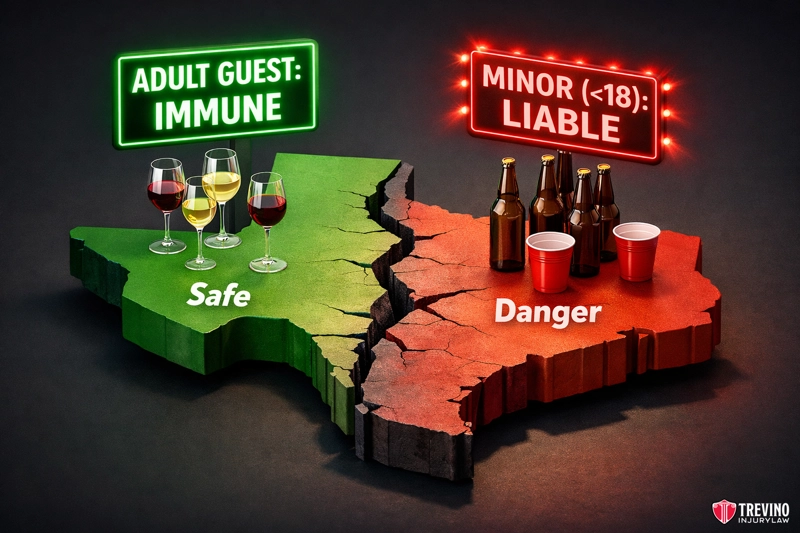
Texas law generally grants strict immunity to social hosts who serve alcohol to adult guests aged 18 and older, but imposes severe civil liability on adults who knowingly serve minors under 18 or allow them to consume alcohol on their property. Even though it’s illegal for most people under 21 to drink, Texas’s civil social host liability statute is narrowly focused on alcohol furnished to, or allowed for, minors under 18.
In San Antonio, the “general rule” is that social hosts are not responsible for the actions of adult guests under the landmark case Graff v. Beard, which established that a social host owes no common-law duty to monitor the alcohol consumption of adult guests.
This means if you are hit by a drunk driver who was overserved at a dinner party in Olmos Park or a tailgate at the Alamodome, you typically cannot sue the host for negligence. However, this immunity vanishes entirely when minors are involved, creating a distinct path for recovery.
Underage drinking remains a major risk. In Texas, an estimated 546,000 people ages 12–20 reported past-month alcohol use (NSDUH 2022). Determining liability often hinges on the guest’s age and the host’s specific actions. While a host in Castle Hills might legally provide alcohol to anyone over 21 without civil fear, that same host faces a lawsuit for providing alcohol to anyone under the age of 18.
For a broader map of potential defendants beyond a private host, see other parties that may be liable for a drunk driving accident in Texas.
The law recognizes that minors cannot responsibly handle alcohol, placing the burden of safety squarely on the adult provider. Establishing this distinction is the first step in building a case, as it shifts the focus from the driver’s negligence to the host’s statutory violation.
No, you generally cannot sue a social host in Texas for overserving an adult guest, even if the host knew the guest was intoxicated and allowed them to drive. Unlike a bartender who is trained and licensed to cut off intoxicated patrons under “Dram Shop” liability, a private host is not expected to judge sobriety levels.
Even if a host encouraged “binge drinking” or provided kegs at a backyard BBQ in Terrell Hills, they are shielded from civil lawsuits if the guest was 18 or older. However, if the intoxication leads to a crash involving a minor, the legal landscape changes immediately.
An adult 21 years or older is liable for damages if they knowingly serve alcohol to a minor under 18 or allow the minor to consume alcohol on property the adult owns or leases. This statutory exception, found in TABC § 2.02(c), is the mechanism Trevino Injury Law uses to trigger homeowner’s insurance policies after a DUI accident involving teenagers. These incidents often turn fatal. In Bexar County in 2024, TxDOT reports 9 DUI (Alcohol) related fatalities involving people under age 21.
It requires proving three specific elements defined by the Texas Alcoholic Beverage Code: the provider was not the minor’s parent, was at least 21 years old, and knowingly provided alcohol to a minor or allowed the consumption to occur.
The Texas Supreme Court confirmed in Reeder v. Daniel that this statute provides the exclusive remedy for social host liability. This means victims cannot sue under general negligence theories but must strictly meet the statutory requirements to pierce the liability shield.
Liability attaches when the host has actual knowledge of the drinking or acts with “willful ignorance” regarding minors consuming alcohol on their premises. Proving that a host “should have known” is often insufficient in Texas courts; the statute demands concrete proof of the host’s mental state. In the context of a San Antonio injury case, this means we must find proof that the host was physically present and witnessed the drinking, or that they supplied the alcohol directly.
Without this “knowing” element, a homeowner in Hollywood Park could successfully argue they were unaware the teens had snuck alcohol into the house. Our investigation focuses on reconstructing the timeline. Did the host unlock the beer fridge? Did they collect keys at the door? These details distinguish a passive homeowner from a liable social host.
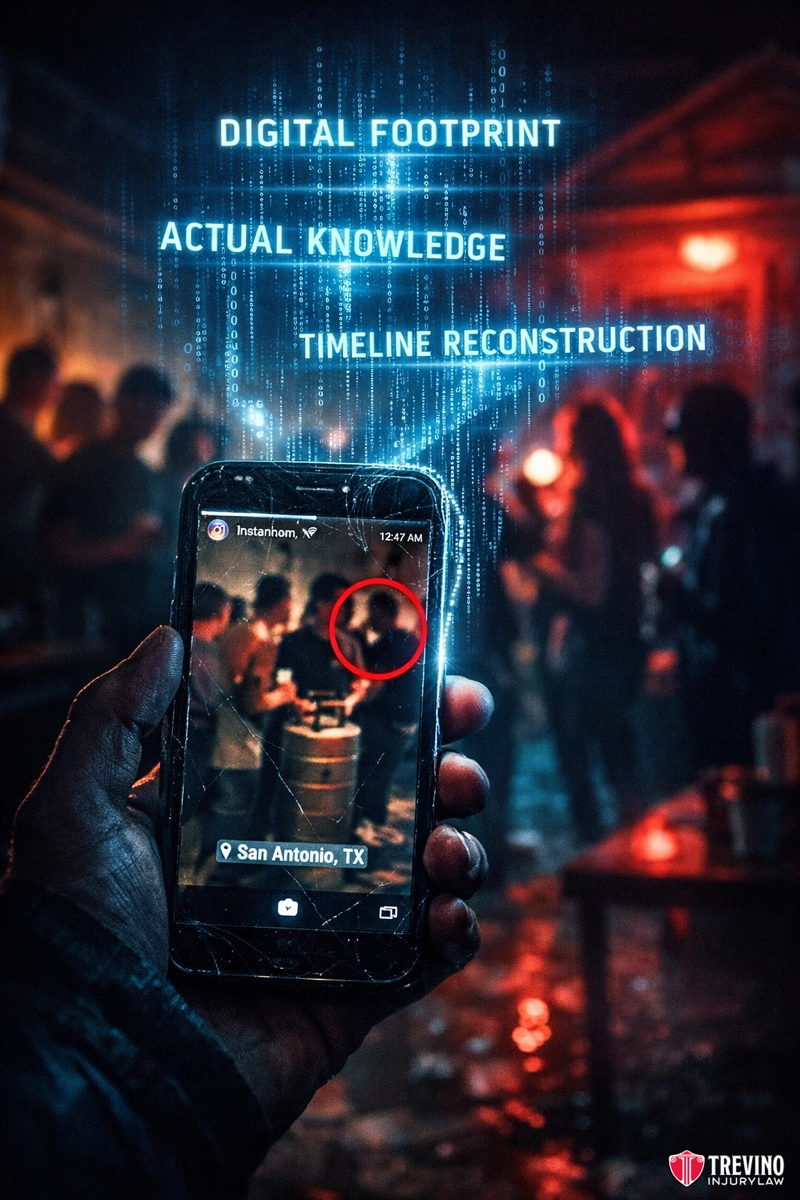
By subpoenaing social media content and deposing other partygoers, we can strip away the defense of ignorance.
Are Parents Liable for Teen Parties on Their Property?
Yes, parents are liable for teen parties on their property if they are present and allow the drinking to occur. Under the “allowed to be served” clause, simply providing the venue, such as a ranch in Helotes or a pool house in Shavano Park, and permitting the drinking to happen creates liability.
This is common when parents are throwing a party for “Senior Week” or after-prom events. They might believe taking car keys makes the drinking safe, but the law still holds them responsible for any damages caused by an intoxicated minor.
What Constitutes “Knowingly Providing” Alcohol?
“Knowingly providing” alcohol includes direct actions like buying alcohol for the minor, giving them access to a liquor cabinet, or unlocking a beer fridge. It is a higher bar than simple negligence.
We often use witness testimony from other partygoers or text messages, such as “Come over, I got a keg” to establish this mental state. Evidence that a host in Leon Valley saw minors with red cups and failed to intervene serves as proof of “allowing” consumption under the statute.
Victims can recover compensatory damages for medical bills, lost wages, and pain and suffering, as well as punitive damages if the host’s conduct constituted gross negligence. We seek these damages directly from the host’s homeowner’s insurance policy.
Because private homes do not have security cameras like commercial bars do, we must build the case on alternative evidence. In many cases, the drunk driver is a minor with little to no assets.
A homeowner in an affluent area like The Dominion or Alamo Heights may have a liability policy ranging from $300,000 to $500,000, or even a $1 million umbrella policy. By connecting the crash back to the social host, Trevino Injury Law accesses these higher limits to ensure you are fully compensated for catastrophic injuries.

This “Deep Pocket” strategy is essential when the driver’s policy is insufficient.
Civil Damages vs. Criminal Penalties: What Is the Difference?
Civil damages are financial payments awarded to the victim, whereas criminal penalties are fines or jail time. A criminal conviction for furnishing alcohol to a minor is powerful evidence for our civil case, a concept known as “Negligence Per Se.”
However, we do not need a criminal conviction to win the civil lawsuit; we can prove liability by a “preponderance of the evidence,” which is a lower standard than the criminal “beyond a reasonable doubt.” This allows us to secure justice for your family even if the police do not pursue charges.
Does Homeowner’s Insurance Cover Auto Accident Damages?
Most standard homeowner’s insurance policies include personal liability coverage that pays for bodily injury caused by the policyholder’s negligence, including social host violations. This coverage applies even if the alcohol was consumed at the policyholder’s residence, but the actual crash occurred miles away on a highway like Loop 1604 or I-10.
This is the primary target in social host cases. In many drunk driving crashes, the at-fault driver is a teenager with a minimum liability policy of only $30,000, which is rarely enough to cover the cost of emergency surgery at University Hospital.
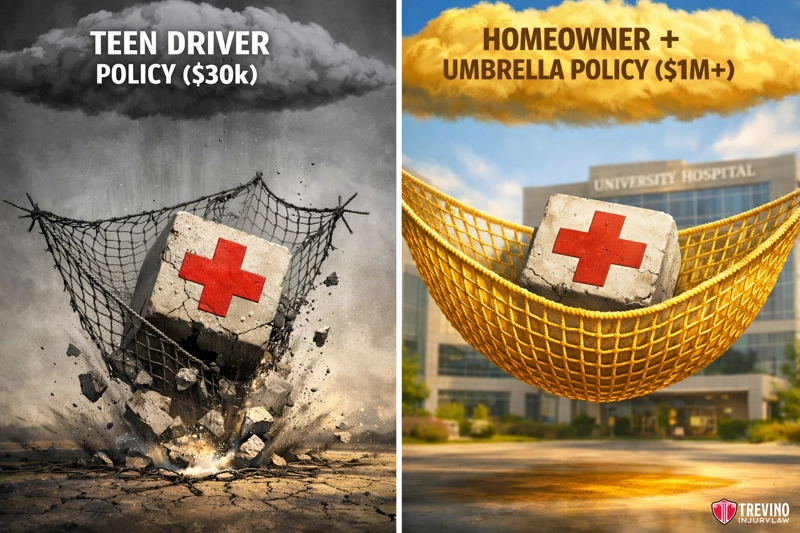
However, a homeowner in an affluent community like Hill Country Village or Fair Oaks Ranch typically carries liability limits of $300,000 to $500,000, and often holds an additional umbrella policy. We handle cases across the county including San Antonio, Helotes, and Universal City.
Who Can Be Sued Under Texas Dram Shop Law After a DUI Crash?
Under Texas Dram Shop Law, victims can sue licensed commercial providers, such as bars and restaurants, if they served alcohol to an obviously intoxicated person who subsequently caused a DUI crash. This liability is firmly established by legal precedents like El Chico Corp. v. Poole, which distinguish commercial vendors from social hosts, who generally cannot be held liable for overserving adults.
This distinction provides a critical pathway for recovering damages in accidents originating near high-traffic entertainment districts like The Pearl or Southtown, where business-related alcohol consumption is a primary factor.
Can a bartender be held liable for a drunk driving accident?
Yes, bartenders and their employers can be held liable under the Texas Dram Shop Act if they serve an obviously intoxicated person who effectively causes a crash.
Does “BYOB” protect a social host from liability?
No, if a social host knowingly allows a minor to consume their own alcohol on the property, the host is still liable.
Will insurance pay if I was drunk?
Generally, your own liability insurance will pay for damages you cause to others, but it may not cover your own injuries if you were committing a crime like DWI at the time.
Local DUI Context
Understanding the broader scope of drunk driving in our area highlights the need for accountability. In 2023, San Antonio saw 1,380 DUI (Alcohol) crashes with 29 fatalities. Bexar County recorded 1,844 total crashes and 46 fatalities. Across Texas, 1,053 people were killed in crashes where a driver was under the influence of alcohol in 2024.
The “Safe Harbor” Defense: When Can Parents Serve Minors?
Texas law provides a specific “Safe Harbor” defense that allows a parent, guardian, or spouse to provide alcohol to their own minor child if they are visibly present. This grants immunity to parents having dinner in Windcrest or Live Oak, provided they are supervising.
However, this protection never extends to the minor’s friends; a parent faces immediate liability the moment they offer a drink to their child’s guest.
When Is a Property Owner NOT Liable for Guests’ Drinking?
A property owner is generally not liable if they were not physically present, did not provide the alcohol, and had no actual knowledge of the drinking. Mere ownership, such as owning a rental property in Converse or a vacant lot in Somerset, is not enough to establish liability if the owner was absent.
Without the “knowing” element, there is an absence of duty.
If you miss the two-year Statute of Limitations for filing a personal injury lawsuit in Texas, your right to sue the social host expires permanently. This deadline is absolute, making it critical for victims in Selma or Universal City to contact our law offices immediately.
Why hire a DWI Attorney?
Texas law strictly protects social hosts who serve adults, but that immunity vanishes the moment a minor is knowingly served alcohol on private property. If your family is suffering because a homeowner in Bexar County allowed a teen to drink and drive, you cannot rely on the driver’s minimum liability coverage alone.
Want to Protect the Full Value of Your Claim?
You’ve seen how this affects your case — but this is only one piece of the puzzle. Our Drunk Driving Accident Lawyer page breaks down what a trial-ready firm does differently.
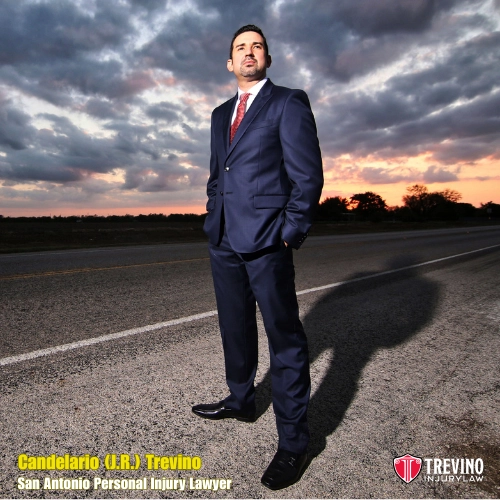
You need the substantial limits of the host’s homeowner’s insurance to pay for your catastrophic injuries. You need the best personal injury accident attorney immediately. Call 210-TREVINO for a free consultation.
We will secure the witness testimony and digital evidence needed to prove they knew.