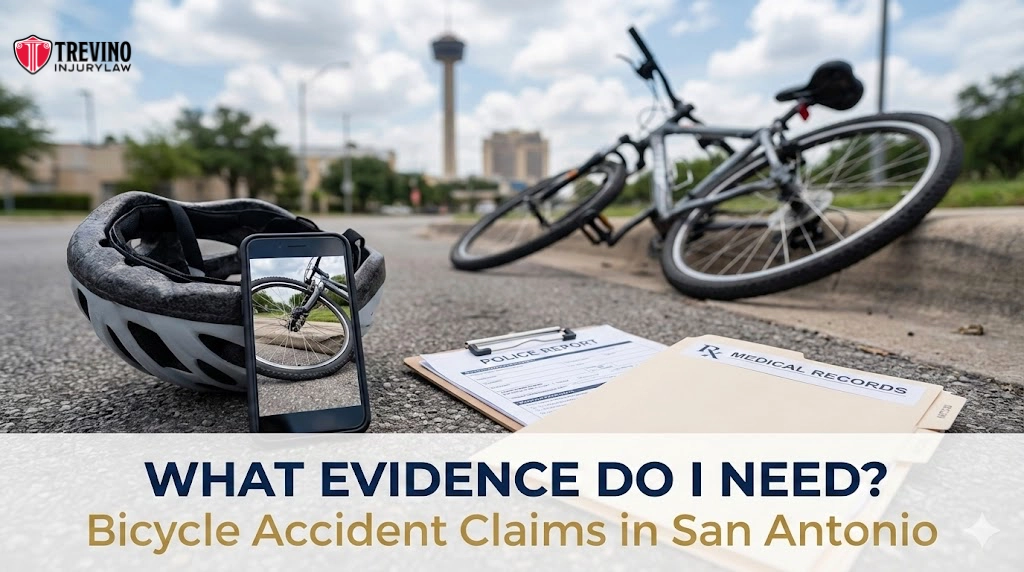
A San Antonio bicycle crash shatters your physical health and instantly forces you into a hostile claims process. The physical impact is over, but the fight to prove liability is already underway.
The insurance adjuster is actively exploiting Texas comparative fault laws to blame you for the collision, searching your medical records for gaps to classify your trauma as pre-existing. According to the Texas Department of Transportation, bicyclist fatalities surged 58% between 2019 and 2023. Speeding and driver inattention drive this spike, yet insurance companies twist the facts to protect their own profit margins.
What Could Your Bicycle Accident Case Be Worth?
Answer a few quick questions about your accident. Takes about 60 seconds.
See What My Case Might Be WorthThe insurance company offered less than $20,000. I ended up with over $1 million. — Jackie Galindo
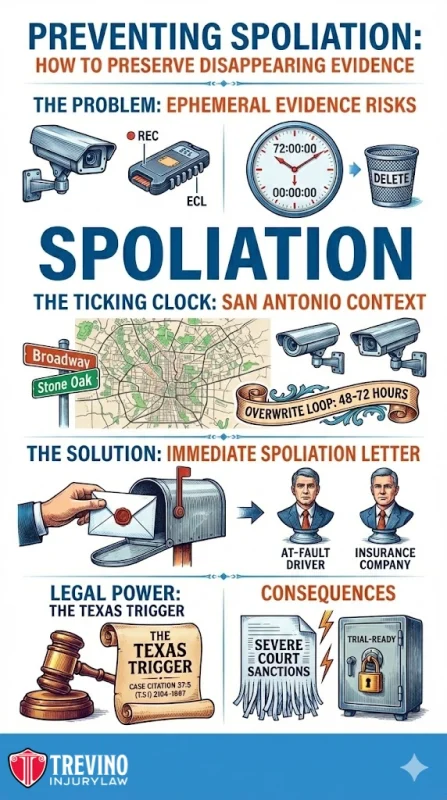
The proof you need to establish negligence vanishes in days. Security cameras along corridors like Broadway automatically rewrite their footage, and modern vehicle black box data gets wiped during routine repairs. You must immediately send a Spoliation Letter, a legal demand that stops the at-fault party from destroying evidence, to lock down this ephemeral digital proof.
Trevino Injury Law, bicycle accident lawyers, subpoena the surveillance video and download the crash data before it disappears forever. Call 210-TREVINO now for a free case review. You pay nothing unless we win. Se Habla Español.
What Constitutes “Strong Evidence” for a Bicycle Accident Lawsuit?
Substantial evidence in a Texas bicycle accident lawsuit goes beyond basic contact information; it must meet the Texas Supreme Court’s rigorous legal standards for negligence. As affirmed in landmark decisions like Greater Houston Transp. Co. v. Phillips, 801 S.W.2d 523 (Tex. 1990), a plaintiff must provide admissible proof, such as certified police reports and authenticated records, to legally establish that a driver owed a specific duty of care and that their breach of that duty was the proximate cause of your injury.
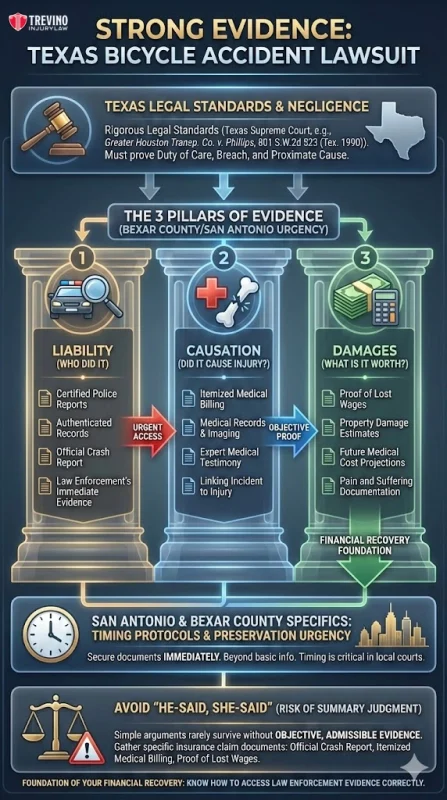
While the primary considerations for seeking medical attention apply to any bicycle accident, the specific timing protocols and evidence-preservation requirements in San Antonio create additional urgency.
Beyond the standard advice to “get names and numbers,” victims in Bexar County must secure documents that specifically satisfy the “3 Pillars of Evidence” required in personal injury cases: Liability (who did it), Causation (did it cause the injury), and Damages (what is it worth).
In local courts, a simple “he-said, she-said” argument without objective evidence rarely survives a motion for summary judgment. You must gather specific documents required to claim bike insurance, including the official crash report, itemized medical billing, and proof of lost wages, which serve as the foundation of your financial recovery. The most immediate pillar of liability evidence is created by law enforcement, but you must know how to access it correctly.
How Do I Obtain and Correct a San Antonio Police Report?
You can obtain your official crash report (CR-3) from the TxDOT online portal or the San Antonio Police Department Records Unit; if the report contains factual errors, your attorney must immediately file a supplemental report to contest them.
Securing this document is the first critical step in validating your claim. You can purchase the report through the TxDOT Crash Report Purchase Portal or visit the SAPD Records Unit in person.
However, simply having the report is not enough if it is inaccurate. While officer opinions, such as a note stating a cyclist was speeding, are challenging to change, factual errors, such as the wrong time of day, an incorrect location, or missing insurance policy numbers, can be amended.
Your attorney can submit evidence to correct these facts, ensuring the official record supports your version of events.
How do Medical Records serve as legal evidence?
Medical records are the linchpin of “legal causation,” serving a function far beyond simple diagnosis. Under the strict evidentiary standards of Guevara v. Ferrer, 247 S.W.3d 662 (Tex. 2007), lay testimony alone is often insufficient to prove that an accident caused a specific injury; your records must explicitly link the collision to your medical condition to withstand insurance defense tactics attempting to label your injuries as “pre-existing” or unrelated.
Insurance adjusters often look for a “gap in treatment” to argue that your injuries were not serious or were caused by something else. To prevent this, your records must be specific. It is not enough for a doctor at University Health System to write “patient has back pain”; the record must explicitly state “patient injured in bicycle collision”.
This specific phrasing connects the medical diagnosis directly to the legal event, thereby closing the causation loop. Documents are crucial, but in modern accidents, some of the most substantial evidence is digital and can disappear in days.
How Do I Preserve and Collect Evidence That Might Disappear (Spoliation)?
Evidence such as surveillance footage and electronic vehicle data is often ephemeral, with a risk of deletion within days. To address this, we use the protections established in Brookshire Bros., Ltd. v. Aldridge, 438 S.W.3d 9 (Tex. 2014), by sending immediate ‘spoliation letters’ that trigger a legal duty for the at-fault party to preserve evidence, potentially subjecting them to severe court sanctions if they subsequently destroy critical evidence.
While understanding your potential damages is essential, having a trial-ready attorney transforms those damages from a calculation on paper into actual compensation your family receives. “Spoliation of evidence” occurs when critical proof is destroyed or altered, either negligently or intentionally.
To prevent this, your lawyer immediately sends a certified preservation letter to the driver and their insurer, giving them official notice to retain all evidence.
This is particularly vital in San Antonio, where businesses along busy corridors like Broadway or Stone Oak often have security cameras that capture accidents.
However, these systems usually overwrite footage every 48 to 72 hours, meaning the evidence of your crash could be deleted before you even leave the hospital. The most potent “silent witness” in many San Antonio cases is video, but accessing it requires legal authority.
How Do I Secure Surveillance or Dashcam Footage?
Securing footage from private businesses or traffic cameras often requires a subpoena or an immediate preservation request, as private owners are rarely legally obligated to provide video to the public.
There is a significant difference between public and private footage. While City of San Antonio (COSA) traffic cameras at major intersections such as Culebra Road or San Pedro Avenue might capture the crash, accessing this government data is subject to strict bureaucratic deadlines.
Private footage from businesses such as H-E-B or Valero is equally valuable but harder to obtain voluntarily. Store managers generally will not release security video to a victim without a court order. This is where your attorney’s subpoena power becomes essential, forcing the release of evidence that proves exactly how the collision occurred.
What Electronic Evidence Can Be Pulled from the Vehicle?
Most modern vehicles are equipped with an Event Data Recorder (EDR), or “black box,” that captures critical data seconds before impact, including speed, braking use, and steering input.
This data serves as an objective witness that cannot lie or forget details. It can, for instance, prove that the driver was speeding well above the speed limit or failed to apply the brakes before hitting you. These data points strongly suggest distraction or gross negligence.
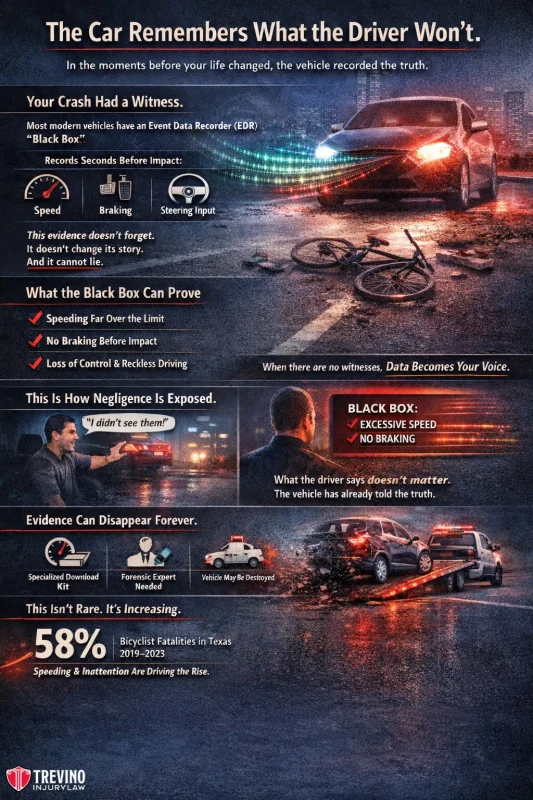
However, accessing the black box requires a specialized download kit and forensic expertise, which Trevino Injury Law provides to ensure this technical evidence is preserved before the vehicle is repaired or scrapped.
The urgency of securing this objective data is underscored by recent statistics from the Texas Department of Transportation, which reports that bicyclist fatalities increased 58% from 2019 through 2023, with driver inattention and speeding cited as the top contributing factors in crashes.
We’ve gathered the evidence; now we must understand how it is used to prove the most contested element of your claim.
How Is Evidence Used to Determine Fault in Texas?
In Texas civil courts, fault is determined by the “preponderance of the evidence,” meaning you must prove that it is “more likely than not” (51%) that the driver’s negligence caused the bicycle accident.
Unlike criminal cases where guilt must be proven “beyond a reasonable doubt,” civil personal injury claims rely on tipping the scales just slightly in your favor. Do you need proof for an insurance claim? Yes, because under Texas’s “Comparative Fault” laws, the insurance company will use any lack of evidence to argue that you were partially responsible for the crash. For the roadway and local rules insurers may cite in that dispute, see how San Antonio bicycle laws affect an injury claim.
If they can convince a jury you were more than 50% at fault, you recover nothing. We use the evidence we have gathered, video, black box data, and witness statements to systematically chip away at their defense and ensure the liability remains firmly on the driver. Sometimes, the “hardest” injury to prove isn’t a broken bone, but an invisible one that requires specialized testing.
What Is the “Hardest Injury to Prove” with Evidence?
Soft tissue injuries (whiplash) and mild Traumatic Brain Injuries (TBIs) are the hardest to prove because they do not appear on standard X-rays, requiring specialized evidence like MRI diffusion tensor imaging or neuropsychological testing.
Insurance adjusters often classify these as “subjective complaints,” implying that because they cannot see a fracture on an X-ray, the pain isn’t real. To counter this, we rely on “objective” advanced imaging and the “before-and-after” testimony of people who know you best.
Statements from family members or coworkers in San Antonio about how your personality or work ability has changed provide the context needed to prove the reality of your suffering. While we gather positive evidence, we must also ensure you don’t inadvertently create negative evidence that undermines your case.
This tactic is statistically significant because TxDOT’s 2024 crash data reveals that ‘suspected minor injuries’ (1,388) outnumber ‘suspected serious injuries’ (428) by more than 3-to-1. This means the vast majority of bicycle accident victims fall into this contested category, facing an uphill battle to prove that their ‘minor’ injury deserves significant compensation.
What Evidence Can Hurt My Bicycle Accident Claim and Compensation?
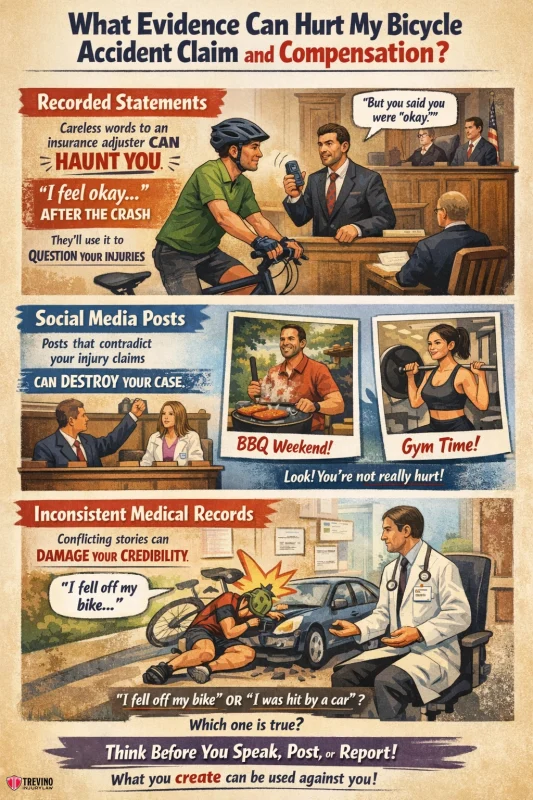
The most damaging evidence in a bicycle accident claim is often created by the victim themselves, including recorded statements given to insurance adjusters, social media posts that contradict injury claims, and inconsistent medical histories that defense attorneys exploit to undermine your credibility.
Many cyclists mistakenly believe that being honest is enough, but insurance companies are experts at twisting innocent statements into “negative evidence.”
The most common trap is the recorded statement: once you give a recorded account to an adjuster without an attorney present, that audio file becomes permanent evidence. If you vaguely say you “feel okay” immediately after the crash, before the adrenaline wears off, they will play that recording in court to argue your injuries are fake.
Social media is another powerful tool for the defense. If you claim to have debilitating back pain from a collision on the San Antonio River Walk trails but post photos of a weekend barbecue or gym workout, defense lawyers will present those images to the jury as proof of dishonesty.
Additionally, inconsistencies in your medical history can be fatal to your case. Telling an ER doctor “I fell off my bike” instead of “I was hit by a car” creates a conflicting official record that is difficult to undo. Understanding what not to make is as important as knowing what legal standards apply, especially when you need to prove your case is more likely true than not.
What Is the “Standard of Proof” in Most Personal Injury Cases?
The standard of proof in personal injury cases is the “preponderance of the evidence,” which requires you to demonstrate that your version of events is more likely true than not, effectively tipping the scales just past 50%.
Unlike criminal cases, where the prosecutor must prove guilt “beyond a reasonable doubt,” civil claims in Bexar County Civil District Courts do not require absolute certainty. You simply need to provide better proof than the other side. For example, if we have a credible witness and the defense has none, we have likely met the preponderance standard.
Our job as your legal team is to stack every piece of evidence, from medical records to dashcam footage, until that 51% threshold is undeniably met. This is why seemingly minor details matter; they are the weights that tip the scale in your favor.
Do I Need a Police Report to File a Bike Accident Claim?
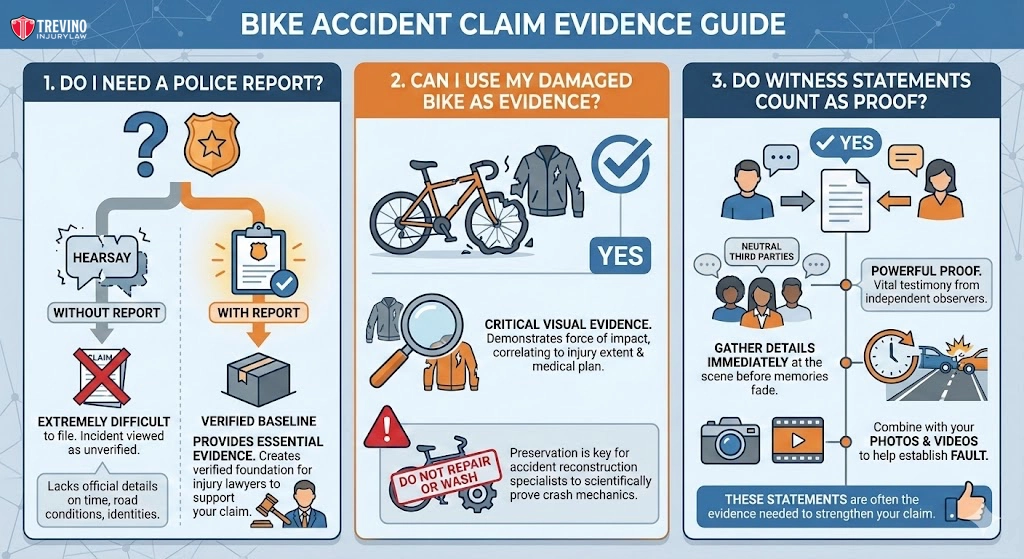
While not strictly impossible, filing a claim without a police report is extremely difficult. These records provide essential evidence of how the accident occurred, including the time, road conditions, and the identities of all involved parties.
Without this official information about the accident, insurance companies generally view the incident as unverified “hearsay.” A police report creates the verified baseline that an injury lawyer needs to support your claim.
Can I Use My Damaged Bike as Evidence?
Yes. The physical damage to your bicycle and torn clothing is critical visual evidence. They demonstrate the force of impact, which directly correlates to the extent of your injuries and your resulting medical treatment plan.
Do not repair or wash your bicycle or gear; accident reconstruction specialists may need to examine them to scientifically establish the crash mechanics. This preservation is often the evidence you need to strengthen your claim.
Do Witness Statements Count as Proof?
Yes, independent witness statements are powerful proof. Testimony from witnesses to the accident is vital because it comes from neutral third parties.
Gathering their details immediately after the accident, while still at the scene, ensures you capture their account before memories fade.
These statements, alongside your photos and videos, help establish fault and are crucial if you were injured in a bicycle accident and are seeking the compensation you deserve.
What Happens If Key Evidence Is Lost or Destroyed?
If evidence is lost or destroyed by the at-fault party after being notified to preserve it, the court may sanction them or instruct the jury to presume that the missing evidence would have been harmful to their case (Spoliation Instruction).
In Texas litigation, “spoliation” is a serious offense. If a trucking company deletes logbooks or a store erases security footage after receiving our preservation letter, we can seek sanctions from the court. The most powerful sanction is a “jury instruction” telling jurors they must assume the destroyed evidence would have proven the defendant’s guilt.
However, the catch is that you must prove they knew they had a duty to save it. This is why hiring an attorney immediately is critical; without that official preservation letter sent via certified mail, the other side can claim they deleted the files as part of “routine maintenance.”
Preventing destruction is only one part of the equation; you must also proactively gather the core components of your claim.
What Are the “3 D’s” of Insurance Claim Evidence?
The “3 D’s” of a successful claim are Documentation (reports and records), Diagnosis (medical proof of injury), and Damages (financial proof of loss), all of which must be supported by tangible evidence.
If any one of these “D’s” is missing, the entire claim can fail. Documentation establishes the facts of the event, including the police report, scene photos, and witness information.
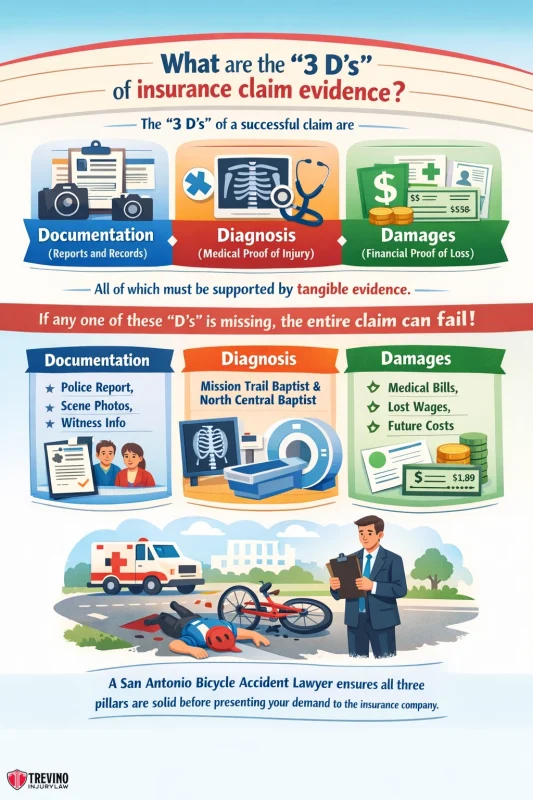
A diagnosis validates the physical reality of your pain with objective medical data, such as X-rays and MRI reports from facilities like Mission Trail Baptist or North Central Baptist.
Finally, Damages quantifies that pain in financial terms using medical bills, proof of lost wages from your employer, and estimates of future care costs. A San Antonio bicycle accident lawyer ensures all three pillars are solid before presenting your demand to the insurance company.
Why Hire a San Antonio Bicycle Accident Lawyer?
When surveillance footage on Broadway vanishes in 48 hours, you cannot face insurance adjusters alone. We shift focus from the chaos of the crash to demanding your rightful financial compensation. Insurance giants rely on delay tactics and “settlement mills” that fold under pressure. At Trevino Injury Law, our trial lawyers prepare for war and force the other side to pay.
Want to Protect the Full Value of Your Claim?
You’ve seen how this affects your case — but this is only one piece of the puzzle. Our Bicycle Accident Lawyer page explains how a trial-ready firm operates differently.
We aggressively litigate in Bexar County, turning lowball rejections into record-setting results, including our 107x jury verdict. Retain a San Antonio accident compensation lawyer immediately to send spoliation letters and secure black box data before it is destroyed.
Call 210-TREVINO for a free case review. Se Habla Español. We win, or you pay nothing.