
A crush injury at a construction site or an oil field accident changes your life in seconds. You are in pain, fearing job loss, and facing medical bills. Your foreman tells you to walk it off and wait.
The insurance adjuster is already using that delay against you. They encourage a verbal conversation rather than a formal report to create a gap in care and argue that your injury did not occur at work. According to the 2023 Texas Census of Fatal Occupational Injuries, the state construction sector recorded 124 confirmed fatalities. Behind these casualties is an employer minimizing safety to protect profits, leaving you financially exposed.
What Could Your Work Injury Accident Case Be Worth?
Answer a few quick questions about your accident. Takes about 60 seconds.
See What My Case Might Be WorthThe insurance company offered less than $20,000. I ended up with over $1 million. — Jackie Galindo
Evidence from heavy industrial sites fades fast. Scaffolding moves, spills get cleaned, and warehouse surveillance systems overwrite digital video within seventy-two hours. You must file a formal written report within thirty days or forfeit your right to benefits entirely. A Spoliation Letter, a legal demand that prevents the property owner from destroying evidence, must be sent immediately to lock down maintenance logs and security feeds.
Trevino Injury Law’s work injury lawyers bypass the adjuster’s traps and force the company to preserve the scene. Call 210-TREVINO now for a free case review. You pay nothing unless we win. Se Habla Español.
What Are the First Steps to Take After a Workplace Injury?
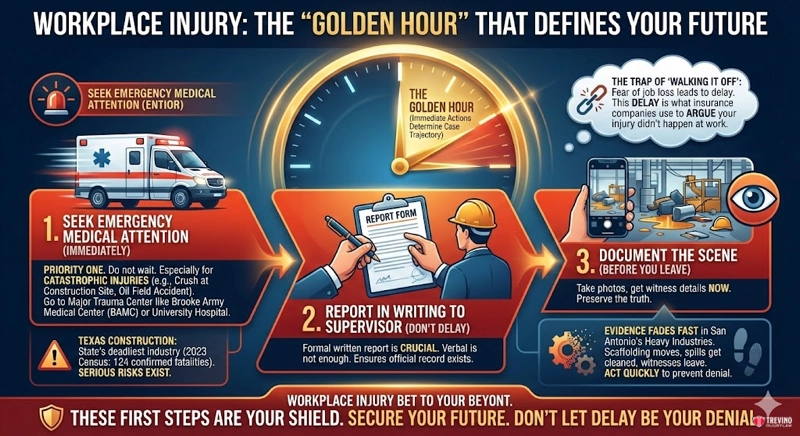
The first steps are to seek emergency medical attention immediately, report the injury in writing to a supervisor, and document the scene with photos and witness details before leaving the premises, to ensure your claim isn’t denied later.
These “Golden Hour” actions determine the trajectory of your entire case.
If you have suffered a catastrophic injury, such as a crush injury at a construction site identified by the 2023 Texas Census of Fatal Occupational Injuries as the state’s deadliest industry sector with 124 confirmed fatalities, or an oil field accident, your priority must be getting to a major trauma center immediately,y like Brooke Army Medical Center (BAMC) or University Hospital.
Many workers try to “walk it off” or wait to see if the pain goes away because they fear losing their job, but this delay is exactly what insurance companies use to argue your injury didn’t happen at work.
In San Antonio’s heavy industries, evidence changes rapidly; scaffolding is moved, spills are cleaned, and witnesses leave, so you must act quickly to preserve the truth of what happened.
How Do You Document the Accident Scene Before Leaving?
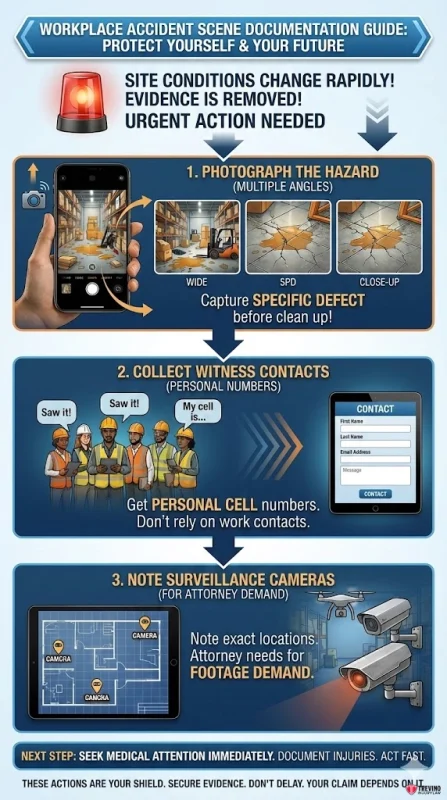
You can document the scene effectively by taking explicit photos of the hazard from multiple angles, collecting the names and phone numbers of all witnesses, and noting the exact locations of any surveillance cameras before site conditions are altered or evidence is removed.
Leaving the scene without evidence forces your lawyer to reconstruct the accident months later, when proof may be gone.
To protect your rights, you must gather specific information immediately:
- Photographs of the Hazard: Take wide shots and close-ups of the hazard, such as a slippery floor, an unguarded machine, or defective scaffolding.
- Witness Contact Information: Collect the personal cell phone numbers of coworkers who saw the incident, as they may change jobs or move away.
- Surveillance Cameras: Note if there are cameras at the facility, such as in a warehouse or distribution center, so your attorney can demand that footage later.
Once you have secured the physical evidence at the scene, you must immediately navigate the medical system to document your physical injuries.
Should You Go to the Company Doctor or Your Own Physician?
You should generally see your own doctor unless your employer is part of a certified Workers’ Compensation Health Care Network (HCN), as independent doctors prioritize your health over the company’s insurance costs and are less likely to minimize your diagnosis.
In Texas, many employers are ‘non-subscribers,’ meaning they opt out of the state-regulated workers’ compensation system.
In these cases, the landmark Supreme Court of Texas decision Kroger Co. v. Keng, 23 S.W.3d 347 (Tex. 2000), established that non-subscribers lose standard defenses, such as the partial-fault defense.
Because they are fully exposed to negligence claims, these employers often pressure you to see ‘company doctors’ who may minimize your diagnosis to a simple sprain. Seeing your own independent physician is critical to countering these tactics and accurately documenting the harm caused by the employer’s negligence.
If you are not in a strict HCN, go to an independent ER or urgent care facility to ensure your medical records accurately reflect the severity of your condition.
Once your medical needs are met and your injuries are documented, the official clock for reporting the incident begins.
How Long Do You Have to Report an Accident at Work in Texas?
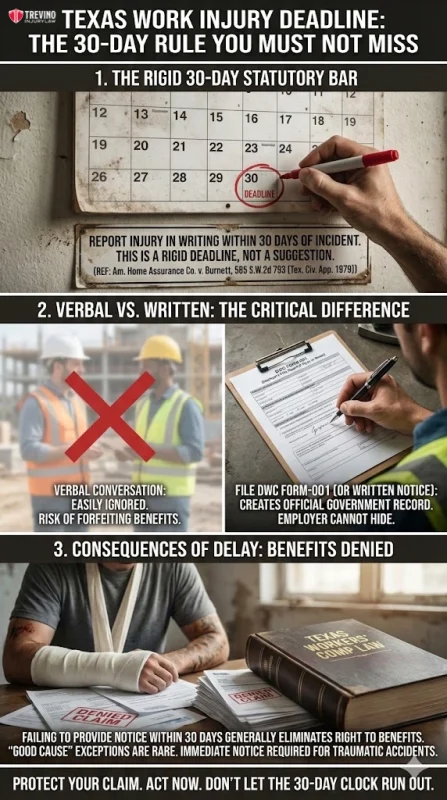
Under Texas law, you must report your work injury to your employer within 30 days of the incident. This deadline is not merely a suggestion; it is a rigid statutory bar, confirmed by cases such as American Home Assurance Co. v. Burnett, 585 S.W.2d 793 (Tex. Civ. App. 1979).
In that decision, the court emphasized that failing to provide notice within 30 days generally eliminates your right to benefits unless a specific ‘good cause’ for the delay exists, a standard that is notoriously difficult to meet.
Without this timely report, you risk forfeiting your benefits entirely, regardless of the severity of your injuries. While there are exceptions for occupational illnesses that develop slowly, a traumatic accident like a fall at a construction site in the Pearl District requires immediate notice.
Do not rely on a verbal conversation with a foreman. To protect your claim, you should file a DWC Form-001 (Employer’s First Report of Injury or Illness) or a similar written notice, which creates an official government record of the incident that the employer cannot easily hide or ignore. This form serves as the official start of your claim and helps prevent the company from claiming they “didn’t know” you were injured.
If you’ve been injured at work in San Antonio, don’t wait to take action. The steps you take now can determine whether you receive the workers’ compensation benefits and medical coverage you deserve.
Why Is Written Notice Better Than Verbal Reporting?
Written notice provides irrefutable proof that you met the 30-day deadline. In contrast, employers frequently deny receiving verbal reports to avoid liability for your medical bills and lost wages in expensive injury cases.
The “he said/she said” defense is a common tactic employers use to avoid paying claims. If you only tell your supervisor verbally, they may later testify that the conversation never happened or that you only mentioned a minor ache rather than a specific accident.
- Sending an email, a text message, or submitting a formal accident report provides a timestamped record that creates a paper trail your attorney can use to prove you followed the law.
- When preparing your written notice, be sure to include every detail of your work-related injury or illness to protect your workers’ compensation coverage. Your report should include the date and location of the injury, the witnesses, and how it occurred.
- If you seek medical care immediately, attach documentation of your treatment plan and doctor’s recommendations. Following your doctor’s orders not only strengthens your claim but also ensures your workers’ compensation insurance continues without delay.
- Submitting a complete, accurate report helps prove that your injury occurred within 24 hours of the incident and prevents the insurance company from denying your compensation coverage.
Once the report is filed, the insurance adjuster will contact you to begin their investigation, often looking for ways to deny coverage.
What Details Must Be Included in Your Incident Report?
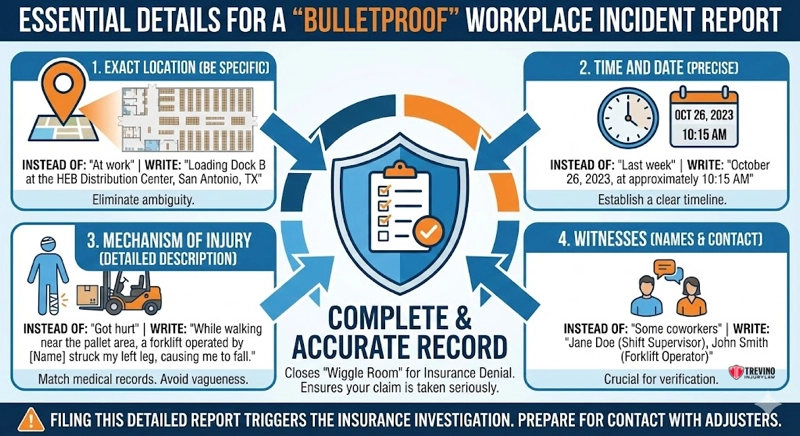
Your report must include the specific date and time of the incident, the exact location within the facility, a detailed description of how the injury occurred, and the names of any witnesses present to ensure the record is complete and accurate.
A vague report can give the insurance company wiggle room to deny your claim.
Ensure your written notice includes the following specific details:
- Exact Location: Be specific, such as “Loading Dock B at the HEB Distribution Center,” rather than just “at work”.
- Time and Date: State the precise time the accident occurred.
- Mechanism of Injury: Describe exactly what happened, for example, “forklift struck my left leg,” to match your medical records.
- Witnesses: List the names of everyone who saw the event.
Filing this detailed report triggers the insurance investigation, which brings you into direct contact with adjusters trained to minimize your payout.
What Should You Not Say to an Insurance Adjuster After an Accident?
You should never give a recorded statement, admit fault, or downplay your symptoms to an insurance adjuster without legal representation, as these statements will be used to devalue or deny your claim later.
Adjusters from companies like Fred Loya or Texas Mutual are trained to extract admissions of guilt or minimize the value of your case. They may act friendly and ask, “How are you feeling?” hoping you will say “I’m fine” or “It’s not that bad”.
These casual comments can be used to destroy a back injury claim that manifests severe pain days later. Your priority is protecting your claim, which means limiting your communication until you have an attorney who knows the playbook.
When speaking with an adjuster after a workplace accident, remember that their goal is to minimize what the insurance company pays, not to help you get the compensation you deserve.
Avoid giving recorded statements, discussing the extent of your injuries, or admitting fault before you notify your employer and speak with an attorney. You have the right to get proper medical attention and allow your workers’ compensation process to move forward without interference.
Instead of handling the claim on your own, let a qualified San Antonio workers’ comp lawyer communicate with the insurance company on your behalf to ensure your rights are protected.
Why Should You Refuse a Recorded Statement?
Insurance adjusters use recorded statements to find inconsistencies in your story compared to the police or medical report, often asking leading questions designed to shift blame away from the employer and onto you.
You are not legally required to give a recorded statement immediately after an accident. Adjusters want this recording early, while you are in pain, confused, or under the influence of medication, because it is the easiest time to get you to say something that hurts your case.
They look for any discrepancy between what you say on the phone and what you told the doctor, using even minor differences to argue that you are lying.
Understanding what not to do helps you recognize the risks of handling the claim entirely on your own.
Do You Need a Lawyer to File a Work Injury Report?
While you do not legally need a lawyer to file the initial accident report, hiring one immediately is crucial if your employer is a non-subscriber or if your injuries are severe to prevent insurance adjusters from manipulating your statement or denying valid coverage.
For minor incidents requiring only basic first aid, you may be able to handle the paperwork yourself. However, if your accident occurred at a high-risk industrial site such as Port San Antonio or involved heavy machinery at Toyota Motor Manufacturing on the South Side, the case’s complexity changes immediately. In these scenarios, corporate legal teams begin their defense investigation immediately.
If you attempt to manage a claim involving significant lost wages or permanent impairment on your own, you are fighting professionals who know precisely how to use Texas labor laws to minimize your payout.
Once you realize that professional legal help is necessary to protect your rights, the next primary concern most workers face is the fear of losing their livelihood for speaking up.
How Do You Handle Employer Retaliation After Reporting?
It is illegal in Texas to fire or discriminate against an employee solely for filing a workers’ compensation claim in good faith. Still, you must document every interaction to prove retaliation if it occurs. For a broader explanation of retaliation, workplace safety rules, and related employee protections, review San Antonio workplace injury rights and OSHA protections.
While the law protects you, employers in competitive sectors like the retail hubs at The Rim or La Cantera often try to bypass these protections by citing “performance issues” or “tardiness” as false reasons for termination.
If your supervisor suddenly changes your shift to impossible hours or assigns physical tasks they know you cannot perform due to your injury, this is a form of “quiet firing” designed to make you quit. You must maintain a detailed log of these events, including dates, times, and specific comments, to build a retaliation case.
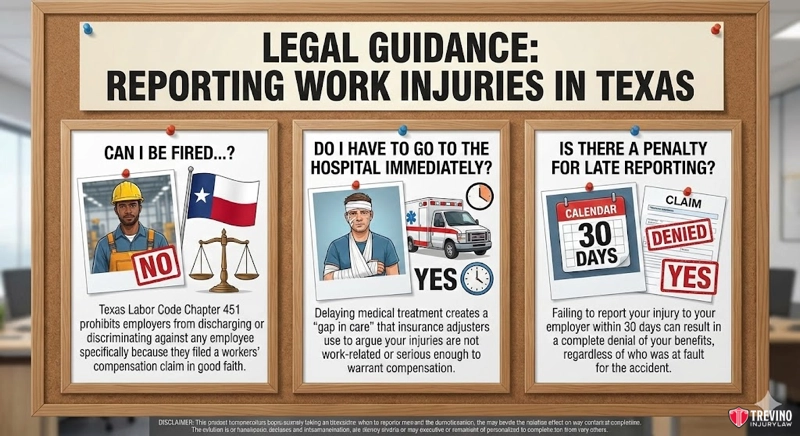
Can I Be Fired for Reporting a Work Injury in Texas?
No, Texas Labor Code Chapter 451 prohibits employers from discharging or discriminating against any employee for filing a workers’ compensation claim in good faith.
The moments following an accident are chaotic, but with the U.S. Bureau of Labor Statistics recording 564 fatal occupational injuries in Texas in 2023, relying on your employer’s goodwill is a mistake that often leads to denied claims and unpaid medical bills.
Do I Have to Go to the Hospital Immediately?
Yes, delaying medical treatment creates a “gap in care” that insurance adjusters use to argue your injuries are not work-related or severe enough to warrant compensation.
Is There a Penalty for Late Reporting?
Yes, failing to report your injury to your employer within 30 days can result in a complete denial of your benefits, regardless of who was at fault for the accident.
How Long Do You Have to Seek Medical Treatment After an Accident?
You must seek medical treatment immediately after a workplace accident, as waiting even 24 to 48 hours creates a “gap in care” that insurance adjusters will use to deny your claim.
In the bustling traffic on Loop 1604 or I-10, it is tempting to drive home and “rest” rather than deal with ER wait times. However, insurance companies view any delay as evidence that you weren’t truly hurt at work.
If you cannot reach a major hospital such as Methodist Stone Oak, visit a reputable urgent care facility in North Central San Antonio immediately. Prompt medical documentation links your injury directly to the time and place of the accident, making it much harder for the insurance company to argue that you were hurt elsewhere.
Understanding the urgency of medical care clarifies why missing administrative deadlines can be equally devastating to your case.
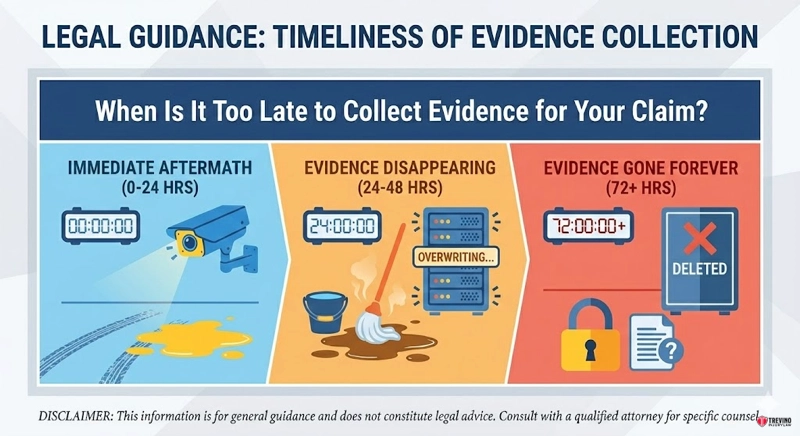
When Is It Too Late to Collect Evidence for Your Claim?
It is often too late to collect critical physical evidence, such as surveillance footage or temporary site conditions, after 24 to 48 hours, as digital data is frequently overwritten and physical hazards are repaired.
The risk of “spoliation,” the destruction of evidence, is highest in the first few days. Large commercial operators, such as those near San Antonio International Airport, often have automated security systems that delete video footage after 72 hours unless a preservation letter is sent.
Similarly, a defective walkway or a spill will be cleaned up immediately to prevent further accidents. Once this evidence is gone, it is gone forever, making it essential to contact a lawyer who can immediately send a preservation-of-evidence letter. Preserving the evidence is only the first step. See how a trial-ready work injury case is built in San Antonio to understand how time-sensitive evidence can be secured and organized for litigation.
What Happens If You Don’t Report the Injury Within 30 Days?
If you fail to report your injury within the 30-day window, you effectively waive your right to recover workers’ compensation benefits in Texas, leaving you with no financial safety net for your medical bills.
This “administrative bar” is strict and unforgiving. Even if you have witnesses and video footage proving the accident happened at a warehouse in Live Oak or Universal City, missing the 30-day deadline gives the insurance carrier grounds to deny coverage automatically.
While you might still have a common-law claim if your employer is a “non-subscriber” (which has a longer two-year statute of limitations), you lose the immediate income and medical benefits that workers’ compensation provides.
Just as your right to benefits can expire due to a missed deadline, the physical proof of your accident can disappear if you don’t act quickly. A workplace accident can leave you stressed, injured, and uncertain about what to do next.
Why Hire a San Antonio Work Accident Lawyer?
Missing a 30-day reporting deadline effectively waives your right to medical coverage in Texas, leaving you financially exposed. Corporate insurers like Texas Mutual and high-volume settlement mills profit by exploiting this “administrative bar” and your “gap in care”. They are not your friends. Trevino Injury Law forces these powerful opponents to pay what they owe by preparing for trial immediately, while other firms fold.
Want to Protect the Full Value of Your Claim?
You’ve seen how this affects your case — but this is only one piece of the puzzle. Our Work Injury Lawyer page breaks down what a trial-ready firm does differently.

We secured a $7.9 million judgment for an injured worker by aggressively preserving evidence before it vanished. Whether your injury occurred at the HEB Distribution Center or a warehouse in Live Oak, a qualified San Antonio injury attorney from our team will immediately file spoliation letters to secure video feeds and maintenance logs.
Call 210-TREVINO for a free case review. Se Habla Español . We operate on a contingency fee—No Win, No Fee.