San Antonio work injury laws operate at the intersection of federal safety mandates and state compensation rules that protect you from retaliation when an employer prioritizes speed over your life.
Human Resources and the insurance adjuster are already moving to suppress your claim to protect company premiums, downgrading your lost-time injury to a minor incident or inventing a pretext to terminate your employment entirely. According to the 2023 Texas Census of Fatal Occupational Injuries, the state’s construction industry recorded 124 worker deaths. Behind these fatalities are contractors who intentionally bypassed guardrails or ignored machinery de-energization protocols to meet a production quota.
What Could Your Work Injury Accident Case Be Worth?
Answer a few quick questions about your accident. Takes about 60 seconds.
See What My Case Might Be WorthThe insurance company offered less than $20,000. I ended up with over $1 million. — Jackie Galindo
Critical evidence vanishes instantly on a job site. You must immediately send a Spoliation Letter, a legal demand that stops the property owner from destroying evidence, to lock down maintenance logs and equipment records before the company erases their gross negligence. If you wait, your leverage disappears.
Trevino Injury Law’s work accident lawyer forces powerful corporations to pay by securing the scene and aggressively preparing for trial. Call 210-TREVINO now for a free case review, where you pay nothing unless we win. Se Habla Español.
What Laws Protect San Antonio Workers from Unsafe Conditions?
The primary laws protecting San Antonio workers are the federal Occupational Safety and Health Act (OSHA), which mandates safe working conditions, and the Texas Labor Code, which explicitly prohibits retaliation for reporting injuries.
Texas is unique in being the only state that allows “non-subscribers,” making these specific safety laws critical to establishing the gross negligence required to win a case in Bexar County courts.
What Legal Obligations Does HR Have to Protect Employees?
Human Resources departments are legally obligated to enforce compliance with safety regulations, maintain accurate OSHA 300 logs of all workplace injuries, and investigate all hazard reports without bias or retaliation. Despite their title, HR’s primary function often shifts toward protecting the company from liability rather than protecting employees from harm.
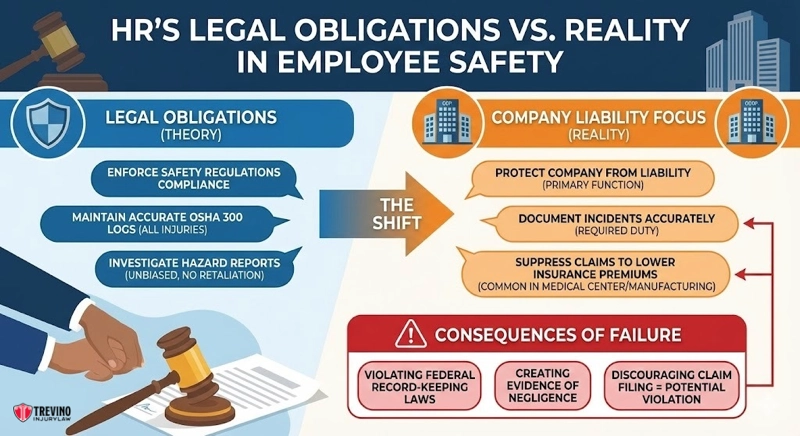
This legal duty requires them to accurately document incidents, yet many companies in the Medical Center and manufacturing hubs attempt to suppress claims to keep insurance premiums low.
If your HR department fails to document your report or discourages you from filing a claim, they may be violating federal record-keeping laws and creating evidence of negligence.
What Should You Do If You Don’t Feel Safe in Your Workplace?
You should immediately report the specific hazard in writing to your supervisor and request a correction. Under the narrow exception established in Sabine Pilot Service, Inc. v. Hauck, 687 S.W.2d 733 (Tex. 1985), you have the right to refuse to perform a task if that task is illegal and would subject you to criminal penalties.
While Texas generally adheres to “at-will” employment, the Texas Supreme Court ruled in Sabine Pilot that no worker should be forced to choose between their livelihood and obeying the law.
Mere fear is not enough; the danger must be immediate, and the request to fix it must be documented. In San Antonio, industries such as construction and oil and gas often involve operating machinery without proper guards or working at heights without fall protection. Always create a paper trail of your refusal to protect yourself against later claims of insubordination.
Understanding your legal rights to a safe workplace provides a framework for identifying the specific, deadly hazards that frequently violate these laws across San Antonio’s major industries.
What Are the Most Dangerous Risks for San Antonio Employees?
The most dangerous risks in San Antonio are falls from heights in the construction sector and heat illness during our extreme summer months, both of which are entirely preventable when employers follow mandatory safety protocols.
Expanding on the general causes of accidents mentioned in our main guide, this section drills down into the specific regulatory violations that drive our region’s fatality statistics, particularly along major infrastructure projects.
With major developments such as the Loop 1604 expansion and new high-rises in the Pearl District, the pressure to work quickly often leads to the safety shortcuts outlined below.
What Is the #1 OSHA Violation in San Antonio Construction?
Here is the optimized copy, focusing on the specific violation codes (Trust Signals) and linking them directly to the Geo-Entities and fatality crisis to establish extreme urgency and authority.
Fall Protection – General Requirements (29 CFR 1926.501) consistently ranks as the most-cited OSHA violation in San Antonio’s construction industry, primarily due to failures to use guardrails, safety nets, or personal fall arrest systems. This violation is particularly prevalent in residential roofing and commercial framing projects across North Central San Antonio.
Employers often skip these life-saving measures to save time, leading to catastrophic injuries that are entirely avoidable. This is not just a regulatory issue; it is a crisis of fatalities.
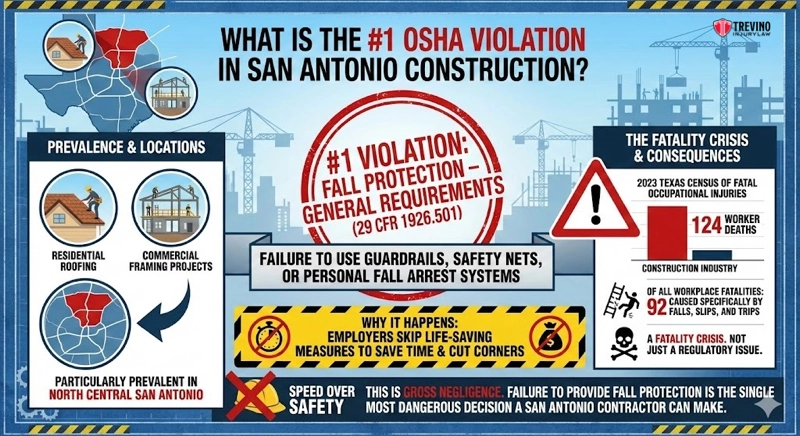
According to the 2023 Texas Census of Fatal Occupational Injuries, the construction industry was the deadliest sector in the state with 124 worker deaths. Of all workplace fatalities, 92 were explicitly caused by falls, slips, and trips, proving that the failure to provide fall protection is the single most dangerous decision a San Antonio contractor can make.
When a company chooses speed over safety equipment, it is not just cutting corners; it is engaging in gross negligence.
What Are Common Workplace Violations in the Eagle Ford Shale?
Common violations in the Eagle Ford Shale sector include Lockout/Tagout failures, where machinery is not adequately de-energized before maintenance, and Hazard Communication violations involving exposure to hazardous chemicals such as silica dust.
For workers commuting from Southside San Antonio to oilfield sites near Somerset, these risks are compounded by fatigue and pressure to meet production quotas. A Lockout/Tagout failure can result in crushed limbs or amputations in seconds.
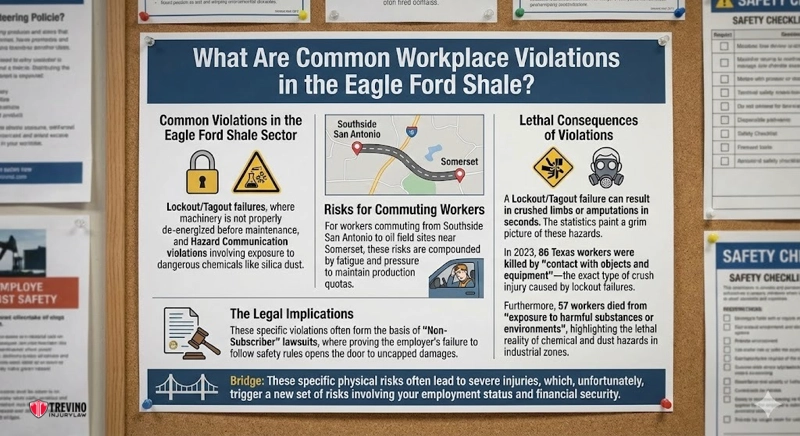
The statistics paint a grim picture of these hazards. In 2023, 86 Texas workers were killed by ‘contact with objects and equipment,’ the exact type of crush injury caused by lockout failures. Furthermore, 57 workers died from ‘exposure to harmful substances or environments’, highlighting the lethal reality of chemical and dust hazards in industrial zones.
These specific violations often form the basis of “Non-Subscriber” lawsuits, in which proving the employer’s failure to comply with safety rules can lead to uncapped damages. If your employer opted out of workers’ compensation, review which work injuries can qualify for a Texas non-subscriber lawsuit for a focused explanation of negligence and qualifying injury scenarios.
These specific physical risks often lead to severe injuries, which, unfortunately, trigger additional risks to your employment status and financial security.
Can You Lose Your Job Because of a Work Injury?
While Texas is generally an “at-will” employment state, Chapter 451 of the Texas Labor Code explicitly prohibits firing, harassing, or discriminating against an employee for filing a good-faith workers’ compensation claim. As established in Continental Coffee Products Co. v. Cazarez, 937 S.W.2d 444 (Tex. 1996), you do not need to prove that your claim was the sole reason for your termination. Still, you must demonstrate that “but for” your injury claim, the termination would not have happened.
Employers often invent a “pretext” for termination, such as suddenly citing you for tardiness or poor performance, days after an injury, to cover up their retaliatory motives.
What is Proof of a Hostile Work Environment After Being Injured at Work?
Proof of a hostile work environment includes documented evidence of sudden shift changes, assignment of impossible physical tasks, or verbal harassment specifically targeting your injury status to force a “constructive discharge.” You must listen closely for specific HR trigger words, such as “liability,” “high risk,” “insurance premium,” or “fit for duty,” when used in a derogatory context.
These terms, when combined with actions such as isolating you from team meetings or relocating your workspace to a less desirable location, serve as evidence that the company is trying to force you to leave. Documenting these interactions is crucial for a retaliation claim.
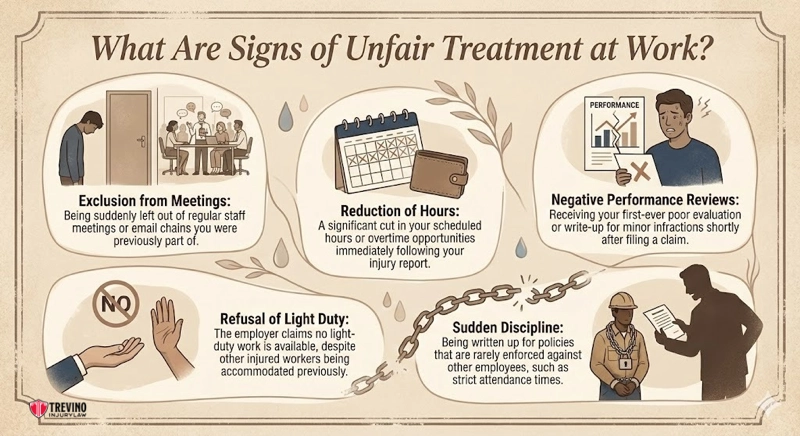
What Are Signs of Unfair Treatment at Work?
- Exclusion from Meetings: Being suddenly left out of regular staff meetings or email chains you were previously part of.
- Reduction of Hours: A significant cut in your scheduled hours or overtime opportunities immediately following your injury report.
- Negative Performance Reviews: Receiving your first-ever poor evaluation or write-up for minor infractions shortly after filing a claim.
- Refusal of Light Duty: The employer states that no light-duty work is available, despite having previously accommodated other injured workers.
- Sudden Discipline: Being written up for policies that are rarely enforced against other employees, such as strict attendance times.
How Do These Laws Impact Your Work Injury Compensation?
Violating these specific safety laws is key to obtaining uncapped negligence damages in a non-subscriber lawsuit, effectively removing compensation caps and allowing you to recover fully for pain and suffering, as well as future medical needs.
In many San Antonio work injury cases, specifically those involving “non-subscriber” employers who opted out of state workers’ comp, proving a safety violation is the “golden key” to the case.
When we can demonstrate to a jury in the Bexar County Courthouse that your employer ignored a known OSHA regulation, such as the fall protection standards mentioned earlier, the claim becomes gross negligence.
This legal distinction is massive. It prevents the company from blaming you for the accident. It opens the door to punitive damages, intended to punish the company for its reckless disregard for human life. Instead of just receiving paid medical bills, you become eligible for life-changing compensation that secures your family’s future.
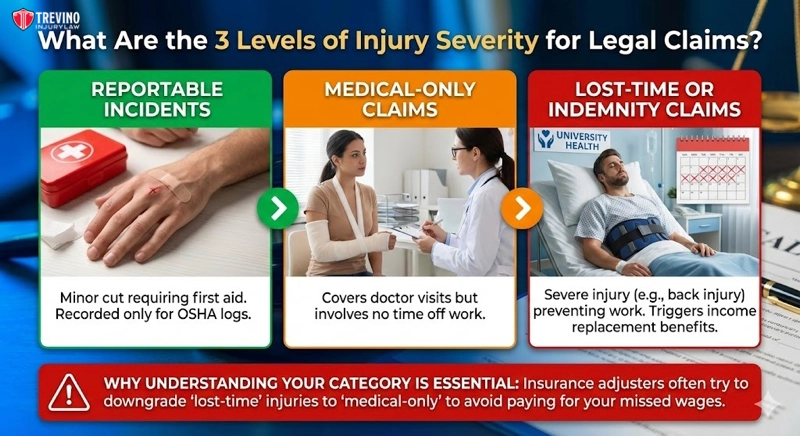
What Are the 3 Levels of Injury Severity for Legal Claims?
For legal purposes in Texas, work injuries are generally categorized as reportable incidents, medical-only claims, and lost-time or indemnity claims, with the severity determining your potential compensation. A reportable incident might be a minor cut requiring first aid, documented solely for OSHA recordkeeping. A medical-only claim covers doctor visits but does not involve time off work.
The most critical category is the lost-time claim, where the injury is severe enough, like a back injury treated at University Health, to prevent you from working, triggering income replacement benefits.
Understanding which category your injury falls into is essential because insurance adjusters often try to downgrade “lost-time” injuries to “medical-only” to avoid paying for your missed wages.
Can I Lose My Job Due to Ill Health?
Yes. If you have exhausted your FMLA leave and cannot perform the essential functions of your job with a reasonable accommodation, an employer may legally terminate you. However, losing your position does not automatically extinguish your right to compensation.
If your injury or illness occurred during the course of employment, you may be able to continue receiving income benefits and coverage for medical expenses even after your termination date.
Insurance adjusters often imply that your claim ends when your job does, but it is crucial to know your rights; usually, the insurance carrier remains liable for your expenses and lost wages until you reach maximum medical improvement or are cleared to return to work, regardless of your current employment status.
Can I Be Fired for Being in the Hospital?
No, if you are hospitalized for a work-related injury and have properly notified your employer, firing you for this absence would likely constitute illegal retaliation under Chapter 451 of the Texas Labor Code.
Furthermore, federal law often works alongside state protections to ensure your access to necessary medical care remains uninterrupted. Texas workers’ compensation laws strictly prohibit retaliation, and the Texas Department of Insurance, Division of Workers’ Compensation (TDI-DWC) actively investigates employers that punish employees for seeking hospital treatment.
Even if your employer does not carry workers’ compensation insurance (a non-subscriber), they cannot fire you simply for being injured. When hospitalization results from unsafe conditions, filing a complaint with OSHA adds a layer of documented protection, making it significantly harder for an employer to justify termination legally.
When Is It Too Late to Report a Safety Violation?
While you should report safety violations immediately, OSHA generally requires that complaints be filed within 30 days if you are suffering retaliation or within 6 months for general hazards. Waiting too long can destroy your case. For example, if you are fired for reporting a hazard on an I-35 construction site, you must act fast to preserve your federal rights.
However, for a personal injury lawsuit under state law, you typically have two years from the date of injury. The most critical step is to report the issue before it expires or is covered up.
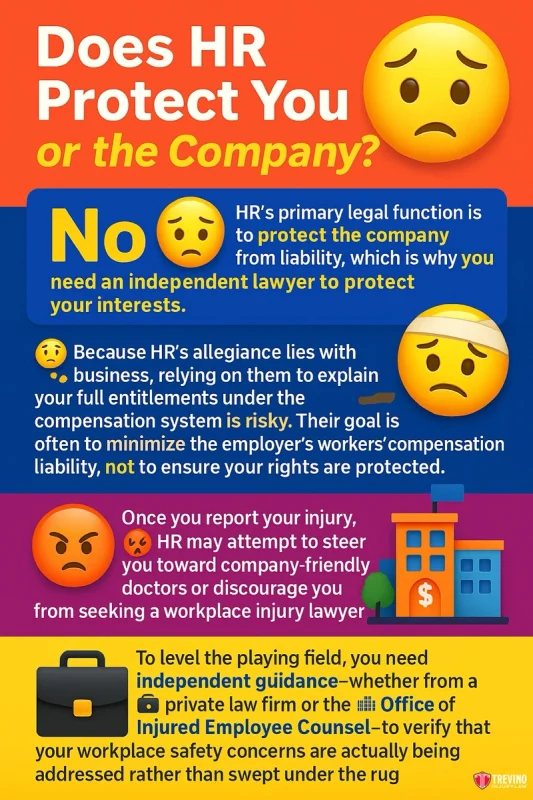
Does HR Protect You or the Company?
No, HR’s primary legal function is to protect the company from liability, which is why you need an independent lawyer to protect your interests.
Because HR’s allegiance lies with the business, relying on them to explain your full entitlements under the compensation system is risky. Their goal is often to minimize the employer’s workers’ compensation liability, not to ensure your rights are protected. Once you report your injury, HR may attempt to steer you toward company-friendly doctors or discourage you from seeking a workplace injury lawyer.
To level the playing field, you need independent guidance, whether from a private law firm or the Office of Injured Employee Counsel (OIEC), to verify that your workplace safety concerns are actually being addressed rather than swept under the rug.
Federal vs. State Safety Laws: Which Applies to You?
Most San Antonio private-sector employees are covered by Federal OSHA safety standards, while their compensation rights are governed by the State of Texas Labor Code. It can be unclear to workers in Live Oak or Universal City which law applies when. The table below clarifies the difference:
| Feature | Federal OSHA | Texas Labor Code |
| Primary Focus | Prevention & Safety Standards | Compensation & Employment Rights |
| Who Enforces It? | Department of Labor Inspectors | Texas Dept. of Insurance / Courts |
| Your Right | Right to a safe workplace | Right to benefits (or to sue) |
| Consequence | Fines for the employer | Payments to the injured worker |
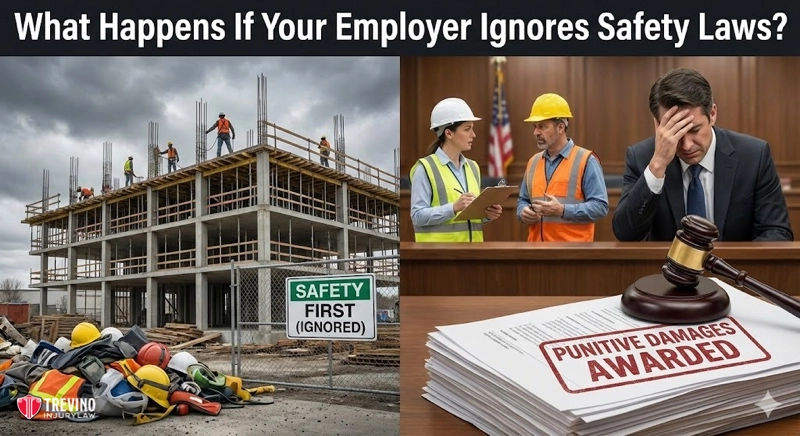
What Happens If Your Employer Ignores Safety Laws?
If an employer willfully ignores safety laws, they face federal penalties from OSHA and lose protection against gross negligence lawsuits from injured workers.
When a construction company in Leon Valley ignores fall protection rules to speed up a job, they are not just breaking a rule; they are demonstrating “conscious indifference” to your safety. In a non-subscriber lawsuit, this proof of gross negligence allows a jury to award punitive damages, intended to punish the company. This transforms a standard injury claim into a high-stakes legal battle in which the employer can be held fully accountable for the harm they caused.
When it comes to workers’ compensation, the insurance company has a team of lawyers working to deny your comp claim. You need aggressive legal representation to level the playing field.
We handle the complexities of your case from gathering evidence that links your injury directly to negligence to fighting for a strong workers’ comp settlement or lawsuit verdict.
How Long Do You Have to File a Work Injury Claim or Lawsuit in Texas?
The deadline depends on which kind of claim you have, and missing any one of them can end your right to recover:
- Report the injury to your employer within 30 days under Section 409.001 of the Texas Labor Code, or you can lose workers’ compensation benefits.
- File a workers’ compensation claim within one year of the injury with the Texas Department of Insurance, Division of Workers’ Compensation, if your employer carries coverage.
- File a lawsuit within two years if your employer is a non-subscriber or if a third party, such as an equipment manufacturer or another contractor, caused your injury.
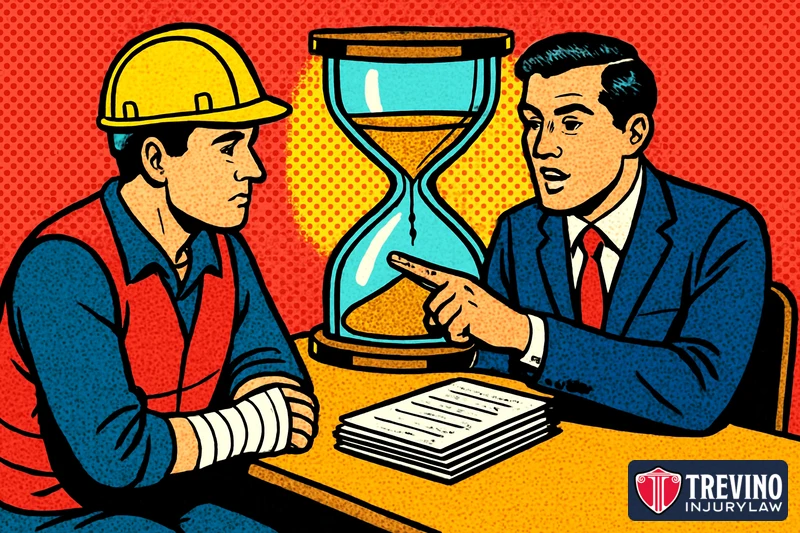
A third-party lawsuit can proceed alongside a workers’ compensation claim, and it is not limited by workers’ compensation benefit caps. When a work injury is fatal, the family generally has two years from the date of death to file a wrongful death claim.
Why Hire a San Antonio Work Injury Lawyer?
When a construction company in Leon Valley ignores fall protection rules, insurance adjusters and corporate lawyers fight to bury the evidence and deny your claim. While high-volume settlement mills fold early and avoid trial, Trevino Injury Law brings an aggressive trial-first mindset to expose their negligence. We fight for families and force powerful corporations to pay.
Want to Protect the Full Value of Your Claim?
You’ve seen how this affects your case — but this is only one piece of the puzzle. Our Work Injury Lawyer page breaks down what a trial-ready firm does differently.
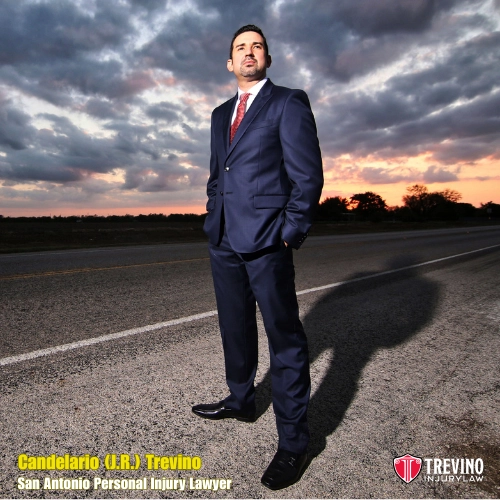
Armed with a record of securing $7.9M for work injuries, we fight for uncapped punitive damages in the Bexar County Courthouse. You need a San Antonio trial attorney to immediately send a spoliation letter to prevent the company from destroying critical evidence before it disappears.
Call 210-TREVINO for a free case review. Se Habla Español. We work on a contingency-fee basis: No Win, No Fee