San Antonio slip-and-fall accidents cluster in high-volume grocery aisles, on uneven limestone riverwalks, and in poorly lit apartment stairwells. Liability requires you to immediately pinpoint exactly which entity controlled the specific lease line or common area where your footing failed.
The commercial insurance adjuster is already weaponizing the open-and-obvious defense to blame your footwear and excuse their fraudulent sweep logs.
What Could Your Slip and Fall Accident Case Be Worth?
Answer a few quick questions about your accident. Takes about 60 seconds.
See What My Case Might Be WorthThe insurance company offered less than $20,000. I ended up with over $1 million. — Jackie Galindo
According to the National Floor Safety Institute, the walking surface itself accounted for 55% of all fall incidents in 2021. Behind that metric is a corporate property manager who bypassed safety protocols to prioritize speed over hazard removal. Surveillance footage overwrites rapidly. A Spoliation Letter, a legal demand that prevents the property owner from destroying evidence, must be issued immediately. The filing window drops to just ninety days if the hazard involved a municipal sidewalk or city property.
A Trevino Injury Law slip and fall injury lawyer subpoenas the maintenance logs and secures the video evidence before the negligent corporation deletes it. Call 210-TREVINO now for a free case review. You pay nothing unless we win. Se Habla Español.
Why Are Grocery and Retail Stores Common Sites for a Slip and Fall Accident?
High-volume grocery retailers like HEB, Walmart, and Costco account for the highest frequency of slip-and-fall claims in San Antonio due to liquid hazards, perishable goods, and clutter or debris resulting from aggressive stocking schedules that often prioritize speed over safety.
For falls at these retailers, the next question is whether you can sue HEB or Walmart after a Texas slip and fall.
In “Mega-HEB” locations, the sheer volume of foot traffic significantly increases the probability of spills. This aligns with national findings that floors and flooring materials account for over 2 million fall injuries annually (CPSC, 2021).
The expansive square footage makes it difficult for staff to conduct safety sweeps, yet the National Floor Safety Institute estimates that walking surfaces account for 55% of all slip, trip, and fall incidents (NFSI, 2021). This confirms that the floor itself, not the victim, is often the root cause. Under Texas premises liability law, establishing liability frequently hinges on proving Constructive Notice.
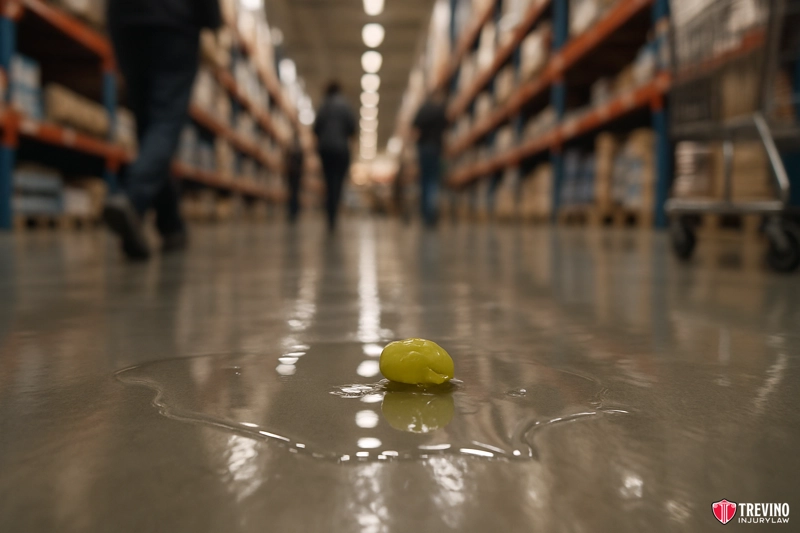
As established by the Texas Supreme Court in Wal-Mart Stores, Inc. v. Reece, it is not enough to show a hazard existed; we must demonstrate that the spill was present for a sufficient length of time that the store, in the exercise of reasonable care, should have discovered and removed it. Without this temporal evidence, a claim cannot succeed.
We often find that store managers encourage employees to bypass safety logs to restock shelves faster, creating a culture where spills are ignored until someone gets hurt.
What Hazards Are Unique to the Produce Area and Floral Departments?
The produce and floral departments present unique liability challenges because automatic misters often malfunction, spraying water directly onto tile floors and creating slippery surfaces that heighten the risk of slips. At the same time, loose items like grapes or berries create rolling hazards that are notoriously difficult to see.
In newer store designs featuring polished concrete, drainage from floral displays can leak slowly. While this seems minor, falls on the same level are catastrophic; in 2023, 134 workers died from falls on the same level nationwide (National Safety Council Injury Facts, 2024). If it kills workers wearing safety gear, it is devastating for shoppers in sandals.
To prove liability here, we subpoena the store’s Sweep Logs. We frequently expose cases where employees “whip” the logs, signing for safety checks at 9:00 AM, 10:00 AM, and 11:00 AM all at once. We prove this fraud by comparing the log timestamps to security camera footage.
How Do Freezer Leaks and Building Maintenance Failures Create Liability?
Freezer and refrigeration leaks create liability when machinery malfunctions or when damage to the infrastructure allows water or condensation to accumulate on the floor, proving the store had constructive knowledge, as mechanical breakdowns leave a maintenance paper trail. Unlike a dropped drink, a “slow leak” in a frozen food aisle is a structural failure the store should have known about.
This issue is particularly prevalent in older grocery stores on San Antonio’s West Side, where aging infrastructure is often patched rather than replaced.
Case Example: Fighting Low-Ball Offers. In Jose Simon Arriaga Jr. v. Emily Montemayor, the defense offered our client only $5,000. We refused to settle. By proving negligence in court, we secured a $536,007 jury verdict—over 100 times the initial offer.
Who Is Liable for Falls in Shopping Malls Under Texas Law?
Liability in shopping centers like North Star Mall or The Shops at La Cantera is strictly determined by who had ‘control’ over the specific area where the injury occurred. Texas courts hold that a party is liable for premises defects only if it had the right to control the security and maintenance of that specific space.
This means we must legally distinguish between the tenant’s ‘lease line’ responsibility and the property manager’s ‘common area’ duties.
- Inside the Lease Line: If you fall inside a specific retailer (e.g., a shoe store), the claim is typically against that tenant’s commercial general liability (CGL) policy.
- Common Areas: If you fall in the food court, a walkway, or a restroom, the claim targets the property management firm (e.g., Brookfield Properties).
We typically file suit against both entities to prevent them from using the “Empty Chair Defense,” where the tenant blames the landlord, and the landlord blames the tenant, to avoid paying you.
What Are the Risks in Open-Air Centers Like The Rim?
Open-air centers like The Rim and Alamo Quarry Market introduce unique environmental hazards because rain can track directly into storefronts from outdoor walkways. The historic nature of the Quarry, particularly near the smokestacks, creates uneven surfaces that pose common trip hazards.
During San Antonio rainstorms, the “transition zones”, where wet sidewalks meet polished interior floors, become instant slip hazards. Property owners must immediately place heavy-duty rain mats; failure to do so constitutes negligence.
How Does Polished Concrete Contribute to Retail Falls?
High-gloss polished concrete is favored by big-box retailers for its low maintenance costs, but it acts like ice when exposed to minimal moisture, significantly increasing the risk of severe slip-and-fall injuries by dropping the floor’s Coefficient of Friction below safe levels and creating significant fall risks. In severe injury cases, we hire forensic engineers to test the floor’s slip resistance using a tribometer.
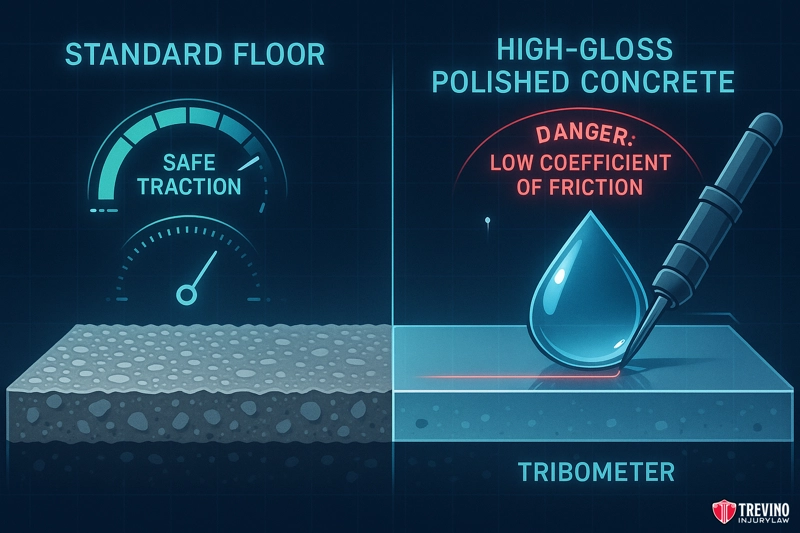
If the floor tests unsafe even when dry, we can argue the retailer created an unreasonably dangerous condition simply by choosing that flooring material.
What Makes the San Antonio River Walk a High-Risk Zone?
The San Antonio River Walk is a high-traffic environment where fall accidents can occur due to unique premises liability challenges. You have 11.5 million annual visitors navigating just 15 miles of walkways. The dense crowd on narrow, unguarded limestone pathways often forces pedestrians near unrailed edges where algae can make the stone slippery.
High-traffic zones near the Convention Center are particularly dangerous. Defense attorneys often argue that algae or wet limestone is a “natural condition.” Still, with $3 billion in annual economic impact generated by these visitors, we argue that the property owners have the resources and duty to maintain a safe footing.

Defense attorneys often argue that algae or wet limestone is a “natural condition” under the Natural Accumulation Doctrine. We counter this by proving the River Walk is an artificial improvement, requiring businesses to maintain safe footing for their patrons.
Can You Sue Restaurants and Bars for Spills or Dim Lighting?
Yes, you can sue a restaurant. If you can prove that the establishment created the hazard or failed to follow appropriate safety protocols expected in the hospitality industry regarding minimum illumination. Many River Walk establishments use “ambiance” as a defense for dangerously dim lighting, but this does not excuse them from marking elevation changes or steps with reflective tape.
How Do Hotel Bathroom and Lobby Falls Occur?
In hotels and resorts throughout Downtown San Antonio and the Hill Country, the “grand entrance” often prioritizes visual impact over safety, leading to high-polished marble lobbies that become treacherous when guests track in water. In guest rooms, we frequently see liability arising from bathtub defects when hotels fail to provide non-slip surfaces or grab bars, leading to guests losing their balance and suffering serious harm in confined spaces.
Who Is Responsible for Falls at Apartment Complexes?
Under Texas Property Code § 92.052, landlords and property management companies have a non-delegable duty to repair or remedy conditions that materially affect the physical health or safety of an ordinary tenant. This duty extends to maintaining safe common areas, including stairwells and parking lot security.
In high-density rental areas like the Medical Center, maintenance requests are often ignored. This is particularly dangerous for older tenants; in 2023, 28.1% of Texas adults over 65 reported a fall (America’s Health Rankings, 2023).
Are Landlords Liable for Staircase and Railing Failures?
Yes. Landlords are liable when they allow structural wood to rot. These falls are often fatal or permanently disabling; CDC data reveal that over 319,000 older adults are hospitalized annually for hip fractures, the vast majority caused by falls (CDC, 2024). We fight to ensure the settlement covers this long-term reality.
Falls on stairs and other hard surfaces can produce very different medical outcomes; see the common slip-and-fall injuries in San Antonio for the injury patterns and treatment issues that can follow.
Fail to tighten loose bolts or maintain steps that do not comply with municipal building codes. In older complexes, exterior wooden staircases are often painted over to hide rot rather than repaired.
Case Example: We secured a $1.8 Million Settlement for a client who suffered spinal injuries in a premises liability case. Staircase falls often cause life-altering harm like herniated discs, and we fight to ensure the settlement covers medical bills, pain and suffering, and decades of future care.
How Do Parking Lot Defects Lead to Lawsuits?
Parking lot defects lead to lawsuits when property owners fail to repair known potholes, leave wheel stops unpainted and practically invisible at night, or provide inadequate lighting. Property owners often argue these defects are “open and obvious.”
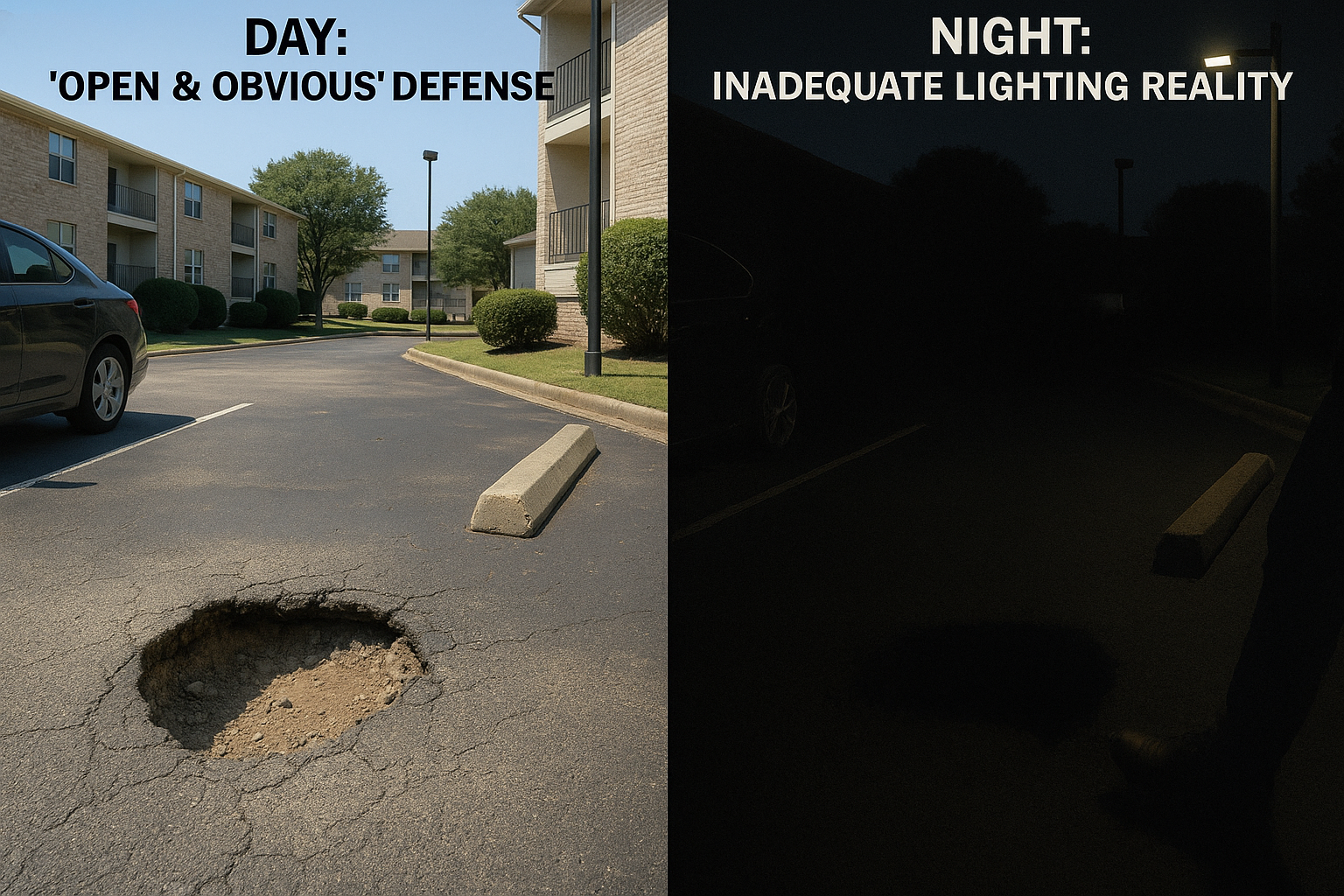
We defeat this defense by proving inadequate lighting, if the complex failed to replace burnt-out floodlights, you cannot be blamed for tripping on potential hazards you could not see.
Can You Sue the City for a Sidewalk Fall on Public Property?
Suing a government entity like the City of San Antonio or VIA Metropolitan Transit is possible, but it requires overcoming Sovereign Immunity and strict adherence to the Texas Tort Claims Act.
Generally, the government is only liable for:
- Injuries arising from the use of a motor-driven vehicle (e.g., a VIA Bus) under Tex. Civ. Prac. & Rem. Code § 101.021(1).
- Injuries caused by a condition or use of tangible personal or real property (“premise defect”) under Tex. Civ. Prac. & Rem. Code § 101.021(2), provided the government knew of the defect and failed to correct it.
Who Is Liable for Falls at VIA Bus Stops?
Liability for falls at VIA Bus Stops is complex because ownership overlaps; the shelter may belong to VIA Metropolitan Transit, while the cracked sidewalk beneath it belongs to the City of San Antonio. Because VIA is a governmental unit, the same strict notice deadlines apply. We immediately identify the exact coordinates of the fall to determine which entity is responsible.
Is a Fall at a Construction Site a Premises Liability Case?
Yes, if you are a visitor, pedestrian, or worker injured by a third-party contractor, it is a personal injury claim distinct from the exclusive remedy of Workers’ Compensation. We secured a $7.9 Million Verdict for a client injured in a work-related accident due to unsafe conditions.
Do I Have a Case If I Fell in a Parking Lot Pothole?
Yes, property owners must repair known pavement defects. The risk in transition areas like parking lots is well documented; statewide, pedestrian deaths rose by 22% from 2019 to 2023 (TxDOT, 2023).
Defense attorneys typically argue the pothole was “open and obvious”. We use crash and injury data to prove that these environments are inherently hazardous, making poor lighting or obstruction critical evidence to overcome their defenses.
Can I Sue If I Slipped on Spilled Salsa at a Restaurant?
Yes, if we can prove the restaurant employees caused the spill (active negligence) or if it remained on the floor long enough for them to have cleaned it (constructive notice).
Does the Location of the Fall Change the Time You Have to Sue?
Yes, the classification of the location, whether it is a private business, a federal building, or city property, drastically alters the statute of limitations and the mandatory notice requirements for your claim.
- Private Property (HEB, Malls): You generally have Two Years to file a lawsuit under Texas Civil Practice and Remedies Code Section 16.003.
- City Property (Sidewalks, Parks): You must file a formal Notice of Claim within 90 days (for San Antonio) per Section 101.101.
- Federal Property (Post Office): You must file an administrative claim within Two Years under the Federal Tort Claims Act.
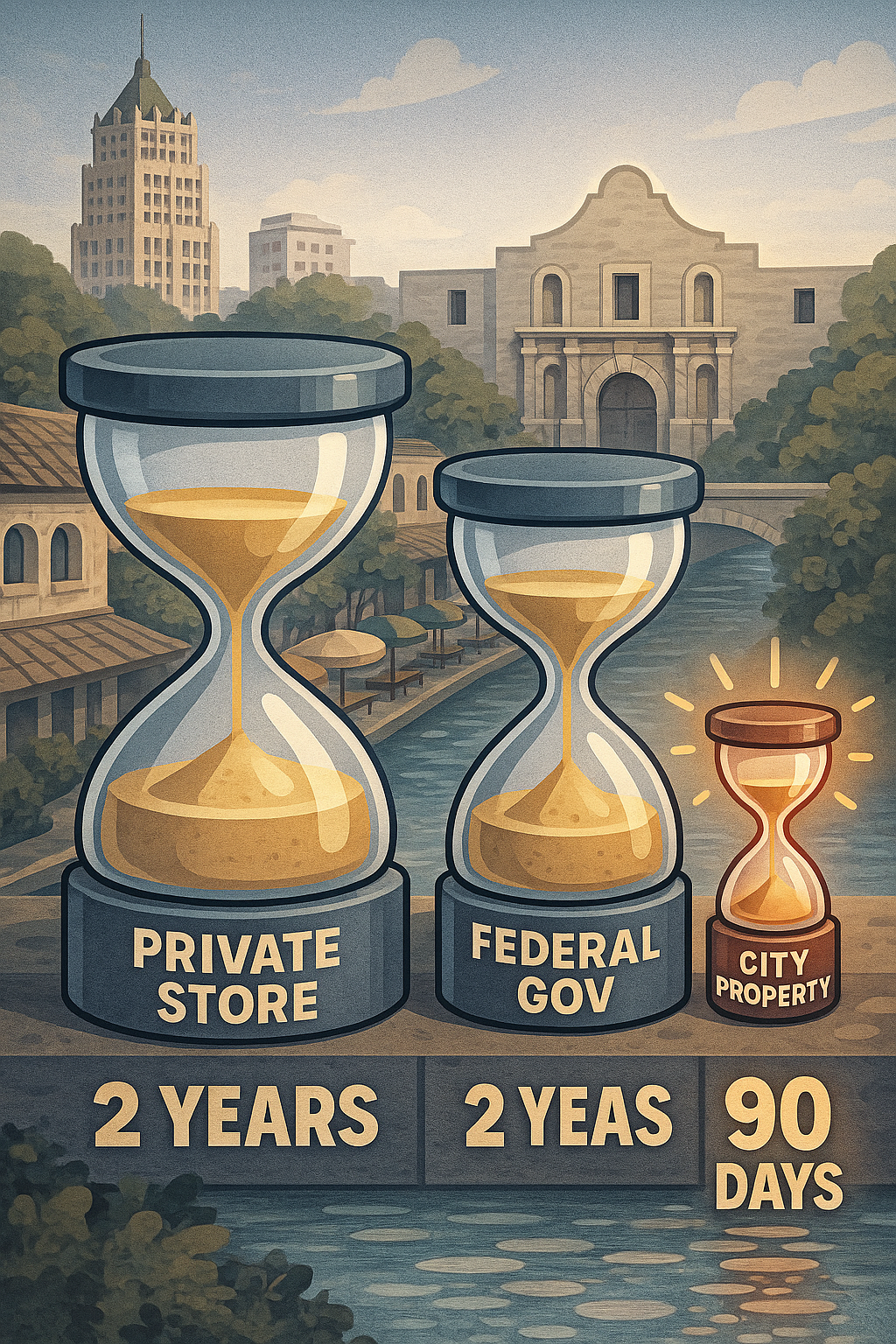
Warning: If you miss the 90-day municipal notice deadline, your case can be permanently dismissed, regardless of how severe your injuries are.
Supplementary Evidence and Documentation Guides
The type of evidence you must collect immediately depends entirely on the nature of the property and the business’s data retention policies.
Site-Specific Evidence Checklists
- Retail & Grocery Stores: Photograph the spill and the ceiling above it to check for leaks. Demand preservation of CCTV footage in writing within 24 hours, as stores often overwrite video data every 48 hours.
- Public Sidewalks: Use a reference object (coin or ruler) placed inside the crack to demonstrate the depth of the defect. Take wide-angle shots to prove there were no warning signs.
- Apartment Complexes: Screen capture your maintenance request logs immediately. Property management portals in Stone Oak or Alamo Heights often lock tenants out of their accounts once a legal dispute arises.
Why Hire a San Antonio Slip and Fall Lawyer?
Proving constructive notice for a spill or defeating the “open and obvious” defense is exactly where insurance adjusters try to bury your claim. They know settlement mills will fold, but we fight for families. Trevino Injury Law exposes negligent property owners and forces them to pay by preparing every file for the courtroom, not a quick exit.
Want to Protect the Full Value of Your Claim?
You’ve seen how this affects your case — but this is only one piece of the puzzle. Our Slip and Fall Lawyer page breaks down what a trial-ready firm does differently.
We secured a $536,000 jury verdict despite an offer of just $5,000, demonstrating our refusal to back down in the Bexar County Courthouse. Our San Antonio personal injury wreck attorneys immediately send spoliation letters to preserve critical video evidence.
Call 210-TREVINO for a free case review. Se Habla Español. We work on a strict contingency basis—No Win, No Fee.