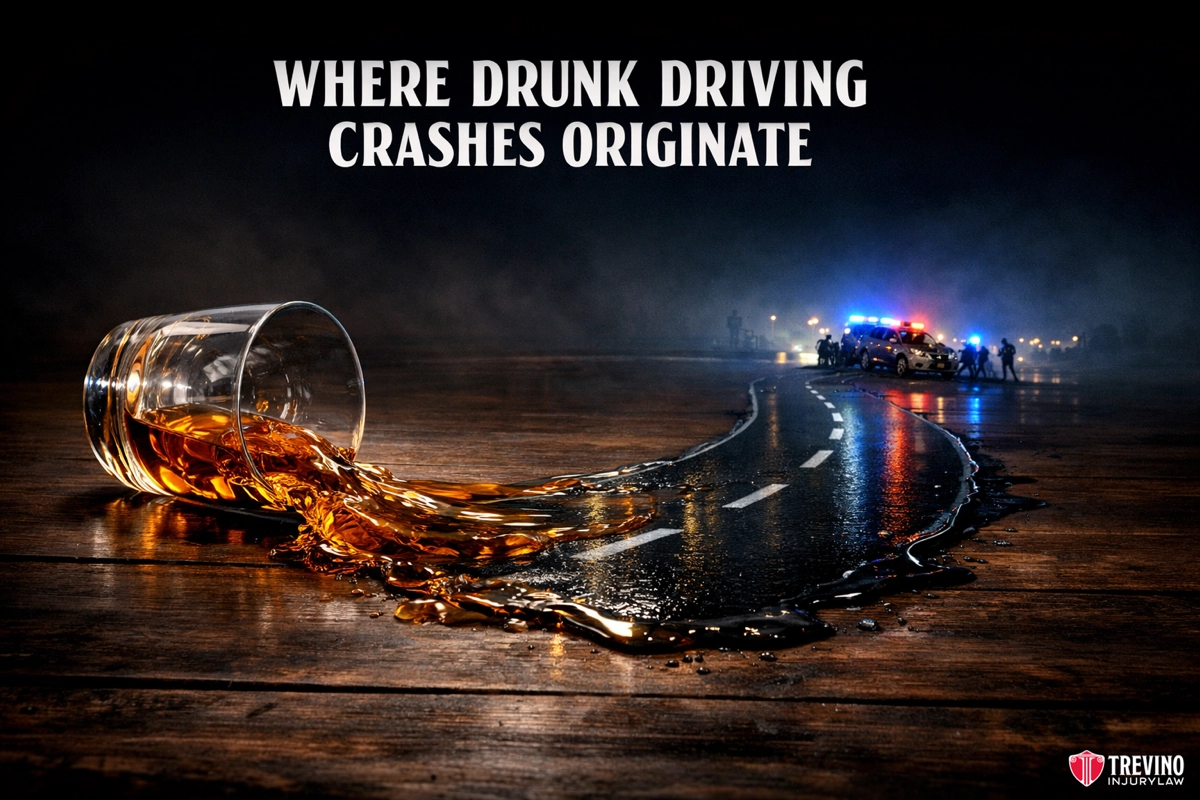
Drunk driving collisions originate at the cash registers of local bars and entertainment districts. Establishments across San Antonio over-serve patrons and send them straight onto major arterials like Culebra Road. You face the devastating fallout of a crash that a responsible bartender would have prevented.
The venue owner is already deploying the Safe Harbor defense to shield their commercial insurance policy. Their corporate attorneys blame the impaired driver entirely, erase the connection to the bar, and insist their staff followed all safety regulations. This tactic isolates your recovery to the driver’s inadequate personal auto limits.
What Could Your Drunk Driving Accident Case Be Worth?
Answer a few quick questions about your accident. Takes about 60 seconds.
See What My Case Might Be WorthThe insurance company offered less than $20,000. I ended up with over $1 million. — Jackie Galindo
According to the Texas Department of Transportation, impaired drivers claimed 72 lives across Bexar County in 2024. The evidence linking these tragedies to the business vanishes quickly. A Spoliation letter, a legal demand that prevents the property owner from destroying evidence, must be issued immediately to lock down the surveillance footage. Texas gives you two years to file suit before the claim expires.
A Trevino Injury Law drunk driving injury lawyer will subpoena this footage to expose negligent venues and secure maximum compensation. Call 210-TREVINO for a free case review. You pay nothing unless we win. Se Habla Español.
Which City Districts Have the Highest Concentration of Drunk Driving Accidents?
San Antonio’s alcohol-related crashes frequently originate in high-density entertainment districts like the St. Mary’s Strip and Southtown, before spreading onto major arteries like Loop 1604 and I-10, where intoxicated drivers attempt to return to suburbs like Stone Oak or Helotes. While our main drunk driving accident page covers the general principles of driver liability, this section pinpoints the specific geographic “hot zones” where negligence often begins and how those locations impact your case strategy.
Beyond the standard collision report, victims in Bexar County must navigate the complex reality that where a driver started drinking often dictates the legal strategy we employ.
The geography of a drunk driving case in San Antonio often follows a predictable and tragic pattern. Drivers consume alcohol in centralized entertainment hubs and then attempt to navigate high-speed corridors to reach residential areas. For example, a driver leaving a bar in the Tobin Hill area may travel several miles before causing a catastrophic head-on collision or wrong-way wreck on US-281 or Loop 410. Identifying this route is critical because it helps us secure dashcam footage and surveillance video from businesses along the path.
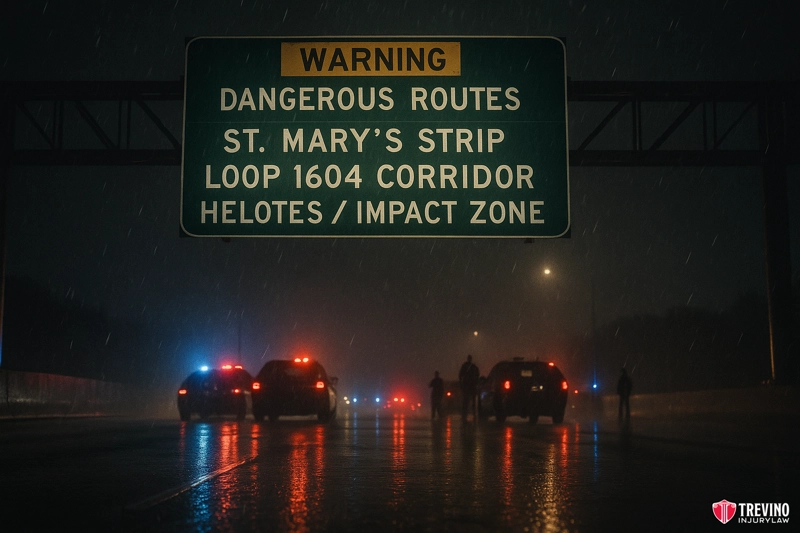
For the road-location side of that route analysis, review the most dangerous drunk driving accident hotspots in San Antonio, including the corridors and roadway segments identified as especially high-risk.
We frequently see cases where the “origin point” is a bar in the Central Core, but the crash site is miles away in a residential zone like Hollywood Park or Castle Hills. Establishing this connection allows us to widen the scope of our investigation beyond just the crash scene itself.
How Does the St. Mary’s Strip Contribute to Local Crash Rates?
The St. Mary’s Strip contributes significantly to local crash rates due to its high density of bars and music venues, creating a concentrated release point for intoxicated drivers entering residential streets and nearby highways like US-281 late at night. This area serves as a major funnel for nightlife traffic, and when patrons leave at closing time, the surrounding roads often become hazardous.
Our investigations frequently trace the timeline of a defendant’s intoxication back to credit card receipts from establishments along this specific corridor. If a driver was over-served here, the short drive to a highway entrance ramp becomes a lethal window of opportunity for a collision.
Why Are Texas Roads Like Loop 1604 Considered High-Risk?
Loop 1604 and I-10 are considered high-risk corridors because they serve as the primary high-speed connectors between late-night entertainment districts and the rapidly growing residential communities in the Far North and Northwest sides of San Antonio. Drivers attempting to reach homes in areas like Alamo Ranch or Fair Oaks Ranch must navigate these multi-lane highways, often at high speeds, while their judgment is impaired.
The “Mixing Bowl” interchange, where I-35, I-10, and US-90 converge, and the construction zones along Loop 1604 further complicate driving conditions, making it difficult for even sober drivers to react, let alone those under the influence. High-speed collisions on these corridors rarely result in minor bumps; they frequently cause catastrophic spinal cord injuries or traumatic brain injuries that require lifetime care.
Pinpointing the driver’s geographic origin is the first step in the investigation, but determining who poured the drinks is the critical next step to maximize your recovery.
Can Bars Be Held Liable to Victims for Car Crashes Starting on Their Premises?
Yes. Under Texas Alcoholic Beverage Code § 2.02(b), bars and restaurants in San Antonio can be held liable if they continue serving an obviously intoxicated patron who subsequently causes a crash. This creates a distinct avenue for compensation beyond the driver’s insurance policy.
While establishing the driver’s fault is central to any claim, identifying the serving establishment expands the potential recovery for victims with severe injuries, especially when the driver carries minimum liability limits.
The Texas Supreme Court affirmed that alcohol providers can be held responsible for their share of the liability when they over-serve patrons. However, venue owners often try to use the “Safe Harbor” defense to avoid paying victims. As established in 20801, Inc. v. Parker, this protection is void if we can prove management was complicit in the negligence.
Digging for the Evidence Because Texas law recognizes that a bar’s negligence can be just as dangerous as the driver’s actions, we must look beyond the crash report to the business practices of the establishment. Did they serve a patron who was already slurring their speech or stumbling? Did they continue to sell alcohol to someone who was clearly a danger to themselves and others?
We have successfully utilized these laws to secure significant settlements, including a $1.4 million recovery for a victim suffering spinal injuries in a drunk driving accident and a separate $1 million recovery in a wrongful death case involving dram shop liability. These cases require a higher standard of proof, often necessitating the preservation of internal video logs and server testimony that settlement mills frequently overlook.
What Police Reports and Evidence Prove a Bar Served an Intoxicated Driver?
Evidence that proves a bar served an intoxicated driver includes time-stamped surveillance footage showing the patron’s behavior, credit card receipts establishing the volume of alcohol purchased, and witness testimony from other patrons or staff who observed signs of visible intoxication. We immediately send preservation letters to secure this data before it is overwritten or “lost” by the venue.
Simultaneously, we file Freedom of Information Act (FOIA) requests to obtain police body cam footage, which often captures the driver admitting exactly where they were drinking moments after the crash. This “digital trail” is often what links a crash on Bandera Road back to a specific happy hour miles away.
Does the “Safe Harbor” Defense Protect San Antonio Venue Owners?
The “Safe Harbor” defense protects venue owners only if they can prove they required their employees to attend TABC-approved seller training and did not directly encourage their staff to violate the law, but this protection is void if we can prove management was complicit in the negligence. Many bars claim this defense automatically, but we dig deeper to find evidence of a culture that prioritizes sales over safety.
If a manager was present and ignored an employee over-serving a customer, or if the bar has a history of TABC violations, the Safe Harbor defense crumbles. We fight to ensure that this legal shield does not become a loophole for reckless business owners.
Once we establish who is responsible for serving the alcohol, we must also analyze the temporal patterns to understand when these negligence-fueled tragedies are most likely to strike.
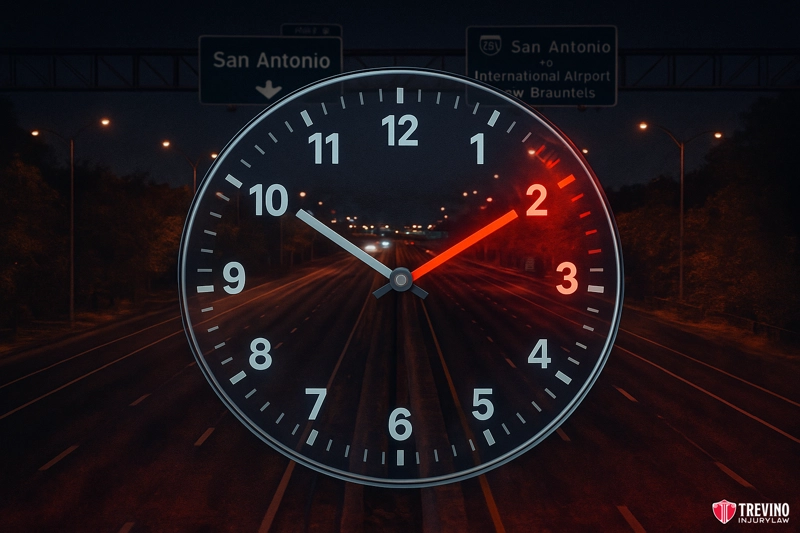
Statewide data from TxDOT confirms that 2:00–2:59 AM is the single deadliest hour for DUI-alcohol crashes in Texas, with 2,462 crashes and 113 fatal crashes occurring in that hour alone in 2024, with significant seasonal surges occurring during major local events like Fiesta San Antonio and the holiday season.
Understanding where accidents happen is crucial, but knowing when they occur helps establish the timeline of negligence required for a successful lawsuit. Beyond the standard traffic patterns, San Antonio’s unique cultural calendar creates specific windows of elevated risk that every driver and victim needs to recognize.
The timing of a crash is a critical piece of the forensic puzzle. A collision occurring at 2:15 AM on a Sunday morning carries a strong presumption of alcohol involvement, often originating from bars closing their tabs. This “closing time” rush floods roads like I-35 and Loop 410 with impaired drivers simultaneously. In our experience litigating these claims, this specific 2:00 AM to 3:00 AM window accounts for a disproportionate number of catastrophic spinal and traumatic brain injuries we handle, as highway speeds on Loop 1604 combine with peak driver impairment.
Furthermore, during local celebrations, the “origin points” scatter across the city, moving from specific bar districts to city-wide event zones. We use this temporal data to cross-reference with police dispatch logs and 911 call records, painting a complete picture of the environment at the exact moment your life was changed.
How Does the City’s Fiesta Celebration Impact Drunk Driving Statistics?
Fiesta San Antonio significantly impacts drunk driving statistics by introducing a ten-day period of city-wide alcohol consumption.
- Arrest Spikes: In 2024, despite enforcement efforts, there were 139 Fiesta-related DWI arrests.
- Crash Increase: Historical analysis shows that alcohol-related crashes in San Antonio jump by approximately 19% during Fiesta compared to the rest of the year.
- Injury Surge: Even more alarming, alcohol-related crash injuries increase by about 41% during this period.
We often see a spike in crashes involving drivers who have been drinking throughout the day at events like NIOSA or the Battle of Flowers Parade, creating a different type of fatigue and impairment profile.
Are Holiday Weekends More Dangerous for Car Travel?
Yes, holiday weekends are statistically more dangerous for local drivers. During the summer of 2024 alone, alcohol-related crashes in Texas killed 273 people and seriously injured 596. In San Antonio, the July 4th weekend consistently sees high crash numbers, with 16 DWI crashes reported by SAPD in 2024.
New Year’s Eve and Independence Day consistently ranking as peak periods for alcohol-related fatalities due to the combination of increased traffic volume and widespread celebrations. On these dates, the risk extends beyond just the late-night hours; “day drinking” at barbecues or parties means impaired drivers are on the road earlier in the evening. For families in residential areas like Windcrest or Universal City, the threat is not just on the highway but on the local surface streets leading to and from these gatherings.
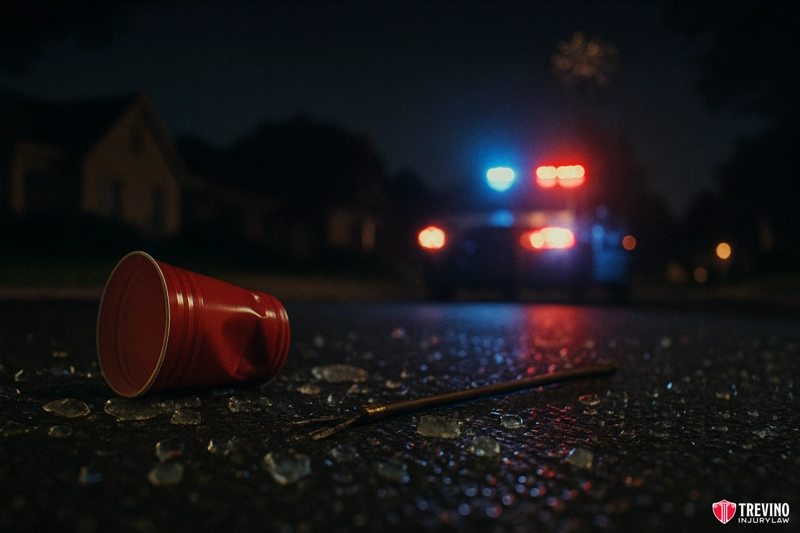
While understanding the where and when explains the cause, victims are often left with a more pressing question about the practical aftermath of these crashes.
Does Proving the Crash Origin Increase My Potential Compensation?
Yes, proving the crash origin increases potential compensation by triggering Texas Dram Shop liability, which allows us to access the commercial insurance policy of the negligent bar or venue when the drunk driver’s personal coverage is insufficient to pay for your long-term medical needs.
In many San Antonio drunk driving cases, the at-fault driver carries only the state minimum liability insurance of $30,000 per person. Suppose you or a loved one needs immediate medical care or long-term treatment at a Level I trauma center like University Hospital. In that case, the expense will quickly exhaust the policy of an uninsured or underinsured driver. This leaves a massive financial gap and significant emotional distress that can bankrupt a family. Our law firm focuses on securing an outcome that covers this total loss, not just the initial damage from a serious car crash.
For a detailed breakdown of medical costs, lost income, household services, and future care, see economic damages after a Texas drunk driving accident.
By successfully identifying the “origin point”—whether it was a bar on the St. Mary’s Strip or a club in the Pearl District, we can file a claim against that business’s commercial liability policy. These policies typically carry limits of $1 million or more.
Our trial history includes securing multi-million-dollar settlements by proving that the establishment, not just the driver, is responsible for the tragedy. We treat the investigation of the venue with the same intensity as the crash scene itself because we know it is often the only way to secure full justice for catastrophic damages.
While securing these financial resources is essential for your future, failing to act quickly on your legal rights can permanently destroy your ability to access them.
How Do We Investigate a Venue’s History of Negligence?
We investigate the incident by strictly examining whether the bar served a patron with a dangerous blood alcohol level. We document any repeat violations in the venue’s history, as a significant percentage of these cases involve venues that habitually prioritize profit over safety.
This evidence is crucial because it dismantles the “Safe Harbor” defense often used by bars in areas like The Pearl or Downtown San Antonio. Insurance adjusters fight hardest to hide this history because it transforms a simple accident claim into a case about systemic corporate recklessness.
Do Past TABC Violations Help My Case?
Yes, past TABC violations establish a pattern of negligent behavior that we use to prove the establishment habitually prioritizes profit over public safety standards.
Can I Get Security Footage Without an Attorney?
No, bars and nightclubs rarely voluntarily release security footage to victims, so we issue immediate legal preservation demands to prevent the deletion of video.
How Does the Criminal DWI Case Affect My Civil Injury Claim?
The criminal DWI case proceeds entirely separately from your civil injury claim. Still, a guilty verdict or a plea deal in criminal court serves as undeniable proof of liability that we use to secure a maximum settlement in your civil case. While the Bexar County District Attorney focuses on punishing the driver with jail time or fines, our focus is exclusively on securing the financial compensation your family needs for medical bills and lost wages.
We do not wait for the criminal case to conclude; we file your civil suit immediately to depose witnesses while their memories are fresh, often using the evidence collected by police on Potranco Road or Marbach Road to strengthen your position before the criminal trial even begins.
What If I Don’t Hire a Lawyer to Investigate the Origin?
If you do not hire a lawyer to investigate the crash origin immediately, critical evidence like surveillance video and credit card receipts will likely be overwritten or “lost” by the bar, permanently destroying the link between the alcohol service and your injuries.
Without this evidence, you are often left with only the drunk driver’s personal insurance policy, which typically caps at $30,000, a fraction of what is needed for severe injuries. Insurance companies for venues in places like Leon Valley know that without a trial-ready attorney forcing them to produce records, they can simply deny involvement and avoid paying the millions of dollars in coverage they actually hold.
What If I Miss the Statute of Limitations for a Dram Shop Claim?
If you miss the strict two-year statute of limitations to file a lawsuit against the bar or restaurant, you permanently lose the right to seek compensation from that establishment, regardless of how clear their negligence was or how devastating your injuries are. In Texas, the clock usually starts ticking on the day of the crash, and there are very few exceptions to this rule.
Waiting to see “how the insurance handles it” is a strategy designed to make your claim expire; once that deadline passes, the bar’s insurance carrier is no longer legally obligated to pay you a single cent.
Why Hire a San Antonio Drunk Driving Accident Lawyer?
That security footage of the driver stumbling is often the only link to a million-dollar commercial policy, and venue owners are counting on it being deleted before you act. Commercial insurance adjusters fight to bury this evidence, while high-volume “settlement mills” often lack the aggression to force them to produce it. We know their playbook. Trevino Injury Law exposes negligent venues and fights for families in the Bexar County Courthouse, protecting you from the corporations that prioritize profit over safety.
Want to Protect the Full Value of Your Claim?
You’ve seen how this affects your case — but this is only one piece of the puzzle. Our Drunk Driving Accident Lawyer page breaks down what a trial-ready firm does differently.
You need a trial attorney to send spoliation letters and subpoena surveillance footage before the evidence vanishes.
Call 210-TREVINO for a free case review. Se Habla Español. You pay nothing unless we win.