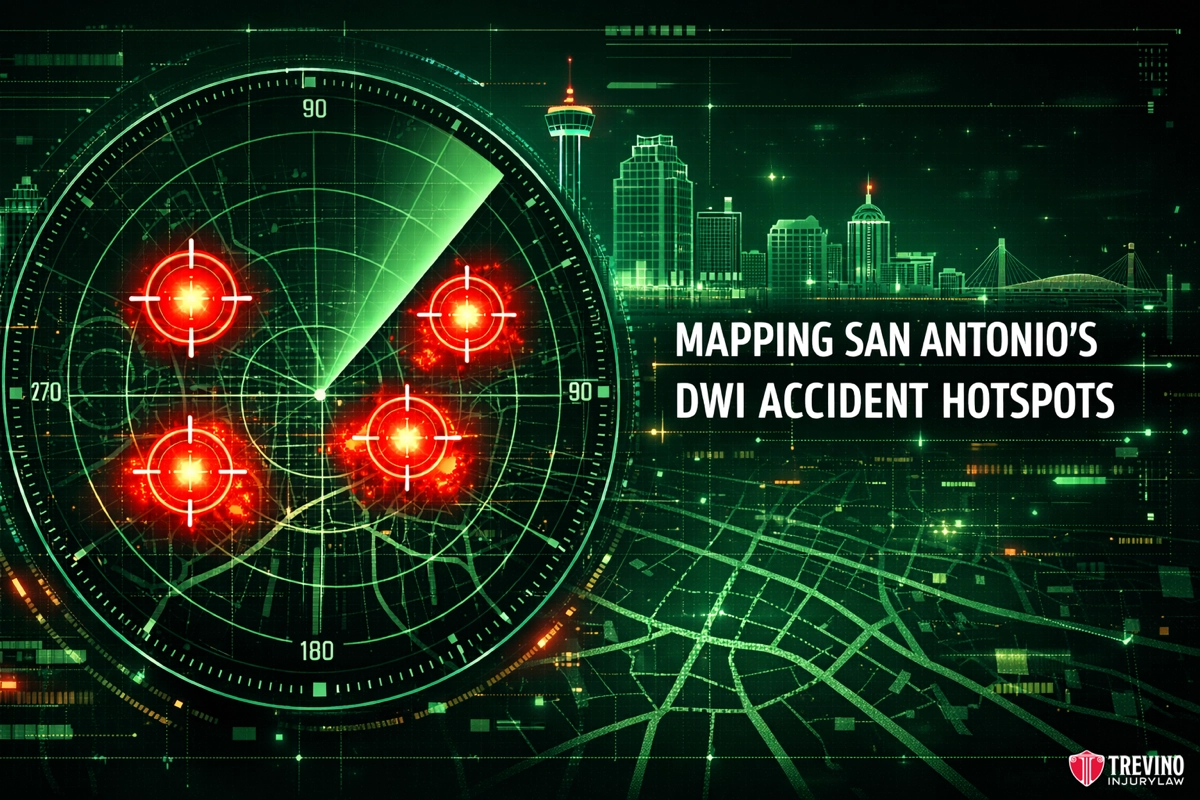
A drunk driving crash on a lethal San Antonio corridor like Bandera Road plunges your family into an immediate financial crisis. While the district attorney pursues criminal charges and jail time against the driver, they do absolutely nothing to secure the financial compensation you need for catastrophic medical care.
The Insurance Adjuster assigned to your claim is already moving to minimize the payout, racing to offer a lowball settlement before you discover the bar that overserved the driver shares civil liability. According to the Texas Department of Transportation, San Antonio experienced nearly 1,700 DWI-related crashes in 2024. Behind those wrecks are negligent drivers and corporate insurers banking on your silence and your desperation.
What Could Your Drunk Driving Accident Case Be Worth?
Answer a few quick questions about your accident. Takes about 60 seconds.
See What My Case Might Be WorthThe insurance company offered less than $20,000. I ended up with over $1 million. — Jackie Galindo
Evidence disappears in the first week. Security camera footage showing a bartender overserving the intoxicated driver gets overwritten. A Spoliation Letter, a legal demand that prevents the property owner from destroying evidence, must be issued immediately to preserve the truth.
A San Antonio DUI accident attorney from Trevino Injury Law’s team will subpoena the receipts and lock the evidence down before it vanishes. Call 210-TREVINO now for a free case review. You pay nothing unless we win. Se Habla Español.
Hotspot #1: SE Military Dr — I-35 to Roosevelt Ave
SE Military Drive from I-35 to Roosevelt Ave represents San Antonio’s highest-risk corridor for severe alcohol-related crashes. This segment, one of San Antonio’s most volatile, has seen a spike in vehicle crashes, requiring immediate vigilance from all defensive drivers in the South Side.
While many roads in Bexar County see fender benders, this specific stretch of SE Military Drive functions as a high-velocity funnel connecting residential zones to major highways like I-35. The infrastructure here creates a “stroad” environment where drivers frequently exceed 45 mph. When alcohol impairs a driver’s reaction time, these design features turn fatal.
An intoxicated driver speeding toward the Brooks commercial district often fails to perceive a vehicle turning left until it is too late. The data support this grim reality, with the corridor scoring a Total Risk Score of 95 in recent municipal safety analyses.
For residents in nearby neighborhoods like Hot Wells or Highland Hills, this means a higher statistical likelihood of encountering a severe wreck. The risk is compounded by the presence of numerous bars and restaurants in the vicinity.
If you are struck by a drunk driver on this corridor, the physical damage is often catastrophic. Establishing liability requires immediate preservation of surveillance footage from nearby businesses.
Hotspot #2: Bandera Rd — Hillcrest Dr to Culebra Rd
Bandera Road between Hillcrest Drive and Culebra Road creates a lethal environment for impaired driving. This priority corridor, with a Total Risk Score of 90, serves as a primary artery for Leon Valley and the Northwest Side, funneling thousands of vehicles daily through a gauntlet of conflict points.
The danger on Bandera Road (SH-16) stems from its dual role as a highway connector and a local shopping destination. The increased risk is amplified when distracted driving or intoxication impairs a driver. Locals often consider alternative routes, but for families in Leon Valley or commuting from Helotes, this corridor is often the only way home.
The layout encourages “micro-speeding,” which significantly increases the force of impact in a collision. A driver under the influence may fail to notice a red light at a major intersection like Huebner Road.
Securing justice after a crash on Bandera Road often involves analyzing the timeline of the drunk driver’s movements. We frequently look for credit card receipts to build a timeline of intoxication.
Hotspot #3: SE Military Dr — Quintana Rd to Zarzamora St
The segment of SE Military Drive from Quintana Road to Zarzamora Street serves as a high-speed launchpad to the highway interchanges. San Antonio consistently sees high risk scores here, highlighting the persistent danger facing motorists in the Southwest San Antonio area.
Unlike the commercial density near Brooks, this western stretch of SE Military Drive is characterized by its proximity to industrial zones and the I-35 south interchange. The road design here encourages higher speeds as traffic flows toward Lackland AFB or Palo Alto College.
For an intoxicated driver, the complex decision-making required to navigate highway on-ramps becomes impossible. They often misjudge the road’s curvature, leading to serious injuries, rollover accidents, or head-on collisions. The presence of heavy commercial trucks adds another layer of lethality. A drunk driver swerving into the path of an 18-wheeler near Zarzamora Street leaves the truck driver with zero time to react.
Recovering from a crash in this zone requires a legal team that understands the industrial context of the South Side. We investigate the entire sequence of events that led to the crash.
Hotspot #4: W W White Rd — Houston St to Rigsby Ave
W W White Road from Houston Street to Rigsby Avenue is exceptionally dangerous for drunk driving crashes because long stretches of road with sparse signalization cause impaired drivers to lose track of their speed.
In this part of San Antonio, the roadway feels more open, falsely signaling to an intoxicated driver that it is safe to speed. Without the constant feedback of traffic lights found downtown, impaired driving remains a significant threat. Darkness exacerbates this issue, making it difficult to see roadway markers. A driver traveling well above the limit near Rigsby Avenue may not realize the road is curving until they have already crossed the centerline.
Residents in East Side neighborhoods know that weekend nights on this corridor can be treacherous. Injuries are rarely minor; we see severe orthopedic trauma and internal injuries that require months of rehabilitation at facilities like Brooke Army Medical Center (BAMC) or Mission Trail Baptist.
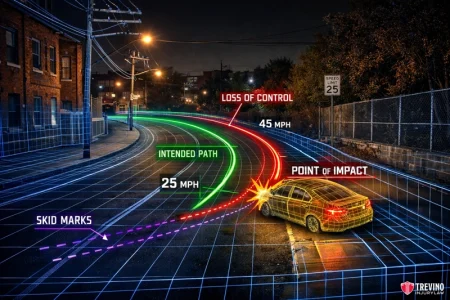
Proving fault in these cases often relies on reconstructing the crash dynamics. Our team works with accident reconstruction experts to analyze skid marks and vehicle data to paint a clear picture for the jury.
Hotspot #5: Culebra Rd — Bandera Rd to I-10
Culebra Road between Bandera Road and I-10 poses a critical threat to pedestrians and cyclists. With a Total Risk Score of 85, this corridor is a primary site for intersection collisions and Vulnerable Road User (VRU) fatalities involving alcohol.
The layout of Culebra Road encourages speed, acting as a major east-west connector for the West Side and Inner West Side. However, it is also lined with bus stops and businesses that generate high foot traffic. An intoxicated driver suffers from “tunnel vision,” focusing only on the road directly ahead and completely missing a pedestrian crossing mid-block.
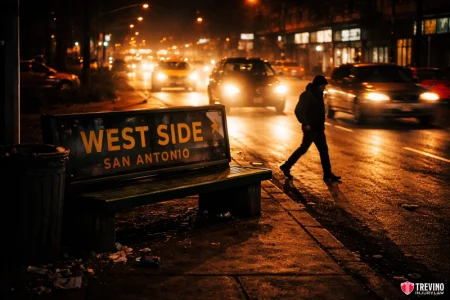
For families in neighborhoods like Woodlawn Lake or Prospect Hill, the danger is constant. We have seen too many cases where a loved one was struck simply trying to cross the street. We fight back by using the Texas Penal Code and civil liability laws to hold the driver fully accountable. We investigate the driver’s blood alcohol content to prove that a sober driver could have avoided the collision.
The Reality of High-Risk Intersections, Traffic Safety & Accident Trends
San Antonio faces a persistent drunk driving crisis, with local reports indicating nearly 1,700 DWI-related crashes in 2024 alone. According to the Texas Department of Transportation (TxDOT), the official reports often undercount the true danger. We analyze San Antonio’s dangerous intersections to understand the full scope of the crisis involving mixed drug and alcohol impairment.
Statewide data confirms that fatal impaired crashes peak between 2:00 AM and 3:00 AM, aligning perfectly with the “last call” rush from bars in Downtown, The Pearl, and the St. Mary’s Strip. This predictable wave of intoxicated drivers floods major arteries like I-10 and Loop 1604.
These numbers represent families torn apart in Bexar County. Behind every one of the 754 crashes reported through mid-2025 is a victim facing surgery, lost wages, and a fight against an insurance company.
Understanding Texas DWI Penalties & Compensation for Victims
A standard first-offense DWI (§49.04) is a Class B misdemeanor, but when a victim is hurt or killed, the charges escalate to felonies.
- Intoxication Assault (Texas Penal Code §49.07): If the crash causes “serious bodily injury“, defined as injury that creates a substantial risk of death or permanent disfigurement, the charge becomes a Third-Degree Felony. This carries a potential 2 to 10 years in prison.
- Intoxication Manslaughter (Texas Penal Code §49.08): If the crash results in a death, it is a Second-Degree Felony, punishable by 2 to 20 years in prison.
Why This Matters to Your Civil Case: While the District Attorney uses these statutes to seek jail time, we use them to establish Gross Negligence. A conviction under §49.07 or §49.08 is powerful evidence that the driver’s conduct was criminal. This allows us to pursue Exemplary (Punitive) Damages by meeting the rigorous standard for gross negligence established in Transportation Insurance Co. v. Moriel.
What Is the Texas DPS ALR 15-Day Deadline?
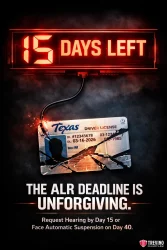
You must formally request an Administrative License Revocation (ALR) hearing within 15 days of being served a notice of suspension to avoid an automatic license suspension. This civil process operates independently of your criminal case and the timeline begins immediately if a driver refuses or fails a breath test.
If you miss this strict deadline, your license will be suspended starting 40 days after the notice date. For injury victims, the ALR hearing is a critical strategic tool used to secure sworn testimony from the arresting officer, effectively locking in details regarding driver impairment for use in future personal injury lawsuits.
How Does Texas Dram Shop Law Help You Secure Compensation?
The Texas Dram Shop Act allows victims to secure compensation by holding bars, restaurants, and retailers liable for damages if they served alcohol to an obviously intoxicated person presenting a clear danger.
Texas recognized this principle long before most victims ever hear the phrase “Dram Shop.” In El Chico Corp. v. Poole, 732 S.W.2d 306 (Tex. 1987), the Texas Supreme Court held that a bar can be responsible for injuries caused by serving alcohol to a patron it knows or should know is intoxicated. As the Court put it, liability can arise from “selling or serving alcohol to a patron whom the licensee knows or should know is intoxicated.” That matters here because the crash does not always begin at the point of impact. It often begins at the bar tab, and Texas law allows us to follow that chain of negligence back to the business that helped set the wreck in motion.
Established under §2.02 of the Texas Alcoholic Beverage Code, this statute recognizes that the drunk driver is not the only negligent party. Successful claims rely on direct evidence, such as bar receipts or surveillance footage, to prove the server knowingly over-served the patron.
This legal avenue is often critical for recovering full compensation when a driver’s minimum liability insurance fails to cover catastrophic medical bills from facilities like University Hospital.
Is an ALR suspension separate from the criminal case?
Yes, Texas Dram Shop laws explicitly allow crash victims to file civil lawsuits against negligent bars, restaurants, or liquor stores that serve obviously intoxicated patrons.
Can I sue a bar for overserving the driver who hit me?
Yes, Texas Dram Shop laws explicitly allow crash victims to file civil lawsuits against negligent bars, restaurants, or liquor stores that serve obviously intoxicated patrons.
Does a BAC of 0.15 double the potential fine?
Yes, under the Texas Penal Code, the maximum fine for a standard DWI doubles from $2,000 to $4,000 if the driver’s blood alcohol concentration is 0.15 or higher.
How Civil Liability Promotes Prevention & Improves Safety
While the criminal investigation focuses on statutory guilt, our civil investigation focuses immediately on preserving the perishable evidence necessary to secure your financial recovery. The District Attorney does not prioritize preserving the bar’s security camera footage before it is overwritten in 7 to 14 days.
In a San Antonio DWI case, the police report is just the starting point. For victims, the next practical question is what to do after a drunk driving accident in San Antonio to document the scene, obtain important records, and avoid common claim mistakes.
We frequently find that officers miss critical civil details. Waiting for the criminal case to conclude, which can take 12 to 18 months in Bexar County courts, often means allowing this vital evidence to disappear. We launch a parallel investigation immediately and send spoliation letters to prevent the destruction of data.
What If I Don’t Hire a Traffic Accident Lawyer?
If you do not hire a trial lawyer, you leave the full value of your claim in the hands of insurance adjusters who are trained to minimize payouts. Without an attorney to subpoena credit card records or depose bartenders, you will likely miss the opportunity to prove Dram Shop liability.
Insurance carriers like Fred Loya or Progressive often race to offer unrepresented victims a “quick cash” settlement. By accepting this check, you waive your right to sue for future medical expenses. A lawyer acts as a shield against these tactics, ensuring that no settlement is accepted until the full lifetime cost of the injury is factored into the demand.
What If I Miss the Deadline for My Road Accident Claim?
If you miss the two-year statute of limitations for filing a personal injury or Dram Shop lawsuit in Texas, you are forever barred from recovering any compensation.
Many victims mistakenly believe the “clock” pauses during the criminal trial, but it does not. The two-year window begins the day of the crash. Acting immediately ensures your claim is filed well within the legal limits.
Why hire a Drunk Driving Accident Lawyer?
Navigating the aftermath of a crash on Bandera Road or SE Military Drive demands a legal strategy that understands both San Antonio’s most dangerous corridors and Texas Dram Shop laws.
Want to Protect the Full Value of Your Claim?
You’ve seen how this affects your case — but this is only one piece of the puzzle. Our Drunk Driving Accident Lawyer page breaks down what a trial-ready firm does differently.
You need a San Antonio accident lawyer to send spoliation letters and preserve black box data immediately.
Do not risk your financial recovery on a missed ALR deadline or a lowball offer. Call 210-TREVINO immediately. We help you document the scene, secure medical records, and build a case that can make all the difference in your recovery.