A wrongful death in Texas demands strict proof that a fatality was caused by someone else’s neglect, default, or unskillfulness. A fatal collision on Culebra Road or a surgical error is not just a tragedy. It is a preventable death caused by a failure to exercise reasonable care.
The insurance adjuster evaluating your claim is already building the defense: categorizing the crash as an unavoidable accident or an act of God to escape liability. According to a San Antonio Current 2023 analysis, San Antonio recorded 860 traffic fatalities between 2018 and 2022. These crashes stem from driver error, worn tires, or speeding, not unpreventable acts of nature. That is actionable negligence.
What Could Your Wrongful Death Accident Case Be Worth?
Answer a few quick questions about your accident. Takes about 60 seconds.
See What My Case Might Be WorthThe insurance company offered less than $20,000. I ended up with over $1 million. — Jackie Galindo
Critical data disappears rapidly. Black box records get overwritten, and cell phone logs vanish. A Spoliation Letter, a legal demand that prevents the property owner from destroying evidence, must be sent immediately. Texas gives your family exactly two years from the date of death to file a lawsuit. Miss that deadline, and your right to seek financial justice permanently expires.
Trevino Injury Law’s wrongful death attorneys file preservation orders immediately to secure vital evidence before it disappears. Call 210-TREVINO for a free case review. You pay nothing unless we win. Se Habla Español.
What Is the Legal Definition of Wrongful Death in Texas?
This strict statutory definition means that the plaintiff must prove the death was not merely accidental, but was the direct consequence of a failure to exercise reasonable care.
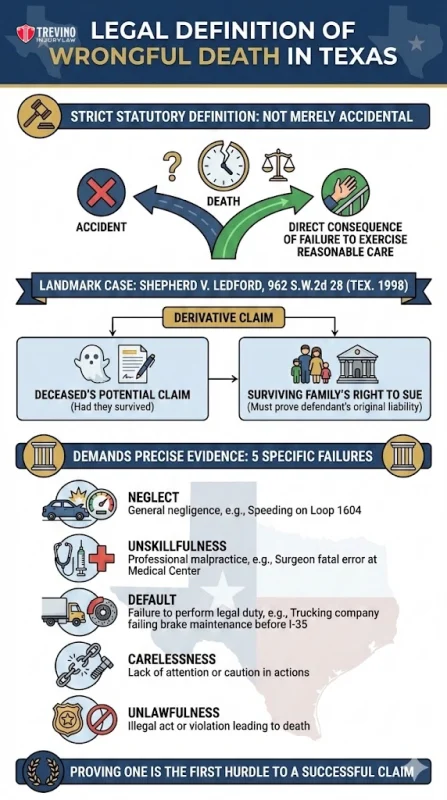
As established in the landmark case Shepherd v. Ledford, 962 S.W.2d 28 (Tex. 1998), a wrongful death claim is a statutory cause of action that confers on the surviving family a right to sue that the deceased would have had if they had survived. This means the claim is “derivative”, we must prove the defendant would have been liable to your loved one directly.
This is not a general grievance for loss; it is a statutory cause of action that requires precise evidence. In San Antonio courts, we must demonstrate that the fatality falls within one of these five specific categories of failure. “Neglect” typically covers general negligence, such as a driver speeding on Loop 1604, while “unskillfulness” often applies to professional malpractice, such as a surgeon making a fatal error at a facility like the Medical Center.
“Default” can refer to a failure to perform a legal duty, such as a trucking company failing to maintain its brakes before sending an 18-wheeler down I-35. Proving that the death fits one of these definitions is the first hurdle in any successful claim.
The 4 Elements Required to Prove a wrongful death claim in texas
To secure a verdict or settlement, we must establish four distinct elements by a preponderance of the evidence, a standard reaffirmed by the Texas Supreme Court in Nabors Drilling, U.S.A., Inc. v. Escoto, 288 S.W.3d 401 (Tex. 2009).
Under this precedent, we must prove: 1) the defendant owed a legal duty to the deceased; 2) they breached that duty; 3) the breach proximately caused the death; and 4) the plaintiffs suffered actual damages.
- Duty: The defendant owed a legal duty of care to the deceased, such as the obligation to drive sober or maintain a safe property.
- Breach: The defendant violated that duty through a specific act or omission, such as running a red light or failing to comply with safety regulations.
- Causation: The breach was the “proximate cause” of the death, meaning the fatality would not have occurred without that specific failure.
- Damages: The surviving family members (spouse, parents, or children) suffered actual injury, such as lost financial support, mental anguish, or lost companionship.
Once you understand these specific legal terms and elements, the next critical question involves determining who exactly counts as a “person” under the law, especially in heartbreaking cases involving pregnancy.
Does an Unborn Child Qualify for Wrongful Death in Texas?
Yes, Texas law explicitly qualifies an unborn child as an “individual” for wrongful death claims from the moment of fertilization to birth, regardless of the gestational age or viability of the fetus.
This powerful protection under Chapter 71.0055 means that parents can seek justice for the loss of a pregnancy caused by another’s negligence, distinct from any injury claim for the mother.
In 2003, the Texas legislature amended the statute to remove the requirement that a fetus must be “viable” (able to survive outside the womb) to qualify for a claim. This is a significant departure from the laws in many other states.
It means that if a pregnant mother is struck by a drunk driver in Alamo Heights and loses the baby, the driver is liable for that death even if the pregnancy was in the very early stages.
This statute acknowledges the loss of the child’s life as a separate and compensable tragedy, allowing parents to recover damages for mental anguish and the loss of the child’s companionship.
Can You Sue a Doctor for the Death of an Unborn Child?
Yes, you can sue a doctor for the wrongful death of an unborn child if the death was caused by medical negligence or “unskillfulness,” but the law includes specific exceptions for lawful medical procedures. If a doctor fails to monitor fetal distress signals or makes a surgical error that results in the death of a wanted pregnancy, that constitutes a valid wrongful death claim.
However, the statute explicitly excludes claims arising from lawful medical procedures or the dispensing of medication, focusing liability solely on acts of negligence that breach the standard of care.
While these civil protections are broad, many families worry that they cannot file a lawsuit if the person who caused the death wasn’t charged with a crime.
Can You File a Wrongful Death Claim if No Criminal Charges Are Filed?
Yes, you can absolutely file and win a wrongful death lawsuit even if the at-fault party is never arrested, charged, or convicted of a crime, because civil claims operate under a completely different legal standard than criminal cases.
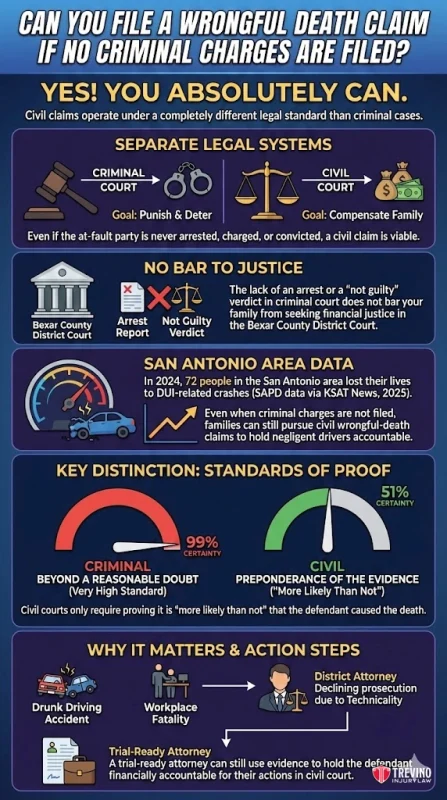
The lack of an arrest report or a “not guilty” verdict in criminal court does not bar your family from seeking financial justice in the Bexar County District Court.
In 2024, 72 people in the San Antonio area lost their lives to DUI-related crashes, according to San Antonio Police Department data reported by KSAT News (2025). Even when criminal charges are not filed, families can still pursue civil wrongful-death claims to hold negligent drivers accountable.
Criminal courts require the state to prove guilt “beyond a reasonable doubt”, a very high standard requiring roughly 99% certainty. Civil courts, however, only require a “preponderance of the evidence,” which means proving it is “more likely than not” (51% certainty) that the defendant caused the death.
This distinction is vital in cases like drunk driving accidents or workplace fatalities, where a District Attorney might decline to prosecute due to a technicality. In those instances, a trial-ready attorney can still use the evidence to hold the defendant financially accountable for their actions.
What Is the Difference Between Murder and Wrongful Death?
Murder is a criminal charge brought by the state to punish the offender with prison time, whereas wrongful death is a civil claim brought by the family to secure financial compensation for their loss.
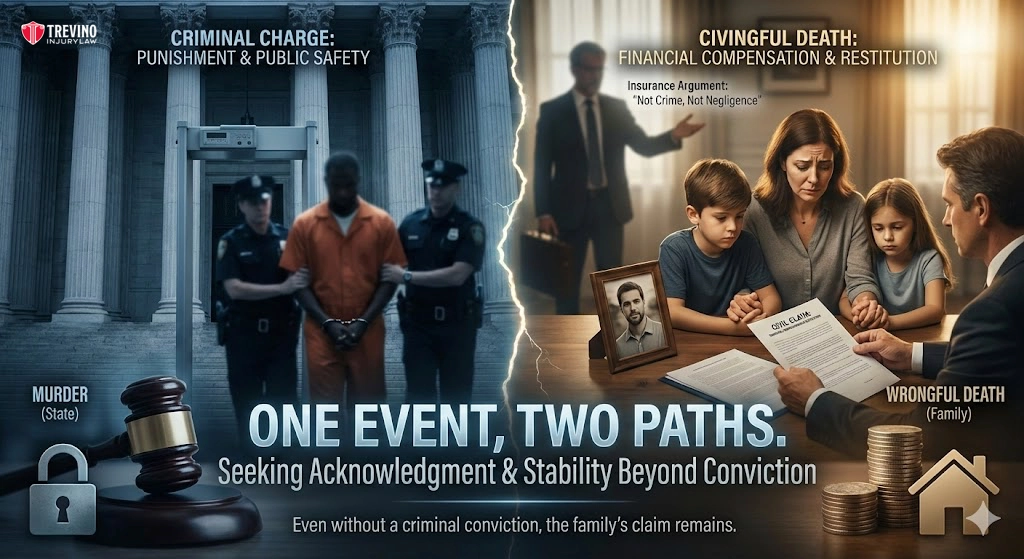
A single event can be both a murder and a wrongful death, but the goals are different: the criminal system seeks punishment and public safety, while the civil system seeks restitution for the survivors.
Even if the criminal justice system fails to secure a conviction, the wrongful death claim remains the family’s primary tool to obtain acknowledgment of the wrong and financial stability for their future.
While criminal intent or clear negligence establishes a strong case, insurance companies often try to argue that the death was neither a crime nor negligence, but something entirely different.
Is Accidental Death Always Considered Wrongful Death?
No, not every accidental death qualifies as “wrongful” under Texas law; to pursue a claim, you must prove that the fatality resulted specifically from someone’s negligence, misconduct, or failure to act, rather than being a purely random or unavoidable event. The law distinguishes between tragic accidents that no one could have prevented and preventable deaths caused by a violation of safety standards.
Between 2018 and 2022, San Antonio recorded 860 traffic fatalities, ranking third in Texas behind Houston and Dallas, according to a San Antonio Current 2023 analysis. Many of these deaths involved driver error or negligence rather than unavoidable accidents.
Insurance companies frequently attempt to classify fatal crashes as “unavoidable accidents” or “Acts of God” to escape liability. For example, if a semi-truck hydroplanes on I-10 near Leon Valley during a storm, the trucking company might argue that the weather was solely to blame.
A San Antonio wrongful death lawyer earns their fee by proving the driver was traveling too fast for conditions or had worn tires, transforming the “accident” into a qualified wrongful death claim. Without this evidence, such as black box data or cell phone records, even a clear tragedy may not legally qualify for compensation.
Proving liability is the only way to overcome the aggressive legal strategies insurance companies use to try to disqualify your family’s claim completely.
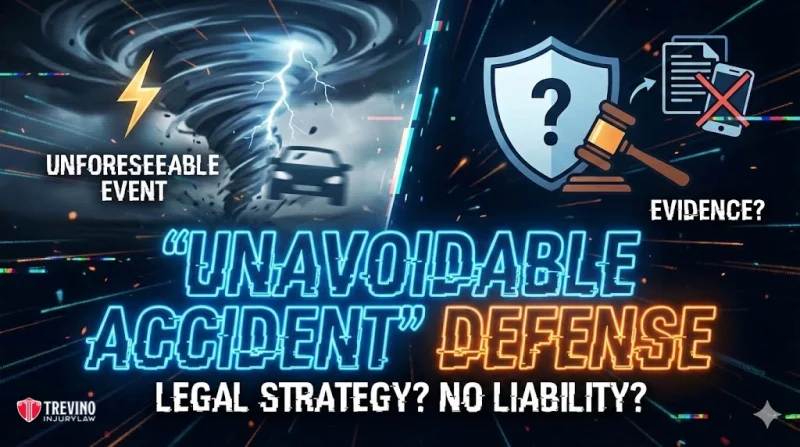
The “unavoidable accident” defense is a powerful legal strategy used by defendants to argue that a death was caused by an unforeseeable event, such as a sudden medical emergency or extreme weather, rather than negligence, effectively relieving them of all financial liability. In Texas civil courts, if a judge allows this instruction and a jury finds the event was truly beyond anyone’s control, the surviving family receives no compensation, regardless of the severity of their loss.
Insurance companies frequently raise this defense in San Antonio traffic cases, asserting that a collision was an “Act of God” rather than driver error. To overcome this, we must present concrete evidence, such as maintenance logs or cell phone records, demonstrating that the defendant had control and failed to exercise it.
Does a Heart Attack While Driving Qualify as Wrongful Death?
However, a sudden, unforeseen cardiac event is often ruled an unavoidable accident, which can complicate legal action and limit the legal rights of survivors. To determine if a claim exists, an experienced attorney from our law firm must analyze medical records to prove that the death of a person was preventable rather than random.
It depends on whether someone else’s negligence played a role. If a driver ignored known medical restrictions and caused a death, you may be able to file a civil lawsuit to seek compensation through a wrongful death claim.
If the evidence confirms the driver shouldn’t have been behind the wheel, a successful wrongful death verdict or wrongful death settlement becomes possible. In these Texas wrongful death cases, recoverable damages include loss of financial support and mental anguish resulting from the death of a loved one.
Does Suicide Ever Qualify as Wrongful Death?
Texas law generally classifies suicide as an “intervening cause” that absolves other parties of liability, but valid claims exist if a hospital, jail, or mental health facility failed to follow mandatory suicide prevention protocols for a patient known to be at risk. This specific area of law, known as “custodial negligence,” applies when a person is under the direct care and protection of an institution.
For example, if a facility in the Medical Center district admits a patient with known suicidal ideations but fails to remove dangerous objects or perform required room checks, the facility can be held liable for the resulting death. These cases hinge on proving that the institution knew of the immediate danger and failed to act, rather than on the individual’s actions.
What If the Deceased Was Partially at Fault? (The 51% Rule)
Under Texas’s proportionate responsibility law, a death remains qualified for a claim as long as the deceased was not more than 50% responsible for the fatal incident, although the final payout will be reduced by their assigned percentage of fault.
If a jury determines the deceased was 51% or more to blame, for instance, if they were intoxicated and jaywalking across a dark stretch of Culebra Road, the claim is legally barred, and the family recovers nothing.
However, if they are found only 30% at fault, the family can still recover the remaining 70% of the damages. Insurance adjusters often attempt to exaggerate the victim’s fault to meet the 51% threshold, making it critical to have a lawyer who can accurately reconstruct the accident.
When Is It Too Late to Qualify for a Claim? (Statute of Limitations)
Your right to file a claim legally expires if you fail to file the lawsuit within exactly two years of the date of death, permanently disqualifying you from recovering compensation regardless of how clear the other party’s negligence might be. This “statute of limitations” is strictly enforced in Texas courts, with very few exceptions.
While the “discovery rule” can sometimes extend deadlines in other types of cases, it rarely applies to wrongful death claims since the fact of the death is usually immediately known.
Waiting too long to contact an attorney can result in the total forfeiture of your rights, leaving your family with no legal recourse against the person or company responsible for your loss.
Why Hire a San Antonio Wrongful Death Lawyer?
When a preventable death strikes on Loop 1604, families need relentless advocacy in the Bexar County District Court. While insurance adjusters aggressively label fatal crashes as “unavoidable accidents” and high-volume settlement mills fold under pressure, Trevino Injury Law prepares for battle. We force negligent corporations to pay by building cases they fear taking to trial.
Want to Protect the Full Value of Your Claim?
You’ve seen how this affects your case — but this is only one piece of the puzzle. Our Wronfgull Death Lawyer page breaks down what a trial-ready firm does differently.
Our trial authority is proven by a record-breaking $17 million settlement secured for a grieving family. As your San Antonio trial attorney, we immediately file preservation orders to secure vital evidence before it disappears.
Call 210-TREVINO for a free case review. You pay nothing unless we win. Se Habla Español.
