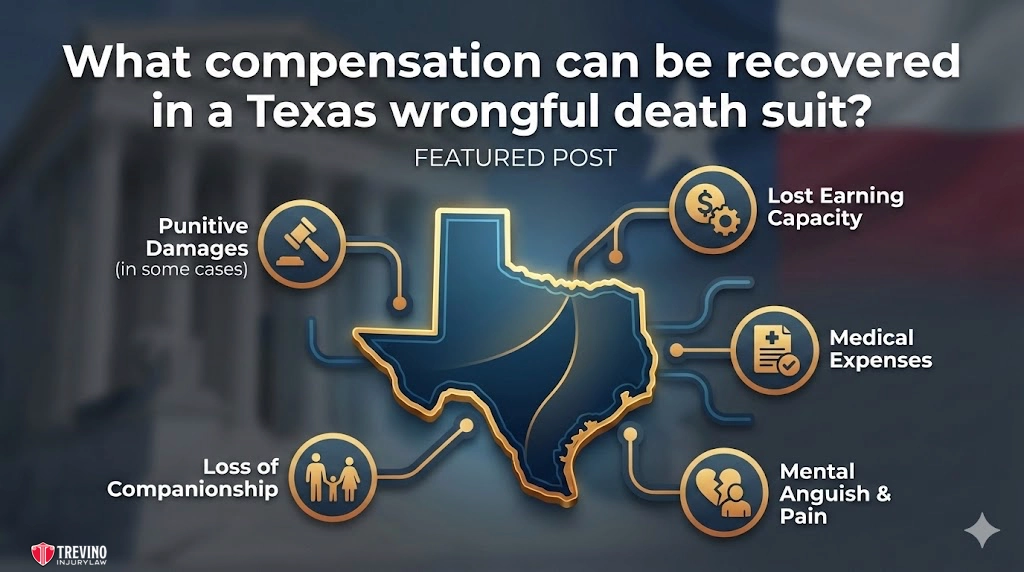
Texas wrongful death compensation covers the exact financial and emotional void left by a preventable death. Economic damages replace lost earning capacity. Non-economic damages compensate for mental anguish and the destruction of a unique relationship.
The commercial insurance adjuster is already working to minimize your recovery. They calculate the cheapest possible settlement by ignoring decades of inflation-adjusted future wages and treating the loss of inheritance as zero.
According to state workplace data, Texas recorded 578 fatal occupational injuries in 2022. Behind those fatalities are adjusters pressuring grieving families to accept immediate checks that pay for the funeral but abandon future financial stability.
What Could Your Wrongful Death Accident Case Be Worth?
Answer a few quick questions about your accident. Takes about 60 seconds.
See What My Case Might Be WorthThe insurance company offered less than $20,000. I ended up with over $1 million. — Jackie Galindo
Evidence of negligence vanishes fast. A Spoliation Letter, a legal demand that requires the corporate defendant to preserve evidence, must be sent immediately. Texas gives your family two years to file a lawsuit. Missing that deadline permanently destroys your right to sue.
Trevino Injury Law’s wrongful death lawyers retain forensic economists to calculate the true value of a life and prepare for a jury trial. Call 210-TREVINO now for a free case review. You pay nothing unless we win. Se Habla Español.
Wrongful Death vs. Survival Actions: Who Gets Paid What?
Wrongful death compensation falls into two distinct legal ‘buckets’: wrongful death damages, paid directly to surviving family members for their personal loss, and survival action damages, paid to the estate. This distinction is fundamental in Texas law, as affirmed in Austin Nursing Center, Inc. v. Lovato, 171 S.W.3d 845 (Tex. 2005).
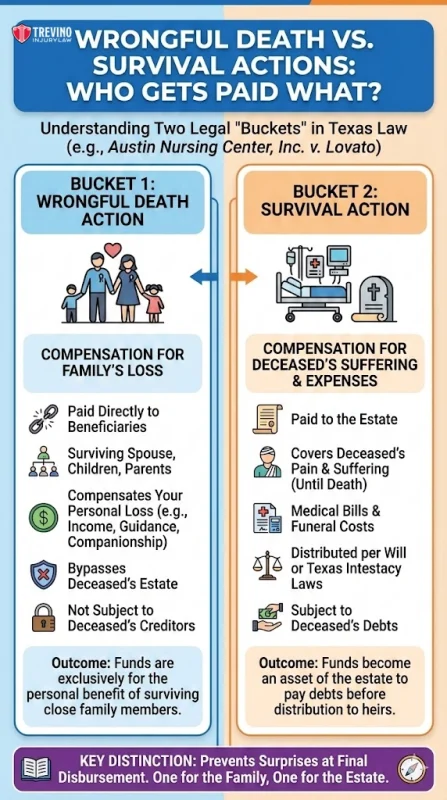
In this case, the Texas Supreme Court clarified that while a wrongful death claim belongs exclusively to the beneficiaries (spouse, children, and parents) to compensate them for their own loss, a survival action preserves the claims the deceased would have possessed had they lived, such as for their own pain and suffering, which then become an asset of their estate.
The first “bucket,” the Wrongful Death Action, is strictly for the exclusive benefit of the surviving spouse, children, and parents of the deceased. These funds compensate you for what you personally have lost: your husband’s income, your mother’s guidance, or your child’s companionship. Because these damages belong to you individually, they generally bypass the deceased’s estate and are not subject to the deceased’s creditors.
The second “bucket,” the Survival Action, functions as if the deceased had survived the accident and sued for their own injuries. These damages cover the pain and suffering the victim experienced from the moment of the accident until death, as well as their medical bills and funeral costs.
The estate pays this money and distributes it according to the will or Texas intestacy laws, meaning it can be used to pay the deceased’s debts before heirs receive their share.
Understanding this distinction prevents surprises when the final settlement is disbursed. For a deep dive into how these funds are split among relatives.
Economic Damages: Replacing Financial Contributions
Economic damages are calculated to replace the tangible financial contributions the deceased would have provided, including lost earning capacity and household services. Crucially, Texas law also permits recovery for ‘loss of inheritance,’ a principle established in the landmark case Yowell v. Piper Aircraft Corp., 703 S.W.2d 630 (Tex. 1986).
In Yowell, the Texas Supreme Court held that survivors have the right to recover the present value of the assets the deceased would, in reasonable probability, have added to their estate and left to the family at natural death, ensuring that a negligent party does not benefit from cutting a life short.
Determining “how much a life is worth” in financial terms is not a guess; it is a forensic projection of what that person would have generated over a full lifetime.
If a father working at the Toyota plant on the South Side is killed at age 35, we do not just calculate his current wages. This forensic analysis is increasingly critical in our state, where workforce risk is statistically higher than in the rest of the country. In 2022 alone, Texas recorded 578 fatal occupational injuries, an 8% increase from the previous year.
With a fatality rate of 4.3 per 100,000 full-time employees (significantly higher than the national average of 3.7), it is imperative that we accurately calculate the decades of lost earning capacity for the families left behind.
Common economic damages include:
- Loss of Earning Capacity: The total salary, wages, and benefits the deceased would have earned from the date of death until retirement.
- Loss of Inheritance: The assets, savings, and investments the deceased would have naturally accumulated and eventually left to you.
- Loss of Household Services: The replacement cost for the specific tasks the deceased performed, such as home repairs, accounting, or childcare, which you must now pay a professional to do.
- Funeral Expenses: The reasonable costs for burial and interment services, which can be substantial in Bexar County.
Non-Economic Damages: Wrongful Death Compensation for Grief and Consortium
Non-economic damages provide financial compensation for the subjective, intangible losses surviving family members endure, specifically covering mental anguish, loss of consortium for spouses, and loss of companionship for parents and children. These damages acknowledge that a family member’s value extends far beyond their paycheck.
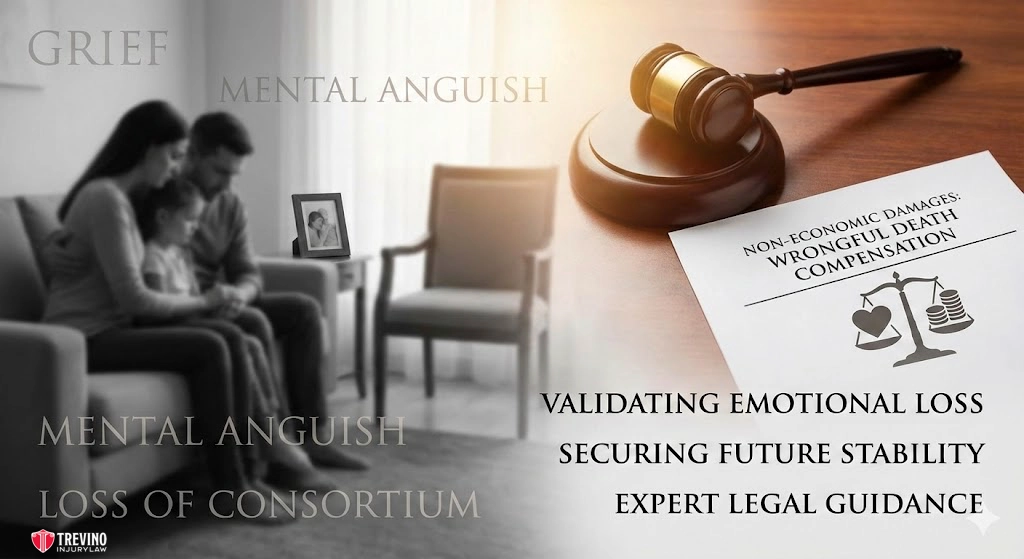
The emotional impact of a tragedy that leads to wrongful death is immeasurable, and the sudden death can be staggering for the family left behind. While no amount of money can heal the grief, the law recognizes that you are entitled to compensation for this profound void.
Non-economic damages are meant to validate the specific emotional destruction caused by the wrongful death, ensuring that the negligent party pays for the human cost of their actions, not just the medical bills. To receive compensation that truly reflects this loss, you must understand the types of damages available. In Texas, the compensation available includes recovery for mental anguish and the loss of the deceased’s positive influence, guidance, and love.
However, insurance adjusters often try to minimize these subjective claims. A skilled wrongful death lawyer fights to prove that these damages may be available to you and ensures your claim includes compensation for every aspect of your suffering.
Securing a fair settlement requires working with a wrongful death expert who can effectively communicate your story to a jury. An experienced wrongful death attorney knows how to quantify the damages in wrongful death cases, ensuring that you seek compensation for the loss of the unique relationship you shared.
Ultimately, a wrongful death lawyer ensures that the final award provides the compensation they deserve, helping to stabilize the family’s future. While money cannot bring them back, this compensation can truly make a difference in your ability to move forward.
Exemplary (Punitive) Damages: When Does Negligence Become Criminal?
Non-economic damages provide financial compensation for the subjective, intangible losses surviving family members endure, specifically covering mental anguish, loss of consortium for spouses, and loss of companionship for parents and children. These damages acknowledge that a family member’s value extends far beyond their paycheck.
Following the shock of an untimely death, families often struggle to quantify their suffering. However, Texas law allows surviving spouses, children, and parents to seek compensation for this profound void. Pain and suffering damages are not merely about money; they are the legal mechanism used to acknowledge the severity of the fatal injuries your loved one suffered and the lasting impact on your life.
While no amount of money can truly make things right, the court may award these funds to ensure the family receives fair compensation for the destruction of the family unit.
Because these losses are personal, the types of damages available vary for each family member. To fully recover compensation for these intangible losses, you must clearly describe the depth of your relationship and the specific emotional toll the wrongful act has taken on your daily life.
Are There Limits on How Much You Can Sue For?
In most standard wrongful death cases involving general negligence, such as car accidents on Bandera Road or commercial trucking crashes on I-35, there is no statutory limit or “cap” on the amount of economic or non-economic damages you can sue for in Texas.
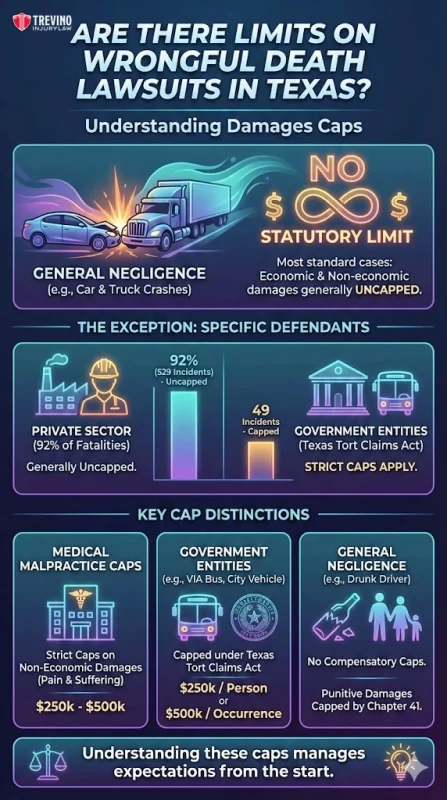
However, strict caps apply to certain defendants, most notably in claims against government entities. Understanding this distinction is vital because the legal path often depends on the employer. According to 2022 data, 92% of Texas workplace fatalities (529 incidents) occurred in the private sector, where damages are generally uncapped.
However, 49 fatal incidents involved public or governmental employees, an increase from the prior year, meaning those specific families face strict damages caps under the Texas Tort Claims Act that private sector litigants do not.
Understanding these distinctions manages expectations from the start:
- Medical Malpractice Caps: If your loved one died due to negligence at a facility such as Methodist Hospital or University Hospital, Texas law caps non-economic damages (pain and suffering) at roughly $250,000 to $500,000, depending on the number of defendants, regardless of the severity of the loss.
- Government Entities: Under the Texas Tort Claims Act, if the negligent party was a government employee, such as a VIA Metropolitan Transit bus driver or a City of San Antonio vehicle, damages are often capped at $250,000 per person or $500,000 per occurrence.
- General Negligence: For standard personal injury cases (like a drunk driver hitting your family), there are no such caps on compensatory damages, though punitive damages (exemplary) are capped by Chapter 41.
Factors That Influence Your Settlement Value
Your wrongful death settlement value is primarily influenced by the “Proportionate Responsibility” assigned to each party, the available insurance policy limits of the defendant, and the specific economic profile of the deceased, including their age, health, and earning potential.
While families naturally ask “what is considered a large settlement,” the answer varies wildly because a settlement is essentially a mathematical replacement of a unique life’s financial future.
Forensic economists in San Antonio courts analyze several key variables to calculate this value:
- Age and Health: A claim for a 30-year-old father in peak health with high earning potential at Valero Energy will generally yield a higher economic valuation than a claim for a retired individual, simply because fewer working years are lost.
- Degree of Liability: Texas follows a “51% Bar” rule; if the deceased is found to be more than 50% responsible for the accident (e.g., speeding through an intersection in Leon Valley), the family recovers nothing. If they were 20% at fault, your award is reduced by 20%.
- Insurance Coverage: Even with a high-value claim, recovery is often limited by the defendant’s insurance. A commercial trucking policy may offer millions in coverage, whereas a standard personal auto policy may cover only the state minimum of $30,000, making “Uninsured/Underinsured Motorist” (UM/UIM) coverage critical.
How Are Wrongful Death Settlements Distributed in Texas?
Wrongful death settlements in Texas are distributed either by a mutual agreement among all surviving family members or, if the family cannot agree, by a jury based on the specific evidence of loss presented by each individual heir during the trial.
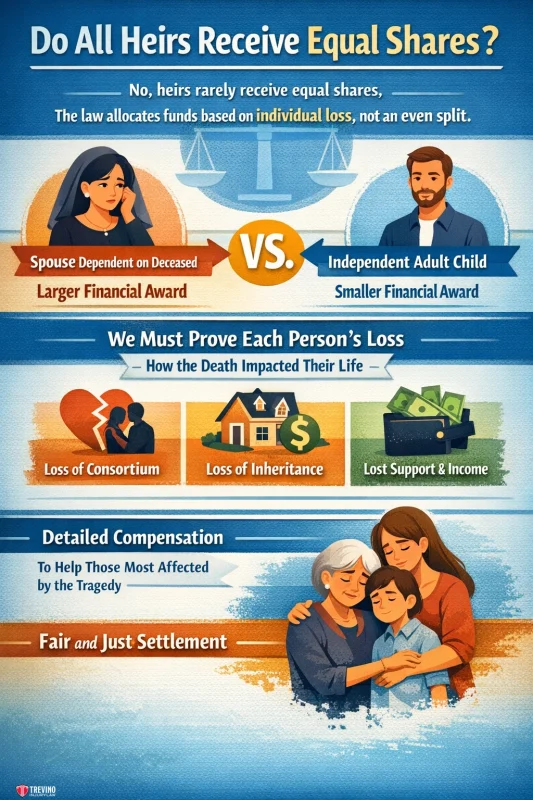
Unlike a standard inheritance, in which assets might be split evenly, these funds are allocated based on each relative’s distinct suffering and economic dependence, meaning a dependent spouse often receives a larger share than an independent adult child.
In Bexar County courts, if the family is united, we draft a settlement agreement that specifies exactly how the net proceeds are divided. If there is, for example, a dispute between a surviving spouse and children from a previous marriage living in Alamo Heights, the judge or jury will assign a percentage of the total award to each person based on testimony about their relationship with the deceased.
No, heirs rarely receive equal shares because the law allocates funds based on individual loss rather than a simple even split. The court’s goal is to reach a fair settlement that accurately reflects the unique suffering and economic dependence of each family member.
For instance, a spouse who relied on the deceased for daily income will typically receive significantly more serious financial damages than an adult child who lived independently. When we seek compensation for the loss, we must prove exactly how the death impacted each person’s life. This ensures that the specific types of damages in wrongful death cases, such as loss of consortium or loss of inheritance, are awarded to the specific relative who actually suffered that deprivation.
Ultimately, this detailed apportionment ensures that the people most devastated by the tragedy receive the compensation they deserve rather than a generic portion of the total award.
Does the Deceased’s Will Control the Payout?
No, wrongful death damages are paid directly to the statutory beneficiaries (spouse, parents, children) to compensate their personal loss, so the distribution is determined by the Texas Civil Practice & Remedies Code, not the deceased’s will. However, the will does play a role in who has the right to file a wrongful death suit if the family hesitates.
Under Texas law, the surviving family members have the exclusive right to file a wrongful death claim within three months of the death. If they do not file wrongful death lawsuits within this window, the executor or administrator named in the deceased’s will may intervene and bring a wrongful death claim on behalf of the estate, unless the family explicitly blocks them.
This technicality highlights why working with a wrongful death lawyer immediately is so critical; waiting too long can complicate who controls the litigation.
An experienced wrongful death attorney ensures that your family retains control over the case and that you are entitled to compensation that flows directly to you, rather than getting tied up in probate courts.
Does the IRS Tax Wrongful Death Payouts?
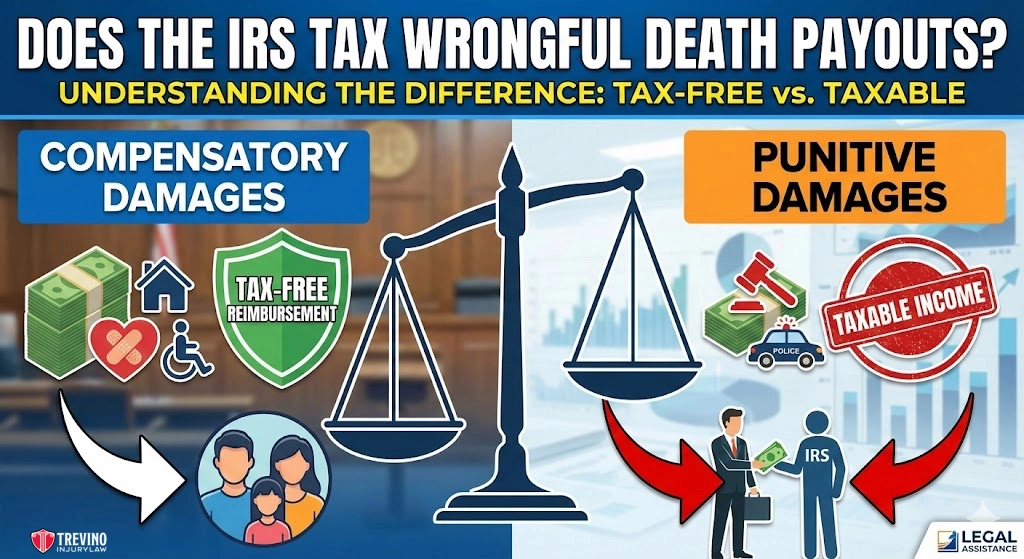
The Internal Revenue Service (IRS) generally does not tax wrongful death settlements that are compensatory in nature, as these funds are considered reimbursement for a loss rather than “income,” but any portion of the award specifically designated as punitive damages is fully taxable. This distinction is critical when structuring a settlement agreement with insurance companies.
If your settlement from a crash on Culebra Road is purely for lost wages, medical bills, and pain and suffering, the federal government views it as making you “whole” again, and it remains tax-free.
However, if a jury awards $1 million in exemplary damages to punish a drunk driver, that specific $1 million is treated as taxable income in the year it is received. We work with tax professionals to structure settlements in a way that maximizes the non-taxable portion for your family.
What If I Don’t Hire a Wrongful Death Lawyer?
If you attempt to handle a wrongful death claim without a trial-ready lawyer, you risk accepting a “lowball” insurance offer that covers immediate bills but fails to account for the millions of dollars in future lost income and loss of inheritance your family is entitled to.
Insurance adjusters for commercial carriers know that without an attorney who can file a lawsuit and retain forensic economists, they are under no pressure to pay the “full value” of the life lost.
Families who settle alone often find themselves facing financial ruin years later when the settlement money runs out, and the deceased’s income is still missing. A specialized attorney ensures that the final number includes the 20 or 30 years of future support you actually lost, not just the funeral costs incurred last week.
What if I miss the Filing Deadline in a wrongful death claim?
If you miss the strict two-year statute of limitations for filing a wrongful death lawsuit in Texas, you generally lose your legal right to sue permanently, and the court will dismiss your case regardless of how clear the defendant’s negligence was or how severe your financial loss is.
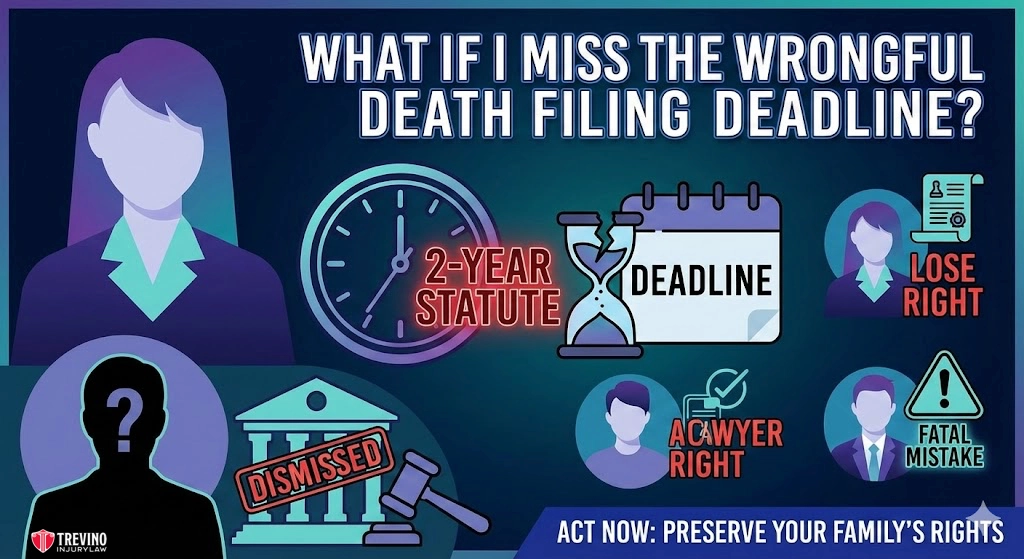
The clock starts ticking on the exact date of your loved one’s death, not the date of the accident if they lingered in a hospital like Brooke Army Medical Center (BAMC) for weeks beforehand.
Exceptions to this rule are extremely rare and difficult to prove. Waiting to “see how you feel” or “finish grieving” can be a fatal legal mistake. To preserve your rights, file the initial petition before this strict deadline expires so your family can retain the option to seek justice. For the steps that follow, see how the wrongful death lawsuit process works in Bexar County, from investigation through resolution.
Why Hire a San Antonio Wrongful Death Lawyer?
Waiting for evidence to vanish at Brooke Army Medical Center is exactly what commercial carriers want. While high-volume settlement mills fold to avoid court, Trevino Injury Law forces these companies to pay. We aggressively prepare every case for a jury trial from day one.
Want to Protect the Full Value of Your Claim?
You’ve seen how this affects your case — but this is only one piece of the puzzle. Our Wrongful Death Lawyer page explains how a trial-ready firm does things differently.
Our trial authority secures record-setting results in Bexar County, famously turning a $20,000 lowball offer into more than $1 million. You need an expert who will immediately retain forensic economists to substantiate future losses. Trust a proven San Antonio personal injury lawyer 24/7 to preserve crucial evidence.
Call 210-TREVINO for a free case review. Se Habla Español. We fight on a strict No Win, No Fee basis