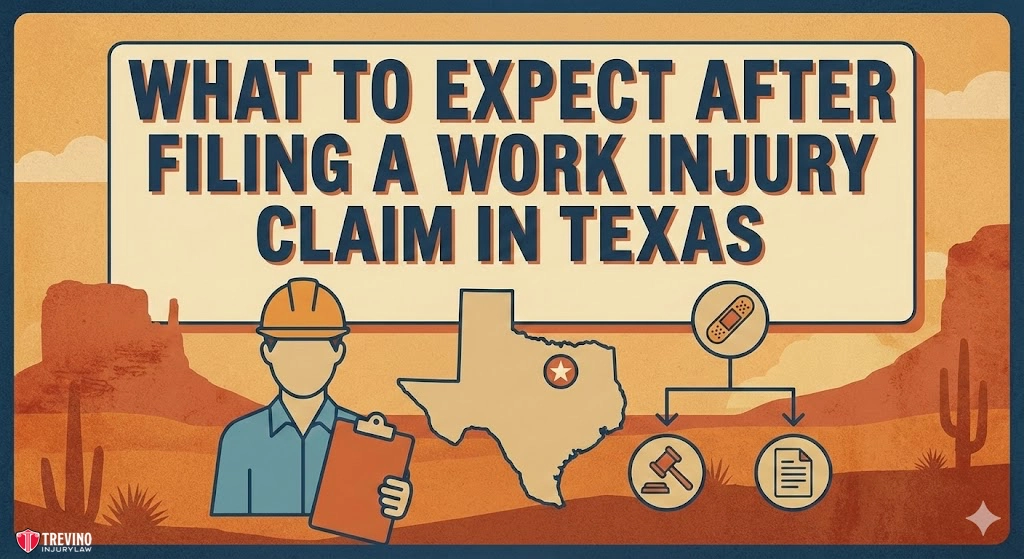
A work injury claim timeline represents the critical post-filing phase in San Antonio, spanning the adversarial gap between your initial report and financial recovery. This stage is characterized by insurance scrutiny, medical disputes, and Maximum Medical Improvement (MMI) milestones. Insurance adjusters immediately deploy invasive tactics, including surveillance and biased “company doctors,” to minimize your diagnosis. Their goal is to manipulate your words or catch you in a moment of weakness to deny benefits, making it critical to consult a personal injury lawyer near you who can protect your rights and handle insurer negotiations.
What Could Your Work Injury Case Be Worth?
Answer a few quick questions about your accident. Takes about 60 seconds.
See What My Case Might Be WorthThe insurance company offered less than $20,000. I ended up with over $1 million. — Jackie Galindo
Trevino Injury Law, our San Antonio work injury lawyer team, fights insurer surveillance, light duty traps, and low impairment ratings before they cost you benefits. Call 210-TREVINO for a free case review. You pay nothing unless we win. Se Habla Español.
Key Takeaways – What to Expect After Filing a Work Injury Claim in Texas
- Insurance carriers often hire investigators to watch injured workers after a claim is filed, looking for activity that contradicts medical restrictions.
- Refusing a light duty job that fits your medical restrictions can end your Temporary Income Benefits.
- Maximum Medical Improvement (MMI) ends Temporary Income Benefits, and your Impairment Rating then drives the rest of your financial recovery.
- Adjusters use social media posts and statements made to the company doctor as “inconsistencies” to deny valid claims.
Will the Insurance Company Investigate Me After I File?
Yes, insurance companies frequently hire private investigators to conduct surveillance on claimants, especially in high-value cases involving back injuries or substantial lost wage claims, to find any evidence that contradicts your reported physical limitations.
Once you file a work injury claim, you essentially trigger an investigation mechanism designed to limit the carrier’s financial exposure. Major insurers, such as Texas Mutual and Liberty Mutual, often deploy investigators to verify whether your daily activities comply with your medical restrictions.
For example, if you claim a severe back injury prevents you from lifting more than ten pounds, but an investigator captures video of you carrying heavy groceries or lifting a child, that footage will be used to deny your benefits immediately. This is not paranoia; it is standard procedure for claims that involve significant time off work or potential surgery.
In the San Antonio area, these investigators are familiar with local geography and habits. They may park down the street from your home in Leon Valley to watch for when you leave, or they might monitor your vehicle’s movements around popular areas such as the HEB Warehouse or shopping centers.
They are looking for “inconsistencies” moments where you appear to function normally despite your injury. It is crucial to live your life honestly while remaining vigilant, understanding that you may be under scrutiny from the moment your claim is opened until the final settlement check clears.

Does Workers’ Comp Follow You Around?
Insurance investigators legally can and will follow you in public spaces, such as to the grocery store, doctor’s appointments, or even your own front yard, to capture video evidence that contradicts your injury claim.
This practice, known as “sub-rosa” surveillance, is perfectly legal as long as the investigator remains on public property and does not trespass or harass you. Beyond physical tailing, insurance carriers now rely heavily on digital surveillance. They run “activity checks” by scanning your social media profiles for check-ins at San Antonio venues, photos of you at parties, or even old pictures that they can misrepresent as current activities. A single Facebook post showing you at a family barbecue can be twisted to argue that your pain and suffering are exaggerated.
While investigators watch you diligently from the outside to find physical contradictions, an even more dangerous trap waits for you inside the medical office, where your words are the target.
What Not to Say to a Workers’ Comp Doctor?
You should never downplay your symptoms, exaggerate your pain, or discuss legal settlement expectations with a workers’ comp doctor, as these statements will be recorded in your medical notes and used to devalue your claim.
The “company doctor” you are required to see often works for the insurance network, not for you, and their primary loyalty may lie with the carrier who pays them. When you speak to them, you must be accurate but cautious. Avoid common “forbidden phrases” that adjusters love to see in medical reports:
- “I’m fine” or “I’m doing okay” (even as a polite greeting).
- “It only hurts when I work.”
- “I hate my boss,” or any complaints about your job satisfaction.
- “I just want a settlement.”
The Texas Department of Insurance has strict guidelines on medical reporting, and every word you say becomes part of the permanent legal record. If you tell a doctor, “I’m okay,” out of habit, the adjuster will argue that your injury has resolved and terminate your benefits.
Instead, focus strictly on your medical symptoms and functional limitations during every visit. Be specific about your pain levels and how the injury restricts your daily life, but never discuss the legal aspects of your case with the treating physician.
Why Is Maximum Medical Improvement (MMI) Critical?
Maximum Medical Improvement (MMI) is the specific point where your condition has stabilized and is unlikely to improve further, which triggers the end of temporary income benefits and the assignment of a permanent impairment rating.
Reaching MMI is the defining milestone in your claim because it shifts your case from ‘treatment’ to ‘damages calculation.’ The Texas Supreme Court upheld this strict framework in Texas Workers’ Compensation Commission v. Garcia, 893 S.W.2d 504 (Tex. 1995). In this landmark decision, the Court affirmed that the use of the AMA Guides to the Evaluation of Permanent Impairment is the exclusive legal standard for determining your financial recovery.
Once MMI is certified, your Temporary Income Benefits (TIBs) legally cease, and your future payout is strictly limited to the mathematical Impairment Rating (IR) assigned by the doctor, making the accuracy of that rating the single most important factor in your financial future.
Once MMI is reached and the medical evidence is finalized, the focus shifts entirely to calculating the final amount and issuing the payment.

How Long After a Settlement Do You Get Paid?
In Texas, once a settlement release is signed, the insurance company typically issues the check within 14 to 30 days, though the timeline can be extended if there are outstanding medical liens to negotiate.
Many injured workers expect immediate payment upon reaching a verbal agreement, but the disbursement process involves several strict administrative steps. First, you must sign a “Release of All Claims,” a binding legal document that formally ends your right to pursue further compensation. Once the carrier receives this, they process the check. However, before the money reaches you, your attorney must ensure that all third-party interests are satisfied. This includes:
- Clearing subrogation liens from health insurance providers.
- Addressing Medicare or hospital liens.
- Finalizing attorney fees and case expenses.
Only after these obligations are met is the final net check disbursed to you. While the wait is frustrating, rushing this process can leave you personally liable for thousands of dollars in unpaid medical bills later.

What Is a Reasonable Settlement Offer?
A reasonable settlement offer must cover all past medical bills, projected future medical costs, lost earning capacity, and, in non-subscriber cases, non-economic damages like pain and suffering.
Determining what is “reasonable” depends entirely on the concrete data in your file, specifically your Impairment Rating and Future Medical projections. Insurance adjusters often start with “nuisance value” offers, low amounts designed to tempt you into a quick closure before you realize the true cost of your injury. A fair offer is not just a random number; it is a calculation that accounts for every year of work you might lose and every surgery you might need in the future.
However, getting to this offer requires avoiding common pitfalls, as insurance companies look for specific administrative reasons to stop payments entirely.
What Stops Workers’ Comp From Paying You?
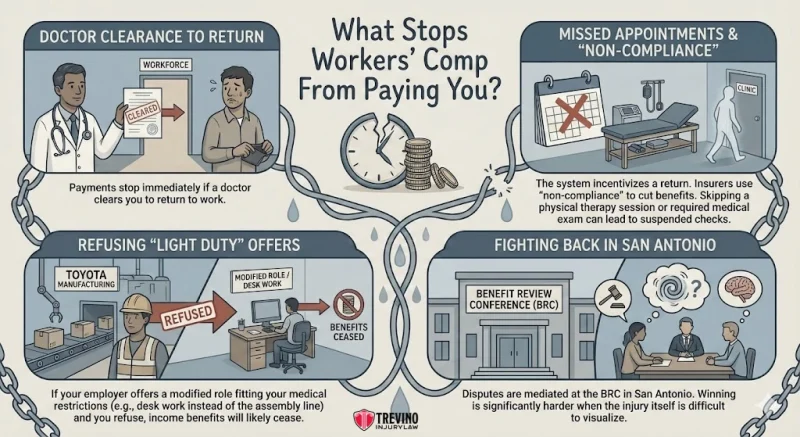
Workers’ compensation payments can be stopped immediately if a doctor clears you to return to work, if you miss scheduled medical appointments, or if you refuse a “light duty” assignment offered by your employer.
The system is designed to incentivize a return to the workforce, and insurers use “non-compliance” as a primary tactic to cut benefits. If you miss a physical therapy session or fail to attend a required medical exam, the carrier may file a dispute to suspend your checks.
Additionally, if your employer offers you a modified role that fits your medical restrictions, such as desk work at a Toyota Manufacturing facility instead of the assembly line, and you refuse it, your income benefits will likely cease.
When these stoppages occur, the venue for fighting back in San Antonio is the Benefit Review Conference (BRC), where disputes are formally mediated. However, winning these disputes is significantly more difficult when the injury is difficult to visualize.
What Happens If You Return to Work Too Early?
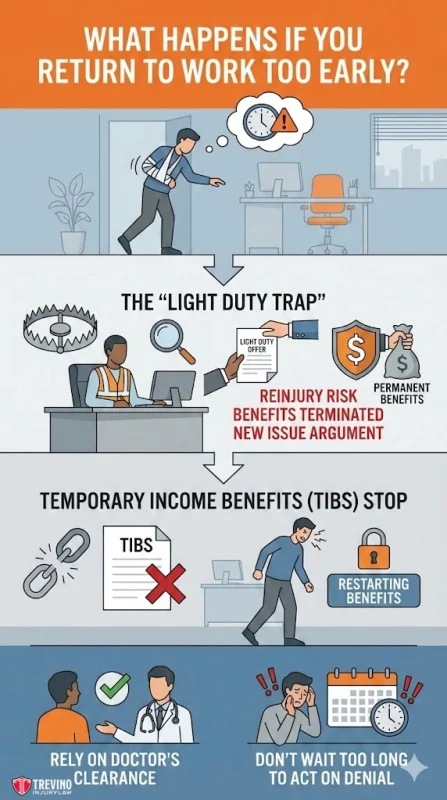
Returning to work before you are physically ready can cause you to reinjure yourself and give the insurance company immediate grounds to terminate your income benefits permanently.
This is often referred to as the “Light Duty Trap.” An employer might offer you a seemingly easy role to get you back on the payroll, but if you accept it and then cannot perform the tasks due to pain, the insurance company will argue that your inability to work is a new issue, not the original injury.
Furthermore, once you return to work, your Temporary Income Benefits (TIBs) stop. If you have to leave again a week later because the pain is too severe, restarting those benefits is incredibly difficult. It is safer to rely on your treating doctor’s clearance rather than yield to pressure from your boss.
While returning too early can ruin a claim, waiting too long to take action on a denial can destroy it entirely.
When Is It Too Late to Appeal a Denied Claim?
If your claim is denied, you generally have 90 days to request a Benefit Review Conference (BRC); failing to act within this window can result in the permanent loss of your right to challenge the denial.
In the Texas workers’ compensation system, deadlines are unforgiving. If you receive a notice of denial or a low impairment rating and you do not file the specific dispute paperwork with the Texas Division of Workers’ Compensation within the statutory timeframe, the insurance company’s decision becomes final.
Many injured workers in San Antonio mistakenly believe they can “wait and see” if they get better, only to find out months later that their right to medical care has expired. Do not let a calendar date be the reason you lose the benefits you deserve.
Frequently Asked Questions About Texas Work Injury Claims
What Is the Hardest Injury to Prove?
Soft tissue and back injuries are notoriously difficult to prove because Texas law generally requires more than just your word to establish they were caused by work. Under the standard set by Guevara v. Ferrer, 247 S.W.3d 662 (Tex. 2007), lay testimony is insufficient to prove causation for complex medical conditions that are not obvious to a layman.
Unlike a broken bone or amputation, proving that a herniated disc or nerve damage resulted specifically from your workplace accident and not ‘pre-existing degeneration’ requires competent expert medical evidence linking the event directly to the diagnosis.
Proving these invisible injuries often requires fighting back against a system designed to doubt you, but understanding the finality of your choices is the first step in that fight.
Can You Reopen a Closed Work Injury Claim in Texas?
Generally, once you sign a “full and final” settlement release, you cannot reopen your claim to demand additional compensation, even if your medical condition worsens unexpectedly or you require new surgeries that were not anticipated at the time of the agreement.
The legal concept governing this is strict. When you accept a lump sum settlement or sign a Compromise Settlement Agreement (CSA) in Texas, you are essentially selling your right to any future medical or income benefits in exchange for immediate payment.
Insurance companies insist on this finality to permanently close their books on your file. If you discover six months later that you need a fusion surgery you didn’t account for, the cost falls entirely on you, not the workers’ comp carrier.
There are extremely rare exceptions, such as cases qualifying for Lifetime Income Benefits (LIBs) involving catastrophic losses, such as total blindness or dual amputation, in which benefits may continue.
However, for the vast majority of San Antonio workers, the settlement is the end of the road. This reality makes the moment you sign the release the most critical point in your entire case; if the calculation is wrong, there is no “do-over” to fix it.
Since you only get one chance to secure these funds, you must ensure every dollar is managed correctly to avoid future financial liabilities.
The Post-Settlement Financial Checklist
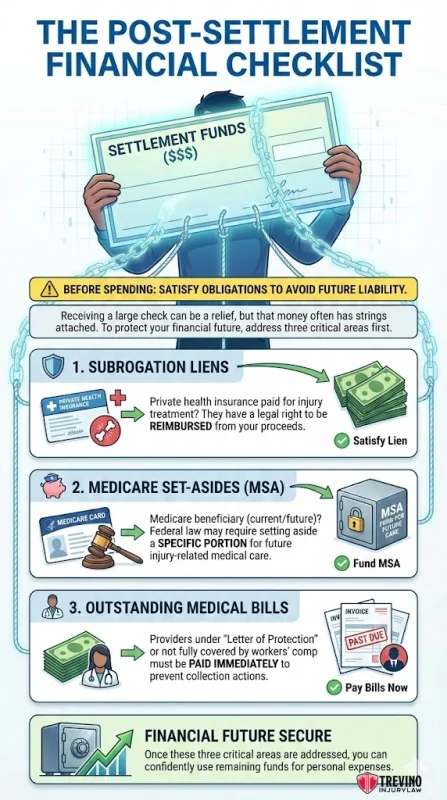
Before spending your settlement funds, you must ensure all financial obligations related to your injury are satisfied to avoid future legal liability.
Receiving a large check can be a relief, but that money often has strings attached that you might not see immediately. To protect your financial future, you must address three critical areas before using the funds for personal expenses:
- Subrogation Liens: If your private health insurance paid for any treatment related to the work injury, they have a legal right to be reimbursed from your settlement proceeds.
- Medicare Set-Asides (MSA): If you are a Medicare beneficiary or will be soon, federal law may require you to set aside a specific portion of your settlement to cover future injury-related medical care.
- Outstanding Medical Bills: Any providers who treated you under a “Letter of Protection” or whose bills were not fully covered by workers’ comp must be paid immediately to prevent collection actions.
Is My Work Injury Settlement Taxable?
No, generally, proceeds received for physical sickness or injury under workers’ compensation or personal injury settlements are exempt from federal income taxes according to IRS Code Section 104(a). However, you should still keep detailed medical records, claim forms, and settlement documents to ensure compliance and accuracy.
If your settlement includes portions for lost wages or interest, those amounts may be taxable. Consult with your attorney or tax professional to fully understand your rights and obligations under Texas workers’ compensation insurance laws.
Can I Quit My Job While on Workers’ Comp?
Yes, you can resign while on workers’ comp, but doing so may give the insurance company grounds to terminate your Temporary Income Benefits (TIBs) by arguing you voluntarily limited your income.
Before quitting, it’s important to review your workers’ compensation claim and understand how leaving your job could affect your ongoing benefits. Your employer and insurance company may claim that your work-related injury no longer prevents you from earning income.
To protect your rights, document your injury, communicate through proper claim forms, and maintain records such as witness statements and medical reports. Speaking with an experienced attorney can help you avoid complications in the workers’ compensation process.
Do I Have to Pay My Medical Bills Out of My Settlement?
Yes, any outstanding medical bills or liens from health insurance providers that paid for your treatment must be reimbursed from your gross settlement amount before you receive your net funds.
In most cases, workers’ compensation insurance covers the costs related to your occupational injury, but if your claim was partially denied or delayed, those medical expenses might need to be deducted. Always review the details of your settlement agreement, medical records, and claim forms to confirm how much you owe. Understanding your rights in the workers’ compensation process helps ensure your health and recovery aren’t jeopardized by unpaid medical costs.
Why Hire a San Antonio Work Accident Lawyer?
A missed 90-day deadline grants insurers like Texas Mutual a permanent victory. Instead of surrendering to high-volume settlement mills that avoid court, you need a Trial Lawyer who forces carriers to pay. Trevino Injury Law neutralizes the “light duty trap” and fights relentlessly for your financial compensation.
Want to Protect the Full Value of Your Claim?
You’ve seen how this affects your case — but this is only one piece of the puzzle. Our Personal Injury Lawyer page breaks down what a trial-ready firm does differently.

Our approach delivers results, including a $7,887,361 jury verdict in a work-related crush foot injury case after the insurance carrier offered $1,300,000. By immediately filing Benefit Review Conference disputes to lock in your rights, we act as the San Antonio work accident attorneys you need to secure your recovery.
Call 210-TREVINO for a free case review. We fight on a No-Win, No-Fee basis. Se Habla Español