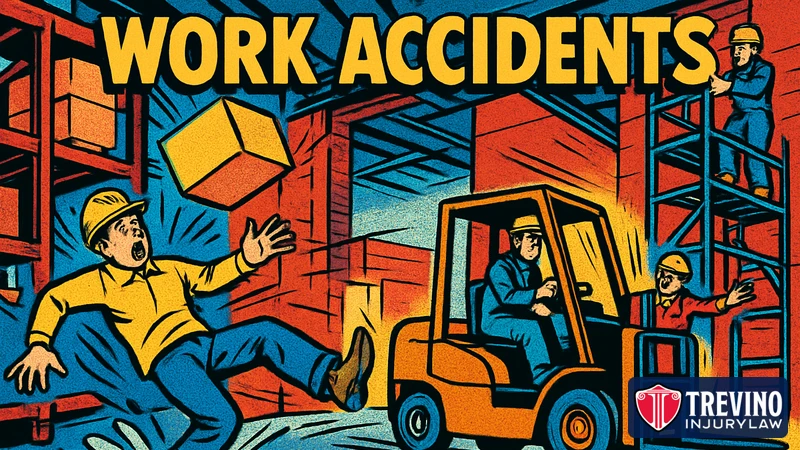
Most workplace accidents in San Antonio come from a short list of hazards: slips and falls, falls from heights, falling objects, forklift and equipment collisions, caught-in machinery, and on-the-job vehicle crashes. These injuries happen in warehouses, construction sites, retail stores, and oilfield yards across Bexar County every week.
After the injury, the fight shifts to coverage. Employers and their insurers often dispute how the accident happened, whether you reported it in time, or whether the injury is work-related at all. Texas also lets private employers opt out of workers’ compensation, which changes who pays and whether you can sue.
Deadlines start running right away. Texas law generally requires you to notify your employer within 30 days of a work injury, and missing that window can jeopardize a workers’ compensation claim. Reporting in writing and seeing a doctor promptly protects both your health and your benefits.
What Could Your Personal Injury Case Be Worth?
Answer a few quick questions about your accident.Takes about 60 seconds.
See What My Case Might Be WorthThe insurance company offered less than $20,000. I ended up with over $1 million. — Jackie Galindo
At Trevino Injury Law, our San Antonio work injury lawyers identify every party responsible for your injury, including employers who opted out of workers’ compensation, as well as outside contractors and equipment manufacturers. Call 210-TREVINO for a free case review. You pay nothing unless we win. Se Habla Español.
What Are the Most Common Workplace Accidents in San Antonio?
The most common workplace accidents fall into six categories. Each one points to a different safety failure, and that failure often decides who can be held responsible.
| Accident type | Common examples | Who may be responsible |
|---|---|---|
| Slips, trips, and falls | Unmarked spills, loose cords, cluttered aisles, icy exits | Employer, property owner, cleaning contractor |
| Falls from heights | Ladders, scaffolds, roofs, unguarded floor openings | Employer, general contractor, scaffold or ladder manufacturer |
| Struck by falling objects | Overloaded shelving, unsecured loads, dropped tools | Employer, subcontractor, racking installer |
| Forklift and equipment collisions | Tip-overs, blind corners, untrained operators | Employer, staffing agency, equipment manufacturer or lessor |
| Caught-in or between | Unguarded machinery, trench collapses, pinch points | Employer, machine manufacturer, site contractor |
| On-the-job vehicle crashes | Delivery, trucking, and work-zone collisions | Negligent third-party driver, trucking company, vehicle owner |
Slips, Trips, and Falls
Slip-and-fall accidents happen when a known hazard is left unmarked or uncleaned. A spill in a stockroom aisle, a loose extension cord, or an icy loading dock can cause fractures, back injuries, and head trauma. Cleanup logs, incident reports, and surveillance video often show how long the hazard sat before someone got hurt.
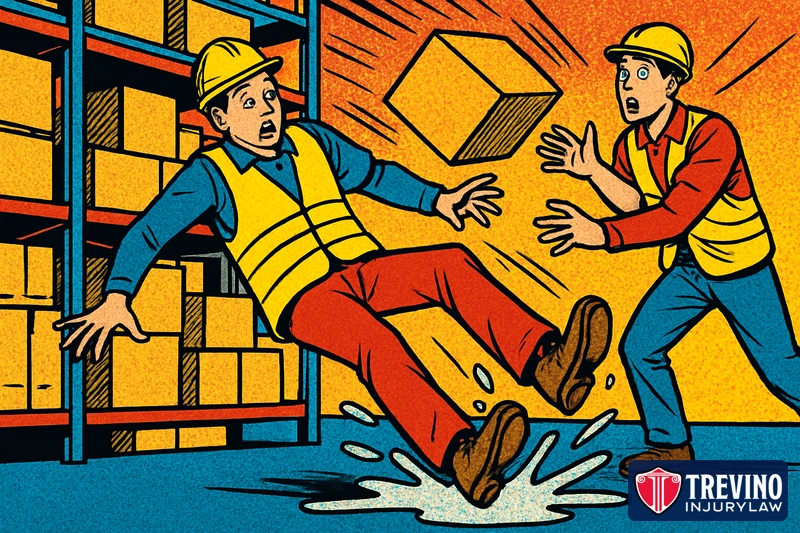
Falls From Heights
Falls from ladders, scaffolds, and roofs are among the most serious construction injuries. OSHA requires fall protection for many elevated work areas, including guardrails, safety nets, or personal fall arrest systems on construction sites. A missing harness or an unguarded edge is strong evidence of a safety failure.
Struck by Falling Objects
In warehouses and big-box stores, every inch of vertical storage matters. When a pallet is stacked unevenly or a rack is bumped by a forklift, boxes on upper levels can crash down on workers below. On construction sites, dropped tools and materials create the same danger.
What Causes Forklift Accidents?
Forklift accidents are among the most serious warehouse and construction site injuries, and most are preventable. The most common causes include:
- Tip-overs from sharp turns, speeding, uneven floors, or carrying a load raised too high.
- Struck-by accidents when an operator cannot see a worker on foot because of the load or a blind corner.
- Falling loads from unsecured, uneven, or overweight pallets and damaged racks.
- Inadequate training. OSHA’s powered industrial truck standard, 29 CFR 1910.178, requires operators to be trained and evaluated before operating a forklift.
- Poor maintenance, including worn brakes, faulty steering, or missing warning devices.
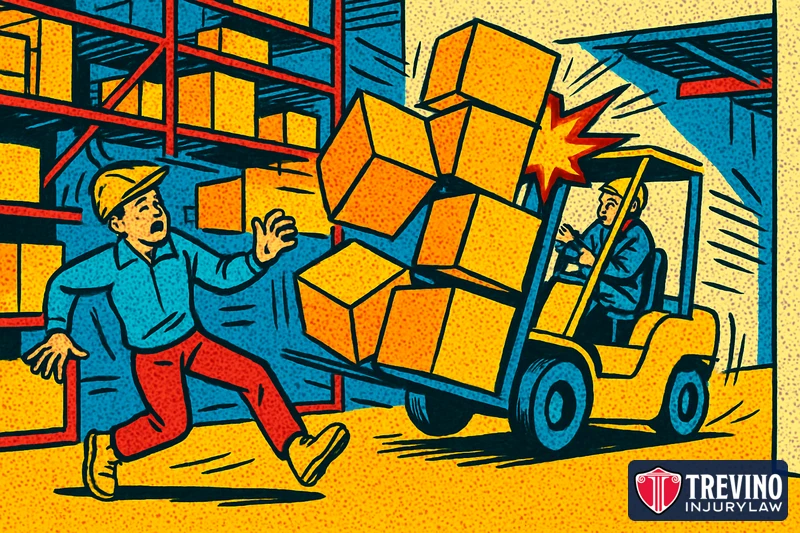
A missing training record or a skipped maintenance inspection can show that the employer, a staffing agency, or an equipment manufacturer failed to keep workers safe.
Caught-In or Between Accidents
Caught-in accidents happen when a worker is pulled into unguarded machinery or crushed between equipment, vehicles, or collapsing trench walls. These injuries often lead to amputations and crush injuries. Missing machine guards or lockout/tagout failures are common causes.
On-the-Job Vehicle Crashes
Transportation incidents are the leading cause of fatal work injuries nationwide, according to the U.S. Bureau of Labor Statistics. Delivery drivers, truck drivers, and highway work-zone crews face this risk daily. When another driver causes the crash, you may have a claim against that driver or their employer in addition to any workplace benefits.
What Should You Do After a Workplace Accident in Texas?
The steps you take in the first days after a workplace accident shape both your medical recovery and your claim.
- Get medical care. Call 911 for serious injuries and tell the treating provider the injury happened at work.
- Report the injury to your employer in writing. Texas generally requires notice within 30 days of the injury.
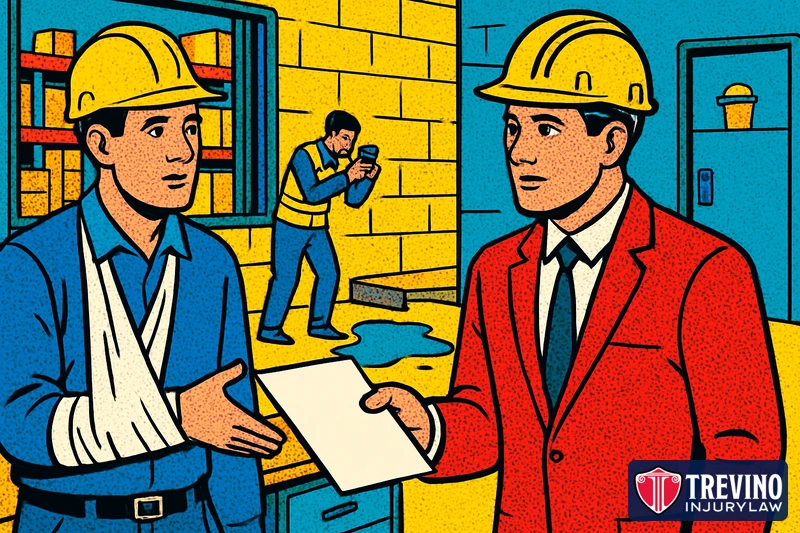
- Document the scene. Photograph the hazard, the equipment, and your injuries, and collect coworker names.
- Ask whether your employer carries workers’ compensation. The answer decides which path your claim takes.
- Avoid recorded statements to an insurer before you understand your rights.
- Talk to a work injury lawyer before signing any release or accepting a settlement.
Does Workers’ Compensation Cover Your Workplace Injury in Texas?
Workers’ compensation covers your injury only if your employer carries it. Texas is the only state that lets most private employers opt out of the workers’ compensation system, and employers that opt out are called nonsubscribers.
If Your Employer Has Workers’ Compensation
Workers’ compensation pays medical care and a portion of lost wages regardless of who caused the accident. In exchange, you generally cannot sue a subscribing employer for negligence. A limited exception allows surviving family members to seek exemplary damages when an employer’s gross negligence causes a worker’s death. You generally must file a claim with the Texas Division of Workers’ Compensation within one year of the injury.
If Your Employer Is a Nonsubscriber
If your employer opted out, you may be able to file a negligence lawsuit directly against it. Texas law strips nonsubscribers of key defenses, so the employer cannot argue that you were partly at fault, that you assumed the risk, or that a coworker caused the accident. You can recover damages beyond what workers’ compensation would pay, including pain and suffering.
Can You Sue Someone Other Than Your Employer?
Yes. A third-party claim can be filed against anyone outside your employer whose negligence contributed to the accident, such as a subcontractor, a property owner, an equipment manufacturer, or a negligent driver. Third-party claims are available whether or not your employer carries workers’ compensation.
Workplace Accidents: Quick Answers
How Long Do I Have to Report a Work Injury in Texas?
Texas generally requires you to notify your employer within 30 days of the injury, or within 30 days of learning that an occupational disease is related to work. Written notice creates a record that is hard to dispute.
Can I Be Fired for Filing a Workers’ Compensation Claim?
Texas law prohibits employers from firing or discriminating against an employee for filing a workers’ compensation claim in good faith. A retaliation claim may be available if that happens.
What If I Was Partly at Fault for My Workplace Accident?
Workers’ compensation is a no-fault system, so your own mistake generally does not bar benefits. If your employer is a nonsubscriber, Texas law prevents it from using your negligence as a defense.
Why Hire a San Antonio Work Injury Lawyer After a Workplace Accident?
Employers and their insurers move quickly to control the story after a workplace accident. At Trevino Injury Law, we prepare every case for a Bexar County jury, and we secured a $17 million settlement in a head-on collision case involving three fatalities. Prior results do not guarantee a similar outcome.
Hurt on the Job in San Antonio?
You’ve seen how this affects your case — but this is only one piece of the puzzle. Our San Antonio Work Injury Lawyer page explains how we handle nonsubscriber and third-party claims.
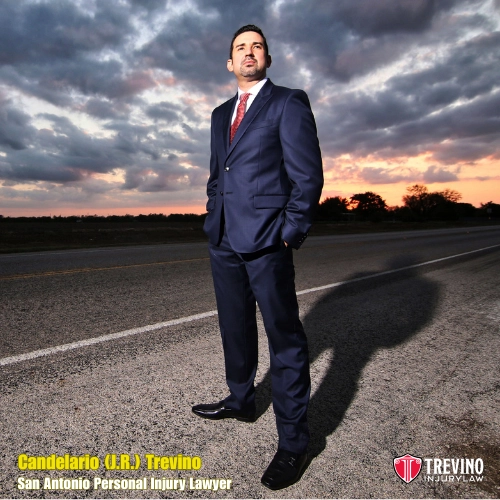
We investigate the accident, determine whether your employer carries workers’ compensation, and pursue every responsible party, from nonsubscribing employers to equipment makers and negligent drivers.
Call 210-TREVINO for a free case review. We operate on a strict no-win, no-fee basis. Se Habla Español.
