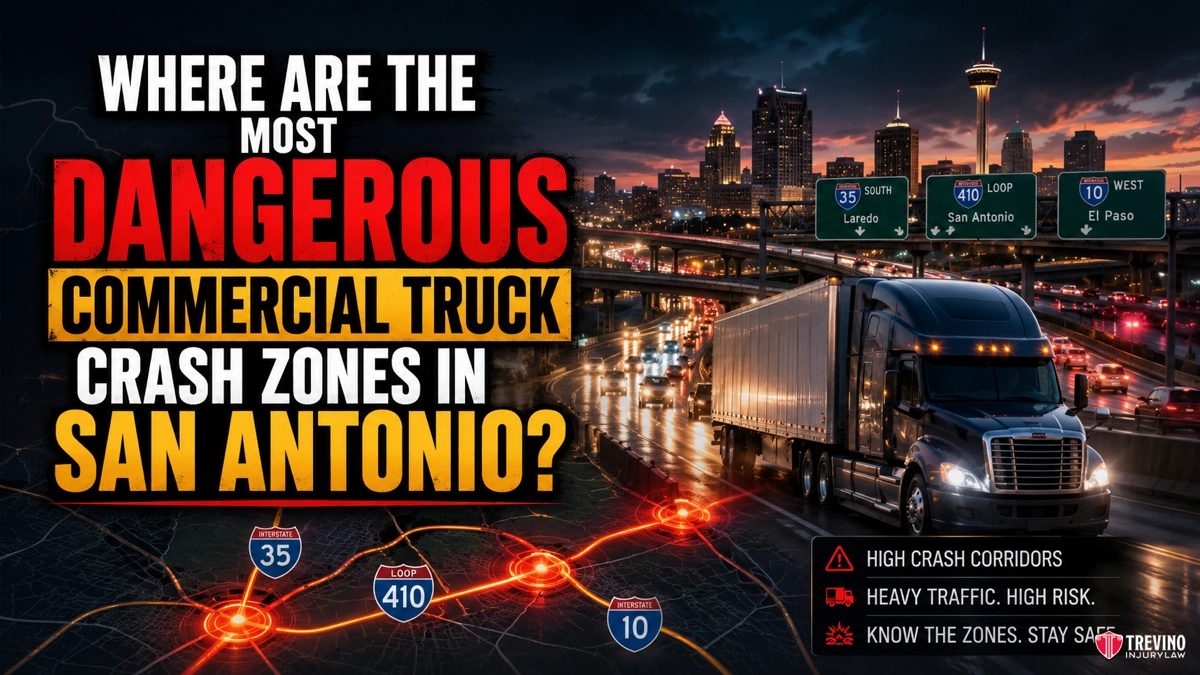
San Antonio commercial truck crashes multiply at the downtown Mixing Bowl interchange and municipal arterials like Culebra Road. These structural chokepoints trap passenger vehicles alongside massive accelerating corporate logistics fleets hauling heavy freight.
The claims adjuster assigned to your wreck is already weaponizing abstract road layouts to falsely blame you for the collision. Progressive Commercial and other defense networks actively use geometric anomalies to shift fault onto local drivers.
What Could Your Commercial Walmart Truck Accident Case Be Worth?
Answer a few quick questions about your accident. Takes about 60 seconds.
See What My Case Might Be WorthThe insurance company offered less than $20,000. I ended up with over $1 million. — Jackie Galindo
Taking negligent carriers to trial forces them to pay full value. Trevino Injury Law secured a $17 million settlement in a wrongful death crash by proving operational negligence. To build undeniable proof, a Spoliation Letter, a legal demand that stops the defendant from destroying evidence, must go out immediately to secure traffic footage. You must act within the first week before city systems automatically overwrite these digital files.
Trevino Injury Law, San Antonio Walmart truck accident lawyers lock down this data before it vanishes and securely anchor your case in state court. Call 210-TREVINO for a free case review. You pay nothing unless we win. Se Habla Español.
Where Do Most Truck Accidents Occur Along the San Antonio Interstate Network?
Commercial truck collisions within Bexar County are heavily concentrated along high-speed interstate corridors where regional loops intersect with major national trade corridors, forcing passenger vehicles to navigate aggressive blind-spot merges alongside accelerating 80,000-pound commercial tractor-trailers hauling massive freight volumes.
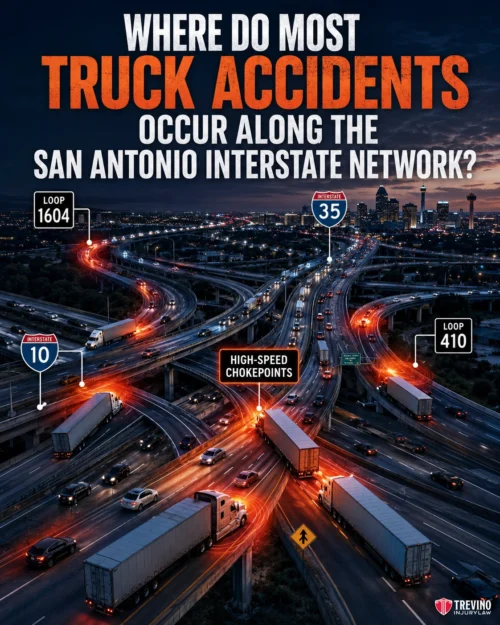
While the main hub addresses the macro-level interstate convergence risks across the region, we must conduct a deep systemic structural analysis of specific interstate chokepoints to prove operational negligence. Pinpointing these high-velocity highway entry bottlenecks isolates the specific lane transitions where standard vehicles clash with massive corporate logistics fleets.
When evaluating the roughest part of San Antonio, Texas, for traffic density, the stark contrast between failing municipal pavement infrastructure and heavy highway freight stress reveals exactly where these fatal collisions multiply. We aggressively fight the insurance adjusters who attempt to blame local drivers for poorly designed highway transitions.
Why the Interstate 35 and Loop 410 Interchange Represents a Catastrophic Merge Zone
The convergence of Interstate 35 and Loop 410 creates an aggressive bottleneck due to rapid lane reductions and short blind-spot merge ramps that trap smaller passenger vehicles alongside accelerating corporate logistics fleets operating heavily within the San Antonio transportation grid.
This specific infrastructure design forces a high degree of co-occurrence between local retail delivery vans and massive interstate semi-trucks. Furthermore, the exceptionally high volume of commercial distribution centers flanking this zone severely limits reaction times for fatigued drivers.
The Structural Failures of the Downtown “Mixing Bowl” Corridor
The urban interchange known as the Mixing Bowl, where Interstate 35, Interstate 10, and US-90 converge, forces complex multi-lane weaves that immediately overwhelm fatigued commercial truck drivers and consistently trigger devastating multi-vehicle crush injuries requiring extensive specialized future medical care.
The structural breakdown of left-hand exit ramps and extremely short weaving distances completely exacerbates driver blind spots. We use these historic geometric anomalies to firmly establish corporate liability and force them to pay full value.
Understanding these high-velocity highway entry bottlenecks naturally leads to an evaluation of the lethal risks on non-freeway municipal roadways.
What Road in San Antonio Has the Most Fatal Traffic Crashes?
Statistical crash tracking identifies Culebra Road as San Antonio’s deadliest non-freeway arterial, a high-injury corridor where commercial distribution trucks frequently interact with local passenger traffic. According to recent accident data from the Texas Department of Transportation, this roadway consistently ranks as among the most dangerous in all of Bexar County.
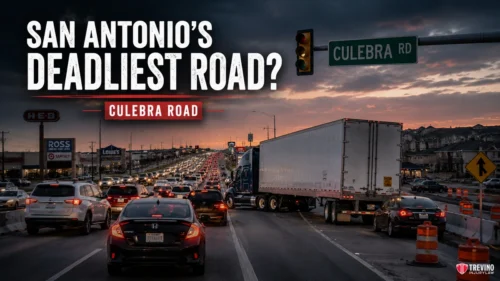
This hazardous hotspot experiences incredibly high traffic volumes, making it a prime location for a catastrophic collision or a devastating fatal crash. Beyond the parent guide’s general geographic focus, analyzing these municipal high-injury networks requires a deep legal and geographic examination of local street-level utility-lane configurations. Several compounding factors make these routes exceptionally perilous:
- Flawed Road Design: Abrupt merge lanes and poorly planned interchange points force drivers into unpredictable and dangerous traffic patterns.
- Rapid Commercialization: Expanding outer rings convert historic rural roads into overloaded arterials with multiple lanes that are entirely unsuited for heavy freight.
- Dangerous Mixing Zones: When massive commercial vehicles and heavy commercial trucks attempt to merge near growing residential neighborhoods, the risk of severe rear-end collisions and deadly side-impact crashes skyrockets.
- Construction Hazards: Ongoing construction zones bottleneck high-speed traffic, making these stretches particularly dangerous for the average commuter navigating heavy traffic during the evening rush and peak morning rush hour.
We meticulously document these pedestrian-commercial traffic interaction dynamics to demonstrate exactly how the pace of suburban development creates unavoidable crash zones for your family. Our San Antonio personal injury attorneys understand that a severe accident is rarely just a mistake. When fighting for victims, we frequently expose the following realities:
- Crashes are routinely caused by aggressive driving, driver fatigue, or distracted driving from motorists navigating these stressful, poorly optimized routes.
- Victims are unfairly left to fight resistant insurance companies while simultaneously struggling with mounting lost wages and enduring immense pain and suffering.
We are committed to exposing these dangerous roadway dynamics and holding negligent parties accountable for the devastation they cause in our community.
The Specific Hazards of Culebra Road and Bandera Road Arterial Commercial Traffic
Continuous commercial development along Bandera Road and Culebra Road has created severe congestion zones marked by continuous center turn lanes that invite devastating T-bone collisions with local delivery fleets aggressively attempting to meet strict corporate delivery deadlines.
Corporate routing pressures force delivery drivers into high-risk maneuvers during peak commuter hours. This direct connection between corporate expectations and driver negligence allows us to pursue vicarious liability under Texas law. This doctrine is firmly supported by landmark cases such as Painter v. Amerimex Drilling I, Ltd., 561 S.W.3d 125 (Tex. 2018), which establishes that employers can be held strictly accountable for crashes when their drivers operate within the course and scope of employment to fulfill corporate objectives.
We litigate to verdict by exposing how this reckless delivery route timing violates basic safety protocols and endangers the public.
Pinpointing these lethal non-freeway streets requires a systematic examination of the specific commercial traffic vectors that flood the entire South Texas region.
How Does the Heavy Commercial Freight Volume on the Mexico-US Commerce Corridor Impact Bexar County Litigation?
The integration of San Antonio into the primary international trade route floods local infrastructure with high-mileage, long-haul commercial trucks, significantly increasing the legal complexity of catastrophic injury claims arising from highly layered corporate liability networks and international third-party logistics entities.
While our foundational litigation guide references cross-border shipping corridors, this specific freight volume introduces highly complex interstate commerce regulatory interactions. These cross-border freight transfers demand advanced legal discovery to trace the true chain of command and operational control within multinational carrier logistics operations.
We force negligent trucking companies to pay by meticulously translating Federal Motor Carrier Safety Administration documentation and parsing liability within the international logistics chain.
Identifying Secondary South Texas Trade Corridors Like the Eagle Ford Shale Region
Heavy industrial transport trucks operating throughout the Eagle Ford Shale energy sector route directly into Southern Bexar County transit loops, posing severe and immediate safety risks as massively overweight, improperly secured industrial cargo navigates through dense civilian commuter traffic. These rural South Texas routes, originating near Laredo and Eagle Pass, feed directly into regional trauma infrastructure such as the University Health System.
We fight for families suffering permanent injuries caused by this heavy industrial transport traffic.
Traced commercial liability across geographic shipping routes dictates exactly which local or state court possesses the authority to hear your injury claim.
How Does Crash Geography Determine Trial Venue at the Bexar County Courthouse?
Under Texas personal injury law, a commercial truck accident lawsuit is structurally tied to the exact geographic location where the collision occurred or where the corporate defendant maintains its primary business headquarters, establishing precise jurisdictional boundaries for your injury claim.
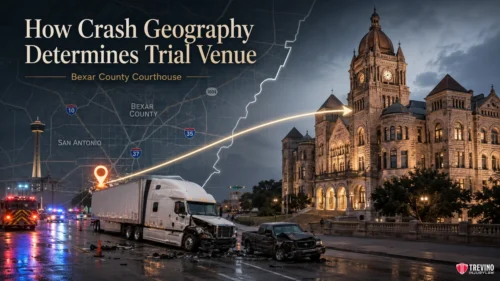
While the core litigation guide confirms local filing for accidents within city boundaries, understanding statutory venue definitions is absolutely critical to preventing federal-court diversity-jurisdiction removals. We launch a forensic deep dive into defense venue tactics to securely anchor your case in state courts located at the historic Bexar County Courthouse.
This structural maneuvering prevents corporate defense networks from isolating your family in more rigid federal jurisdictions. To understand how this venue selection influences your recovery, you can review our complete guide detailing what compensation Walmart truck accident victims receive in Texas.
Why Local Trial Experience Matters Across Distinct South Texas Legal Venues
Law firms lacking local courtroom experience often falter because they fail to understand the specific jury pool demographics and highly localized procedural rules that are unique to individual South Texas counties operating outside standard federal court jurisdiction.
As a proven trial authority, Candelario (J.R.) Trevino has personally taken over eighty personal injury cases to trial across regional South Texas jurisdictions. This extensive history of real courtroom authority firmly forces insurance adjusters to negotiate fairly from day one.
Securing a favorable state-court venue is the strategic foundation for compelling corporate insurers to provide honest financial restitution.
Where Do Most Commercial Truck Accidents Happen Within San Antonio City Limits?
Commercial truck collisions in San Antonio are predominantly concentrated along major industrial transport arteries and the rapidly expanding suburban perimeters, where heavy corporate retail distribution networks constantly intersect with local residential transit grids, creating highly dangerous bottleneck zones for daily civilian commuters.
Connecting the physical reality of the crash scene to immediate legal investigative priorities is absolutely critical for building a successful claim. Knowing the exact geographic coordinates of the wreck allows our elite crash reconstruction experts to instantly retrieve municipal traffic signal timing data, check localized storefront surveillance video feeds, and precisely trace corporate delivery dispatch metrics.
High-volume settlement mills often skip this rapid response, but our trial-first approach means we immediately send FOIA requests within the first week to secure video and witness statements before this crucial data is permanently erased or overwritten by city systems. By mapping these specific industrial transport arteries, we build the undeniable physical proof required to hold negligent trucking companies accountable.
While this precise spatial mapping provides the foundational physical proof to establish liability, knowing exactly how to extract and protect the resulting local municipal data determines whether your case survives aggressive corporate scrutiny.
What Municipal Evidence Must Be Gathered at a San Antonio Crash Scene?
Preserving local evidence requires the immediate collection of municipal police reports, digital traffic cam data, and localized commercial security recordings before public or private systems automatically overwrite the critical digital files.
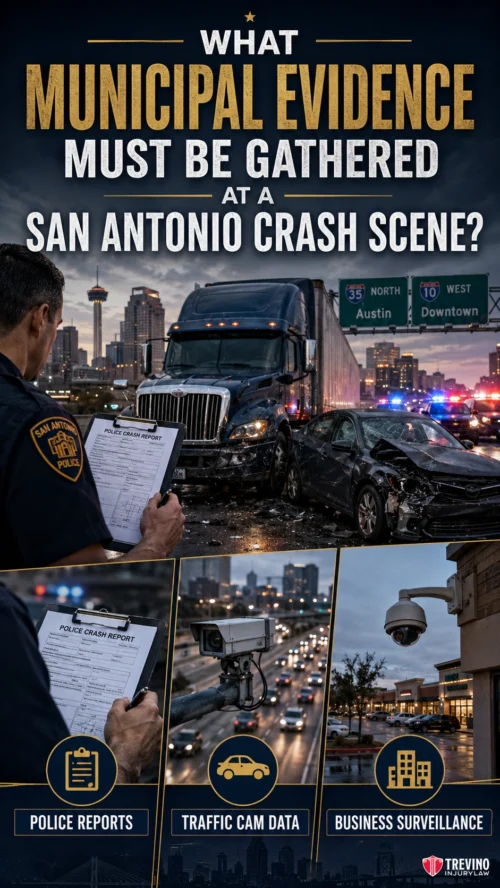
To build a trial-ready case against negligent trucking companies, we must immediately secure physical proof from the specific municipality where the crash occurred. Because settlement mills often delay these crucial investigations, we immediately send FOIA requests to capture critical evidence that might otherwise disappear. Securing this geographic evidence involves three mandatory steps:
- Securing official San Antonio Police Department (SAPD) or local enclave crash reports immediately.
- Extracting TxDOT traffic camera footage along major outer corridors like Loop 1604.
- Preserving nearby commercial surveillance from surrounding business districts, such as the Medical Center.
Reviewing the physical scene preservation demands reveals highly clear legal distinctions regarding regional insurance classification thresholds.
Does a Crash Within a Specific Bexar County Municipality Alter Your Choice of Trial Attorney?
No, a crash within independent enclaves like Alamo Heights, Leon Valley, or Converse does not alter your choice of attorney, as all personal injury claims across Bexar County are litigated within the centralized state courts of San Antonio.
Can Regional Highway Construction Zones Create Direct Municipal Liability for a Commercial Wreck?
No, while negligent construction-zone lane configurations frequently trigger severe tractor-trailer collisions, Texas sovereign immunity statutes make pursuing the municipality exceptionally difficult, meaning the primary legal focus must remain on the commercial trucking company’s operational compliance errors.
Local Highway Intersections vs. High-Injury Urban Arterials
Comparing commercial crash dynamics across San Antonio reveals that high-velocity interstate interchanges produce catastrophic multi-vehicle crush injuries, whereas urban arterials generate high-density side-impact collisions due to sudden turning movements.
| Crash Environment | Primary Impact Forces | Typical Corporate Entities Involved | Severe Injury Types |
| High-Velocity Interchanges (I-35/Loop 410) | Multi-vehicle crush injuries, high-speed rear-end forces | Long-haul logistics fleets, massive 18-wheelers | Spinal cord injuries, traumatic brain injuries, wrongful death |
| Urban Arterials (Culebra Rd/Bandera Rd) | High-density side-impact (T-bone) collisions | Local retail delivery vans, regional distribution trucks | Complex fractures, amputations, severe neck trauma |
This trial-first approach produces real results: When facing catastrophic losses from commercial logistics fleets, Trevino Injury Law took the case to trial and secured a $17 million settlement for a wrongful death 18-wheeler accident involving multiple fatalities. We fight for families and force them to pay full value.
Failing to comprehend these localized intersection dynamics leaves crash victims utterly defenseless against aggressive corporate defense tactics.
What Happens if You Do Not Analyze the Specific Geographic Factors of Your San Antonio Truck Wreck?
Failing to evaluate localized geographic factors allows corporate insurance adjusters to actively weaponize abstract road layout descriptions to falsely claim you caused the collision and deny your catastrophic injury claim.
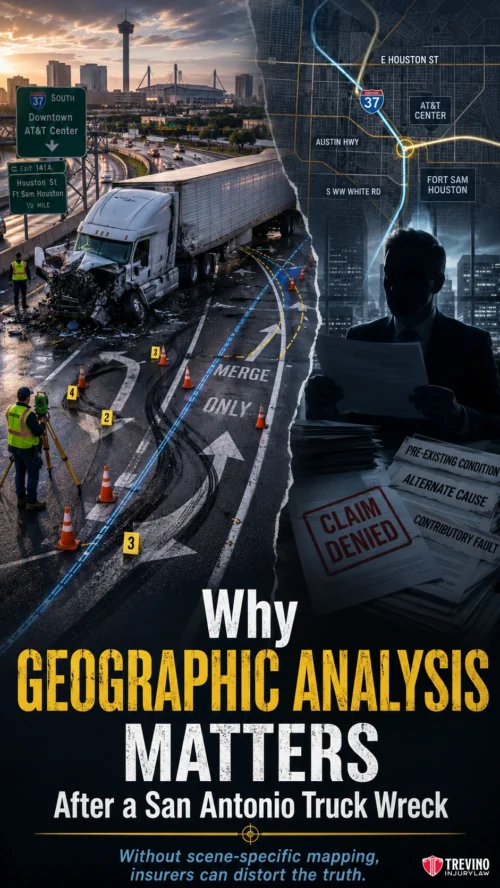
Settlement mills routinely overlook critical corridor engineering data near dense commercial hubs, such as the AT&T Center, or military zones, such as Fort Sam Houston. Without mapping these unique local vectors, your family remains completely vulnerable to bad-faith liability denials by aggressive insurers such as Progressive Commercial or Great West Casualty.
We litigate to verdict, ensuring the physical truth of the exact local crash scene dictates the final compensation amount, rather than the insurance company’s fabricated narrative.
Allowing these local environmental details to go unexamined naturally culminates in the complete expiration of your legal ability to hold corporate fleets accountable.
When Is It Too Late to Map the Physical Scene of a Commercial Truck Crash?
It is effectively too late to capture crucial physical scene metrics once regional transit authorities alter temporary lane markers or repair compromised asphalt infrastructure, permanently erasing visible skid marks and gouge vectors.
While the formal Texas personal injury statute of limitations provides a standard two-year filing window, the physical geography of the crash scene deteriorates within the first week. Delaying representation means losing critical evidence to weather, road crews, and corporate spoliation. Unlike volume-driven firms, we adopt a trial-first mindset from day one to preserve physical evidence in court-admissible formats before it vanishes completely.
By choosing a San Antonio personal injury lawyer who actively investigates the scene, you aggressively protect your claim from insurance adjusters.
Why Hire a San Antonio 18-Wheeler Accident Lawyer?
You hire an 18-wheeler accident lawyer at Trevino Injury Law to preserve physical crash evidence before it vanishes, secure digital traffic cam data, and hold negligent trucking companies accountable in state court.
We send FOIA requests within the first week to extract municipal police reports and commercial security recordings. We deploy elite crash reconstruction experts to analyze the scene and trace corporate delivery dispatch metrics. Settlement mills delay these crucial investigations and lose the data. We do not.
Want to Protect the Full Value of Your Claim?
You’ve seen how this affects your case — but this is only one piece of the puzzle. Our Walmart Truck Accident Lawyer page explains how a trial-ready firm operates differently.
The $17 million wrongful death 18-wheeler settlement and the $7.9 million jury verdict prove what happens when a San Antonio personal injury lawyer drives carriers to settle high or face a Bexar County jury. We securely anchor your case at the Bexar County Courthouse and litigate to verdict.
Call 210-TREVINO for a free case review. Se Habla Español. No Win, No Fee.