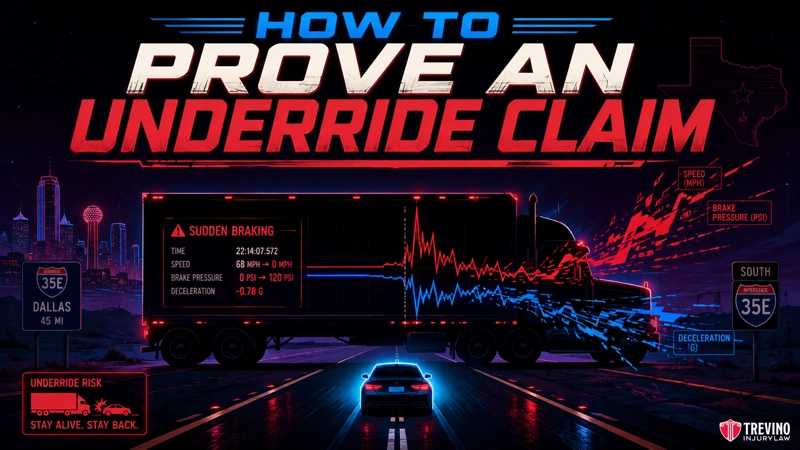
Proving an underride truck accident requires deploying biomechanical experts and extracting digital telemetry to demonstrate exactly how a commercial trailer bypassed your vehicle’s structural crumple zones.
Negligent Trucking Companies are already mobilizing to hide their liability by overwriting the electronic control module data and repairing rusted rear impact guards before investigators arrive. According to TxDOT, in Bexar County alone, commercial motor vehicles were involved in 2,684 crashes in a single year, resulting in 18 fatal collisions (TxDOT, 2024). Behind these devastating impacts are corporate dispatchers pushing drivers past legal hours and fleet managers deferring critical maintenance to protect profit margins. That is not an unavoidable tragedy. That is gross negligence.
What Could Your Underride Truck Accident Case Be Worth?
Answer a few quick questions about your accident. Takes about 60 seconds.
See What My Case Might Be WorthThe insurance company offered less than $20,000. I ended up with over $1 million. — Jackie Galindo
Critical digital and physical proof vanishes in days. A Spoliation Letter, a legal demand that stops them from deleting black box data from an 18-wheeler, must go out immediately. Texas gives you a limited window to act before the wreckage is cleared and the truck returns to active service. After that, the claim is gone.
Trevino Injury Law truck underride accident lawyers extract this hidden telemetry on day one and lock the evidence down before it vanishes. Call 210-TREVINO now for a free consultation. You pay nothing unless we win. Se Habla Español.
What Digital Evidence Proves the Truck Driver Created an Underride Hazard?
You must secure the commercial truck’s electronic control module (ECM) data and camera footage to definitively prove driver negligence, such as when a trucker violently locks their brakes or illegally stalls across lanes of traffic, creating an inescapable underride trap that causes the collision.
While the 48-hour window to execute spoliation letters explains the critical timeline for sending a preservation demand, this digital evidence specifically details how the truck driver illegally positioned the trailer or braked violently, creating the underride hazard. Modern 18-wheelers operate as rolling computers utilizing an electronic logging device (ELD).

The ECM serves as the truck’s “black box,” tracking compliance with the Federal Motor Carrier Safety Administration. Our plaintiff trial lawyers extract this digital footprint to contradict insurers who claim you failed to stop in time. By analyzing telematics following a catastrophic collision on Culebra Road or US-90, we secure specific digital assets:
- For Rear Underrides: Sudden, violent brake applications prove the truck driver cut you off and stopped short.
- For Side Underrides: Engine idle times prove the driver blocked an intersection in low visibility without using hazard lights. This type of obstruction is a proven killer, as commercial units disabled or parked in Texas traffic lanes contributed to over 100 fatal crashes in just one year (TxDOT, 2024).
How Do FMVSS 108 Violations Prove the Trailer Was Invisible?
Federal law, specifically Federal Motor Vehicle Safety Standard (FMVSS) 108, mandates red-and-white retroreflective conspicuity tape for nighttime visibility. Violations prove negligence by demonstrating that the commercial trailer lacked this tape, rendering the massive vehicle entirely invisible to oncoming traffic.
Under Texas law, as established in the landmark case Parrott v. Garcia, 436 S.W.2d 897 (Tex. 1969), an unexcused violation of a safety regulation designed to prevent injury constitutes negligence per se, shifting the legal burden heavily against the at-fault motor carrier and opening the door for recovery covering the full extent of your injuries.
Many side-underride accidents occur at night when a massive trailer stretches across a dark roadway. If the trucking company allowed the reflective tape to become covered in oilfield dirt, degraded by the sun, or completely removed, they are directly liable for the crash and the resulting vehicle damage.
We utilize nighttime visibility experts to prove that a driver simply could not see the massive steel blockade until it was too late to avoid A-pillar collapse. The catastrophic consequences of poor conspicuity are well-documented, with defective or missing lighting equipment on commercial units contributing directly to 12 fatalities statewide in one year (TxDOT, 2024).
While the lack of retroreflective tape causes devastating side impacts, the failure of physical steel creates horrific destruction and serious injuries in rear collisions, making the structural integrity of the guard itself the next critical factor to investigate in your trucking case.
How Do Accident Reconstruction Experts Prove Trailer Guard Failure?
Accident reconstruction experts prove trailer guard failure by using 3D scene mapping and kinetic energy calculations to definitively demonstrate that the steel Mansfield bar sheared off at impact speeds it was federally required to withstand.
Beyond simply understanding how federal underride guard regulations impact your truck accident claim in Texas on paper, proving failure requires focusing on kinetic energy, roof shear, and detailed metallurgical testing of the underride guard. The unique terror of an underride crash is that the trailer bed bypasses your vehicle’s structural crumple zones and airbags.
Trevino Injury Law willingly funds the services of expensive biomechanical experts and metallurgists to analyze sheared bolts, rusted welds, and pavement gouges. We prove that catastrophic roof-shear injuries sustained at high-speed interchanges were directly caused by the manufacturer’s failure to use heavy-duty, impact-resistant materials for the rear guard.

As demonstrated by our $17 Million settlement in an 18-wheeler wrongful death case, we know exactly how to leverage this forensic evidence to hold manufacturers and potentially responsible parties fully accountable. The extreme lethality of trailer-involved impacts is undeniable, with Texas reporting 537 fatalities from 486 fatal trailer-involved crashes in a single recent year (TxDOT, 2024).
Proving Negligence in Rear vs. Side Underride Crashes
Proving an underride claim requires a vastly different legal strategy depending on whether the passenger vehicle struck the rear impact guard or slid beneath the unprotected side of the trailer, as each scenario demands completely different forensic evidence to establish fault.
| Crash Type | Primary Legal Focus | Key Evidence Required |
| Rear Underride | Structural failure and product liability. | FMVSS 223/224 violations, metallurgical fatigue, and rusted Mansfield bars. |
| Side Underride | Visibility, positioning, and driver error. | FMVSS 108 (reflective tape) violations, ECM idle time, failure to use warning triangles. |
Understanding this catastrophic physical hardware failure naturally leads to examining the corporation’s internal company records to determine exactly when they knew this extreme danger existed. This rigorous investigation is especially crucial given that federal safety agencies estimate side-underride fatalities are approximately 80% higher than what is officially reported in current fatal crash databases (NHTSA, 2024).
How Do You Prove the Trucking Company Knew the Trailer Was Dangerous?
You prove a trucking company knew its trailer posed a fatal hazard by aggressively subpoenaing pre-trip inspection records during civil discovery to expose a well-documented history of deferred repairs to rusted guards and blatantly missing reflective tape.
This aggressive civil discovery process specifically targets underride hardware like guards and conspicuity tape maintenance, applying immense trial pressure to force negligent trucking companies to pay for their institutional failures. Holding a corporate defendant accountable requires proving institutional negligence.
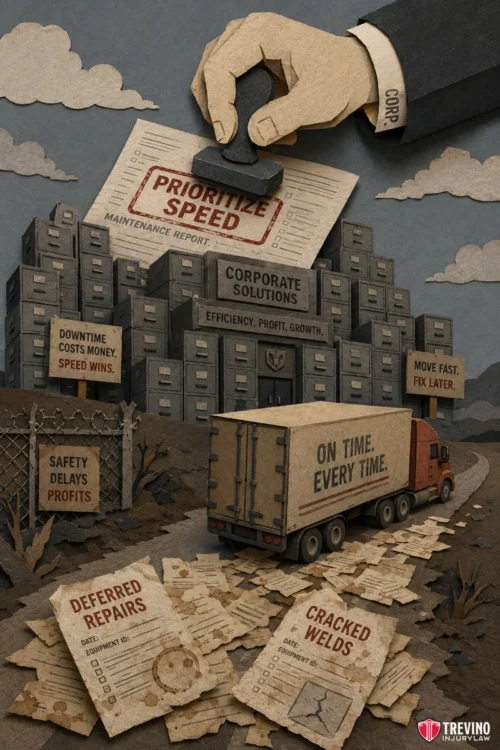
Negligent companies often force aging trailers with compromised structural integrity onto major South Texas corridors like I-10. To force maximum compensation, our trial lawyers file aggressive discovery motions at the Bexar County Courthouse to obtain:
- Deferred work orders specifically noting cracked welds on the rear impact guard.
- Citations for missing or severely degraded FMVSS 108 retroreflective tape.
- Deposition testimony from fleet managers or dispatch admitting they prioritized delivery speeds over trailer structural safety, sometimes even uncovering falsified logs.
Once the records show who controlled the driver, maintained the trailer, or allowed a known defect to remain, the next question is which corporate defendants may be responsible. The liability analysis for a San Antonio underride truck accident examines the roles of motor carriers, manufacturers, maintenance facilities, brokers, and other potential defendants.
What Are the Steps to Subpoena a Commercial Truck’s Maintenance Records?
To successfully subpoena a commercial truck’s maintenance records, your trial attorney must file a formal lawsuit, draft targeted requests for production, and legally compel the motor carrier to surrender years of vehicle repair history and the driver’s qualification file that they would otherwise conceal.
Securing these documents involves three rigorous phases:
- Filing the initial petition to trigger formal civil discovery powers over the trucking fleet.
- Demanding the specific Annual Vehicle Inspection Reports and Daily Driver Vehicle Inspection Reports (DVIRs) related to the trailer’s undercarriage to verify adherence to safety rules.
- Deposing the safety director under oath to explain why known rust, structural fatigue, and dirty reflective tape were actively ignored prior to the crash.
With undeniable proof of structural failures and corporate negligence secured, the next challenge becomes defeating the defense’s aggressive attempts to deflect this overwhelming evidence onto you.
How Does Uncovered Evidence Defeat Texas Comparative Negligence Tactics?
Comprehensive crash evidence completely neutralizes Texas’s comparative negligence tactics by proving that the commercial truck’s missing reflective tape or defective rear guard made the underride collision entirely unavoidable for the passenger vehicle. Quality evidence matters when adjusters try to shift the blame.
While exploring how Texas comparative negligence impacts truck crash liability provides the necessary legal framework, defeating these underhanded tactics requires aggressive forensic proof in the courtroom. Commercial insurers fear a history of multi-million-dollar jury verdicts.
Their primary defense is to weaponize Texas comparative negligence and falsely claim you were speeding and could have easily stopped before the impact. We dismantle this by proving that, even if you were traveling at the exact speed limit, the lack of FMVSS 108 conspicuity tape made the trailer invisible, or that the rusted rear impact guard failed to engage your vehicle’s crumple zones as legally required. When we lay out this overwhelming mechanical and visibility evidence before a judge, we shut down their blame-shifting arguments.
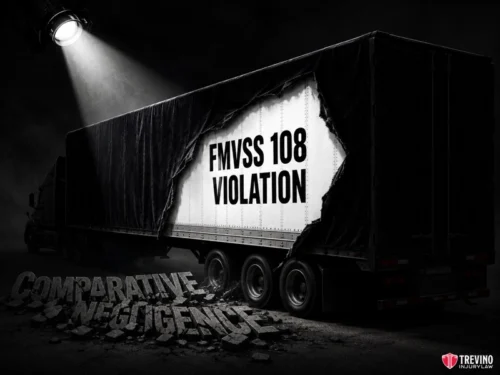
Understanding how to weaponize this evidence effectively against insurers requires clearly distinguishing between the physical wreckage at the scene and the hidden digital data locked inside the truck’s computers.
Underride-Specific Physical Evidence vs. Electronic Data (ECM)
To build an impenetrable underride case, your trial lawyer must synthesize the physical devastation of roof shear with the hidden digital telemetry locked inside the truck’s computers.
| Evidence Category | Specific Underride Examples | What It Proves in Court |
| Physical Evidence | Sheared A-pillars, decapitated rooflines, rusted Mansfield bars, dirty reflective tape. | The failure of the underride guard to absorb kinetic energy and the extreme lack of visibility. |
| Digital Evidence (ECM) | Hard-braking events, engine idle times across traffic lanes, exact impact speed. | The truck driver’s actions in illegally positioning the trailer as a roadway barricade. |
Can you prove a side underride claim if the trailer didn’t have side guards?
Yes, you can successfully prove a side underride claim without side guards by demonstrating the driver made an illegal turn, blocked the roadway, or operated the trailer with missing retroreflective conspicuity tape.
Does a passed DOT inspection protect the trucking company from liability?
No, a passed DOT inspection does not protect the trucking company from liability because basic visual inspections frequently miss underlying metallurgical fatigue and substandard steel used in the rear underride guard.
Accessing this hyper-specific evidence depends heavily on immediate, independent verification.
What Happens If You Don’t Secure the Truck’s ECM Data Immediately?
If you do not secure the truck’s ECM data immediately, the negligent trucking company will legally overwrite the digital logs, permanently destroying the exact speed, driving hours, and braking data needed to prove the driver created the underride trap by violating hours-of-service limits.
Without a trial lawyer sending a Spoliation Letter within the first 48-hour window, critical electronic evidence vanishes. Insurance adjusters rely entirely on your lack of legal representation to bulldoze your claim. Failing to lock down this data allows the defense to fabricate their own timeline—claiming you rear-ended them recklessly, rather than proving they violently locked their brakes and caused the crash.
This strict urgency regarding digital evidence applies equally to the physical state of the sheared commercial trailer.
When Is It Too Late to Inspect the Commercial Trailer for Defects?
It is too late to inspect the commercial trailer for defects once the trucking company repairs the damaged underride guard, washes the dirt off the conspicuity tape, or returns the trailer to active service.
Negligent trucking companies routinely attempt to repair defective bumpers or replace missing reflective tape shortly after a severe impact. If you delay hiring a trial attorney, the physical evidence of rusted steel, sheared bolts, and invisibility will be completely erased. Once the physical trailer is altered, proving a product liability case against the manufacturer becomes nearly impossible, permanently barring a massive avenue of financial recovery for your catastrophic injuries.
Why Hire a Truck Underride Accident Lawyer?
You must hire a trial-ready truck underride accident lawyer to immediately secure disappearing electronic crash data, prove the trucking company’s structural hardware failures, and defeat the insurance adjuster’s blame-shifting tactics to secure the maximum financial compensation your family deserves. These crashes often involve multiple parties, from the driver to the trailer manufacturer, requiring an expert to untangle the liability.
Want to Protect the Full Value of Your Claim?
You’ve seen how this affects your case — but this is only one piece of the puzzle. Our Truck Underride Accident Lawyer page breaks down what a trial-ready firm does differently.
Negligent trucking companies and commercial insurers begin building a defense against you the moment the crash occurs. You need an injury lawyer San Antonio who litigates to a verdict rather than accepting a quick, lowball settlement from a settlement mill. We fight for families by exposing missing conspicuity tape, rusted Mansfield bars, and illegal driver maneuvers to force these corporations to pay for the devastation they caused.
Do not give a recorded statement to the insurer. Call 210-TREVINO for a free consultation today. Se Habla Español.