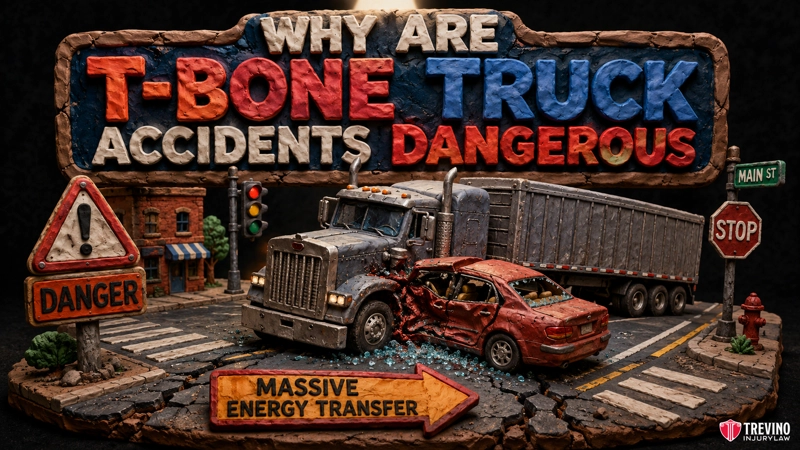
T-bone truck accidents cause extreme physical devastation because a fully loaded commercial rig entirely bypasses your vehicle’s reinforced frontal crumple zones and drives massive kinetic energy directly through your thin side doors. Total structural failure happens instantly as the steel frame collapses inward.
The defense is already moving against you. Adjusters from Progressive Commercial and Great West Casualty Company immediately manipulate intersection geometry to argue you failed to yield, weaponizing the chaotic wreckage to protect their profit margins. The Texas Department of Transportation recorded 2,684 commercial motor vehicle crashes across Bexar County in 2024. Your crushed vehicle is not a tragic anomaly, but the direct result of a corporate driver prioritizing speed over safety.
What Could Your T-Bone Truck Accident Case Be Worth?
Answer a few quick questions about your accident. Takes about 60 seconds.
See What My Case Might Be WorthThe insurance company offered less than $20,000. I ended up with over $1 million. — Jackie Galindo
The trucking company will quickly repair its rig and overwrite the Event Data Recorder to erase proof of its braking failure. A Spoliation Letter, a legal demand that stops the corporate defendant from destroying evidence, must be sent immediately. Delaying gives them time to scrap your vehicle and bury the truth forever.
A Trevino Injury Law t-bone truck accident lawyer will extract the black box data and lock down the physical evidence before the defense hides it. Call 210-TREVINO for a free case review. You pay nothing unless we win. Se Habla Español.
Why is the side of a passenger vehicle so vulnerable in a commercial truck crash?
The side of a passenger vehicle is extremely vulnerable because it offers only a few inches of steel and plastic door paneling to absorb the impact of a commercial truck, thereby bypassing the vehicle’s heavily reinforced frontal crumple zones. Federal crash data reveal that 13.8% of two-vehicle fatal large-truck crashes involve the truck’s front striking the left side of the other vehicle, representing a highly deadly configuration (NHTSA, 2024).
While determining fault in a commercial truck T-bone accident in Texas establishes basic negligence, the specific mechanical destruction seen in Bexar County crashes requires deeper forensic understanding.
Beyond basic negligence, victims must understand B-pillar failure, side-panel weakness, and the deadly bypass of frontal crumple zones. Modern cars are engineered to absorb impacts from the front and rear effectively. However, a 90-degree perpendicular strike, also known as side impact, offers virtually zero kinetic dissipation.

Insurance carriers like Great West Casualty Company deliberately seek to minimize the severity of side-impact claims to protect their profit margins. The physical reality on high-traffic corridors like Bandera Road remains undeniable.
Frontal Crash vs. T-Bone Impact: Structural Defense Comparison
The survival rate in a T-bone truck crash is significantly lower than a head-on collision because the passenger vehicle’s primary safety features are structurally bypassed. This structural vulnerability is why an estimated 116,475 occupants of other passenger vehicles were injured in large-truck crashes across the United States in a single year, making up 72% of all such injuries (NHTSA, 2024).
| Structural Defense Feature | Frontal/Rear Collision Dynamics | T-Bone (Side-Impact) Dynamics |
| Crumple Zones | 3 to 4 feet of engine block/trunk space to absorb energy. | Only 4 to 6 inches of door width; zero crumple zone. |
| Intrusion Risk | The engine firewall usually protects the cabin.The | B-pillar collapses directly into the passenger cabin. |
| Airbag Efficacy | Front airbags fully cushion forward momentum. | Side airbags often fail to stop heavy commercial steel bumpers. |
How does the weight disparity between an 18-wheeler and a car multiply the danger?
The massive weight disparity, an 80,000-pound loaded semi-truck versus a 4,000-pound passenger car, creates an overwhelming transfer of kinetic energy that destroys the smaller vehicle’s frame upon the point of impact. To put this weight disparity into perspective, 69% of the large trucks involved in fatal crashes nationwide are classified as heavy trucks with gross vehicle weight ratings exceeding 26,000 pounds (NHTSA, 2024).
The Physics of Momentum: The kinetic energy of the crash is mathematically defined by the mass and velocity of the vehicles. Because a loaded truck carrying freight from the Eagle Ford Shale has 20 times the mass of a passenger car, the energy transfer into the side panel is unsurvivable.
Ride Height Discrepancy: The elevated steel bumper of a commercial rig often overrides the car’s lower frame, striking the window line at head and chest level. This causes severe injuries in a t-bone, particularly for the occupant closest to the impact. Common injuries include traumatic brain injuries and internal injuries.
Understanding this inherent structural vulnerability explains why the immense size of the opposing 18-wheeler dictates the catastrophic outcome.
How does highway speed compound the danger of a T-bone truck accident?
Highway speeds drastically increase the danger of a side-impact crash because a fully loaded commercial truck traveling at 65 miles per hour requires the length of two football fields to stop. This makes collision avoidance impossible if they fail to yield. These high-speed intersection scenarios are incredibly lethal. Statewide data shows that 1,050 people were killed in intersection and intersection-related crashes in Texas in 2024 (TxDOT, 2024).
While assigning fault in a commercial truck T-bone accident sets the legal foundation for comparative negligence law, factoring in stopping distance, reaction time, and intersection geometry transforms how we prove negligence to a jury.
The physical reality of commercial braking distances dictates that split-second reaction times are instantly erased by immense commercial momentum. Negligent corporate defendants like J.B. Hunt Transport and Swift Transportation frequently pressure their drivers to speed through intersections to meet unrealistic delivery deadlines, completely prioritizing corporate profit over public safety.
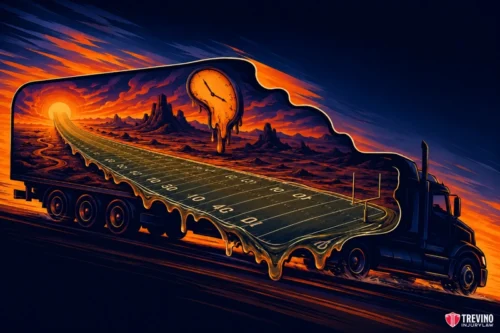
In high-speed environments along the US-90 and Loop 1604 corridors, a driver failing to yield the right of way makes catastrophic collisions mathematically unavoidable.
Why are broadside collisions at San Antonio intersections so violent?
Broadside collisions at major intersections are exceptionally violent because the commercial driver is often accelerating to beat a changing traffic light, striking the unsuspecting victim at a perfect 90-degree angle with maximum force. Statistics show that 8.1% of two-vehicle fatal large-truck crashes happen specifically when a large truck is traveling straight while the other vehicle is making a left turn.
The mechanics of intersection crashes at notorious hotspots like the Mixing Bowl interchange and S. Zarzamora St create extreme danger. The 90-degree angle of impact provides zero structural deflection. This transfers 100 percent of the crash force directly into the victim’s body.
The physical inability to stop in time forces catastrophic broadside collisions that require immediate, complex emergency rescue operations.
Why is victim extrication more complex after a commercial broadside collision?
Victim extrication is highly complex after a commercial broadside collision because the immense force deeply crushes the vehicle’s B-pillar and jams the doors shut, requiring first responders to use heavy hydraulic tools to cut the vehicle apart.
Understanding the average settlement for an 18-wheeler T-bone accident requires examining the terrifying pre-hospital trauma that fundamentally drives up your case value. The deployment of the Jaws of Life by Bexar County first responders highlights the sheer brutality of these wrecks. The devastating nature of these impacts is reflected in local statistics, with 46 people sustaining suspected serious, incapacitating injuries in Bexar County commercial motor vehicle crashes last year (TxDOT, 2024).
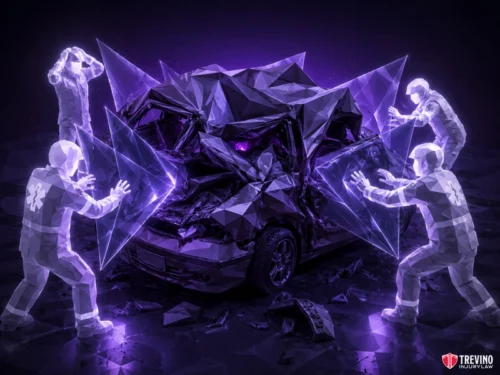
The lateral collapse of the vehicle physically wraps the frame around the occupants. High-volume settlement mills simply process paperwork and fail to understand the deep, terrifying physical trauma their clients endured. We are a trial firm that ensures the jury understands exactly what your family survived.
How does side-panel crush depth delay the “golden hour” of trauma care?
Severe side-panel crush depth delays the critical “golden hour” of trauma care because paramedics cannot stabilize the victim’s spine or stop internal bleeding until the fire department successfully dismantles the crushed vehicle frame. When a vehicle strikes the side of a trailer during these impacts, the outcomes are dire, resulting in an estimated 89 fatalities and 409 serious injuries annually nationwide (NHTSA, 2023).
Transport to Level 1 trauma centers like University Health System or the South Texas Medical Center is dangerously delayed when a commercial truck folds a car in half. The longer the extrication takes, the higher the risk of permanent catastrophic injury.
Surviving this prolonged, terrifying extrication is immediately followed by the predatory tactics of commercial insurance adjusters.
How do commercial insurers use the severity of the crash to shift blame?
Commercial insurers attempt to shift blame by arguing that your vehicle was improperly positioned in the intersection, weaponizing the chaotic, mangled wreckage to confuse liability and protect their corporate profit margins before a personal injury law firm can secure the evidence. Given that 511 occupants of other vehicles were killed in Texas large-truck crashes in 2024, insurers have a massive financial incentive to deflect liability away from their drivers (NHTSA, 2024).
Because the catastrophic physical evidence is often utterly destroyed in a broadside collision, insurance adjusters rapidly manipulate the narrative before an attorney can extract the Event Data Recorder. This marks a dangerous transition from the physical dangers of the crash to the legal dangers of facing the insurance company alone. We do not let them rewrite the facts. As a trial-first law firm, we secured a $7.9 Million Verdict against corporate defendants by aggressively shutting down these exact blame-shifting tactics in court.
Defeating these deceptive defense strategies requires an immediate, forensic reconstruction of the crash data.
How do forensic experts reconstruct a catastrophic T-bone truck crash?
Forensic experts reconstruct a catastrophic T-bone crash by analyzing crush depth, measuring yaw marks on the pavement, and downloading the commercial vehicle’s black box to mathematically prove the truck’s exact speed and braking failures.
To build a trial-ready case against corporate defendants, we execute a meticulous, three-step forensic investigation:
- Scene Preservation: We immediately secure the intersection, such as the rapidly developing Potranco Road corridor, to measure skid marks, debris fields, and yaw marks before rain or traffic washes this physical evidence away.
- Crush Profile Analysis: Our experts measure the exact deformation of the passenger vehicle’s side panels to calculate the kinetic energy transfer, providing mathematically undeniable proof of the 18-wheeler’s impact force.
- Black Box Extraction: We immediately send a Spoliation Letter, a legal demand that legally forces the trucking company to preserve the 18-wheeler’s Event Data Recorder (EDR) before the data is destroyed or overwritten.
Do I need an accident reconstructionist for a Bexar County truck crash?
Yes, you need an accident reconstructionist to mathematically prove the commercial driver’s negligence and prevent the insurance company from successfully blaming you under comparative negligence principles for the intersection collision.
Can black box data prove the truck’s speed at the moment of impact?
Yes, the commercial truck’s Event Data Recorder records the exact speed, brake application, and engine RPMs in the final critical seconds leading up to the broadside collision.
Do San Antonio police automatically assign fault to the truck driver in a T-bone crash?
No, Bexar County law enforcement only documents the initial scene, meaning you must still hire an experienced car accident attorney to prove negligence through black box data and forensic reconstruction to win your claim.
What is the difference between a side impact and a sideswipe commercial collision?
A side-impact collision involves a 90-degree perpendicular strike that transfers massive direct force, whereas a sideswipe involves parallel contact that typically causes glancing damage without deep cabin intrusion.
| Collision Metric | T-Bone (Broadside) | Sideswipe |
| Angle of Attack | 90 degrees (Perpendicular). | 0 to 15 degrees (Parallel). |
| Energy Transfer | 100% of kinetic energy transfers directly into the passenger cabin. | Energy deflects along the length of the vehicle body. |
| Common Locations | Intersections like San Pedro Ave and Culebra Rd. | Unsafe lane changes on highways like I-10. |
| Structural Failure | Complete collapse of the B-pillar and doors. | Surface damage to mirrors, tires, and outer door skins. |
What happens if you don’t investigate the truck’s speed and weight immediately?
If you do not investigate the truck’s speed and weight immediately, the negligent trucking company will quickly repair the commercial vehicle, overwrite the black box data, and destroy the mathematical evidence required to prove their driver’s liability. With 608 fatalities in commercial motor vehicle crashes statewide, trucking companies act immediately to protect themselves from multi-million-dollar liabilities (TxDOT, 2024).
Under the landmark Texas Supreme Court ruling in Brookshire Brothers, Ltd. v. Aldridge, 438 S.W.3d 9 (Tex. 2014), companies have a strict legal duty to preserve relevant evidence when litigation is reasonably anticipated. Without immediate intervention by a plaintiff trial lawyer to invoke this precedent and issue a Spoliation Letter, the physical evidence of the 18-wheeler’s extreme force disappears forever, leaving you vulnerable to the insurer’s tactics.
This critical failure leaves your family entirely vulnerable to the commercial insurer’s aggressive delay, deny, and defend playbook. We step in immediately to secure the data before the defense can hide it.
When is it too late to preserve your crushed vehicle for structural analysis?
It is permanently too late to preserve your crushed vehicle for structural analysis if it is sold at auction, scrapped by your insurance company, or released from the tow yard before your attorney issues a protective order.
Never allow your own insurance company to quickly total and scrap your vehicle following a catastrophic commercial crash. The physical crush depth of your vehicle is essential forensic evidence required for trial. You have a rigid, unforgiving timeline to preserve this physical evidence for litigation before it is sent to the salvage yard.
Why Hire a T-Bone Truck Accident Lawyer?
Commercial insurance adjusters will weaponize the chaotic scene of your broadside collision to shift the blame onto you. You need a trial-tested personal injury lawyer San Antonio who knows their playbook and will immediately secure the 18-wheeler’s black box data to force them to pay. We are not a settlement mill; we have taken over 80 cases to trial and secured massive outcomes, including a $7.9 Million Verdict against corporate defendants.
There were 39,393 reportable crashes involving commercial motor vehicles across Texas last year. Do not let the insurance company treat your family like just another statistic (TxDOT, 2024).
Want to Protect the Full Value of Your Claim?
You’ve seen how this affects your case — but this is only one piece of the puzzle. Our T-bone Truck Accident Lawyer page breaks down what a trial-ready firm does differently.
The insurance company is already building its defense to devalue your claim. Do not give a recorded statement. Protect your family’s financial future and demand maximum compensation. Call 210 TREVINO to schedule a free consultation. Se Habla Español.
