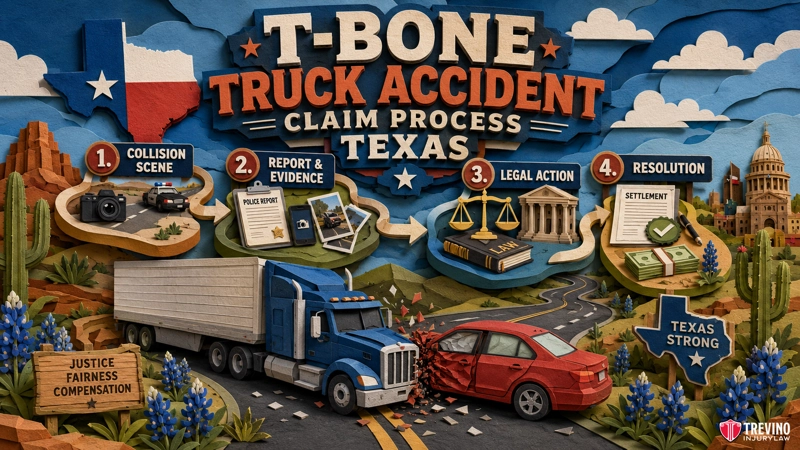
A Texas t-bone truck accident claim is a specialized administrative process that bypasses the individual driver and targets the corporate entity that put them on the road. The claim formally demands compensation from commercial umbrella policies for your catastrophic injuries.
The corporate response team is already at the intersection, rewriting the narrative. They scour the crash site to twist right-of-way disputes against you using the modified comparative negligence rule and reduce your financial recovery. Trevino Injury Law prepares every commercial claim for trial, previously securing a $17 Million settlement in a commercial trucking wrongful death case when the defense refused to negotiate fairly.
Black box data and dashcam footage vanish quickly. A Spoliation Letter, a legal demand that prevents the negligent trucking company from destroying evidence, must be issued immediately. Texas gives you exactly two years to file suit. After that deadline passes, your right to financial recovery is permanently blocked.
Trevino Injury Law t-bone truck accident attorneys will classify your case on day one and lock the evidence down before the corporation deletes it. Call 210-TREVINO now for a free case review. You pay nothing unless we win. Se Habla Español.
What Are the First Steps in a Texas Truck Accident Injury Claim?
The first steps in a Texas truck accident injury claim involve your attorney filing a formal letter of representation to the commercial insurer, issuing a spoliation letter to the trucking company, and completely taking over all communications with the claims adjuster.
Filing a commercial claim against an entity like J.B. Hunt Transport is vastly different from a standard car accident claim. It triggers a rapid response from corporate defense teams. From day one, an attorney at Trevino Injury Law steps in to establish a protective barrier between your family and the insurance company. We immediately issue a Spoliation Letter.
This is a legal demand that stops negligent trucking companies from deleting critical black box data or dashcam footage. Federal regulations mandate that motor carriers retain electronic logging device (ELD) records for only 6 months, making immediate action crucial before this data legally vanishes. While settlement mills might wait months to gather evidence, our trial-first approach ensures we capture vital proof immediately.

We treat every intersection collision in San Antonio involving passenger vehicles and commercial trucks as if it were going before a jury. This early intervention forces insurers to treat your catastrophic injury case with the severity it deserves.
When Should You File the Initial Commercial Truck Claim?
You must file the initial commercial truck claim immediately after the crash to officially trigger the insurer’s legal obligations and block them from contacting you directly.
Delaying the start of your legal case gives the opponent an unfair advantage. At Trevino Injury Law, an attorney reviews the details from the very beginning to formally initiate the claim. We know that waiting allows critical evidence from the accident scene on South Texas highways to vanish.
Filing promptly ensures we can submit Freedom of Information Act (FOIA) requests for police reports and secure video footage before they are permanently erased. Prompt action is particularly important because an investigating officer must submit a CR-3 crash report no later than the 10th day after a collision involving injury or apparent property damage of at least $1,000.
Why Do Adjusters Try to Intercept Your Claim Early?
Adjusters attempt to intercept your claim early to secure a recorded statement before you hire legal representation, allowing them to twist your words and deny liability.
Insurance Adjusters use your silence against you. They want to catch you off guard while you are still experiencing physical pain from your collision. By formally opening the claim with a qualified attorney, we can immediately shut down this deceptive tactic. Once our firm is on record, corporate adjusters are legally prohibited from contacting you directly.
Once the claim is formally opened, the insurance company immediately begins its defense protocol.
How Do Commercial Insurers Investigate T-Bone Accident Claims?
Commercial insurers investigate t-bone crashes by deploying corporate response teams to the crash site, reviewing the Bexar County police report, and actively searching for ways to shift blame onto you under the modified comparative negligence rule.
There is a distinct waiting period during the claim process during which victims receive necessary medical treatment for common injuries. During this time, powerful companies like Progressive Commercial conduct their own internal investigations.
They will scour the intersection where the crash occurred, whether it was on Loop 1604 or a busy street near the University Health System. Our job is to rigorously monitor their actions to ensure they do not hide or destroy crucial evidence related to truck speed or traffic signals.
We also hold them accountable to federal post-accident testing timeframes. For victims seeking to understand exactly what documentation matters during this phase, reviewing what evidence you should collect after a Texas t-bone truck accident provides essential context.

We oversee this entire evaluation to block adjusters from minimizing the severity of your damages. As they perform accident reconstruction, we concurrently demand access to the commercial vehicle’s inspection, repair, and maintenance records.
How Long Does the Trucking Company Investigation Take?
The trucking company’s investigation typically takes several months, during which they analyze dashcam footage and electronic data to determine if they can legally deny your claim.
Settlement mills often rush this critical phase to collect a fast fee. Conversely, a trial-first firm meticulously checks trial boxes to build massive leverage for the eventual financial demand. We understand that properly investigating a complex commercial crash takes time.
Rushing the process only benefits the insurance company, so we focus on gathering undeniable proof of their negligence and identifying the exact point of impact. It is also important to note that standard prompt-payment deadlines do not apply when another driver’s insurance company is paying the claim.
Unlike first-party insurance claims under your own policy, third-party commercial claims operate without strict statutory timeframes.
What Happens if the Adjuster Denies Fault During the Claim?
If the adjuster denies fault during the claim investigation, your attorney will escalate the process by preparing to file a lawsuit in the Texas state courts.
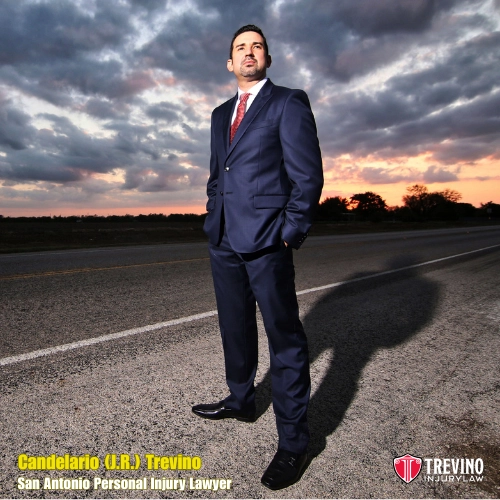
A dispute or denial at the administrative claim level is extremely common. When they refuse to accept responsibility, it simply transitions the process from a preliminary claim into formal litigation. Trial Attorney Candelario (J.R.) Trevino has successfully taken over 80 cases to trial. We are fully prepared to take your case directly to the Bexar County Courthouse if the insurer refuses to negotiate in good faith.
Establishing how the insurer investigates your case lays the foundation for understanding when we can accurately demand compensation for injuries.
When Does Your Lawyer Send the Settlement Demand Package?
Your lawyer sends the settlement demand package only after you have reached Maximum Medical Improvement (MMI), ensuring that every past and future medical expense is accurately calculated and submitted to the insurance company.
The claim process temporarily pauses while the victim heals from their injuries. A formal claim demand cannot be sent until the full scope of future medical costs and rehabilitation is clearly known. High-volume settlement mills frequently rush this phase to secure a quick payout. We take a completely different approach.

We meticulously track your medical progress at facilities like UT Health San Antonio to ensure every single future cost is documented before negotiations ever begin. We have seen how early intervention and patience lead to massive results, such as securing a $7.9 Million Verdict when the defense initially offered a fraction of the value. Proper timing prevents victims from paying out of pocket for immediate medical bills or future surgeries.
What is Maximum Medical Improvement (MMI) in a Claim?
Maximum Medical Improvement (MMI) is the procedural point in your claim where your doctors determine that your condition has stabilized and will not significantly improve with standard treatment.
Reaching MMI officially triggers the creation of the settlement demand package. This medical milestone means your physicians have a clear understanding of your permanent limitations. Whether you require ongoing physical therapy or future accommodations, reaching this stage ensures we can accurately calculate the total financial impact the crash will have on the rest of your life, including your ability to work and loss of enjoyment of life.
What is Included in a Commercial Settlement Demand?
A commercial settlement demand includes all of your medical bills, proof of lost wages, the police report, and a detailed Life Care Plan projecting your future financial needs.
We compile a comprehensive physical package and send it directly to the insurer to trigger the formal negotiation phase. This essential package includes:
- Comprehensive medical records.
- Verified proof of lost wages.
- The official police report.
- A detailed Life Care Plan outlining your future medical needs and costs over your lifetime.
By presenting undeniable documentation, we force the insurance company to face the full reality of the catastrophic harm their driver caused.
Understanding this timeline directly leads to the most critical phase, where we aggressively fight for your financial recovery.
What Happens During the Claim Negotiation Phase?
During the claim negotiation phase, the commercial insurance adjuster will respond to our comprehensive demand package with a preliminary counteroffer. This initiates a series of aggressive legal negotiations in which we continuously use the credible threat of a jury trial to drive the settlement value of your catastrophic injury case to its maximum potential.
Transitioning from submitting your demand package to evaluating the insurer’s response reveals their true tactics. Initial offers from commercial insurance companies are never sufficient to cover your lifelong medical needs or lost wages. High-volume settlement mills often pressure victims to accept these lowball offers, but Trevino Injury Law operates differently.
As a trial authority, Trial Attorney Candelario (J.R.) Trevino has taken over 80 cases to trial. We know that securing a maximum settlement during the administrative claim phase requires the undeniable, credible threat of a jury verdict. Insurance adjusters evaluate our track record, knowing we have secured verdicts that multiplied initial offers by over 100 times, which forces them to negotiate fairly from the start.

While aggressive negotiations often result in fair compensation, understanding what happens when the commercial insurer completely refuses to pay determines the ultimate trajectory of your legal fight.
How Does the Claim Process Transition into a Lawsuit?
The claim process transitions into a formal lawsuit when the commercial insurance company refuses to offer a fair and just settlement. This forces your dedicated trial attorney to officially file a legal petition against them in the Bexar County Courthouse to demand maximum financial compensation.
The administrative claim is a pre-litigation phase in which we present undeniable proof of negligence to corporate defendants such as Swift Transportation or Werner Enterprises in an attempt to reach a settlement out of court. However, a formal lawsuit begins the moment we file a petition in civil court, legally compelling the defendant to answer before a judge. High-volume settlement mills fear this transition and will often urge victims to take whatever cheap offer is initially presented.
As a Scholar Warrior firm, we embrace the courtroom. When an adjuster delays or denies liability, we aggressively transition your case from a stack of paperwork into a high-stakes legal battle. Filing suit triggers the discovery phase, allowing us to subpoena internal company records, depose safety directors, and expose the systemic safety failures that caused the intersection crash. We prepare every commercial claim with the expectation of trying it before a jury, ensuring we hold maximum leverage.
Will my claim be denied if I was partially at-fault in the San Antonio crash?
No. Under Texas law, your claim will not be denied outright if you are 50% or less responsible, although your compensation may be reduced according to your percentage of responsibility. Recovery is completely barred only when the claimant is found more than 50% responsible.
Texas courts may also consider conduct that contributed to the severity of the injuries. In Nabors Well Services, Ltd. v. Romero, 456 S.W.3d 553 (Tex. 2015), a case involving a commercial transport truck, the Texas Supreme Court held that relevant evidence of seat-belt use or nonuse may be considered when apportioning responsibility.
This makes preserving physical evidence, medical documentation, and expert analysis critical when an insurer attempts to shift blame after a T-bone collision.
Do I have to accept the first settlement offer during the claim process?
No. You should never accept the first settlement offer during the claim process, as it is a calculated lowball tactic designed to close your case cheaply.
Does every commercial truck claim end up going to court?
No. Many claims resolve through aggressive negotiations before a lawsuit is filed, but we prepare every single commercial truck claim as if it will go to trial.
What is the Difference Between a Claim Against the driver and the Corporate Policy?
A claim against the individual truck driver typically targets their limited personal auto policy, while a formal claim against the corporate entity triggers massive commercial umbrella policies capable of fully funding catastrophic life care plans and addressing lifelong medical needs.
Commercial truck drivers are often shielded by the massive companies that employ them. By applying the legal doctrine of vicarious liability, we do not just pursue the reckless driver who ignored a traffic rule or stop sign on Highway 281. We aggressively target the multi-billion-dollar corporation that controlled their schedule and rushed them to make the delivery.
This distinction is critical for catastrophic injuries like traumatic brain injuries or amputations, which require far more compensation than a basic individual policy can provide.
While individual policies might cover minimal damages, commercial companies carry federal minimums of $750,000 and often have umbrella coverage exceeding $1 million. We meticulously investigate the corporate hierarchy to access these larger policies, holding negligent trucking companies fully accountable for their dangerous hiring and training practices.
What Happens If You Delay Starting the Claim Process?
If you delay starting the formal claim process, commercial adjusters will aggressively exploit the timeline to argue your injuries are entirely unrelated to the crash. Meanwhile, critical black box evidence is systematically deleted by the negligent trucking company to avoid liability.
Operating without early administrative intervention strips the victim of their greatest legal leverage. When a San Antonio personal injury lawyer is not immediately involved, trucking companies implement rapid-response protocols to minimize their financial exposure. They swiftly repair damaged trailers, overwrite electronic logging devices (ELDs), and deploy corporate investigators to secure favorable witness statements before the victim even leaves the hospital.
By the time you attempt to recover compensation months later, the undeniable proof required to win has permanently vanished. Delaying the claim represents the total absence of protection, leaving you vulnerable to corporate defense strategies explicitly designed to deny you justice and fair compensation.
When Is It Too Late to File a Commercial Truck Crash Lawsuit?
In Texas, the state’s strict civil statute of limitations dictates that it is permanently too late to file a formal commercial truck crash lawsuit exactly two years from the specific date the catastrophic intersection collision initially occurred. This non-negotiable deadline represents the general limitations period for a personal injury lawsuit.
This non-negotiable deadline represents the ultimate failure point for any personal injury claim. Missing this expiration date completely bars you from financial recovery, regardless of how severely you were injured or how obvious the trucking company’s negligence was caught on dashcam video.
The Texas state courts are entirely unforgiving regarding this expiration. While settlement mills might let the clock run out while waiting on slow paperwork, our trial attorneys meticulously track these deadlines to definitively preserve your right to trial. Initiating the administrative claim early ensures we never reach this legal deadline without a formidable litigation strategy already in motion.
Why hire a T-bone truck accident lawyer today?
Commercial Insurance Adjusters use your silence against you. After a devastating intersection crash in San Antonio involving right-of-way disputes or violations of traffic laws, you need a trial-proven accident attorney who actually tries cases, not a high-volume settlement mill. At Trevino Injury Law, we litigate to verdict and hold negligent trucking companies accountable for the full value.
With over 80 cases taken to trial and massive victories like a $7.9 Million Verdict, we know their playbook, and we shut it down. We immediately step in to preserve critical evidence and protect your family from corporate defense tactics.
Want to Protect the Full Value of Your Claim?
You’ve seen how this affects your case — but this is only one piece of the puzzle. Our T-bone Truck Accident Lawyer page breaks down what a trial-ready firm does differently.
Do not give a recorded statement to the insurance company. Contact us immediately for a free consultation on a contingency fee basis. We fight for families, and you owe us nothing unless we win.
