
A slip and fall settlement in San Antonio is a negotiated financial agreement designed to compensate a victim for specific damages, such as medical bills and lost wages. This legal remedy is critical in a city where, according to 2011–2014 data analyzed by the IJERPH, EMS responders handled 13,163 fall-related incidents involving older adults. Furthermore, Texas DSHS records from 2018 to 2022 indicate that Texas fatal falls increased by over 50%, making these life-altering events rather than minor inconveniences.
San Antonio Slip and Fall Litigation: Trial Lawyer Takeaways
- As your San Antonio slip and fall lawyer, we defeat insurance algorithms like Colossus that dehumanize your injury to minimize financial payouts.
- Our firm fights premises liability cases at locations like The Pearl throughout Bexar County to ensure local juries understand your physical suffering.
- The Stowers Doctrine triggers unlimited liability for bad faith, forcing insurers to pay beyond policy limits when they reject fair settlement demands.
- Trevino Injury Law secured a $536,000 jury verdict on a $5,000 offer by proving the true severity of the victim’s spinal injury.
Do You Qualify For Full Compensation?
“The insurance company offered less than $20,000. I ended up with over a million.” – Jackie Galindo
Under Texas personal injury law, the value of your case in Bexar County is calculated by combining economic damages with pain and suffering, then adjusting for fault under comparative negligence.
While internet searches often suggest an average slip and fall settlement of $15,000 to $45,000, 2005 Bureau of Justice Statistics data reveals a median premises liability award of $98,000. Actual recovery depends on severity; cases against major defendants like H-E-B or Walmart can range from $5,000 to over $500,000, despite insurers using Colossus software to suppress payouts.
This page explains compensation formulas, the Stowers Doctrine, and “Net Recovery.” Call 210-TREVINO for an authoritative valuation. Se Habla Español.
How Do I Calculate the Average Settlement Amount for a Slip and Fall Claim?
You calculate a slip and fall settlement amount by summing your Economic Damages (quantifiable losses like bills and wages) and Non-Economic Damages (subjective losses like pain), then adjusting for any shared fault. While our main overview of San Antonio Slip and Fall Lawyers lists the types of compensation available, this section details the specific mathematical formulas Texas courts use to turn those concepts into a final dollar figure. This “Three-Bucket” approach ensures that every single loss you have suffered, past, present, and future, is accounted for before we ever send a demand letter.

Bucket 1: Economic Damages: Using Medical Records to Prove Loss
Economic damages in Texas are strictly limited to the medical expenses actually ‘paid or incurred,’ meaning you can only recover the amount your health insurance paid or the amount you still owe, not the inflated ‘chargemaster’ rate the hospital originally billed. This limitation is codified in Tex. Civ. Prac. & Rem. Code § 41.0105, which states that recovery of medical expenses is limited to the amount actually paid or incurred by or on behalf of the claimant.
This distinction, established by the Texas Supreme Court in Haygood v. De Escabedo, prevents plaintiffs from recovering “phantom damages” that were written off by insurance networks. Additionally, we calculate compensation for lost wages by aggregating the exact hours you missed from work, verified by pay stubs and employer documentation. For severe injuries that prevent you from returning to your previous career, we calculate Loss of Earning Capacity, which requires an economist to project the difference in your lifetime earnings due to the disability.
Bucket 2: Non-Economic Damages: Valuing Pain and Suffering in Personal Injury Cases
Since there is no receipt for physical pain or mental anguish, attorneys often use the “Multiplier Method,” multiplying your total economic damages by a factor of 1.5x to 5x to estimate a fair settlement value for suffering. The multiplier used relies heavily on the severity of injury; a ‘minor’ injury might warrant a 1.5x multiplier, while a permanent impairment requiring surgery could justify a 4x or 5x multiplier.
We also assign a specific and separate value to ‘Physical Impairment.’ While often confused with pain and suffering, Texas law recognizes physical impairment as a distinct category of damages encompassing the significant reduction in your quality of life.
As clarified in Golden Eagle Archery, Inc. v. Jackson, 116 S.W.3d 757 (Tex. 2003), clarifying exactly what compensation you may be entitled to, not just for how much you hurt, but for the specific physical limitations that prevent you from performing daily activities you once loved, whether that is lifting a grandchild, running a marathon, or simply walking without a cane.
Furthermore, Disfigurement damages are calculated separately if the fall resulted in visible scarring, particularly on the face or arms, which carries a higher value in settlement negotiations.
Bucket 3: Future Medical Needs: Securing Fair Compensation
For serious injuries sustained as a result of a slip involving permanent damage, the settlement must cover the projected costs of medical care for 10, 20, or even 30 years into the future to ensure you are never left paying out of pocket. We collaborate with certified Life Care Planners to create a detailed report pricing out every future surgery, spinal injection, physical therapy session, and prescription medication you will require over your lifetime.
This component is often the largest part of a high-value settlement. Nationwide, medical costs for older-adult falls alone reach approximately $50 billion annually (Source: CDC STEADI, 2017). Without an expert Life Care Plan that accounts for this skyrocketing cost of healthcare in San Antonio, you risk settling for a sum that runs out within a few years, leaving your family financially vulnerable.
Establishing the mathematical baseline of your damages is the first step, but the unique legal environment of our city determines how likely you are to actually receive that full amount.
What Factors Affect Slip and Fall Accident Settlement Negotiations?
Common factors influencing slip and fall payouts in San Antonio include:
- Venue: Bexar County juries are generally moderate compared to the “plaintiff-friendly” Rio Grande Valley.
- Defendant Identity: Jurors react differently to a local mom-and-pop shop versus a national chain like Walmart.
- Comparative Negligence: Your percentage of fault directly reduces your payout.
- Treatment Gaps: Inconsistent medical care is the #1 reason case values drop.
While establishing Liability is about proving who is at fault, this section focuses on how these facts impact the financial value of the check you receive. Ultimately, the success of your claim depends on how insurance adjusters weigh these variables when deciding whether to offer a fair settlement or force us to file a lawsuit.
The ‘Venue Effect’: How Location Impacts Claims in Texas
Demographic Shifts & Jury Perception: The risk profile in our community is changing. The 65+ population in the San Antonio metro area grew by 11.7% between 2020 and 2023, faster than the national average (Source: Axios/Census Bureau, 2020–2023). As our population ages, Bexar County juries are becoming increasingly aware of the devastation a fall causes to older residents.
While San Antonio juries are historically moderate compared to the Rio Grande Valley, this demographic shift is making them more sympathetic to victims who suffer mobility-ending injuries.
However, the identity of the defendant still plays a psychological role; jurors may be sympathetic to a local mom-and-pop business in Olmos Park, effectively lowering the settlement value. Conversely, they may be more punitive toward a negligent national chain or an absentee landlord who ignored safety in a working-class neighborhood.
Comparative Negligence: Premises Liability When the Property Owner Failed to Maintain Safety
Texas operates under the strict rule of Proportionate Responsibility (Chapter 33 of the Texas Civil Practice and Remedies Code), where your final recovery is reduced by your percentage of fault. In premises liability cases, the jury is tasked with assigning this percentage to both the property owner and the injured guest, a process highlighted in Del Lago Partners, Inc. v. Smith, 307 S.W.3d 762 (Tex. 2010). If a jury finds you were 30% at fault for looking at your phone, a $100,000 award is legally reduced to $70,000. Crucially, if you are found to be 51% responsible, you recover nothing.
However, there is a strict ‘cliff’ at 51% under Tex. Civ. Prac. & Rem. Code § 33.001. This statute dictates that ‘a claimant may not recover damages if his percentage of responsibility is greater than 50 percent,’ meaning if you are found to be 51% or more responsible for the fall, you recover $0, regardless of how severe your injuries are. This reality is why giving a recorded statement without an attorney is “financial suicide,” as adjusters are trained to manipulate your words to pin just enough blame on you to hit that 51% threshold.
Colossus and Insurance Algorithms: Why Software Cannot Value Your Human Suffering
While you are focused on healing, the insurance adjuster is feeding your medical codes into Colossus, a dehumanizing software program designed to minimize settlement payouts. Colossus doesn’t see your pain; it sees “Value Drivers.” If your medical records lack specific keywords or if there is a treatment gap, the algorithm automatically slashes the “worth” of your claim.
This is why insurance adjusters offer predatory “nuisance values”, they are simply reading a number from a screen. At Trevino Injury Law, we counter this digital “black box” by preparing every case for a Bexar County jury.

A software algorithm cannot predict the emotional impact of a San Antonio trial, and our trial-first mindset forces adjusters to step away from the computer and negotiate based on the real-world risk of a multi-million dollar verdict.
How Surgery and Low Settlements Affect Your Slip and Fall Injuries
Consistent medical treatment is the strongest evidence of injury severity, whereas “gaps” in treatment (waiting weeks to see a doctor) give the insurance company ammunition to argue that your injuries were not caused by the fall at their store. A delay of even three weeks can reduce a settlement offer by 40-60%, as the defense will claim you could have been injured anywhere else during that time.
Conversely, cases involving surgery, such as an Open Reduction Internal Fixation (ORIF) or lumbar fusion, inherently command higher multipliers than those treated only with chiropractic care. The objective nature of a surgical intervention makes the pain undeniable to a jury, forcing the insurer to increase their valuation significantly.
Even with a perfect case and high damages, the actual amount of money available to pay your claim is often dictated by the insurance policy cap and the legal obligations of the insurer.
What Is the Maximum Compensation I Can Recover from Insurance Companies?
The maximum amount you can typically recover is defined by the at-fault party’s insurance policy limits, unless we can trigger the Stowers Doctrine to open the insurer up to unlimited liability for bad faith. Understanding the “money flow” helps explain why some clear-liability cases settle for less than expected, and why understanding “Net Recovery” is vital for your financial planning.
We investigate these limits immediately to determine if the “ceiling” of the case is sufficient to cover your catastrophic losses.
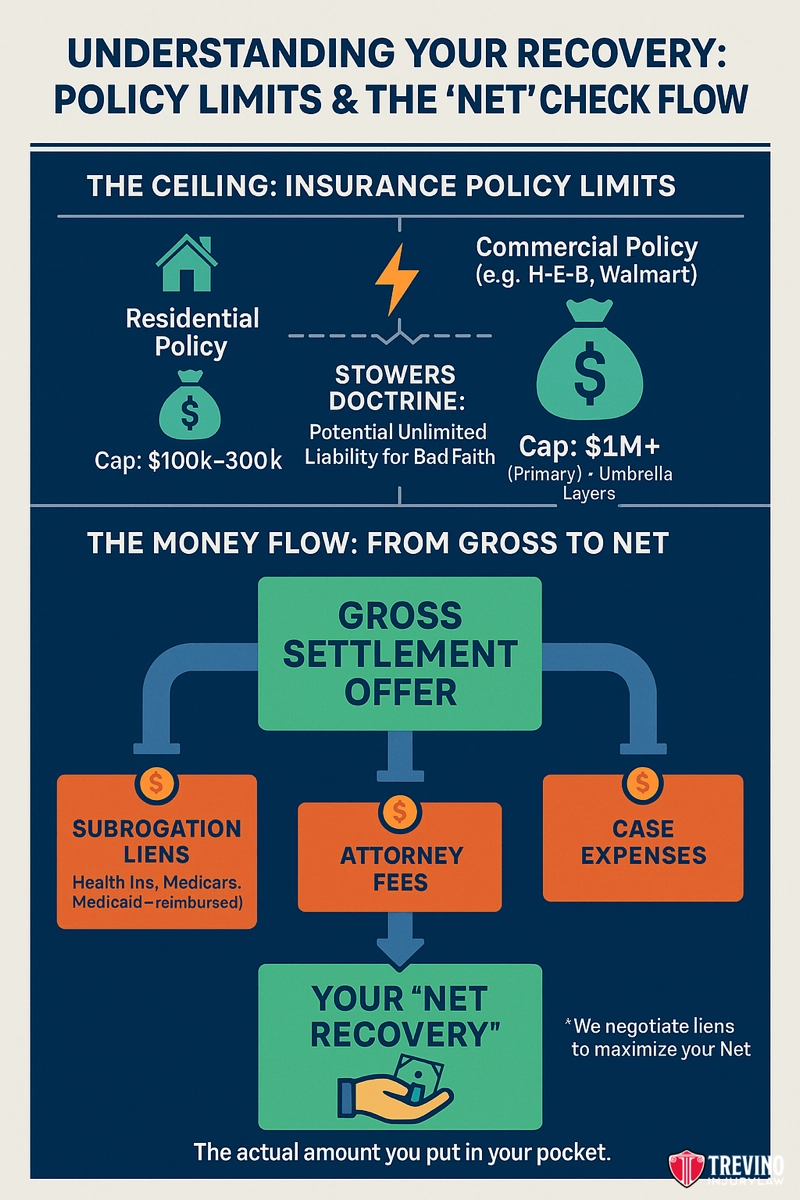
The Ceiling: Understanding Limits in a Slip and Fall Lawsuit
The potential settlement value is often capped by the at-fault party’s insurance policy, which places a strict limit on how much the carrier is required to pay, with residential policies usually offering much lower limits than commercial ones. If you fall at a private residence in Terrell Hills, the homeowner’s policy is likely capped at $100,000 or $300,000; even if your injuries are worth $1 million, you may only recover the policy limit unless the individual has significant personal assets.
In contrast, commercial defendants like H-E-B or Walmart typically carry “primary” policies of $1 million, often with “excess” or “umbrella” layers that provide millions more in coverage. Knowing these limits early allows us to strategize whether we are fighting for the policy limit or negotiating within a larger commercial layer.
The “Net” Check: Determining Fair Compensation After Liens
Your “Net Recovery” is the amount you actually put in your pocket after all mandatory deductions, specifically Subrogation Liens, attorney fees, and case expenses are paid. If Blue Cross, Medicare, or Medicaid paid for your initial emergency room visit or surgery at University Hospital, they have a legal right (a lien) to be reimbursed directly from your settlement funds.
We negotiate aggressively with these lienholders to reduce the amount they take, ensuring that more money stays with you and your family. However, under the Texas Collateral Source Rule, the jury is generally not allowed to know that your insurance paid a portion of the bills.
This prevents the negligent defendant from getting a discount just because you were responsible enough to carry health insurance. We calculate this “Net to Client” figure before accepting any settlement offer so you are never surprised by the final amount you take home.
With the legal and financial frameworks established, it is helpful to look at hypothetical scenarios to visualize how these factors combine in real-world San Antonio cases.
Estimated Fall Settlement in Texas: Ranges for San Antonio Cases
Estimated settlement ranges in San Antonio vary wildly, from $8,000 to $12,000 for minor soft tissue injuries to $250,000 to $500,000+ for severe surgical cases involving permanent disability. These tiers illustrate how the ‘Factors’ and ‘Calculations’ discussed above translate into actual dollar ranges based on the specific type of injury you sustained. Disclaimer: These figures are educational estimates based on typical fact patterns and do not guarantee a specific outcome for your unique case.
Scenario A: The “Minor” Slip and Fall Accident (Soft Tissue)
In a scenario where a victim suffers a simple ankle sprain at a retail store, completes six weeks of physical therapy, and fully recovers, the settlement value is primarily driven by the medical bills. If the paid medical expenses are $4,000 and the pain multiplier is a standard 1.5x, the total settlement range would likely fall between $8,000 and $12,000.
These cases typically resolve quickly, often without filing a lawsuit, provided there are no major liability disputes. The goal here is a typical amount that efficiently covers bills and provides a modest amount for the temporary inconvenience and pain.
Scenario B: The “Moderate” Injury: Average Settlement Amount for Slip and Fall
Consider a case involving a wrist fracture from a wet floor in a busy restaurant at The Pearl or along the River Walk that requires casting but no surgery, causing the victim to miss one month of work. With $12,000 in paid medical bills, $4,000 in documented lost wages, and a higher pain multiplier of 2.5x due to the disruption of daily life, the estimated settlement range climbs to $35,000 – $55,000.
In this tier, the “venue effect” begins to matter more; a sympathetic plaintiff in Bexar County can push this value toward the higher end if the business was clearly negligent in ignoring the hazard.
Scenario C: The “Severe” Surgical Case: When to Hire Slip and Fall Attorneys
For a catastrophic injury, such as a herniated disc or spinal cord damage requiring a lumbar fusion surgery after a fall on an oily surface, the damages and settlement stakes are exponentially higher. If the paid medicals reach $80,000, future medical needs are projected at $50,000, and the permanent impairment justifies a 3x-4x multiplier, the settlement range is $250,000 – $500,000+.
These are the cases where we aggressively deploy the Stowers Doctrine and prepare for trial, as insurance companies rarely offer full value voluntarily without the threat of a Bexar County jury verdict.
While these ranges provide a baseline, many victims struggle with the frustration of proving injuries that aren’t immediately visible on an X-ray.
How to Strengthen Your Claim for Hard-to-Prove Injuries
The hardest injuries to prove for high value are “invisible” conditions like Traumatic Brain Injuries (TBI). Despite the fact that falls are the most common cause of TBI in the United States (Source: CDC TBI Surveillance Report, 2016–2017), insurance adjusters routinely dismiss these claims.
Because TBIs lack obvious fractures on standard X-rays, the defense will characterize your legitimate cognitive symptoms as “malingering” or pre-existing conditions. Unlike a broken bone that shows up clearly on a film, these injuries rely on “subjective” complaints like headaches, memory loss, or nerve pain, which defense attorneys aggressively attack in court.
To overcome this skepticism, we cannot rely on standard ER records alone. We must coordinate with specialists to obtain advanced diagnostics, such as Diffusion Tensor Imaging (DTI) for brain injuries or nerve conduction studies for CRPS, which can objectively visualize the damage.
Without this scientific proof, insurance carriers in Texas will default to offering “nuisance value,” claiming your pain is merely stress or age-related. We counter this by hiring credible medical experts who can explain to a jury exactly why your invisible injury is just as debilitating, and deserving of compensation, as a visible fracture.

Once we secure the necessary medical proof to validate these complex injuries, the next critical step is determining if the insurance company’s initial settlement offer is actually fair or just a lowball tactic designed to make you go away.
Is $25,000 the Average Settlement for a Personal Injury Fall?
Whether $25,000 is a “good” settlement depends entirely on the severity of your medical condition, as it may be a fair amount for a soft-tissue injury that healed in six weeks but a predatory “nuisance value” offer for a complex back injury requiring future care. Insurance adjusters often throw this number at unrepresented injury victims because it sounds like a lot of cash, yet it rarely covers the long-term costs of a permanent impairment like a herniated disc or surgical complications. Accepting this amount without a full liability analysis often means you are unknowingly paying for your own future medical treatment out of pocket while the insurance company saves millions.
Do I Need a Personal Injury Attorney to Evaluate a Low Offer?
Yes, you need an experienced personal injury lawyer to evaluate a $25,000 offer because we can identify if the policy limit is actually much higher and if the insurer is hiding coverage layers.
Will I Keep the Entire $25,000 Settlement Amount?
No, you will not keep the entire amount, as you must deduct attorney fees, case expenses, and mandatory reimbursements to lienholders like Medicare or private health insurance before receiving your net check.
How Long to Receive Compensation After a Settlement?
The disbursement process in San Antonio typically takes 30 to 60 days from the moment you sign the release, as we must deposit the settlement check into a trust account and legally clear all third-party claims before releasing your net funds. This timeline is not arbitrary; it is dictated by the need to negotiate final payoff amounts with lienholders like University Health System or Blue Cross, often reducing their claims by substantial percentages to put more money in your pocket. Once these liens are satisfied and court costs are paid to the Bexar County Clerk, we issue your final check immediately, ensuring that no surprise bills haunt you months down the road.
Why Insurance Companies Offer Low Settlements Initially
A settlement offer is often shockingly low because of the absence of clear medical evidence linking the fall to your injury, or the absence of proof that the property owner knew about the hazard before you fell. Insurance adjusters use software that flags “gaps in treatment” or “pre-existing conditions” to argue that your pain is due to age or prior activities rather than the accident at their store. Without an experienced attorney to fill these evidentiary voids with expert testimony and video footage, the insurer has no fear of a verdict and therefore no incentive to offer more than a minimal amount to make you go away.
Can I Reopen a Slip and Fall Case After Settling?
No, you cannot reopen your slip and fall case after settlement, because signing the “Release of Liability” form creates a permanent, legally binding expiration of your right to ever sue that defendant again for the same accident. This finality is why we strictly advise against settling before you reach Maximum Medical Improvement (MMI), as any complications that arise after the check is cashed—such as a failed surgery or new nerve pain—become your sole financial responsibility.
You must also act within the strict timelines set by Tex. Civ. Prac. & Rem. Code § 16.003, which establishes a two-year statute of limitations for personal injury claims. If you fail to file suit or settle your claim within two years of the accident, your right to compensation is permanently extinguished by Texas law.
Does Filing a Slip and Fall Lawsuit Increase Compensation Much?
Filing a formal personal injury lawsuit often results in higher settlements because it signals to the insurance company that you are willing to take the case to trial, which forces them to increase their internal “reserves” to account for the risk of a jury verdict. When a claim remains in the pre-litigation phase, adjusters know they are in control; however, once a petition is filed in Bexar County court, they must spend money on defense attorneys and face the real possibility of a public loss. This shift in leverage frequently motivates insurers to put “new money” on the table to avoid the uncertainty and expense of the courtroom.
Are Slip and Fall Settlements Taxable in Texas?
Generally, slip and fall settlements for physical injuries and medical expenses are tax-free under 26 U.S. Code § 104(a)(2). This federal statute specifically excludes ‘the amount of any damages (other than punitive damages) received… on account of personal physical injuries or physical sickness’ from your gross income.
However, exceptions exist for portions of a settlement not meant to compensate for physical injury. Punitive damages, which are only awarded under Tex. Civ. Prac. & Rem. Code § 41.003 when there is ‘clear and convincing evidence’ of gross negligence are fully taxable. Similarly, pre-judgment interest (which accrues on your damages during the lawsuit pursuant to Tex. Fin. Code § 304.102) is treated as income by the IRS and must be reported. Additionally, if you previously deducted your medical expenses on your tax return and received a tax benefit, that portion of the settlement may be subject to the “tax benefit rule” and require repayment.
Why Hire a Bexar County Slip and Fall Attorney?
Algorithms like Colossus rely on you giving up. Insurance adjusters and commercial property owners bank on “treatment gaps” to deny your claim. We fight for families, not quick checks.
Trevino Injury Law forces negligent companies to pay full value, just as we did when securing a $7.9 million verdict for a client’s crushed foot, turning a rejected claim into a life-changing result in a South Texas courtroom.
You need a fighter now. Contact a San Antonio flip-and-fall law firm immediately so we can send a spoliation letter to preserve the surveillance footage before they erase it.
Call 210-TREVINO for a free case review. We only get paid if we win. Se Habla Español.