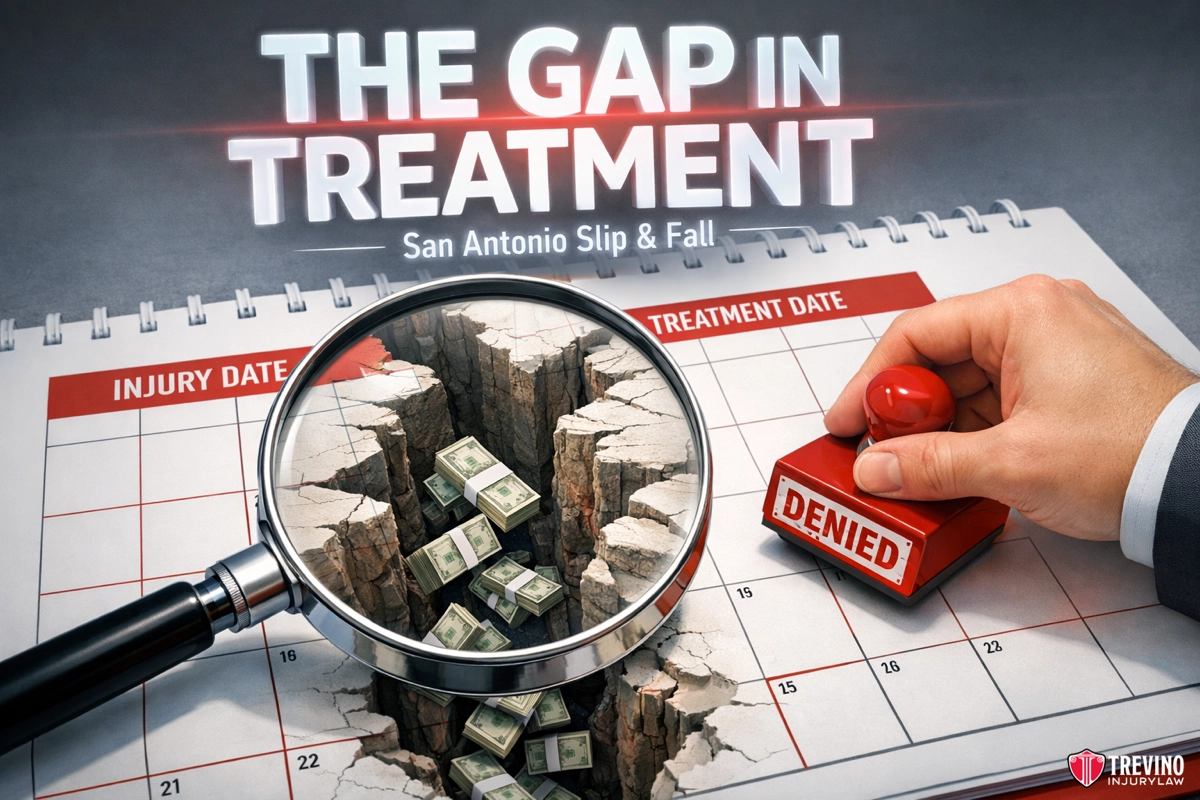
You fell, the adrenaline masked the pain, and you tried to tough it out at home to avoid an emergency room bill. Now the agony is undeniable, but the internal insurance deadline has already expired.
The Insurance Adjuster is already weaponizing this gap in treatment against your recovery. They plug your medical timeline into severity deduction software like Colossus to automatically sever legal causation and reduce your injury claim value to nothing.
According to the U.S. Census Bureau, 16.9% of Bexar County residents lacked health insurance between 2020 and 2024. Insurers know this financial reality forces victims to delay initial care, and they systematically use your hesitation to erase their liability. A gap in care can also directly impact how much a slip and fall settlement is worth in San Antonio, because insurers use delayed treatment to argue that your injuries were minor, unrelated, or avoidable.
What Could Your Slip and Fall Accident Case Be Worth?
Answer a few quick questions about your accident. Takes about 60 seconds.
See What My Case Might Be WorthThe insurance company offered less than $20,000. I ended up with over $1 million. — Jackie Galindo
Surveillance video proving a specific hazard existed can disappear in days. A Spoliation Letter, a legal demand that stops the property owner from destroying proof, must go out immediately to save your case.
Trevino Injury Law slip and fall accident lawyers will override these algorithmic denials and secure critical evidence. Call 210-TREVINO now for a free case review. You pay nothing unless we win. Se Habla Español.
What Is Considered a Fatal “Gap in Treatment” in San Antonio Injury Claims?
A fatal gap in treatment is typically defined by insurers as a delay of 72 hours after your accident for initial care. They also flag lapses of two weeks or longer between follow-up appointments as critical gaps. Insurers use these specific timeframes to argue that the accident caused no real harm or that the injury did not occur at their premises.
While not a law, this arbitrary timeframe is a standard “decision point” in insurance evaluation software. If you fail to seek medical attention within 72 hours, it often triggers an automatic reduction in settlement offers or an outright denial of liability.
Adjusters rely on the “72-hour rule” as a hard cutoff. They ignore the reality that many San Antonians try to manage recovery at home with rest and over-the-counter remedies before incurring the cost of an emergency room visit. For example, a resident on the West Side might try managing back pain with Vicks or heating pads for a few days.

However, if you wait until the pain becomes unbearable to visit medical providers like Texas MedClinic, the insurance company will argue that this reasonable delay proves you weren’t seriously injured.
Why Do “Delayed Onset” Symptoms Create Liability Gaps?
Delayed-onset symptoms create liability gaps because the body’s natural adrenaline response immediately after a crash or fall often masks pain for 24 to 48 hours. This creates a window where the victim feels “fine” before the injury manifests.
This biological reality directly conflicts with insurance policies that demand initial documentation, allowing adjusters to claim that the injury reported three days later is unrelated to the fall.
This phenomenon is known as “Adrenaline Masking.” In many slip-and-fall accidents, such as a hard fall on concrete at a hardware store, the shock can spike adrenaline levels. This temporarily masks the severity of soft-tissue injuries like whiplash or herniations.
These accident-related injuries often flare slowly, with significant pain only appearing days later. The physical toll of these accidents is significant; for context, slip, trip, and fall injuries cost Texas state agencies nearly $9 million in a single fiscal year (Texas State Office of Risk Management, FY2024).
Insurers weaponize this biology, arguing that if you walked out of the store without limping, the herniated disc diagnosed a week later must have happened elsewhere.
How Does the Texas Statute of Limitations Apply to Treatment Delays?
The Texas statute of limitations applies to treatment delays by setting a strict two-year deadline for filing a lawsuit. However, in practice, you should seek medical attention right away. A significant delay can destroy evidence of causation long before the legal filing deadline.
While you technically have two years to file paperwork, a six-month gap in medical treatment usually makes it impossible to establish proximate cause, proving to a jury that the fall caused your current condition.
A two-year statute of limitations does not save a claim with a massive treatment gap. In the eyes of the law, you must prove “proximate cause.” If you wait six months to see a doctor, the defense can easily argue that any number of intervening events, from lifting groceries to playing sports, caused the injury during that silence.
Understanding the biological and legal risks of delaying care establishes the foundation for understanding precisely how insurance companies calculate the financial penalty for these delays.
Does a Gap in Treatment Affect Pain and Suffering Damages in Texas?
Yes, a gap in treatment significantly reduces pain and suffering damages because Texas law requires “objective evidence” of continuous pain. Gaps create a presumption that the victim had recovered or was not in pain during that period.
Without consistent treatment records documenting your symptoms, the legal argument for non-economic damages collapses because there is no independent verification of the suffering you claim to have endured.
This concept relies on “Severity Drivers.” In personal injury law, the value of a claim is driven by the severity of the injury as documented by medical providers. If you stop treating, the law assumes you stopped hurting.
While we often discuss “multipliers” in calculating settlement value, a significant treatment gap effectively renders that multiplier zero.
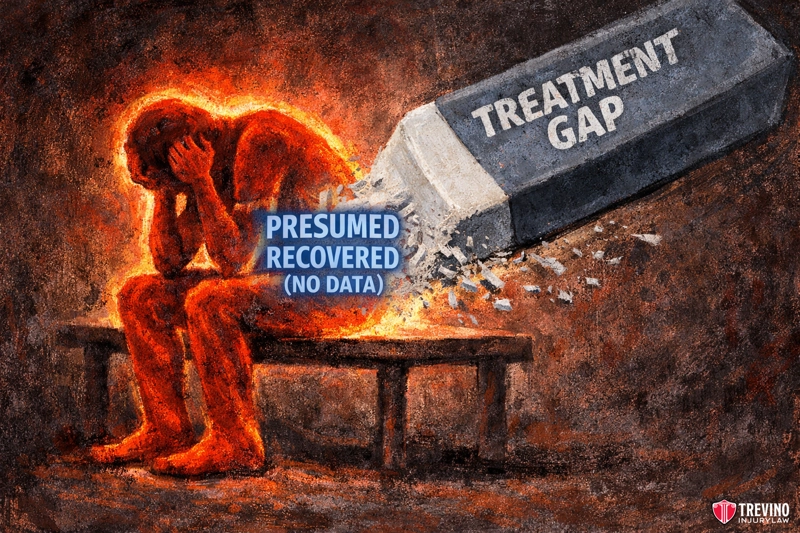
Even if you were facing significant challenges at home in Harlandale or Southtown, without a doctor’s note from a facility like Baptist Medical Center proving it, the insurance adjuster will calculate your pain and suffering at $0 for that period.
How Do Insurance Algorithms Like Colossus Penalize Gaps?
Insurance algorithms like Colossus penalize gaps by using hard-coded “severity deductions.” These automatically narrow the recommended settlement range when medical treatment entry dates do not align with the accident date or when gaps between visits exceed preset thresholds.
These programs are designed to remove human empathy from the equation, treating a missed appointment due to daily life struggles as a strict indicator of a non-serious injury.
Major carriers like State Farm and Allstate use this “Decision Point” software to standardize low payouts. If the software detects a gap of more than 3 days for initial treatment or 14 days for follow-up care, it triggers a devaluation code. It is not a person deciding you’re injured or not; it is a line of code programmed to save the company money.
This automated skepticism makes it crucial to have a San Antonio slip-and-fall lawyer who understands how to manually override these algorithmic deductions with human evidence.
What Are Common Defenses Used Against Claims with Gaps?
Common reasons defense attorneys use to attack claims with gaps focus on severing the link between the accident and the injury. They argue that the delay in medical care after an accident serves as proof that the injury is either fabricated or unrelated to the initial fall. Defense attorneys will use the timeline of your medical care to construct a narrative that portrays you as opportunistic.
The specific arguments often include:
- Intervening Cause: They will argue you hurt your back moving furniture or working in the yard during that two-week gap, not during the fall at the store.
- Malingering: They will claim you only went to the doctor weeks later because you decided to file a lawsuit and needed to generate “medical damages,” not because you were in pain.
- Pre-Existing Condition: They will argue the gap proves the fall didn’t cause the injury, and that your symptoms are just your old arthritis acting up again.
- Failure to Mitigate: They will assert that by failing to adhere to a treatment plan, you allowed the injury to get worse, meaning they’ll argue they should not be responsible for the worsened condition.
Once you understand how the insurance machine weaponizes these gaps against you, the urgent question becomes how to legally justify them to restore your claim’s value.
How to Explain Treatment Gaps to Insurance in Slip and Fall Cases?
You explain treatment gaps to insurance by providing “validating evidence” such as work attendance records showing inability to work, pharmacy receipts for over-the-counter pain management, or sworn affidavits detailing fear of medical costs.
The goal is to shift the narrative from “neglect” to “reasonable justification” by proving that an ordinary client in your specific financial or logistical situation would have acted the same way.
Legal justification moves beyond simple excuses. We utilize the “Reasonable Person Standard.” It is entirely reasonable for a working parent in Leon Valley to fear an unexpected ER bill from a hospital like Methodist Stone Oak.
Given that 20.1% of San Antonio residents under 65 lack health insurance, avoiding these costs is often a rational financial decision rather than a sign of medical neglect (U.S. Census Bureau, 2020–2024). It is reasonable to wait for a primary care appointment rather than rush to an urgent care if you believe the pain will subside.

By documenting these reasons and showing you were mitigating damages by trying conservative home care first, we can counter the defense’s argument that the delay equals dishonesty.
Can a “Letter of Illustration” or Medical Narrative Fix a Gap?
A ‘Letter of Illustration‘ or medical narrative fixes a gap by bridging the timeline with medical science. To be effective, this report from a specialist must explicitly state:
- Consistency: That the delay is consistent with the gradual onset of the specific injury (e.g., a herniated disc).
- Pathology: That the biological mechanism of the injury often masks pain for 24–72 hours.
- Reasonableness: That the patient’s decision to wait was a medically acceptable course of action, not neglect.
This expert opinion provides the objective evidence needed to override an insurance adjuster’s assumptions.
At Trevino Injury Law, we often request these narratives to fill gaps in the record. For instance, a doctor can explain that a herniated disc often starts with minor stiffness that escalates to radiating pain over a week.
This statement explicitly validates that the patient’s decision to wait was medically consistent with the injury type, removing the “suspicion” the insurance algorithm relies on.
How to Win a Negligence Case Despite a Treatment Gap?
To win a negligence case despite a treatment gap, you must present “bridging evidence” that fills the hole in the medical timeline. This includes witness statements from family members who saw you limping, photos of bruising taken at home, or text messages sent to friends describing your pain during the gap period.
This evidence serves as a proxy for medical records, showing that the suffering was ongoing even if you didn’t see a doctor.
For example, if you fell at a grocery store on Culebra Road but didn’t go to the doctor for ten days, a text message sent to your spouse two days after the fall saying “my back is killing me” is powerful evidence. It proves the pain existed before you hired a lawyer.
Consulting a San Antonio premises liability expert immediately allows us to gather and preserve these digital footprints and witness accounts before they are lost.
While bridging evidence can repair the damage to your liability claim, effectively using it during settlement negotiations requires a specific tactical approach to prevent the adjuster from discounting your offer.
How to Negotiate a Slip-and-Fall Settlement with Treatment Gaps?
Negotiating a settlement with treatment gaps requires a proactive strategy that preempts the insurance adjuster’s denial. Instead of waiting for them to flag the delay, your personal injury attorney must acknowledge it upfront in the demand letter and reframe it using the following three steps:
- Mitigation of Damages: Argue that your delay was a “good faith” attempt to treat conservatively at home (using rest, ice, or over-the-counter medication) to save costs. By avoiding an expensive ER visit immediately, you were actually trying to save the insurance company money. This forces the adjuster to argue that you should have been more expensive and litigious, which contradicts their usual stance.
- Reasonable Person Standard: Explain the specific life circumstances that made the delay reasonable. For example, if you live in Prospect Hill or Kirby and work two jobs, explain that you could not afford to time off work to sit in a waiting room until the pain became debilitating. Frame the gap not as neglect, but as the decision of a responsible worker trying to push through the pain.
- Verdict Proof: Adjusters often use gaps to justify “nuisance value” offers. You must show you are willing to fight this.
- Case Example: In Arriaga v. Montemayor, the defense offered only $5,000, likely arguing the injury wasn’t severe. We took the case to trial and secured a $536,007 jury verdict, over 100 times the offer.
While negotiation tactics can frame the delay effectively, the ultimate success of your claim depends on the concrete evidence you preserved to prove negligence occurred, regardless of when you saw a doctor.
What Evidence Is Needed to Prove Negligence When Gaps Exist?
Proving negligence despite a treatment gap requires securing “temporal proximity evidence”, specifically incident reports and surveillance video, to lock in the facts of the fall before the defense challenges the medical timeline.
To satisfy the Corbin elements of liability established in Corbin v. Safeway Stores, Inc., attorneys must independently prove the store knew or should have known of the hazard, a critical step given the 1,500 workers’ compensation claims for slips and falls reported in FY2024 (Texas State Office of Risk Management).
Because stores often delete footage after 14 to 30 days, immediate preservation letters are vital to secure this evidence; lacking that, digital footprints, such as a text message sent immediately after a fall on Loop 1604, can serve as a timestamped record to corroborate the incident.
Does Texas Have a Zero Tolerance Law for Treatment Gaps?
No, Texas does not have a “zero tolerance” law for treatment gaps; juries are permitted to consider reasonable explanations for delays under the “reasonable person” standard when evaluating whether the gap breaks the chain of causation.
Do Gaps in Treatment Automatically Disqualify a Claim?
No, a gap in treatment does not automatically disqualify a claim, but it shifts the burden of proof to the plaintiff’s side to clearly demonstrate through other evidence that the injury was caused by the fall and not an intervening event.
Does Rule 11 in Texas Help Document Agreements on Delays?
Rule 11 agreements in Texas are written stipulations between attorneys that can be used to document procedural extensions, but they generally cannot compel an insurer to ignore a treatment gap unless explicitly agreed upon during settlement negotiations.
These agreements are contracts between lawyers regarding the conduct of the lawsuit, such as extending a deadline to respond to discovery, not medical validations. While a Rule 11 agreement can’t retroactively fix a medical gap, it can be used to agree on the admissibility of certain “bridging” documents during litigation.
For example, defense counsel might agree not to object to the authenticity of pharmacy records from a Universal City drugstore showing you bought pain patches during the gap, simplifying the proof process at trial.
However, reliance on Rule 11 is a procedural tool, not a cure for the factual problem of delayed care.
When Is a Gap in Treatment Legally “Justified”?
A gap in treatment is legally justified when the victim can prove “impossibility of performance,” such as being physically unable to drive, lacking health insurance with no access to credit, or being advised by a medical professional to wait and see if symptoms resolve. In these scenarios, the delay is not a choice but a necessity dictated by external circumstances.
Acceptable justifications often include:
- Financial Destitution: Proving you simply had no money for a co-pay (often requires bank records).
- Pandemic Protocols: Delays caused by clinics refusing non-emergency patients during health crises.
- Medical Advice: Strict instructions from a primary care provider to “rest for two weeks” before seeking imaging.
- Dependent Care: Being the sole caregiver for a child or elderly parent in Somerset or Von Ormy with no relief options to visit a doctor. This is a common constraint in San Antonio, where 13.4% of the population is aged 65 or older (U.S. Census Bureau, 2020–2024).
When Does a Gap Become “Fatal” to Causation?
A gap becomes fatal when it is wide enough to allow for a plausible ‘intervening superseding cause‘, such as a three-month silence, where the defense can argue you hurt your back lifting a box at work rather than at the store. In legal terms, this is known as a ‘New and Independent Cause.’ As detailed in Lear Siegler, Inc. v. Perez, 819 S.W.2d 470 (Tex. 1991), if a separate event breaks the causal chain between the store’s negligence and your injury, the claim can collapse.
Our job is to close that gap with evidence, preventing the insurer from using the Lear Siegler defense to sever liability. Once the gap is wide enough to fit another accident inside it, the claim is usually dead because the link between the fall and the injury is too weak to persuade a jury.
This is the concept of “Intervening Cause.” If you wait four months to treat a knee injury, the defense will ask about every step you took in those 120 days. Did you lift a box? Did you trip at home? The uncertainty destroys the “preponderance of the evidence” needed to win fair compensation.
Understanding these critical timelines is essential for calculating the impact on your settlement value and determining if your claim can still be saved.
Why Hire a San Antonio Slip and Fall Lawyer?
Hiring a San Antonio slip and fall attorney is the only way to effectively rebut the “gap in treatment” defense, as we can secure the expert medical narratives and witness testimony required to prove you’ve been injured legitimately despite the delay. Insurance adjusters count on you facing this complex argument alone, hoping you will accept a denial or a nuisance-value offer because you don’t know how to legally justify your time away from the doctor.
Want to Protect the Full Value of Your Claim?
You’ve seen how this affects your case — but this is only one piece of the puzzle. Our Slip and Fall Lawyer page breaks down what a trial-ready firm does differently.
We proved this at the Bexar County Courthouse with a $536,007 jury verdict over an insulting $5,000 offer. To build this leverage, your personal injury lawyer immediately issues a spoliation letter to preserve vanishing surveillance video before the defense destroys it.
If an insurance company is using your delay against you, discuss your specific situation with us immediately so we can preserve the remaining evidence and force them to evaluate your claim fairly.
Contact us for a free consultation at 210-TREVINO. Se Habla Español.