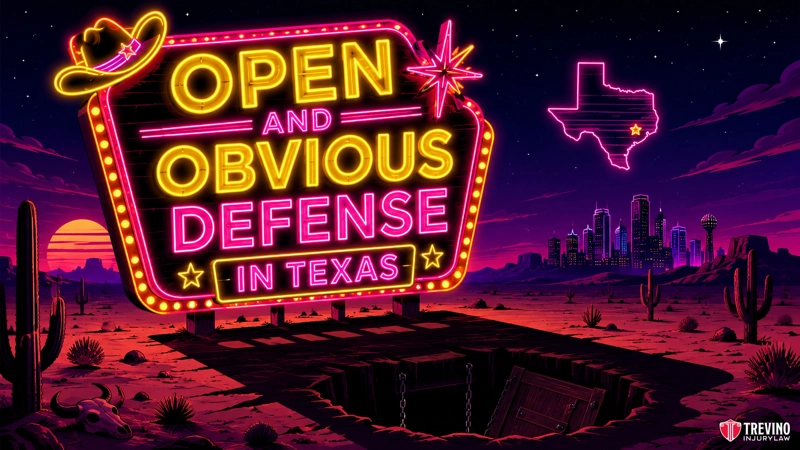
Yes, you can still sue even if an adjuster claims the hazard was open and obvious. Under this rule, no duty generally exists to warn or protect against these dangers, subject to limited exceptions (Supreme Court of Texas, 2015). However, an owner may still be liable if the condition was unreasonably dangerous.
The insurance company is already weaponizing this defense by deploying rapid-response teams to photograph the scene under optimal lighting, deliberately ignoring the exact conditions at the time of your injury. According to the Texas Legislature, adjusters only need to push your assigned fault past the 51% threshold to permanently bar your financial recovery.
What Could Your Premises Liability Accident Case Be Worth?
Answer a few quick questions about your accident. Takes about 60 seconds.
See What My Case Might Be WorthThe insurance company offered less than $20,000. I ended up with over $1 million. — Jackie Galindo
Crucial environmental evidence proving the defect was actually a concealed trap vanishes in the first week. Because establishing when a property owner is liable for injuries depends entirely on this physical proof, a Spoliation Letter, a legal demand that stops the property owner from destroying evidence, must go out immediately to lock down time-stamped surveillance footage and line-of-sight photographs before the defense erases them.
Trevino Injury Law will secure this fragile evidence and aggressively dismantle the corporate defense. Call 210-TREVINO now for a free case review. You pay nothing unless we win. Se Habla Español.
Texas Open and Obvious Claim: Key Takeaways
- As your San Antonio premises liability lawyer, we aggressively defeat the open and obvious defense on corridors like Loop 1604 in Bexar County.
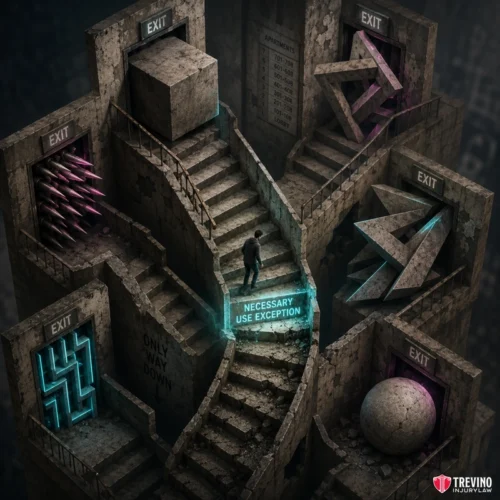
- Our legal team applies the necessary use exception to prove liability when a lack of safe alternatives forces you to encounter an unavoidable hazard.
- Trevino Injury Law issues immediate Spoliation Letters to secure visual evidence and destroy the corporate claim of an obvious danger.
- Your attorney fights subjective fault assignments from companies like State Farm, ensuring property owner negligence supersedes any blame placed on you.
How Does the “Open and Obvious” Defense Work in Texas Premises Liability?
In Texas, this defense functions as a legal shield for property owners. They use it to argue that they owed no duty to warn a visitor if a dangerous condition was so apparent that anyone acting reasonably would have avoided it. To successfully navigate a premises liability claim, you must understand that Texas law generally assumes individuals will avoid self-evident dangers. Furthermore, whether a danger is actually open and obvious is evaluated objectively as a question of law, not merely by your subjective knowledge alone (Supreme Court of Texas, 2021). The property owner’s duty depends on these objective facts.
However, this does not grant corporations blanket immunity. We evaluate the specific context of the incident. We look at whether it occurred in a highly congested area like The Pearl or a poorly lit stairwell in a Medical Center apartment complex. A property owner may claim the hazard is visible, but environmental factors often prove otherwise.
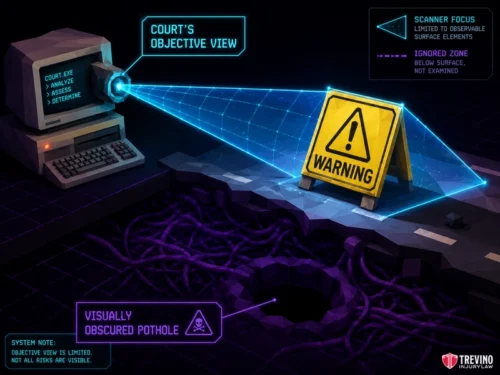
The Supreme Court of Texas‘s landmark ruling in Austin v. Kroger Texas, L.P., 465 S.W.3d 193 (Tex. 2015) firmly established key rules. While landowners generally have no duty to protect invitees from open and obvious dangers, two critical exceptions exist. These are the criminal-activity exception and the necessary-use exception (Supreme Court of Texas, 2015). Our trial attorneys leverage this exact precedent to dismantle the defense.
We litigate to a verdict to prove that what an adjuster calls obvious was actually a concealed trap.
Insurance Adjuster Tactics: Weaponizing the Defense
Adjusters systematically weaponize this defense during their initial investigation. They take recorded statements out of context. They argue you simply failed to watch where you were walking and are at fault for not noticing the risk.
They deploy rapid-response teams to photograph the scene under optimal lighting. They completely ignore the conditions at the time of your injury. We aggressively combat these tactics. We prove that a pothole on Culebra Road or spills on the floor in a dimly lit grocery store aisle were visually obscured. Surrounding merchandise, glare, or shadows can distract. This renders it a hidden hazard rather than an obvious one.
Duty and the open-and-obvious inquiry are ultimately questions of law for the court, not for the jury (U.S. Court of Appeals for the Fifth Circuit, 2024). Understanding these tactics is critical because they directly impact how fault is assigned under Texas law.
How Does Comparative Fault Impact an Open and Obvious Hazard Claim?
Texas follows a modified comparative negligence rule. Even if a jury finds a hazard was partially open and obvious, you can still recover financial compensation. Your specific percentage of responsibility cannot exceed 50%.
Adjusters attempt to push your percentage of fault past the 51 percent threshold to bar your recovery entirely. They exploit the fact that juries must apportion responsibility in whole numbers across four categories. These include the claimant, the defendant, any settling person, and responsible third parties (Texas Legislature, Current statute). We fight these subjective fault assignments. We demonstrate that the property owner’s negligence vastly outweighed any alleged inattention on your part.
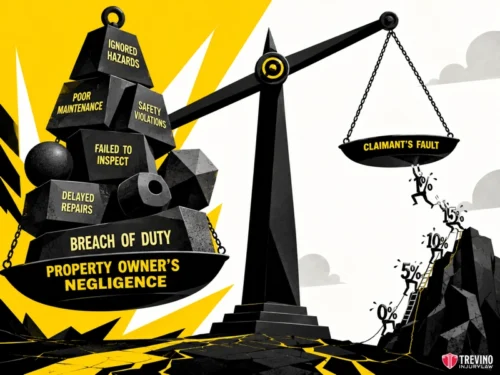
For example, a major retailer on the Northwest Side near Loop 1604 might fail to cordon off a massive structural defect. Their gross negligence supersedes your comparative fault. Through our deep legal scholarship and aggressive courtroom advocacy, we establish that the owner retained the ultimate duty of care.
The necessary use exception legally prevents a property owner from escaping liability if the victim had no reasonable alternative but to encounter the known hazard. Specifically, triggering this exception requires proving two elements:
- The necessary use of the premises.
- A condition that the landowner should anticipate the invitee cannot avoid despite awareness (U.S. Court of Appeals for the Fifth Circuit, 2024). Under this exception, the property owner still has a duty to make the area safe.
If you live in a second-story apartment and the only descending staircase has a clearly rotting step, you are legally forced to encounter the danger to leave your home. In such cases, the landlord cannot use the open-and-obvious defense to avoid liability. Your use of the hazardous area was strictly necessary.
Proving this necessity requires securing irrefutable documentation of the property’s layout before it is altered.
What Evidence Defeats an Open and Obvious Defense in Texas?
To completely defeat an open and obvious defense, you must immediately secure time-stamped surveillance footage, line-of-sight photographs, and witness testimonies. These prove the hazard was practically invisible from the victim’s vantage point. Without such evidence, courts routinely affirm summary judgments for defendants. They legally declare hazards like a sidewalk crack (U.S. Court of Appeals for the Fifth Circuit, 2024) or a wet garden-center floor (U.S. Court of Appeals for the Fifth Circuit, 2021) as open and obvious conditions where no duty is owed. Because settlement mills run on volume, they often fail to secure this fragile evidence.
At Trevino Injury Law, our trial-first mindset means we take immediate action in the first week. We issue a Spoliation Letter. This is a legal demand that stops them from deleting CCTV video and internal incident reports before they accidentally disappear.
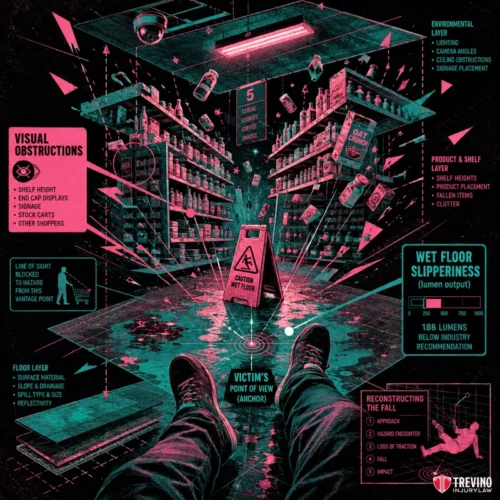
We also analyze environmental factors to legally prove the defect was concealed. These include obstructed views caused by endcap displays or inadequate parking lot lighting along I-35.
The Role of Expert Witnesses in Proving Concealment
We collaborate with forensic engineers and human factors experts. They scientifically reconstruct the incident scene. They testify that a normal person’s biomechanical line of sight would not have registered the danger. These experts measure the coefficient of friction on a wet floor or the precise lumen output of security lights.
By utilizing our established medical and technical expert network, we provide Bexar County juries with irrefutable, data-driven proof. We show that the insurance adjuster’s claim of obviousness is scientifically false.
For instance, the mere physical presence of a suspended power line might be visually obvious. However, expert analysis can help establish that its highly dangerous energized condition was not open and obvious as a matter of law (Supreme Court of Texas, 2021).
This strategic evidence-gathering directly answers the ultimate question faced by victims who thought they ruined their own premises liability claims.
Can You Still Sue if You Knew About the Dangerous Condition Before the Injury?
Yes, you may be able to file a lawsuit even if you had prior knowledge of the dangerous condition. You must prove that encountering the hazard was unavoidable or that the property owner’s gross negligence left you with no safe alternative. Insurance carriers automatically assume that your prior knowledge destroys your claim. If they can conclusively establish your full awareness of the specific danger, they can win summary judgment (Supreme Court of Texas, 2022).
However, simply knowing that a San Antonio parking lot is generally poorly maintained does not absolve the owner of their legal duty to fix a specific, newly formed sinkhole. We force them to pay by demonstrating that your prior knowledge did not equate to an assumption of the specific risk that caused your catastrophic injury.
If your employment duties or living situation compelled you to navigate the danger, we will ensure they are held accountable in court. Successfully arguing this requires meeting specific evidentiary thresholds regarding concealment.
Legal Requirements to Prove a Defect Was Concealed
To legally prove a defect was concealed rather than obvious, you must establish that the hazard was physically obscured. It might be camouflaged by its surroundings or hidden by inadequate lighting. This distinction is vital. Courts have ruled that risks such as crossing an adjacent public roadway with careless drivers are unquestionably open and obvious. Property owners generally owe no duty for such off-premises conditions (Supreme Court of Texas, 2024).
- First, we evaluate color contrast. A clear liquid spill on a highly polished, light-colored floor is inherently camouflaged.
- Second, we analyze physical obstructions, such as a pallet left around a blind corner in a retail store causing a slip and fall.
- Finally, we assess environmental lighting.
We prove that a hazard clearly visible during the day becomes a concealed trap at night. If an owner fails to fix the lighting, they act in an unreasonable manner.
These concealment factors frequently arise in very specific daily scenarios.
Does a slip-and-fall in a retail store automatically constitute an open-and-obvious hazard?
No. If someone slips in a retail store, it does not automatically count as an open and obvious hazard. The spill might be clear, the warning signs hidden, or merchandise displays might intentionally distract your line of sight. Without proper notice, the store can be held liable.
Can an apartment complex use the open-and-obvious defense for stairs that are structurally defective?
No, an apartment complex cannot successfully defend a claim for broken stairs using this doctrine if those stairs are the only means of egress. This triggers the necessary use exception under Texas law.
Commercial Retailers vs. Residential Landlords: Applying the Doctrine
Texas courts apply the open and obvious doctrine differently. It depends on whether the injury occurred at a commercial retailer inviting the public for profit, or a residential apartment complex where tenants have established living rights on someone’s property.
| Property Type | Doctrine Application |
| Commercial Retailers | Commercial retailers, such as massive shopping centers near La Cantera, face strict scrutiny. They intentionally design their spaces to distract consumers with advertising and displays. This negates the obviousness of floor-level hazards. |
| Residential Landlords | Conversely, residential landlords often rely heavily on lease agreements. They argue tenants assumed the risk of common area defects. This requires our attorneys to aggressively counter with statutory habitability requirements and necessary use arguments. |
When property owners rely too heavily on this defense, it creates an actionable legal failure.
What Happens If the Property Owner Fails to Prove the Hazard Was Obvious?
If the corporate defendant’s defense team fails to conclusively prove the hazard was open and obvious, their primary shield is destroyed. This makes them fully liable for your medical care, lost income, and damage.
When our aggressive litigation exposes that the danger was actually concealed, the insurance company loses its leverage to dismiss the claim. Without this defense, they are forced to negotiate based on the true value of your catastrophic injuries. They cannot rely on a procedural loophole to escape accountability.
However, the defense’s applicability changes completely when evaluating workplace injuries.
When Does the Open and Obvious Defense Not Apply to Workers and Contractors?
The open and obvious defense generally does not apply to employees or independent contractors if their specific job duties legally required them to encounter the hazardous condition on the premises.
If you are an oilfield worker in the Eagle Ford Shale or a delivery driver for UPS, you might be forced to navigate a clearly dangerous worksite to perform your job. The property owner cannot blame you for encountering the hazard. Furthermore, under the Texas Workers’ Compensation Act, employers of nonsubscribing companies are specifically barred from asserting common-law defenses. These include contributory negligence, assumption of risk, or fellow-employee negligence (Texas Legislature, Current statute).
In these third-party liability claims, we argue that the economic necessity of completing your job effectively outweighs the open-and-obvious doctrine. This secures your right to maximum compensation.
Why Hire a Premises Liability Lawyer
Hire a trial-ready personal injury claim attorney to immediately secure critical evidence and systematically dismantle the open and obvious defense. We ensure that corporate landowners and insurance adjusters cannot unfairly deny your legitimate claim. They cannot shift the blame, cause you further harm, or escape accountability for your catastrophic injuries.
Want to Protect the Full Value of Your Claim?
You’ve seen how this affects your case — but this is only one piece of the puzzle. Our Premises Liability Lawyer page breaks down what a trial-ready firm does differently.
We know their playbook, and we litigate to a verdict to force them to pay. Do not give a recorded statement to the insurance company. Contact Trevino Injury Law at 210-TREVINO for a free consultation today and get the legal help you need.