You file a lawsuit for a FedEx truck accident directly at the Bexar County Courthouse in downtown San Antonio. State civil district courts hold the unlimited monetary jurisdiction required to formally evaluate catastrophic commercial delivery collisions and secure life care planning resources.
Corporate defense teams are already executing deceptive delay tactics to starve you financially and push your claim into a corporate-friendly federal venue. They rely on procedural expirations to escape liability, while their logistics operations overwrite the critical black-box data proving that their driver skipped mandatory rest periods.
What Could Your Fedex Truck Accident Case Be Worth?
Answer a few quick questions about your accident. Takes about 60 seconds.
See What My Case Might Be WorthThe insurance company offered less than $20,000. I ended up with over $1 million. — Jackie Galindo
According to the Texas Department of Transportation, Bexar County absorbed 2,684 commercial motor vehicle crashes in 2024. Securing your right to a localized jury verdict demands immediate legal intervention to prevent the corporate defendant from shifting blame onto an unnamed maintenance provider. The state imposes a strict filing deadline, but the telematics proof disappears within the first week. A Spoliation Letter is a legal demand that prevents the logistics company from destroying evidence and locks down the data before it can be destroyed.
Trevino Injury Law, FedEx truck accident lawyers, establish proper state court venue and aggressively litigate your commercial collision claim. Call 210-TREVINO for a free case review. You pay nothing unless we win. Se Habla Español.
High-Injury Corridors: Where Local Infrastructure Meets Corporate Logistics Pressure
Commercial truck accident lawsuits in San Antonio frequently originate from high-injury corridors like the I-35 freight route and Loop 410, where local infrastructure meets intense corporate logistics pressure. The devastating reality of this convergence is undeniable: according to the Texas Department of Transportation, Bexar County experienced a staggering 2,684 total Commercial Motor Vehicle crashes in 2024 alone, resulting in 18 tragic fatalities.
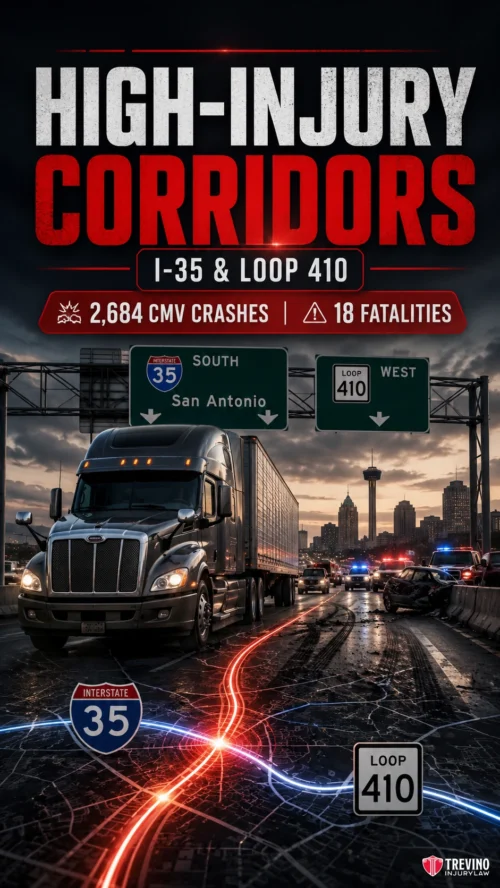
This immense volume of local destruction requires prompt legal intervention to preserve evidence of the collision and establish proper state-court venue before corporate defense teams can manipulate the narrative.
While the main hub covers general commercial vehicle liability, establishing corporate accountability requires proving the truck driver was acting within the course and scope of their employment. This critical legal standard was affirmed in the landmark Texas case Goodyear Tire and Rubber Co. v. Mayes, 236 S.W.3d 754 (Tex. 2007), which ensures that massive logistics companies cannot evade vicarious liability when their on-the-clock drivers cause devastating collisions within San Antonio’s specific geographic hazard zones.
Beyond standard negligence principles, victims in our region must navigate localized transit risks, specific arterial dangers, and neighborhood enclave impacts.
The Major Freeways
The most dangerous freeway segments in our jurisdiction are in heavily congested areas where large commercial fleets operate daily. These major freeways create high-risk environments for smaller passenger vehicles navigating around enormous delivery trucks. The primary hazard zones include:
- The I-35 freight corridor is known for heavy international commercial traffic.
- Loop 410, which frequently experiences major crashes and closures.
- Loop 1604, a rapidly expanding perimeter route handling heavy suburban logistics.
- The “Mixing Bowl” interchange where heavy commercial traffic converges from multiple interstates.
Deadly Non-Freeway Arterials
Severe congestion and accident volume regularly occur on local non-freeway arterials, transforming daily commutes into dangerous interactions with delivery vehicles rushing to meet logistics deadlines. The catastrophic physical impact of commercial wrecks often occurs on specific local transit corridors, which is why victims frequently require a specialized Culebra road delivery truck accident lawyer. The deadliest local roads include:
- Culebra Road, identified as San Antonio’s deadliest non-freeway corridor.
- Bandera Road, one of the region’s most congested routes.
- Potranco Road and Marbach Road, which struggle with explosive suburban growth and pedestrian accidents.
Surrounding Neighborhoods
These transit routes explicitly tie commercial delivery traffic to independent enclaves and suburban hubs scattered throughout Bexar County. Delivery drivers frequently enter these quieter zones to complete “last mile” logistics, bringing massive vehicles into residential areas. Key surrounding neighborhoods affected include Leon Valley, Helotes, Castle Hills, Live Oak, and Alamo Ranch. Establishing proper venue under the Texas Civil Practice and Remedies Code Chapter 15 often begins by pinpointing exactly where the crash occurred within these local boundaries.
Understanding where these catastrophic collisions physically occur establishes the foundation for navigating the precise legal venue where these claims are ultimately resolved.
The Jurisdiction Blueprint: Inside the Bexar County Court System
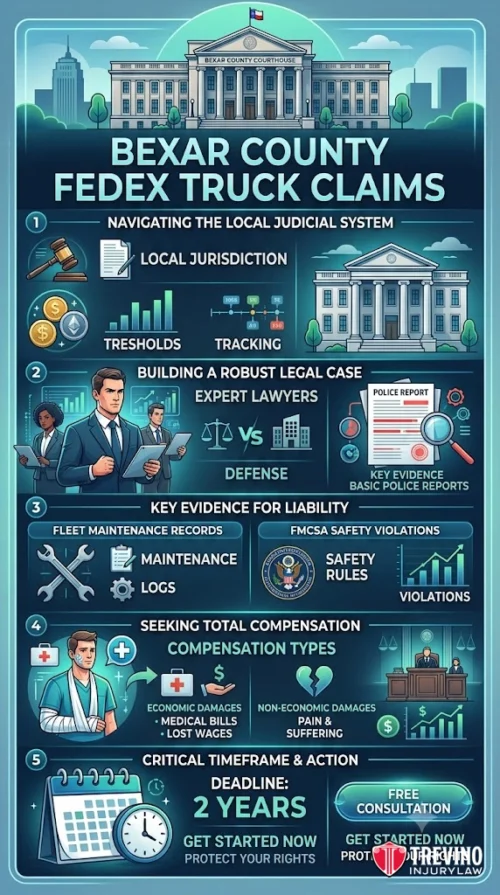
FedEx truck accident lawsuits are officially filed at the Bexar County Courthouse in downtown San Antonio, where state civil district courts and county courts at law hold original jurisdiction to formally evaluate and try catastrophic personal injury claims. While basic injury claims outline standard damage recovery, the structural mechanics of the local judicial system dictate how catastrophic cases are formally evaluated. Beyond standard filing steps, local litigants must understand unlimited monetary jurisdiction, intermediate court thresholds, and forensic docket tracking.
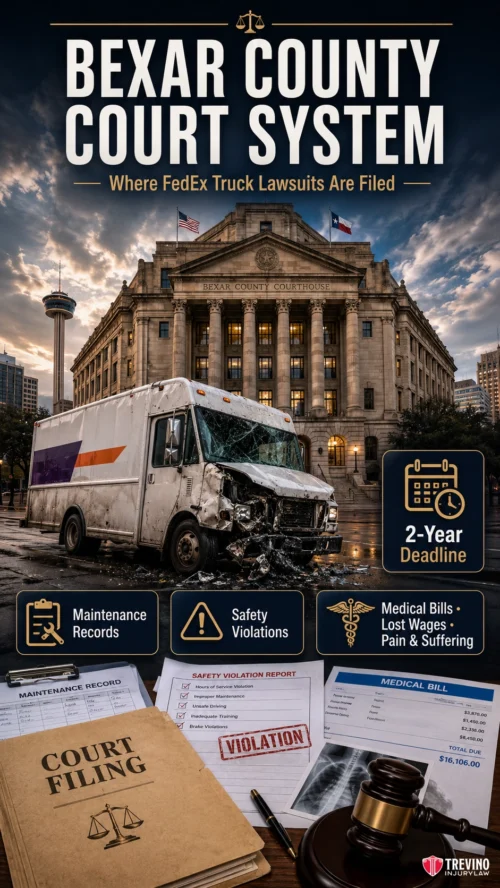
When litigating complex truck cases, particularly those involving an accident with a FedEx vehicle, thorough evidence collection is paramount within the Bexar County system. An experienced FedEx truck accident attorney understands that simply obtaining a police report from the San Antonio Police Department or the Texas Department of Public Safety is rarely enough.
To establish liability under Texas law and level the playing field against corporate defense teams that actively work to minimize payouts to accident victims, formidable legal representation will meticulously uncover key evidence, such as:
- Crucial maintenance records detailing the fleet’s upkeep.
- Safety violations enforced by the Federal Motor Carrier Safety Administration.
Unlike standard personal injury claims or a routine car accident, collisions involving a heavy commercial truck or a standard delivery truck frequently result in serious injuries. Pursuing these injury cases in local courts requires a comprehensive presentation of your total economic and non-economic damages, encompassing:
- Exorbitant medical bills for emergency and long-term care.
- Crippling lost wages resulting from an inability to work.
- Severe physical and emotional pain and suffering.
Furthermore, the statute of limitations for personal injury requires that victims file a lawsuit within 2 years of the collision, meaning the exact date of the accident. To successfully protect your rights and hold FedEx accountable for negligence on Texas’s dangerous highways, decisive action is required. Do not delay; schedule a free consultation to ensure your claim is filed promptly and correctly within the appropriate Bexar County jurisdiction.
Bexar County District Courts
Bexar County District Courts handle the most severe commercial vehicle litigation, with civil judges presiding over catastrophic-damage claims arising from local collisions. These courts, located at the historic downtown courthouse, maintain unlimited monetary jurisdiction.
This means an elite plaintiff trial attorney can seek maximum financial compensation for permanent injuries, life care planning, and wrongful death without any artificial statutory caps on the damages requested. Filing in district court prevents corporate defendants from easily transferring the case to a more corporate-friendly federal venue.
County Courts at Law
County Courts at Law serve a different structural function within the Bexar County judicial system, operating with specific jurisdictional thresholds for intermediate claims. While district courts handle limitless catastrophic damages, county courts are structured to evaluate cases in which the monetary controversy falls within a capped statutory range.
Understanding these structural differences is vital for a trial attorney when selecting the exact filing counter inside the courthouse.
How Do I Search for a Case in Bexar County?
You search for a case in Bexar County by accessing the District Clerk’s online portal system, entering the assigned docket number, and monitoring the dashboard for early defense filings. This forensic tracking mechanism allows a trial-ready law firm to monitor the exact progress of a commercial trucking lawsuit. Plaintiff attorneys use this portal to track docket scheduling, monitor opposing counsel’s motion practice, and ensure the case maintains aggressive momentum toward judicial resolution.
These structural court mechanisms dictate where a case is filed, but how local citizens evaluate the evidence ultimately determines a claim’s financial value.
San Antonio juries value corporate negligence cases by closely examining systemic safety failures and by heavily favoring individual accountability when an elite plaintiff trial attorney presents clear, trial-tested evidence that a commercial logistics company cut corners.
While general truck accident guidance emphasizes securing maximum compensation, litigating a high-value commercial claim before a local pool of Bexar County citizens requires specific strategic considerations.
Beyond standard valuation, successful local litigation demands trial-ready advocacy, an understanding of regional jury characteristics, and absolute leverage over settlement mills.
Regional Jury Characteristics
The regional characteristics of a San Antonio jury pool reflect a community that respects hard work but punishes corporate entities that prioritize logistics deadlines over public safety.
Maximizing the value of your recovery requires a deep, forensic understanding of how San Antonio truck accident lawyers secure multi-million-dollar verdicts before local civil judges. Local jurors heavily favor individual corporate accountability, especially when presented with aggressive discovery maneuvers that reveal internal safety shortcuts.
Trial-Ready Approach vs. Settlement Mills
Securing maximum compensation requires a thorough, trial-ready approach designed to win in local state courts, in stark contrast to the rapid, low-value practices used by high-volume settlement mills.
Before choosing counsel for that process, review the qualifications a FedEx truck accident lawyer should have.
Settlement mills prepare cases for quick payouts, often limiting the resources spent per client. Conversely, a dedicated trial firm prepares every commercial wreck claim as if it will proceed to a jury verdict, checking “trial boxes” from day one to build undeniable leverage against the defense.
The Warrior Imperative
Commercial insurance adjusters closely track a law firm’s local trial record, meaning true leverage is built only when the defense knows the attorney is prepared to litigate to verdict. This protective, unyielding stance is the warrior imperative. Trevino Injury Law demonstrates this leverage through a history of over 80 cases taken to trial. For example, in Jose Simon Arriaga Jr. v. Emily Montemayor, the defense offered a mere $5,000. By taking the case to trial, the firm secured a $536,007 jury verdict, representing a recovery 107 times the initial offer.
While understanding local courtroom dynamics is essential for maximizing the value of a single verdict, the sheer volume of these cases is largely driven by broader economic pressures across the region.
How Do South Texas Regional Factors Impact Local Commercial Truck Lawsuits?
South Texas regional economic factors directly impact local commercial truck lawsuits by funneling massive international freight from border checkpoints and heavy industrial equipment from the Eagle Ford Shale into San Antonio, creating systemic pressures that force drivers to commit severe federal safety violations under strict corporate deadlines.
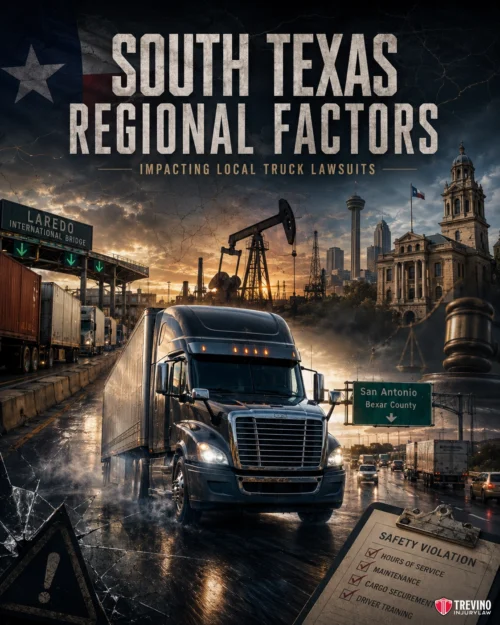
Bexar County does not exist in a vacuum; it sits at the center of a broader economic and logistical web. To fully comprehend the local dangers, an injured person must consider the macro-regional systemic pressures that drive up collision rates on our streets.
The persistent danger posed by overworked commercial fleets is largely driven by international logistics, highlighting the need for a truck accident attorney specializing in Mexico trade corridors. Confronting these systemic issues requires a law firm with a proven record in South Texas trials and the capacity to challenge massive corporate entities.
How Does the International Commerce Wave Affect San Antonio Roadways?
The international commerce wave significantly affects San Antonio roadways by directing an immense, continuous flow of heavy commercial freight originating from major border points like Laredo straight into the city’s primary interstate systems, exponentially increasing the risk of catastrophic collisions.
San Antonio serves as a primary funnel for this lucrative cross-border trade. This constant influx transforms daily commuter routes into high-pressure freight corridors, where local families are forced to share the asphalt with massive logistics operators.
What Is the Industrial Convergence from the Eagle Ford Shale?
The industrial convergence from the Eagle Ford Shale introduces significant additional risks to local highways by mixing standard commuter traffic with heavy industrial trucks and specialized drilling equipment that travel constantly to and from the southern energy region.
Holding these specific commercial entities fully liable within South Texas jurisdictions requires proven trial authority and unyielding advocacy. For example, Trevino Injury Law demonstrated this capacity by securing a landmark $7.9 Million Verdict (Mario Trevino Mendoza v. Farmers Best International LLC) for a client who suffered a crushed foot and an amputated toe, resulting in a recovery six times higher than the defense’s settlement offer.
Why Do Logistics Deadlines Lead to Hours-of-Service Violations?
Unrealistic corporate logistics deadlines lead directly to critical hours-of-service violations because massive trucking companies routinely pressure their operators to skip mandatory rest periods, resulting in extreme driver fatigue right as these enormous vehicles enter densely populated municipal zones.
Federal trucking regulations strictly govern how long a driver can operate a commercial vehicle before resting. However, negligent corporate logistics operators frequently ignore these rules to maximize profit.
Understanding how these macro-regional economic pressures inevitably lead to catastrophic local accidents lays the foundation for navigating the precise procedural timeline required to hold these corporations legally accountable.
The Litigation Timeline: From Local Filing to Judicial Resolution
The litigation timeline from local filing to judicial resolution in Bexar County involves drafting a trial-ready petition, executing aggressive formal discovery to preserve black-box data, and winning pretrial motions to prevent corporate delay tactics, culminating in a localized jury verdict or a maximum financial settlement. The formal timeline transforms an initial legal complaint into an enforceable judgment.
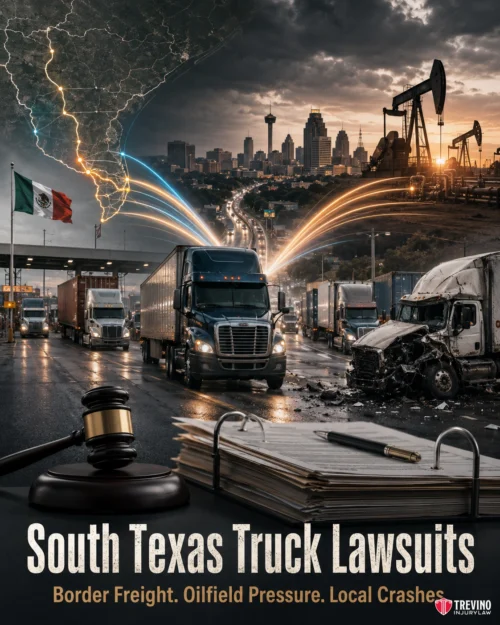
While the main hub outlines the overarching phases of a personal injury claim, understanding the specific procedural mechanisms used in state courts provides essential context for navigating commercial vehicle litigation. Beyond standard timeline expectations, victims in South Texas must navigate aggressive corporate defense maneuvers, rigorous evidentiary deadlines, and complex docket scheduling inside the local courthouse.
What Is the Discovery Phase in a Commercial Trucking Lawsuit?
The discovery phase in a commercial trucking lawsuit is the aggressive legal process where a plaintiff’s trial attorney formally subpoenas the trucking company’s internal logbooks, vehicle maintenance ledgers, and black box data before this critical evidence can be legally overwritten or destroyed by the corporate defense team.
Securing this data requires immediate, decisive action. High-volume settlement mills often skip this rigorous investigation, opting for fast payouts instead of fighting for full value. A true trial-ready firm utilizes this phase to uncover critical safety failures. The discovery process targets specific evidence, including:
- Telematics and GPS tracking data documenting the vehicle’s speed and route.
- The driver’s qualification file, background checks, and toxicology reports.
- Internal corporate communications regarding delayed vehicle maintenance or skipped inspections.
Can I Access the Truck’s Electronic Logging Device (ELD) Data?
Yes, you can access the truck’s Electronic Logging Device data through a formal spoliation letter and court-ordered subpoena before the company overwrites it.
Do We Subpoena the Driver’s Internal Logbooks?
Yes, we subpoena the driver’s internal logbooks to identify federal hours-of-service violations and prove systemic negligence within the logistics company’s operations.
How Long Is the Litigation Timeline from Local Filing to Judicial Resolution?
The litigation timeline typically ranges from several months to over a year, depending heavily on the complexity of the catastrophic injuries, the number of liable corporate defendants, the time required to complete formal discovery, and the scheduling availability of the assigned Bexar County civil district court judge.
Unlike a simple collision near the Mission Historic District or Somerset, commercial crashes require meticulous preparation and unyielding procedural momentum. The defense frequently employs deceptive delay-and-deny tactics, attempting to drag out the timeline and starve the victim financially. Retaining a dedicated FedEx truck accident lawyer in San Antonio ensures your local lawsuit is built on a foundation of proven trial results.
Pre-trial motions keep the case moving forward, forcing insurance providers such as Great West Casualty Company or Northland Insurance to confront the reality of an impending jury trial.
What Happens if You Don’t File the Petition Against All Liable Corporate Entities?
If you do not file the petition against all liable corporate entities, you risk losing the ability to recover full compensation for your catastrophic injuries because the primary defendant may shift blame onto an unnamed maintenance provider or third-party logistics broker not included in your lawsuit.
Commercial vehicle operations involve a web of distinct corporate actors. The driver might be an independent contractor, the truck cab owned by one company, the trailer leased by another, and the freight loaded by a completely separate third-party warehouse. Failing to properly identify and name every liable party in the initial lawsuit limits your financial recovery. An experienced trial attorney dissects these corporate structures to ensure every responsible entity is held fully accountable.
For example, comprehensive liability identification is what enables an attorney to secure maximum compensation, such as a $1.8 Million Settlement for a victim suffering a severe spinal injury in an 18-wheeler crash.
What if Procedural Motions Fail and Pre-Trial Deadlines Expire?
If procedural motions fail and critical pre-trial statutory deadlines expire, the presiding judge can dismiss your lawsuit entirely, permanently depriving you of the right to seek financial compensation from the negligent trucking company and allowing the commercial insurance provider to close the claim without payment.
The rules of civil procedure are strict and unforgiving. Missing a deadline to respond to a defense motion for summary judgment or failing to designate medical experts within the court’s scheduling order results in catastrophic failure for the plaintiff. The defense relies on these procedural expirations to escape liability. Procedural successes in local courtrooms prevent corporate legal teams from hiding behind these technicalities. High success rates in pre-trial motions and discovery disputes demonstrate a law firm’s technical competency, providing the necessary leverage to force maximum settlements or proceed confidently to a jury verdict.
Understanding exactly where FedEx truck accident lawsuits are filed in Bexar County is the first step in holding negligent corporations accountable for the devastation they cause on local roadways. Protect your family and your future. Call 210-TREVINO for a free consultation. Se Habla Español.
Why Hire a San Antonio 18-Wheeler Accident Lawyer?
You hire an 18-wheeler accident lawyer at Trevino Injury Law to secure the black box data before the logistics company overwrites it, subpoena the internal logbooks to prove hours-of-service violations, and compel the corporate defense to appear in the Bexar County Courthouse.
We file a spoliation letter, a legal demand that stops the trucking company from destroying evidence, to immediately preserve the Electronic Logging Device data. We build a trial-ready life care plan. Settlement mills prepare cases for quick payouts. We do not.
Want to Protect the Full Value of Your Claim?
You’ve seen how this affects your case — but this is only one piece of the puzzle. Our FedEx Truck Accident Lawyer page breaks down what a trial-ready firm does differently.
The $17 million 18-wheeler wrongful death settlement and the $7.9 million jury verdict (6 times the defense’s settlement offer) prove what happens when Trevino Injury Law’s San Antonio personal injury lawyer forces massive corporate entities to settle high or face a Bexar County jury rather than allowing the insurer to rely on procedural expirations.
Call 210-TREVINO for a free case review. Se Habla Español. No Win, No Fee.