Move to safety, call emergency services, demand a responding officer to generate an official crash report, and refuse any immediate cash settlement from the driver.
Adjusters from non-commercial carriers like Fred Loya and Progressive are already building a jaywalking defense to argue you crossed illegally and reduce your compensation to zero. The Texas Department of Transportation recorded 768 pedestrian fatalities in 2024. Behind these tragedies is a distracted motorist who violated their mandatory duty of lookout, and an insurance company determined to deny the bodily injury claim.
What Could Your Pedestrian Accident Case Be Worth?
Answer a few quick questions about your accident. Takes about 60 seconds.
See What My Case Might Be WorthThe insurance company offered less than $20,000. I ended up with over $1 million. — Jackie Galindo
Surveillance systems overwrite critical intersection footage from nearby businesses in days. A Spoliation Letter, a legal demand that prevents the property owner from destroying evidence, must be issued immediately to preserve the visual record of the impact. Texas gives you two years to file a lawsuit, but the physical evidence vanishes in a fraction of that time.
A Trevino Injury Law pedestrian crash lawyer will demand the police reports and lock the camera data down before the system deletes it. Call 210-TREVINO for a free case review. You pay nothing unless we win. Se Habla Español.
What are the vital first steps immediately after a pedestrian accident in San Antonio?
San Antonio’s high-speed infrastructure makes the first minutes after a crash the most dangerous. Follow these right steps to protect your life and your legal claim:
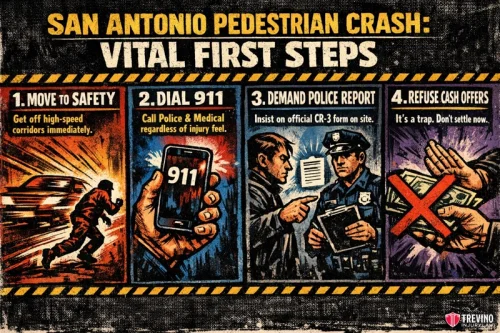
- MOVE to Safety: If you can move, get away from traffic immediately. Traffic on high-speed corridors like Loop 410 or Bandera Road does not stop for pedestrians, and secondary impacts are often fatal.
- DIAL 911: Call for medical help and summon San Antonio Police immediately. Do not let the driver talk you out of calling the authorities. You must seek medical attention even if injuries seem minor.
- DEMAND a Police Report: You must insist that officers arrive to generate an official Texas Peace Officer’s Crash Report (CR-3). Without this document, it is your word against the driver’s, and they will change their account of the incident later.
- REFUSE Cash Offers: If the driver attempts to “settle it now” with cash to avoid police involvement, refuse immediately. This is a trap to prevent you from documenting the parties involved.
Why you must demand an officer at the scene (vs. self-reporting)
You must request that an officer come to the scene to generate an official report, as this independent documentation is the foundation of establishing liability against the driver.
Without a police report, it is simply your word against the driver’s, and insurance adjusters will always side with their policyholder to deny your claim. San Antonio Police officers often handle high call volumes, so when you call 911, you must emphasize that you are a pedestrian and that you have severe injuries (if true) or need evaluation to ensure a unit is dispatched.
A “blue form” (driver self-report) carries far less weight with insurance adjusters than an officer’s narrative. If the police do not arrive, specific administrative steps are required to request a copy of any data filed later to ensure your version of events is on the record.
What evidence must you collect before leaving the scene?
You or a bystander must gather evidence that shows the driver had the time and visibility to avoid hitting you.
Because “he said/she said” is the primary defense in accident cases, physical evidence is your strongest counter-argument. You must collect:
- Driver Info: Exchange information with the driver immediately. Get the license plate, driver’s license, and insurance details, paying close attention to substandard carriers like Fred Loya or Geneva, who are notorious for denying claims.
- Scene Dynamics: Take photos of the location of the accident, traffic signals (specifically if the “Walk” sign was illuminated), and road conditions or skid marks, which prove the driver hit the brakes late or not at all.
- Witnesses: Collect names and phone numbers immediately; witnesses at busy intersections like Loop 1604 and Culebra Road will leave within minutes once traffic clears.
- Surveillance: Look for cameras at nearby businesses (e.g., H-E-B, Valero) or residential doorbell cameras if the accident occurred in a neighborhood like Alamo Heights or Stone Oak.
Documentation at the scene prevents the driver from changing their story later, but understanding how traffic laws apply to your specific location is just as vital.
Are you automatically at fault if you were not in a crosswalk?
No. Jaywalking is not a free pass for the driver. Texas law may require a pedestrian to yield outside a crosswalk, but drivers must still use due care to avoid hitting people in the roadway and keep a proper lookout. Montes v. Pendergrass, 61 S.W.3d 505, 509 (Tex. App.—San Antonio 2001, no pet.); Tex. Transp. Code §§ 552.005, 552.008. In real cases, that usually results in comparative fault, not automatic dismissal.
Insurance adjusters love to use the “jaywalking” defense to deny claims, but our law firm knows how to defeat this tactic. Drivers have a mandatory duty of lookout to continuously scan the road for hazards, regardless of where a pedestrian is located.
This non-negotiable duty was cemented by the Supreme Court of Texas, which established that a driver’s failure to keep a proper lookout constitutes negligence. If the driver was speeding down San Pedro Avenue or distracted, they violated this duty.
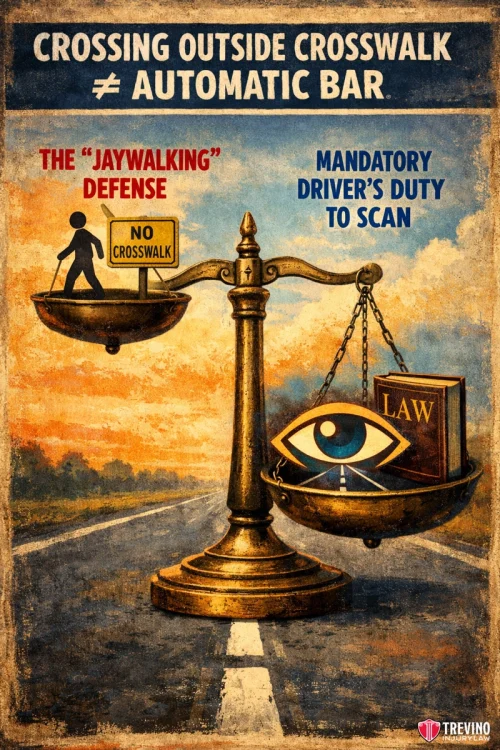
We use accident reconstruction to prove that a vigilant driver could have stopped, effectively shifting the liability from your location to their failure to follow established Texas law.
For the broader framework behind these fault disputes, review how Texas pedestrian accident liability and fault rules apply.
What is the 51% Rule in Texas and how does it affect pedestrians?
The 51% Bar Rule (Modified Comparative Negligence Rule) means you can recover damages as long as your share of the fault is 50% or less; if you are found 51% responsible, you receive nothing.
This rule is the critical decision-making factor in your case and the reason you must never make an admission of fault to an insurance adjuster. For example, if a jury finds you 20% at fault for crossing Austin Highway mid-block, but finds the driver 80% at fault for speeding, you can still recover 80% of your total damages.
Insurance companies will try to trick you into admitting you “should have looked better” to increase your percentage of fault so your compensation will be reduced to zero. Understanding this rule protects you from their manipulative tactics.
How do you prove the driver was negligent?
We establish driver negligence by securing electronic data, witness testimony, and forensic evidence that proves they violated the standard of care.
To overcome the bias against pedestrians, we must provide irrefutable proof of the driver’s failures. This involves subpoenaing cell phone records to prove distracted driving at the time of impact or pulling the Event Data Recorder (black box) if you were hit by a commercial vehicle to show speed and direction of travel.
Our firm has extensive experience with 18-wheeler pedestrian cases where preserving this data is the key to securing settlements. We investigate fatigue, impairment, and mechanical failures to build a wall of evidence around the defendant. Given that there were 6,077 total pedestrian crashes across the state in a single year, the need for irrefutable proof is undeniable (TxDOT, 2025).
Establishing the driver’s negligence is the first hurdle, but navigating the complex insurance claims process is the next step to actually receiving funds.
How to file an insurance claim as a pedestrian in Texas?
Filing a claim involves navigating multiple coverage layers to ensure you are not left with unpaid medical bills. Use this “Warrior” strategy to secure every dollar available:
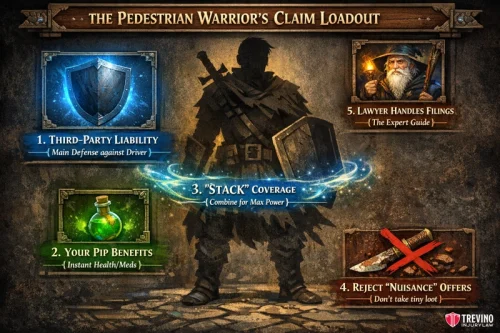
- File a Third-Party Liability Claim: You primarily file against the at-fault driver’s insurance policy to cover your total damages and compensation demand.
- Access Your Own PIP Benefits: You may also file a Personal Injury Protection (PIP) claim on your own auto policy. Even though you were walking, your PIP can cover immediate medical costs like ambulance and ER visits.
- “Stack” Your Coverage: Use your own PIP benefits to pay bills immediately while the third-party claim against the driver’s insurance (like State Farm or Allstate) is being processed.
- Reject “Nuisance Value” Offers: Be warned that major carriers often call quickly to offer a small check to minimize payouts. Do not accept these offers until you know the full extent of your injuries.
- Let Your Lawyer Handle Filings: Trevino Injury Law manages these complex filings to prevent you from accidentally releasing your rights for pennies on the dollar.
Should you give a recorded statement to the driver’s insurance?
You should never give a recorded statement to the at-fault driver’s insurance company without your lawyer present, as they are trained to extract soundbites that damage your claim.
This is the most common error victims make, and it can be fatal to your case. The adjuster will act friendly and concerned, asking questions designed to get you to say “I’m okay” or “I didn’t see him coming.” Anything you say can be used to downplay your injuries or argue you were distracted.
We know their playbook, and we shut it down. By avoiding discussing fault on a recorded line, you force them to evaluate the claim based on the objective evidence we provide.
What compensation can I claim after a pedestrian accident in San Antonio?
San Antonio pedestrian victims can recover two distinct categories of damages. We fight to ensure the insurance company pays for the lifetime cost of your injuries and treatment plans, not just the initial ER visit.
| Compensation Type | What It Covers | Why It Matters |
| Economic Damages (Financial Losses) | • Medical Bills: Past and future surgeries, rehab, and medications. • Lost Wages: Income lost while you are unable to work. • Loss of Earning Capacity: If you cannot return to your previous job. | These are calculable costs. We use Life Care Plans to prove your future needs will cost millions, not thousands. |
| Non-Economic Damages (Human Cost) | • Physical Pain & Suffering: The agony of the crash and physical recovery. • Mental Anguish: PTSD, anxiety, and trauma. • Physical Impairment: Loss of enjoyment of life (e.g., unable to walk or play sports). | These are often the largest part of the claim. Example: We secured a $7.9 Million verdict for a client with a crushed foot by proving the severe impact on his daily life. |
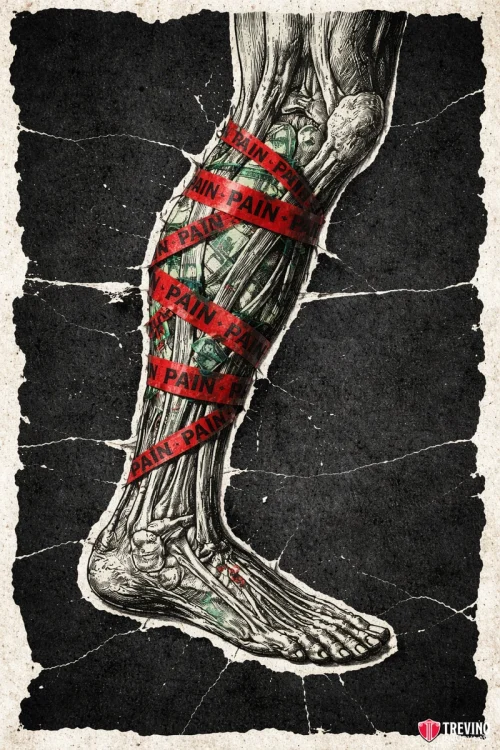
Critical Note: With 1,452 suspected serious injuries reported among pedestrians in 2024, insurance adjusters are trained to downplay “Non-Economic” damages to save money. We force them to account for every single day of your pain.
What if the driver flees the scene (Hit-and-Run)?
If the driver flees, you must treat the case as an Uninsured Motorist (UIM) claim and immediately file a police report to trigger coverage under your own auto policy.
In San Antonio, hit-and-run incidents are unfortunately common, especially near highway on-ramps. You must become the investigator immediately. Rely on witness descriptions of the vehicle’s make and color, and scan the area for cameras at nearby businesses or intersections.
San Antonio Police hit-and-run detectives require actionable leads to pursue a suspect, so any detail you can provide, even a partial license plate, is crucial. Your own insurance policy’s UIM coverage pays for your bodily injury in this event, acting as the safety net when the at-fault driver abandons their responsibility.
Are you automatically at fault if you hit a pedestrian?
No, drivers are not automatically liable if a pedestrian darts out unexpectedly, but they must prove they exercised reasonable care to avoid the collision.
Do pedestrians always legally have the right of way?
No, pedestrians generally only have the right of way in marked or unmarked crosswalks and must yield to vehicles when crossing elsewhere.
How soon after an accident do you have to file an insurance claim?
You should file a notice of claim as soon as possible, typically within days, to avoid coverage denials for “failure to cooperate” or “late notice.”
Why You Need a Trial Lawyer vs. A Settlement Mill
A “settlement mill” aims to process your claim quickly for a low amount, whereas a Trial Lawyer prepares your case for court to force the insurance company to pay full value.
High-volume firms often assign your case to a case manager who is instructed to settle quickly, leaving money on the table. Trevino Injury Law takes the opposite approach: we prepare every file as if it is going to a jury.
This aggressive posture is the only thing that scares insurance giants. For instance, in one case involving a low back injury, the initial offer was only $5,000. Because we refused to fold and took the case to trial, we secured a $536,007 verdict, more than 100 times the original offer. This is the difference between a quick check and actual justice.
What are the risks of “Walking It Off” (Adrenaline Masking)?
If you delay seeking medical care after a pedestrian accident, insurance adjusters will argue that your injuries may not be caused by the crash or are not serious, significantly devaluing your claim.
Adrenaline is a powerful painkiller that can mask serious trauma for hours or even days. You may feel “fine” walking around the scene along US-90 or I-10, but you could be suffering from internal bleeding or a concussion.
Nationwide, the scope of harm is massive, with an estimated 67,336 pedestrians injured in traffic crashes in a recent year (NHTSA, 2022). If you wait to see a doctor, the insurance adjuster will use this “Gap in Treatment” to deny payment.
Specific symptoms such as headaches or numbness may not appear for days, but they still require a medical visit and detailed records to link them to the accident. For a detailed breakdown of what to watch for, read our guide on Medical Care After a Pedestrian Accident.
When Is It Too Late to Preserve Evidence?
While Texas allows two years to file a lawsuit, critical evidence like surveillance footage is often overwritten within 7-14 days, effectively destroying your case long before the legal deadline.
This “soft” deadline is often more fatal to a case than the official Statute of Limitations. Commercial businesses along busy corridors like Marbach Road often have security systems that automatically delete video footage after a short cycle to save storage space. If you wait months to contact an attorney, the video that proves the driver ran the red light is likely gone forever.
We send immediate spoliation letters to preserve this evidence before it is destroyed, locking in the proof needed to win your case.
Why Hire a San Antonio Pedestrian Accident Lawyer?
You only get one chance to secure the compensation your family needs for the long road ahead. Insurance giants like Progressive and State Farm count on you being overwhelmed, but we know their playbook, and we shut it down.
Want to Protect the Full Value of Your Claim?
You’ve seen how this affects your case — but this is only one piece of the puzzle. Our Pedestrian Injury Lawyer page breaks down what a trial-ready firm does differently.
When an insurer offered a miserable $5,000, we fought at the Bexar County Courthouse and secured a $536,007 verdict. You need a relentless San Antonio injury compensation attorney who immediately executes spoliation letters to preserve critical camera evidence before it vanishes. We fight for families.
Call 210-TREVINO for a free case review. Se Habla Español. We operate on a strict No Win, No Fee promise.