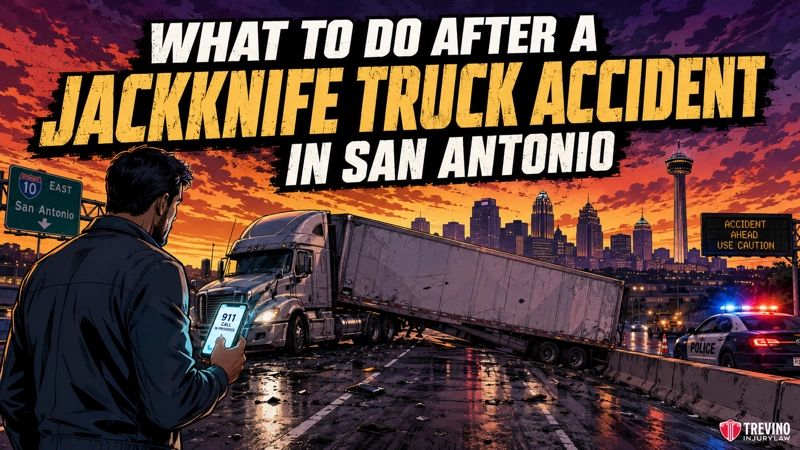
Call law enforcement to force a certified police report, refuse recorded statements, and lock down the tractor’s electronic data. Surviving a commercial jackknife crash thrusts you into an immediate legal crisis before the wreckage clears.
Corporate trucking carriers like J.B. Hunt are already deploying rapid-response teams to the scene. Their sole mission is to manipulate your initial shock into an apology that triggers the comparative negligence bar, blaming environmental factors for their driver’s failure.
They deploy these aggressive defense tactics because passenger vehicles absorb the catastrophic physics of a commercial impact. According to national data, 82% of fatalities in fatal large-truck crashes are not the truck occupants themselves. That is a foreseeable transfer of risk onto your family.
What Could Your Jackknife Accident Case Be Worth?
Answer a few quick questions about your accident. Takes about 60 seconds.
See What My Case Might Be WorthThe insurance company offered less than $20,000. I ended up with over $1 million. — Jackie Galindo
Before the carrier overwrites the engine control module and alters the federal driver logs, you must send a Spoliation Letter, a legal demand that stops the property owner from destroying evidence. Waiting even 48 hours can make this critical proof vanish forever.
Trevino Injury Law jackknife accident lawyers block the corporate adjusters on day one and force negligent carriers to pay full value. Call 210-TREVINO today for a free case review. You pay nothing unless we win. Se Habla Español.
Should You Call the Police Immediately After a Jackknife Crash?
Yes, you must call 911 immediately after a jackknifed rig incident to ensure a certified Texas Peace Officer secures the scene and generates an official crash report. This serves as the foundational legal document for proving the corporate trucking company is liable and preventing them from denying the collision occurred.
This local threat is substantial, as recent state records indicate that 2,684 commercial motor vehicle crashes were reported in Bexar County in a single year. While the main considerations for emergency scene response apply to any commercial collision, the specific timing protocols and evidence preservation needs create additional layers of urgency.

Beyond the standard guidance, injured victims must navigate specific San Antonio Police Department protocols, Texas Transportation Code mandates, and scene safety on high-risk highways such as Loop 1604 and Culebra Road.
The physical environment immediately following an 18-wheeler wreck presents extreme danger to nearby vehicles. The truck’s trailer is significantly heavier than that of a passenger car, especially when fully loaded with freight or cargo. If you are physically able to safely operate your car, Texas law requires you to move your vehicle out of active traffic lanes to prevent deadly secondary collisions. Wait on the shoulder or behind a barrier for authorities to arrive.
What Information Should You Give to the Responding Officer?
You should provide only factual, objective observations to the responding officer regarding the commercial truck’s precise movements and lane positions. Never speculate about your own actions, apologize for the collision, or guess about factors you could not clearly see from your vehicle.
Providing objective facts protects your ability to recover damages and prevents speculative apologies that adjusters weaponize against you under the 51% bar rule. Do not discuss road conditions, the risk of a jackknife, or a loss of traction, as a CDL holder with a commercial license is professionally trained to handle these environmental factors.
| Factual Statements (What to Say) | Speculative Statements (What NOT to Say) |
| “The trailer swung into my lane.” | “I think I might have been in their blind spot.” |
| “I was traveling at the speed limit.” | “I am sorry, I did not brake fast enough.” |
| “The truck crossed the center line.” | “I guess I could have swerved sooner.” |
How Do You Safely Document the Commercial Crash Scene?
To safely document the commercial crash scene before evidence disappears, you must quickly photograph the acute angle of the tractor and trailer, capture wide shots of the debris fields, photograph the skid marks, and secure immediate contact information from any neutral bystanders who witnessed the wreck.
- Photograph the jackknife angle and DOT number on the cab.
- Capture skid marks on roads like I-10.
- Identify potential dashcam witnesses who stopped to help.
- Note specific weather and lighting conditions at the exact time of the wreck.
- Document any text messages or mobile device usage you observe the driver engaged in immediately following the crash.
While documenting the scene builds your legal foundation, you must seek medical evaluation to protect your physical health and establish the vital medical baseline for your catastrophic injury claim.
Why Is Immediate Medical Attention Critical Even If You Feel Fine?
Immediate medical attention is absolutely critical because the adrenaline surge following a commercial collision temporarily masks the symptoms of severe traumatic brain injuries and spinal trauma. Securing a same-day medical record legally links your physical trauma directly to the trucking company’s negligence rather than a pre-existing condition.
Building upon the standard financial responsibilities covered in the main guide, understanding local emergency medical routing and trauma center documentation requirements provides vital protection for your case.
The violent physics of an 18-wheeler crash send massive forces through your body, often causing internal damage that takes hours to manifest. The sheer physical toll of these severe impacts is evident in local statistics, which recorded 46 suspected serious injuries resulting strictly from commercial motor vehicle crashes in Bexar County.

Getting routed to major trauma facilities like Methodist Hospital ensures you receive a proper diagnostic workup. Delays in treatment are heavily weaponized by defense adjusters at companies like State Farm or Progressive to argue the injury happened elsewhere.
How Do Emergency Medical Records Prove the Severity of Your Injury?
Emergency medical records serve as vital, objective, court-admissible proof of your immediate physical trauma. This completely neutralizes the commercial insurance adjuster’s predictable attempts to minimize your pain and suffering or claim that your injuries occurred long after the initial highway collision.
- Initial Triage Notes establish the exact time and date of your injury.
- Diagnostic Imaging, such as X-rays and MRIs, documents spinal trauma.
- Pain severity reporting demonstrates your immediate suffering, explaining why omitting “minor” pain damages a claim.
While doctors focus on healing your injuries, commercial insurance adjusters immediately focus on defeating your claim.
Once emergency treatment is underway, the next practical concern is how the bills and missed work will be handled. See who pays medical bills and lost wages after a jackknife crash in Texas for the financial side of the claim.
What Should You Say to the Trucking Company’s Insurance Adjuster?
You should say absolutely nothing to a commercial insurance adjuster following a collision. You must firmly decline their immediate request for a recorded statement and direct all case communication to your plaintiff trial attorney to prevent accidental admissions of fault that could let the responsible party off the hook.
While federal regulations dictate liability at a high level, the most immediate threat to your family’s financial recovery comes directly from the corporate adjuster contacting you within 24 hours of the collision.

Exposing the tactics of companies like Great West Casualty or Lancer Insurance reveals their true motives. They call under the guise of checking on you, but their sole mission is to lock you into a recorded statement that triggers the 51% bar rule in Texas.
Refusing to speak with the adjuster requires you to quickly secure an advocate who will speak on your behalf and preserve vital evidence.
How Do Commercial Adjusters Weaponize Your Words?
Insurance adjusters representing negligent trucking companies, such as Great West Casualty Company or J.B. Hunt Transport, are highly trained to protect corporate profits. Their primary goal in requesting an immediate recorded statement is to manipulate your words to establish comparative negligence.
Under Texas law, if an adjuster can trick you into apologizing or guessing you were in the truck’s blind spot on a chaotic, high-collision corridor like I-35 or the Mixing Bowl interchange, you could be entirely barred from financial recovery.
This is exactly where the difference between a high-volume settlement mill and a dedicated plaintiff trial lawyer becomes critical. A settlement mill might allow these recorded statements to happen just to secure a fast, lowball payout. At Trevino Injury Law, our trial-first mindset means we block these adjusters from contacting you immediately. We know their playbook, and we shut it down. By stepping between you and corporate insurers, we completely neutralize their primary weapon against your claim.
Backed by our history of taking over 80 cases to trial and securing results like a $17 Million Settlement in an 18-wheeler wrongful death case, we force them to pay full value for catastrophic injuries. Once the adjuster’s threat is neutralized by your silence, the window to launch an aggressive legal strategy opens. This transition requires a strict timeline for formal legal intervention to protect your case.
When Should You Hire a San Antonio Trial Lawyer After a Jackknife Accident?
You should hire a board-tested plaintiff trial lawyer within the first 24 to 48 hours following a collision to immediately send a legally binding Spoliation Letter. This prevents the commercial trucking corporation from deliberately destroying critical electronic black box data and driver logs.
The urgency of this step is underscored by the landmark Texas Supreme Court ruling in Brookshire Brothers, Ltd. v. Aldridge, 438 S.W.3d 9 (Tex. 2014), which established strict limitations on when juries can be instructed about destroyed evidence. Immediate, formal preservation of commercial evidence is absolutely essential for litigating your claim.
While knowing how to choose a qualified San Antonio trial attorney for a complex commercial truck case establishes your long-term legal foundation, the immediate timing of that decision dictates what evidence actually survives. Hiring an experienced attorney shifts your family from a defensive crisis response to an offensive legal strategy.

Commercial carriers like Swift Transportation or Werner Enterprises deploy corporate response teams to the crash site immediately to minimize their liability. The financial stakes for these corporations are incredibly high, considering there were 430 truck-tractors or semi-trailers involved in fatal crashes across Texas in just one year, prompting highly aggressive corporate defense tactics.
If you wait to secure representation, crucial evidence detailing the truck’s speed, braking patterns, and the driver’s history will disappear before you even file a claim.
| Immediate Hiring (0-48 hours) | Delayed Hiring (Weeks later) |
| Spoliation letter legally halts data destruction. | Engine control module (black box) data is overwritten. |
| Federal driver logs are secured and preserved. | Hours-of-service logs go missing or get altered. |
| Dashcam and local intersection footage obtained. | Commercial surveillance video is routinely deleted. |
Because time is the enemy of evidence, understanding the specific mechanisms of commercial evidence preservation becomes your next vital step.
What Are the Steps to Preserve Commercial Evidence Before It Disappears?
Preserving commercial evidence requires immediate legal intervention to issue binding spoliation letters, subpoena dashcam footage, and secure the tractor’s electronic control module (ECM) data before the vehicle is salvaged. Commercial insurance companies prioritize their financial interests, which is why having an experienced trial attorney act on your behalf is essential to securing the proof needed to ensure they are held responsible.
- Issuing the Spoliation Letter immediately to halt data overwriting.
- Securing FMCSA Hours of Service (HOS) logs that prove driver fatigue or an illegal driving schedule.
- Extracting ECM (black box) data regarding speed, braking, and steering inputs prior to the crash.
Understanding evidence preservation leads directly to answering critical yes/no questions about your legal standing.
Can I request the truck’s black box data myself without a lawyer?
No. Trucking corporations will ignore civilian requests for electronic control module (ECM) data. Securing this data requires a formal, legally binding Spoliation Letter from a trial attorney to halt data overwriting before the truck crashes are fully covered up.
Do I need a police report to file a commercial truck claim in Texas?
Yes, you need a certified Texas Peace Officer crash report to establish the initial facts of the jackknife collision and prevent the trucking company from entirely denying the event occurred.
Will my insurance rates increase if the jackknife crash wasn’t my fault?
No, Texas law generally prohibits your auto insurance provider from raising your premiums if you are involved in an accident where the commercial truck driver was entirely at fault.
While the San Antonio Police Department handles the immediate scene and traffic reporting, catastrophic jackknife crashes often trigger secondary investigations by the Federal Motor Carrier Safety Administration (FMCSA) for regulatory violations. A major collision on South Texas highways involves multiple layers of law enforcement. Local officers focus on immediate safety and clearing intersections, while federal investigators dig into the corporate history of carriers like Schneider National or Swift Transportation to uncover systemic safety failures.
| Local Jurisdiction (SAPD / Bexar County) | Federal Jurisdiction (FMCSA / NTSB) |
| Secures the immediate crash scene and traffic flow. | Audits the commercial carrier for systemic safety failures. |
| Generates the initial Texas Peace Officer crash report. | Investigates widespread regulatory and hours-of-service violations. |
| Focuses on clearing major intersections quickly. | Reviews carrier hiring practices and fleet maintenance records. |
With multiple investigations underway, failing to act swiftly leaves you vulnerable to the trucking company’s narrative.
What Happens If You Don’t Document Intoxication or Fatigue at the Scene?
If you fail to document erratic behavior or suspected impairment at the scene, the trucking company will claim the jackknife was an unavoidable “act of God” caused by weather, entirely denying liability. Without your initial police reports detailing the driver’s actions, the defense will use its own reconstruction to shift the blame. They will point to environmental factors on corridors like Loop 410 or attempt to place the fault on you and your family. Capturing these details immediately prevents corporate entities from rewriting history to protect their bottom line.
This urgency to document extends to the strict timelines governing your entire claim.
When Is It Too Late to Prove the Truck Driver Caused the Jackknife?
It is too late to definitively prove the truck driver’s negligence if you wait until the commercial carrier has repaired the trailer, overwritten the black box data, and destroyed the driver’s hours-of-service logs. Evidence spoliation in a commercial collision happens in days, not years. While Texas allows a two-year statute of limitations to file a personal injury lawsuit, waiting months to hire an attorney guarantees that the most persuasive evidence will be lost forever. Taking immediate action is essential to holding negligent trucking companies fully accountable for your injuries.
Why Hire a Jackknife Truck Accident Attorney?
Hiring a trial-proven personal injury lawyer near me immediately after a collision is the only way to stop corporate carriers from destroying black box data, insulate yourself from predatory adjusters, and force negligent trucking companies to pay the maximum compensation your family deserves.
Want to Protect the Full Value of Your Claim?
You’ve seen how this affects your case — but this is only one piece of the puzzle. Our Personal Injury Lawyer page breaks down what a trial-ready firm does differently.
We are not a settlement mill; we are trial attorneys with over 80 cases taken to court and a history of multi-million-dollar results, including a $17 million settlement in an 18-wheeler wrongful death case. Insurance companies will use your delay against you. Do not give them a recorded statement. Call 210-TREVINO today for a free, no-obligation consultation to protect yourself and become a valued client.