You must immediately prioritize protecting your health, preserving evidence, and establishing liability to secure a lawsuit by a San Antonio injury lawyer.
Insurance companies and defense attorneys aggressively exploit the chaos following a crash to devalue legitimate claims while victims are vulnerable. Acting decisively prevents these adversaries from undermining your case and denying your financial recovery.
San Antonio Drunk Driving Accident Litigation: Trial Lawyer Takeaways
- As your drunk driving accident lawyer San Antonio, we preserve evidence immediately after crashes on dangerous corridors like Loop 1604 in Bexar County.
- We use negligence per se to establish automatic liability when drivers violate safety statutes, as affirmed in cases like El Chico Corp. v. Poole.
- Trevino Injury Law secured a $536,007 jury verdict after the insurance company offered a mere $5,000 for a low back injury.
- Insurance adjusters exploit confusion to devalue claims. We block recorded statements to protect your right to maximum compensation in San Antonio and South Texas.
Do You Qualify For Full Compensation?
“The insurance company offered less than $20,000. I ended up with over a million.” – Jackie Galindo
Trevino Injury Law acts as your shield, applying over 20 years of trial experience to immediately secure dash-cam footage and witness statements, building a trial-ready case from day one.
The threat on our roads is undeniable. Last year, Bexar County recorded 1,654 DUI-alcohol-related crashes resulting in 64 tragic wrongful deaths, according to official data from the Texas Department of Transportation.
Understanding what to do after a drunk driving accident is the only way to counter these statistics and secure maximum compensation for your injuries.
This page outlines the essential actions to take at the scene, from obtaining the official police report to seeking urgent care at trauma centers like University Hospital. Whether the collision occurred on high-risk corridors like Loop 1604, I-35, or Culebra Road, the drunk driver’s insurance company is already preparing a defense to limit your recovery. You must act decisively to protect your future.
Call 210-Trevino for a free case review. Se Habla Español.
What Steps Should I Take at the San Antonio Accident Scene?
The most important steps to take at a San Antonio accident scene are to check for injuries and call 911; move to a safe location away from traffic; document everything with photos and video; obtain contact information from witnesses; and avoid confronting the impaired driver.
Your first priority is safety. If possible, move your vehicle out of active traffic lanes to prevent a secondary collision, a common occurrence on busy highways like I-10 or I-35, which the Alamo Area Metropolitan Planning Organization has identified as a top high-injury network corridor in its official reports. Immediately call 911 to report the crash and request both police and emergency medical services.
When speaking to the operator, state that you suspect the other driver is intoxicated. While waiting for the San Antonio Police Department or Bexar County Sheriff’s Office to arrive, use your smartphone to document the scene thoroughly.
Take pictures of both vehicles, the license plates, visible injuries, and any alcohol containers in or around the other car. Get contact information from any witnesses, as their independent testimony can be invaluable. Do not engage in an argument with the drunk driver; let law enforcement handle them.
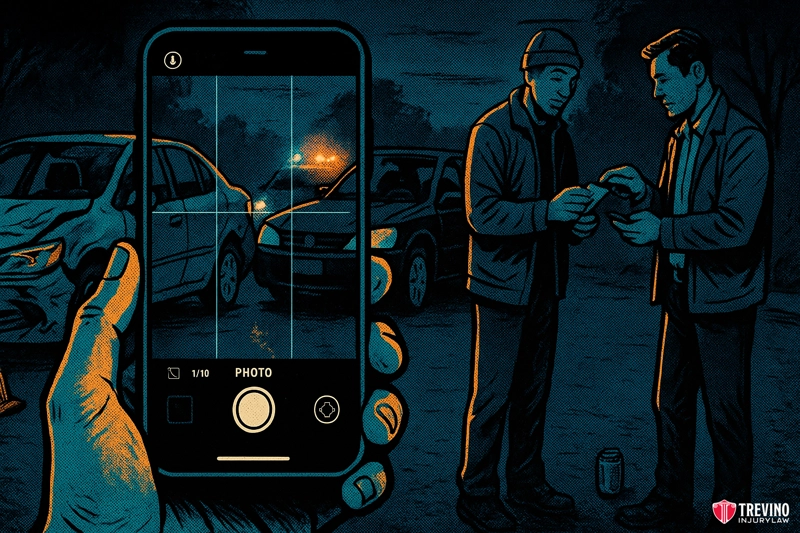
Now that the scene is secure, let’s break down the exact evidence you need to gather.
A Checklist for Documenting the Accident Scene
Here are the critical actions after an intoxicated driver crash to protect your rights:
- Call 911: Report the accident and your suspicion of intoxication.
- Take Photos/Videos: Capture vehicle damage, positions, skid marks, traffic signs, and the surrounding area, especially if you are near a major landmark like The Rim shopping center.
- Photograph Injuries: Document any visible cuts, bruises, or bleeding.
- Exchange Information: Get the other driver’s name, address, license number, and insurance details, but keep the conversation minimal.
- Identify Witnesses: Get names and phone numbers of anyone who saw the crash.
- Note Officer Details: Write down the responding officer’s name and badge number.
- Seek Medical Attention: Always get a medical evaluation, even if you feel uninjured.
While your own photos are important, they exist to support the official record created by law enforcement.
What Should I Say to the Police Officer?
When speaking to the police, stick to the objective facts of what happened. Do not guess, speculate, or apologize. Clearly state what you saw, heard, and felt. For example, say “The other car ran the red light on Culebra Road and hit my driver’s side door”.
If you notice signs of intoxication, such as slurred speech, the smell of alcohol, or unsteady balance, report your specific observations to the officer. Answer their questions honestly and directly. This information becomes part of the official record and is vital for proving the other driver’s negligence.
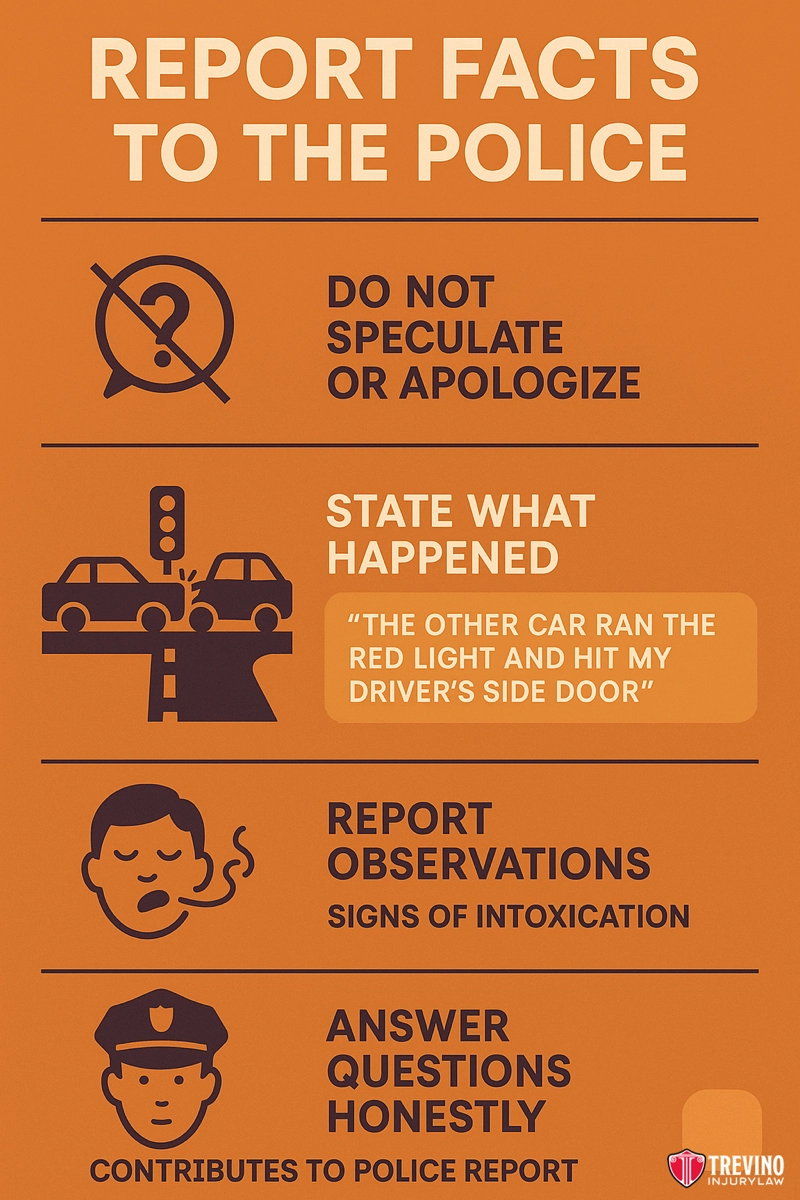
Your statement directly contributes to the police report, the foundational document for your entire legal claim.
Why Is the Police Report So Critical for My Claim?
The police report is the most critical piece of evidence for your claim because it provides an official, unbiased account from law enforcement that documents the other driver’s intoxication and establishes legal fault.
In a drunk driving case, the police report is the cornerstone of your civil claim because it provides powerful evidence for establishing fault. Under Texas law, a driver who causes an accident by violating a public safety statute, such as driving while intoxicated, is considered negligent as a matter of law.
This legal principle, known as negligence per se and affirmed in landmark cases like El Chico Corp. v. Poole, moves the case beyond a ‘he said, she said’ argument, giving insurance adjusters a clear basis for assessing liability.
A report that clearly indicates the other driver was intoxicated, failed a field sobriety test, or was arrested for DWI provides immense leverage during settlement negotiations.
Our firm’s process begins by obtaining this report and filing Freedom of Information Act (FOIA) requests for all related evidence, such as bodycam footage from the responding SAPD officer or dashcam video, which can provide irrefutable proof of negligence. This document is the key to unlocking the full value of your claim at the Bexar County Courthouse.
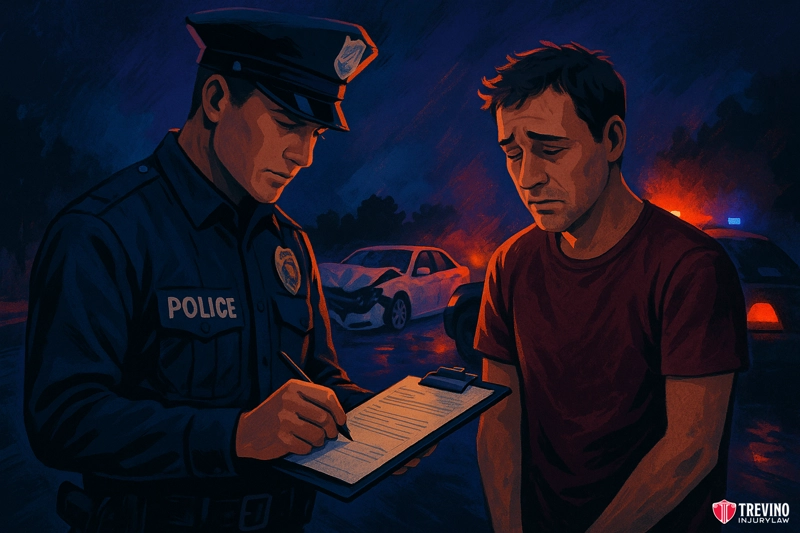
Once you understand its importance, the next step is to obtain a copy for your records.
How Do I Get My Accident Report in Bexar County?
You can obtain your official Texas Peace Officer’s Crash Report (CR-3) through two primary methods after an impaired driving crash. The specific method depends on which agency responded to your accident.
- Online via TxDOT: The easiest way is to purchase and download the report from the Texas Department of Transportation (TxDOT) Crash Report Online Purchase System, which is typically available within 10 days.
- Directly from the Agency: You can request a copy from the records division of the law enforcement agency that investigated the crash, such as the San Antonio Police Department Headquarters downtown or the Bexar County Sheriff’s Office.
Having the report is one thing, but knowing how insurance companies will try to undermine your claim reveals the need for a protective legal strategy.
Should I Report the Accident to My Own Insurance Company?
Yes, you must report the accident to your own insurance company as soon as possible, because your policy is a legal contract that requires you to provide prompt notification of any incident that could result in a claim.
This first call is simply to inform them of the date, time, and location of the crash and the identity of the other driver. Fulfilling this duty is the critical first step to unlocking the benefits you’ve paid for, such as Personal Injury Protection (PIP) or Uninsured/Underinsured Motorist (UM/UIM) coverage, which can be vital for your recovery.
This call is fundamentally different from any conversation with the at-fault driver’s insurance company. You are not admitting fault or giving a detailed statement; you are simply opening a line of communication.
However, you still need to be cautious. Insurance companies, even your own, will document everything you say. When you call your insurer, whether it’s a large national company like State Farm or a major local provider like USAA, stick to the basic facts.
Here is exactly what to do:
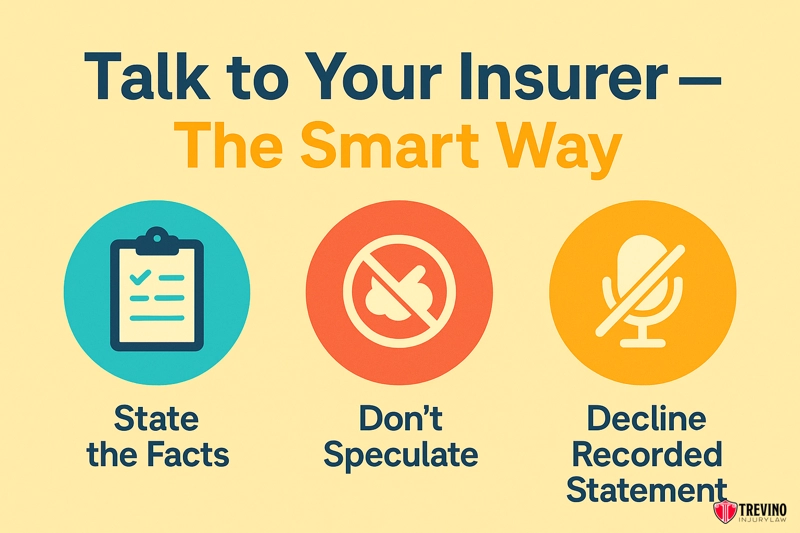
- State the Facts: Provide your name, policy number, and the basic, undisputed facts of the accident.
- Do Not Speculate: Avoid saying anything like “I think…” or “Maybe I could have…” Do not guess about the extent of your injuries. Simply state that you are getting medical treatment.
- Decline a Recorded Statement: You are not required to give a recorded statement at this stage. You can politely decline and state that your attorney will be in contact.
Our firm handles these communications for our clients to ensure the right information is provided without creating any risk to your claim. We protect you from saying anything that could be misinterpreted later.
Handling the call with your own insurer is a necessary step that requires care. However, the truly dangerous call is the one you will receive from the at-fault driver’s insurance adjuster, which is specifically designed to devalue your claim from the very first minute.
What Critical Mistakes Will Devalue My Accident Claim?
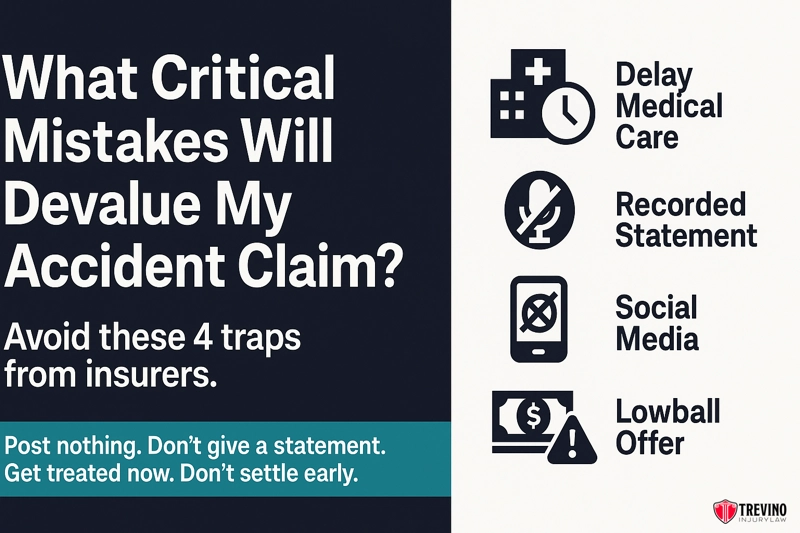
The most critical mistakes that will devalue your drunk driving accident claim are delaying medical treatment, giving a recorded statement to the other driver’s insurance adjuster, posting about the accident on social media, and accepting the insurance company’s first lowball settlement offer without consulting an attorney for an alcohol-impaired collision.
Insurance companies are businesses that profit by paying as little as possible on claims. Their adjusters are trained to find any reason to devalue your case. A common tactic is to argue that a delay in seeking medical care proves your injuries weren’t caused by the crash.
This is why it’s vital to be evaluated immediately at a major local hospital, such as Methodist Hospital in the Medical Center or Brooke Army Medical Center (BAMC). Another frequent mistake is agreeing to a recorded statement, where adjusters use leading questions to trap you into contradictions. Never give a statement without your attorney present.
Finally, accepting a quick settlement is almost always a mistake because these initial offers rarely account for the full scope of your damages. Proving non-economic damages like pain, suffering, and mental anguish requires specific and substantial evidence, as outlined by the Texas Supreme Court in Golden Eagle Archery, Inc. v. Jackson. Accepting an early offer permanently ends your right to seek the true, long-term compensation you are legally entitled to recover for your suffering.
Avoiding these mistakes is a defensive measure; the proactive step is to hire a firm with a proven record of overcoming these exact tactics to secure maximum compensation.
Case Results: How We Turned a $5,000 “Nuisance” Offer into a $536,007 Jury Verdict
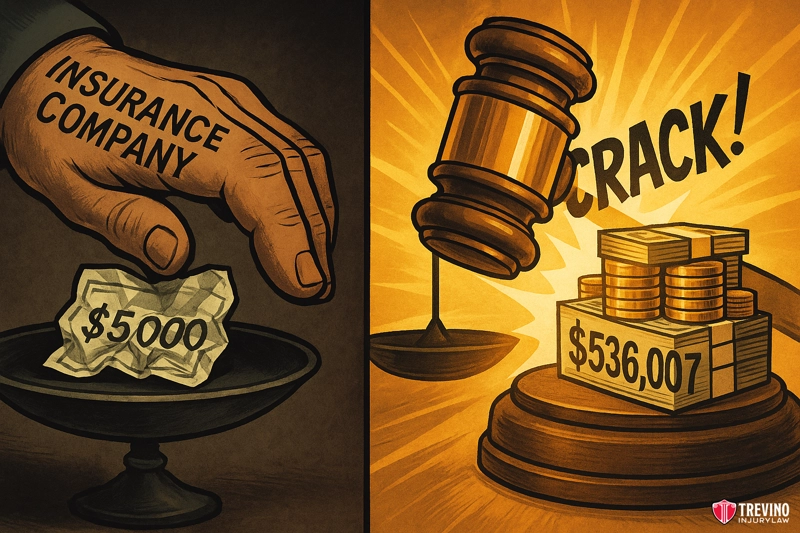
An insurance company’s lowball offer is not just a mistake to avoid; it’s a challenge to be defeated. Our trial-ready approach produces real results. In the case of Jose Simon Arriaga Jr. v. Emily Montemayor, our client suffered a serious low back injury. The insurance company’s final offer was a mere $5,000.
They bet we would fold like a settlement mill firm. We refused. We took the case to trial, and a jury awarded our client a verdict of $536,007—more than 107 times what the insurer claimed the case was worth.
Similarly, in Elma Jane Guerrero v. Benjamin Soloman, the defense offered only $25,000 for our client’s neck and back injuries. A Bexar County jury awarded $291,550, over 11 times their final offer. This principle is especially powerful in DWI cases, where we also recovered a $1.4 Million settlement for a client who suffered a devastating spinal injury.
These results prove the value of a trial-ready approach and highlight why understanding every potential source of liability is so important.
Why do I need a lawyer if the drunk driver was clearly at fault?
You need a lawyer because proving the other driver was at fault is only the first step. The real fight is proving the full value of your damages. Texas law requires that you, the plaintiff, bear the burden of proving every element of your damages with credible evidence. An insurance company’s legal team will challenge the severity of your injuries and the cost of your care.
A trial-ready attorney is essential to build the compelling, evidence-based case required to secure the maximum compensation you deserve.
Even with a DWI arrest and a police report, the insurance company will still fight to minimize your payout. They will question the severity of your injuries, argue that your medical treatment was excessive, and dispute the amount of your lost wages. They have a team of experienced lawyers and adjusters whose job is to protect their profits.
A trial-ready lawyer for a drunk driving wreck levels the playing field. Our advantage is unique: with over 20 years of insurance defense experience on our team, we know their playbook because we helped write it. We anticipate their strategies, handle all communications with the insurer, and build a case so strong that they are forced to negotiate in good faith or risk losing a much larger amount at trial.
Understanding the need for a lawyer naturally leads to more specific questions about the practical steps and legal requirements involved in the claims process.
Who Else Could Be Liable Besides the Drunk Driver?
Under Texas Dram Shop Law, licensed establishments like bars and restaurants are liable for damages if they served alcohol to an obviously intoxicated person who subsequently caused an injury. Establishing third-party liability requires an immediate investigation to preserve critical evidence, including surveillance footage, receipts, and witness statements. Our firm aggressively pursues all sources of compensation, demonstrated by a $1 million settlement we recovered in a wrongful death case involving bar negligence.
How do I properly document my injuries and financial losses?
Essential Documentation Steps
- Establish Medical Necessity: Seek immediate emergency care and attend every follow-up appointment to link catastrophic injuries directly to the collision. Consistent treatment at facilities like the South Texas Medical Center generates the medical records required to prove causation.
- Log Subjective Damages: Maintain a daily Pain and Symptom Journal detailing physical limitations, sleep disruption, and emotional distress. This serves as primary evidence for non-economic damages and pain and suffering claims.
- Centralize Financial Records: Retain all medical bills, pharmacy receipts, and mileage logs for travel to providers. Use a dedicated file to track every invoice for durable medical equipment, such as crutches or braces, to ensure full reimbursement.
- Verify Economic Impact: Secure a formal letter from your employer (e.g., H-E-B) documenting your hourly rate, job title, and exact dates missed. Contrast pre-accident pay stubs with post-accident earnings to calculate lost wages and diminished earning capacity.
Do I need the police report to file an injury claim?
Yes, while you can technically open a claim without it, the official police report is the most critical piece of evidence for proving the other driver was at fault, and you should always obtain it before entering serious negotiations with an insurance company.
Should I give a recorded statement to the insurance company?
No, you should never provide a recorded statement to the at-fault driver’s insurance company without your attorney present. Insurance adjusters are trained to utilize leading questions designed to minimize your injuries or extract statements that shift liability, ultimately allowing them to deny your claim or significantly reduce your compensation.
Do I need a lawyer for a minor accident with a drunk driver?
Yes, you must consult a lawyer for any DWI accident, regardless of perceived severity, as injuries frequently have delayed symptoms and hidden long-term costs. Insurers often drastically undervalue these cases; for example, in the Jose Simon Arriaga Jr. case, the carrier offered just $5,000 for a low back injury, but a jury awarded over $536,000. Legal representation is essential to reject premature settlements and secure the full value of your claim.
How long after the accident can I seek medical attention?
You must seek medical attention immediately—ideally on the same day—to preserve the validity of your injury claim. Insurance adjusters aggressively use any delay, labeling it a “gap in treatment,” to argue your injuries were not caused by the crash and deny coverage.
Waiting even a few days provides them leverage, while a delay of weeks will likely result in a complete rejection of your case. Proceed immediately to an ER in San Antonio or urgent care in Leon Valley to establish a documented causal link between the accident and your injuries. Furthermore, you must attend all follow-up appointments to maintain an unbroken chain of evidence and prove you are actively mitigating your damages.
What happens if I don’t call the police after a drunk driving accident?
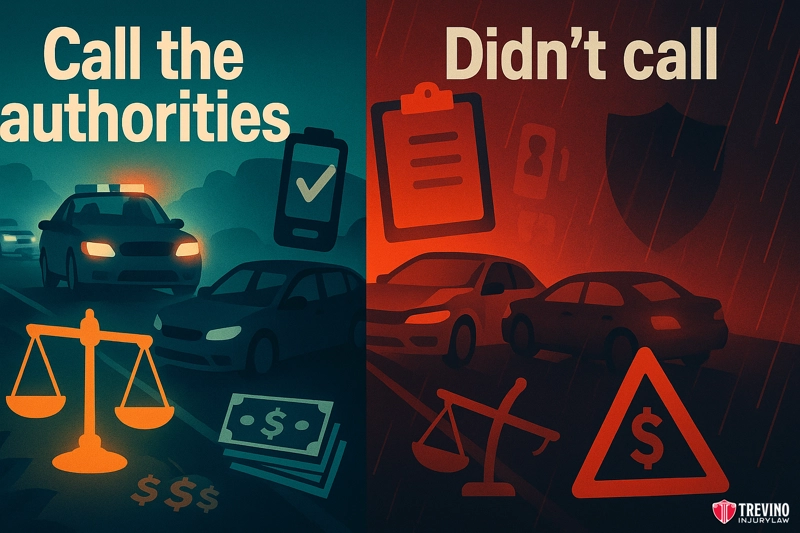
Failing to call the police destroys your ability to prove liability because you forfeit the official police report required to establish intoxication and fault. Without this document, you lose vital officer testimony, field sobriety test results, and the DWI arrest record, reducing the crash to a “he said, she said” dispute. Insurers in areas like Alamo Ranch will leverage this lack of independent documentation to deny your claim entirely.
When is it too late to get evidence from the scene?
It becomes too late to secure critical accident evidence within mere hours or days of a crash. Emergency crews immediately clear physical evidence such as skid marks, debris, and vehicle positions to reopen busy corridors like Bandera Rd.
Furthermore, nearby businesses often auto-delete surveillance footage within 24 to 72 hours. You must document the scene instantly and hire an attorney to issue preservation letters that legally halt the destruction of this vital proof.
Why Hire a San Antonio Drunk Driving Accident Lawyer?
Physical evidence on San Antonio roads disappears within hours, and insurance adjusters exploit that gap to deny your claim. While settlement mills accept quick, low payouts to avoid the courtroom, we prepare for battle. We fight to force the insurance company to pay full value for the harm they caused.
Want to Protect the Full Value of Your Claim?
You’ve seen how this affects your case — but this is only one piece of the puzzle. Our Drunk Driving Accident Lawyer page breaks down what a trial-ready firm does differently.
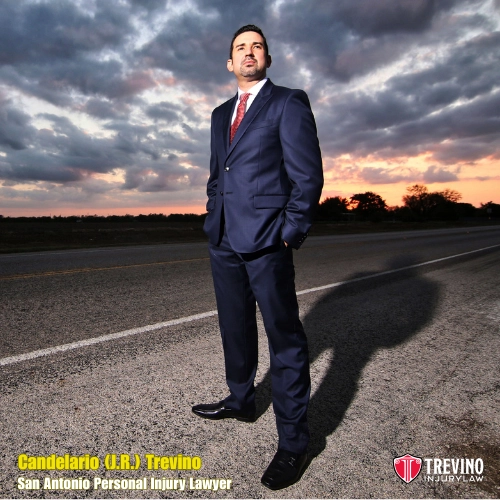
We secured a $1.4 Million settlement for a drunk driving victim by acting immediately to prove liability. As your San Antonio drunk driving accident lawyer, we send spoliation letters and file FOIA requests to preserve vital dashcam footage before it is destroyed. If they refuse fair compensation, we drag them to the Bexar County Courthouse to demand justice.
Call 210-TREVINO for a free case review. Se Habla Español. You pay nothing unless we win—No Win, No Fee.