A drunk driver hits you on Bandera Road and shatters your physical reality. You survive the impact, but the psychological terror of the crash replays every time you enter a vehicle.
Adjusters at companies like Fred Loya fear the gross negligence premium and attempt quick settlements to buy off your mental anguish claim for pennies.
They treat a crime scene like a standard fender bender to protect their profits. According to the Texas Department of Transportation, Bexar County recorded 1,654 alcohol-related crashes in 2024, many of them connected to where drunk driving crashes originate in San Antonio. Jurors punish this lethal pattern, and insurers want to close the file before you leverage the criminal evidence.
What Could Your Drunk Driving Accident Case Be Worth?
Answer a few quick questions about your accident. Takes about 60 seconds.
See What My Case Might Be WorthThe insurance company offered less than $20,000. I ended up with over $1 million. — Jackie Galindo
Police body camera footage and breathalyzer logs disappear quickly. You must immediately send a Spoliation Letter, a legal demand that stops them from deleting black box data and dash cam footage. Texas gives you two years to file suit. After that, your right to force them to pay vanishes.
Trevino Injury Law’s team will subpoena the criminal file and lock the evidence down before it disappears. Call 210-TREVINO now for a free case review. You pay nothing unless we win. Se Habla Español.
In the legal landscape of San Antonio, drunk driving cases carry a distinct “premium” in valuation because the defendant’s conduct constitutes Gross Negligence, not just simple error.
This exposes the insurance company to the risk of punitive damages if they fail to settle fairly. This legal reality forces adjusters to evaluate these claims in Texas differently than in a standard distracted-driving case.
The “Anger Factor” plays a massive role in this valuation. Unlike a distracted teen driver who made a mistake, a drunk driver creates genuine anger in the jury box. When we present the reality of over 1,000 alcohol-related deaths statewide, jurors understand that this was not an isolated incident, but part of a lethal pattern. Jurors in Bexar County want to punish the behavior, and insurance companies often try to avoid this outcome.
Even aggressive insurers pay more on DWI claims to avoid letting a jury see the body cam footage of their drunk insured stumbling during a field sobriety test or slurring words on Culebra Road. We leverage this fear to demand higher pain-and-suffering settlements, ensuring the offer reflects the offense’s severity.
Gross Negligence vs. Standard Negligence: The Multiplier Driver
While standard negligence is a “mistake,” Gross Negligence is defined under Tex. Civ. Prac. & Rem. Code § 41.001(11) is an act involving an extreme degree of risk where the driver proceeded with “conscious indifference” to your safety. Proving this legal distinction is the key to unlocking higher valuation tiers.
When we prove gross negligence through high BAC results or police reports, we unlock the potential for Exemplary (Punitive) Damages. Under Tex. Civ. Prac. & Rem. Code § 41.008, Texas limits exemplary damages to the greater of (1) two times economic damages plus up to $750,000 of noneconomic damages, or (2) $200,000. However, Texas law includes exceptions tied to certain felony conduct, including Penal Code §§ 49.07 and 49.08 (intoxication assault/manslaughter) referenced in the statute.
Even with the statutory cap, the exposure is significant. We use this statutory formula to calculate the potential “upside” risk the insurer faces. Even if we settle before trial, the mere threat of this calculation forces the adjuster to increase the “Pain and Suffering” offer significantly to make the case go away.

This is how we turn a standard policy-limit case into a maximum-value recovery. This premium doesn’t just happen; it comes from a specific legal finding that distinguishes accidents from crimes, setting the stage to prove the crash’s unique emotional suffering and impact.
Documenting Pain and Suffering and Mental Anguish in a DWI Accident in Texas
Proving mental anguish in a DWI case requires documenting the specific psychological terror unique to being hit by an intoxicated driver, which is legally distinct from the physical pain of broken bones and focuses on the emotional disruption of your daily life. Pain and suffering refer to the physical distress, while mental anguish covers the internal trauma.
To recover damages, we must demonstrate that the trauma created a ‘high degree of mental pain and distress’ surpassing mere worry or anger. We adhere strictly to the standard established by Texas Law, which requires us to provide direct evidence of the ‘nature, duration, and severity’ of your mental anguish. We document specifically how this anguish disrupts your daily routine, such as your ability to sleep, work, or parent, to satisfy the rigorous burden of proof required by Texas courts.
In Parkway Co. v. Woodruff, 901 S.W.2d 434 (Tex. 1995), the Texas Supreme Court made clear that mental anguish damages require more than ordinary worry or frustration. The Court required evidence of the “nature, duration, and severity” of the anguish, showing that it caused a real disruption in daily life. That matters in a DWI case because the harm is not just the broken bone or hospital bill. It is the panic at night, the fear of driving, the loss of sleep, and the way a drunk driver’s choice keeps affecting your family long after the crash is over.
The strain on local resources highlights how difficult recovery is for victims. Bexar County’s indicator shows 318.1 mental health providers per 100,000 people (2022), and local BRFSS-based indicators show 66.4% of Bexar County respondents reported fewer than five days of poor mental health in the past 30 days (2021 baseline). When a crash leaves you with chronic pain or permanent anxiety, you fall into a severe category of suffering well outside the local norm.
Discussing the unique psychological scars is essential. Victims of drunk drivers often experience intense fear of headlights at night, severe anxiety when driving on Loop 1604 on weekends, or the “near-death” realization that is more intense in head-on DWI collisions.

We document how the crash has stolen your peace of mind and loss of enjoyment of life, making even a simple trip to the grocery store in Stone Oak a source of panic.
Weaponizing the Criminal Evidence (Body Cams & 911 Calls)
We utilize evidence from the Bexar County District Attorney’s criminal file, including officer body cam footage, 911 audio, and breathalyzer results, to objectively validate the terror and trauma you experienced. This evidence serves as a powerful tool to corroborate your internal suffering with external proof of the defendant’s reckless state.
Visualizing the fear is critical for a jury or adjuster. Playing the 911 tape where you are screaming while the drunk driver is slurring their words validates the “Mental Anguish” claim instantly. We investigate early, sending preservation letters to secure dash-cam or body-cam footage before it is deleted.
This strong evidence transforms subjective feelings into objective facts that insurance companies cannot ignore, forcing them to acknowledge the full weight of your suffering. To prove this terror, we don’t just rely on your words; we use the drunk driver’s own actions against them to establish the mathematical basis for your compensation.
Valuing Your Pain and Suffering Claim in Intoxication Cases
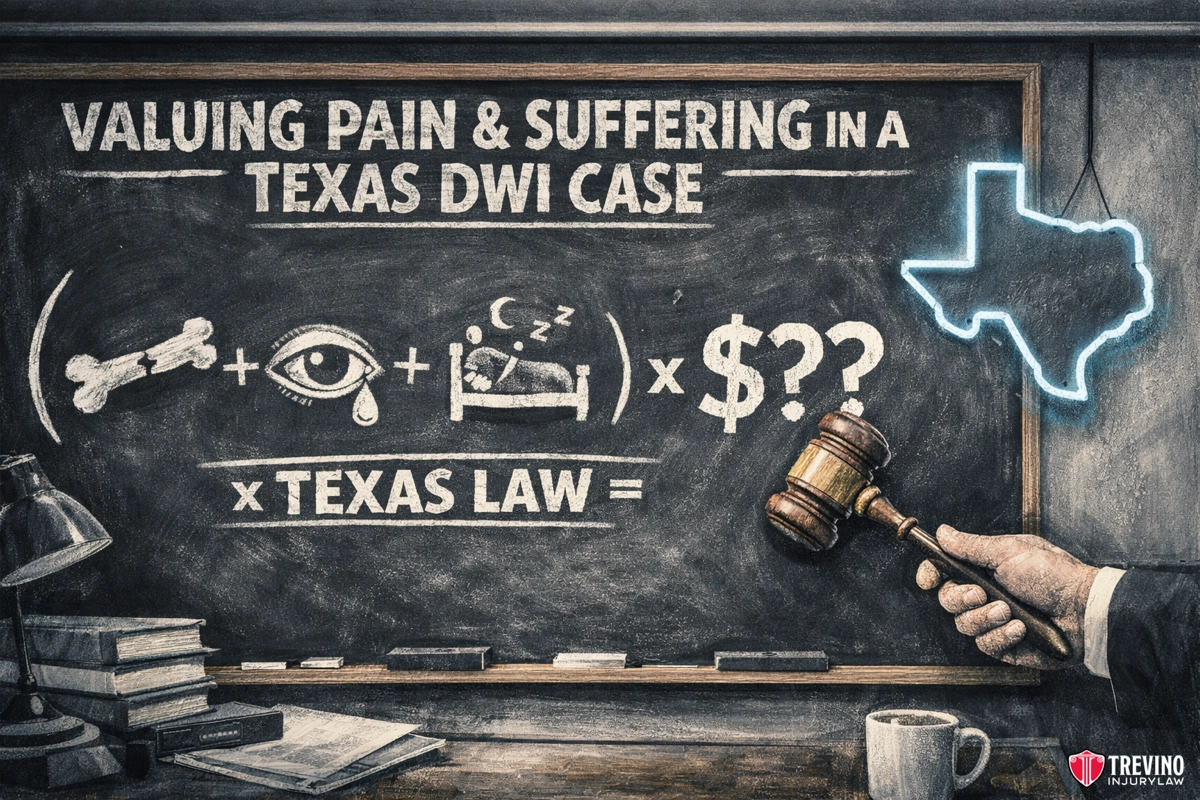
Because there is no price tag for human suffering, pain and suffering are calculated using methods like the Multiplier Method, applying a significantly higher factor in DWI cases to account for the severity of the defendant’s recklessness and the likely jury response to such gross negligence. This method provides a starting point for negotiations that reflects the true gravity of the harm caused.
A standard whiplash case might have a 1.5x multiplier on medical bills. However, a DWI case with the same injury often commands a 3x to 5x multiplier because the “suffering” includes the injustice of the act. Damages are typically calculated based on several factors related to the crash’s impact. Alternatively, the per diem method assigns a daily dollar amount to your pain and multiplies it by the number of days you experience it to arrive at a total.
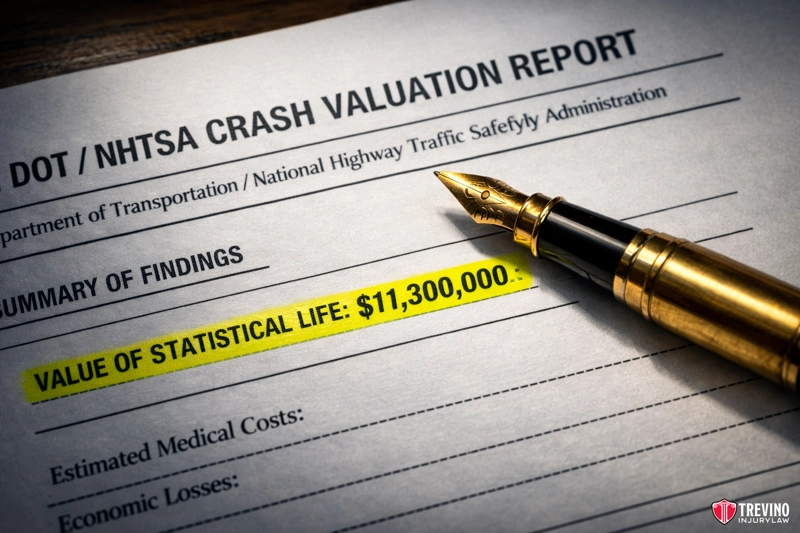
Federal data support these aggressive valuations. A DOT/NHTSA crash-cost report estimates $11.3M per fatality when quality-of-life valuations are included (2019 data, revised report). Even for non-fatal injuries, the loss of life enjoyment is valued in the hundreds of thousands.
We argue that the “price” of pain must be high enough to balance the scales against a driver who chooses to drink and drive. Jury psychology supports this; they are far more willing to award large sums to a victim of a drunk driver than to a victim of a simple accident. We use this leverage to demand compensation that accounts for every sleepless night and every moment of fear.
The “Stowers” Trap: Forcing the Insurance Company to Pay Maximum Compensation
We use the Stowers Doctrine, derived from G.A. Stowers Furniture Co. v. American Indemnity Co., to demand that the insurance company pay their full policy limits immediately for your pain and suffering, or risk being liable for the entire jury verdict later, regardless of the policy cap. This is a high-pressure legal tactic designed to force a fair settlement quickly.
The setup is precise: we send a demand proving your pain and suffering value exceeds their limit. In Texas, the minimum liability limits are only $30,000 per injured person and $60,000 per crash (30/60/25). These amounts are often insignificant compared to the $11.3M quality-of-life valuation or the millions in damages we regularly see in catastrophic cases. The trap springs if they say “no” because they don’t value your pain.
If a jury then awards a massive verdict, like in Arriaga v. Montemayor, where a jury awarded $536,000 on a lowball offer, the insurance company is on the hook for the entire excess amount. This risk often compels them to pay the full limit rather than risk a Bexar County jury verdict. Because insurance companies often try to minimize payouts, taking the case to court is sometimes the only way to get them to pay what they owe. However, arriving at a number is only half the battle; collecting it requires navigating insurance limits and finding every available funding source.
How We Maximize Your Pain and Suffering Recovery Beyond Policy Limits
While the drunk driver’s liability policy has a stated limit, often just the $30,000 minimum required by Texas law, we aggressively search for additional “pockets” of coverage to fully compensate your pain and suffering, ensuring you are not left with a fraction of what your case is worth. Relying solely on the other driver’s minimum insurance is rarely enough to cover the lifetime cost of a catastrophic injury, let alone the “DWI Premium” your suffering commands.
The gap between a $30,000 policy and the true value of a spinal injury or wrongful death case is massive. To bridge this gap, we pivot to other sources. We investigate whether the driver was in a company vehicle on I-35, which triggers commercial insurance policies often worth $1 million or more. We also look at your own Uninsured/Underinsured Motorist (UIM) coverage, which steps in when the drunk driver’s limits are exhausted and helps cover medical bills and lost wages. Furthermore, if a bar overserved the driver before they got on the road, we investigate Dram Shop liability under Texas Alcoholic Beverage Code § 2.02 to hold the establishment accountable for serving an obviously intoxicated person.

We do not accept “policy limits” as the end of the road; for us, it is just the starting line of the investigation. Once we identify the necessary coverage, the insurance company often pivots to a new tactic: trying to devalue your claim by blaming your medical history instead of the crash.
Does a Pre-Existing Condition Defense Work in DWI Cases?
No, under the Eggshell Skull Doctrine, a drunk driver remains fully liable for aggravating a pre-existing condition; they cannot avoid responsibility simply because you had a prior back or neck issue. This core principle of Texas tort law dictates that defendants must “take the victim as they find them,” making them financially accountable for the increased pain and debilitating severity their intoxication caused.
We utilize medical records to establish your pre-crash baseline, proving you were managing your condition effectively, to defeat the “already hurt” defense and ensure the full DWI Premium is applied to your damages, even in cases involving complex spinal cord injuries.
Can I Recover Pain and Suffering if I Wasn’t Wearing a Seatbelt?
Yes, but under Tex. Civ. Prac. & Rem. Code § 33.001 (Proportionate Responsibility), the defense may try to reduce your award by arguing your failure to buckle up contributed to the severity of your pain. However, as long as your responsibility is not greater than 50%, you can still recover damages in your personal injury claim, and the drunk driver remains primarily at fault for the crash itself.
Is There a Cap on Pain and Suffering in Texas DWI Cases?
Generally no; unlike medical malpractice cases, Texas does not cap pain and suffering damages in most personal injury lawsuits involving DWI, allowing juries to award whatever amount they deem fair and just. While Punitive Damages are capped at the formula found in CPRC § 41.008, compensation for your actual physical pain and mental anguish has no ceiling. Because suffering damages are subjective, we fight to ensure the jury understands the full extent of your loss.
Can I Sue for Anxiety and PTSD After a Drunk Driving Crash?
Yes, but under Tex. Civ. Prac. & Rem. Code § 33.001 (Proportionate Responsibility), the defense may try to reduce your award by arguing your failure to buckle up contributed to the severity of your pain. However, as long as your responsibility is not greater than 50%, you can still recover damages in your personal injury claim, and the drunk driver remains primarily at fault for the crash itself.
Can Family Members Claim Mental Anguish?
Yes, close family members who witness the DWI crash may file a Bystander Claim for their own mental anguish, even if they were not physically struck by the vehicle themselves. This legal doctrine recognizes that the horror of watching a loved one be injured is a separate, compensable injury that disrupts a person’s quality of life.
Consider a father watching his daughter’s car get t-boned by a drunk driver on Bandera Road. The physical injuries are hers, but the psychological trauma of witnessing the event belongs to him. To succeed in a Bystander Claim, we must satisfy the strict elements adopted by the Texas Supreme Court in Freeman v. City of Pasadena, 744 S.W.2d 923 (Tex. 1988). Under Freeman, we must prove that:
– You were located near the scene of the accident;
– You ‘contemporaneously perceived’ the crash as it happened (rather than learning of it later); and
– You are closely related to the victim. Meeting this standard allows family members to seek justice for the psychological nightmare they were forced to witness.
What If the Drunk Driver Was Acquitted in Criminal Court?
You can still recover full pain and suffering damages in civil court because the burden of proof is lower (“Preponderance of the Evidence“) than the strict “Beyond a Reasonable Doubt” standard required in criminal trials. Courts and insurance companies operate under different rules in these venues. The criminal system focuses on the driver’s freedom; our civil system focuses on your compensation. A verdict of “Not Guilty” in a criminal case does not mean “Not Liable” in a civil lawsuit. We can often introduce evidence in a civil trial that might have been excluded or insufficient for a criminal conviction. Even if they “beat the rap” on a technicality downtown, we can still show a jury the evidence of their recklessness and win substantial money damages for your suffering.
Can I Claim Pain and Suffering Years After the Settlement?
No, once you sign a release to settle with the insurance company, you permanently waive your right to future compensation, including any future medical bills or lost wages, which is why we never settle until we know the full lifetime impact of your trauma. This “release” is a binding contract that closes your claim forever, regardless of how your condition worsens.
Insurance adjusters often push for a quick settlement while you are still in shock or taking pain medication, hoping you will sign away your rights before you realize you need surgery. We advise clients to wait for Maximum Medical Improvement (MMI), the point where your doctors say you have healed as much as you are going to. Only then can we accurately calculate the lifetime value of your pain and suffering to ensure the settlement covers you forever.
Why Hire a San Antonio Drunk Driving Accident Lawyer?
The driver made the choice to drink; the insurance company shouldn’t get to choose what your pain is worth. Adjusters know that Gross Negligence creates a specific type of suffering and multiplies the value of your claim, but they bank on you treating this like a standard fender bender.
Want to Protect the Full Value of Your Claim?
You’ve seen how this affects your case — but this is only one piece of the puzzle. Our Drunk Driving Accident Lawyer page breaks down what a trial-ready firm does differently.
You need an injury compensation attorney to send spoliation letters and preserve police body cam footage before it vanishes.
Don’t leave the “DWI Premium” on the table. Call Trevino Injury Law at 210-TREVINO for a free consultation today. If we take your case and help you fight, we will ensure your compensation reflects the true criminal nature of the crash.
Contact an experienced personal injury lawyer who knows how to win. Se Habla Español.