A drunk driver crashed into you, leaving your family with catastrophic injuries and a financial crisis. The criminal courts punish the offender, but they do not pay for your lifelong physical recovery.
The insurance adjuster is already moving to limit their exposure by offering a fast settlement before you realize the true cost of your permanent injuries. They know local juries severely punish intoxicated drivers, so they use quick payouts to escape the threat of punitive damages. According to TxDOT, Bexar County recorded 1,722 DUI-alcohol crashes in 2024. Your wreck is not a standard claim. It is a massive liability that the insurer wants to close immediately.
What Could Your Drunk Driving Accident Case Be Worth?
Answer a few quick questions about your accident. Takes about 60 seconds.
See What My Case Might Be WorthThe insurance company offered less than $20,000. I ended up with over $1 million. — Jackie Galindo
Crucial evidence vanishes in the days following the crash. Body camera footage gets purged. A Spoliation Letter, a legal demand that stops them from deleting black box data, must go out immediately. Texas imposes a strict deadline to file suit. Miss it, and the insurer escapes entirely.
A Trevino Injury Law drunk driving injury attorney will subpoena this evidence and force the insurance company to face a trial-ready opponent. Call 210-TREVINO for a free case review. You pay nothing unless we win. Se Habla Español.
What Is the Average Personal Injury Settlement for a Drunk Driving Accident?
While there is no single “average” settlement, drunk driving claims in San Antonio typically command a “DWI Premium”. These cases often settle for 3x to 5x higher than standard crash claims.
This premium exists because the threat of Punitive Damages forces insurers to pay maximum policy limits to avoid a jury trial. The defendant’s conduct was not just negligent; it was criminally reckless.
Online averages are often misleading because they blend minor fender-benders with catastrophic injury cases. A personal injury case involving soft-tissue injuries might settle for the policy limit of $30,000, which is the current Texas minimum auto liability requirement for individual bodily injury.
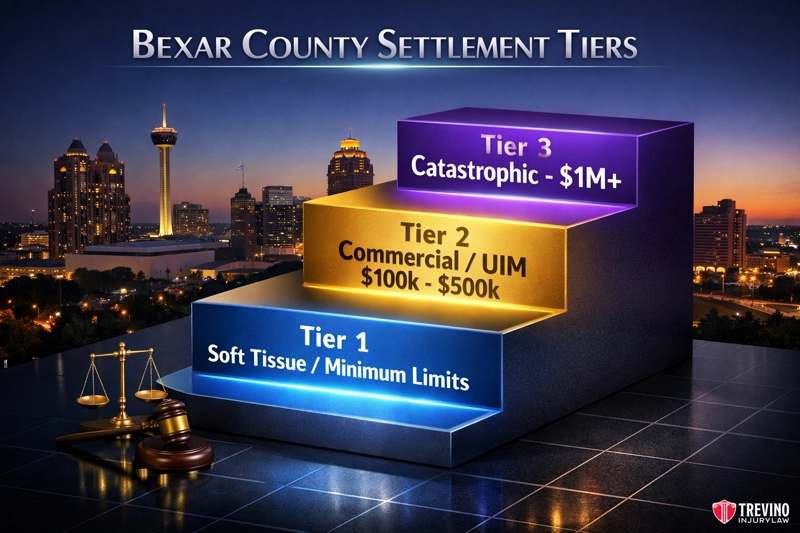
We categorize these cases into three value tiers based on severity:
- Tier 1 (Minimum Limits): Cases where we fight to secure the 30/60/25 policy limits quickly.
- Tier 2 (Commercial/UIM): Cases involving commercial policies, typically ranging from $100,000 to $500,000.
- Tier 3 (Catastrophic): Severe injuries where the value exceeds $1 Million.
The initial offer is rarely a fair settlement. In Jose Simon Arriaga Jr. v. Emily Montemayor, the insurance company offered only $5,000. We refused to settle. We went to trial and secured a $536,007 jury verdict by proving the full extent of the damages.
How Do We Calculate “Pain and Suffering” Damages?
While insurance adjusters often attempt to reduce your agony to a simple formula, Texas law recognizes that a calculator cannot measure human suffering. Under landmark precedents like Golden Eagle Archery, Inc. v. Jackson, the Texas Supreme Court has affirmed that juries possess broad discretion to determine the value of intangible losses.
We use this legal standard to argue that your ‘Pain and Suffering’ is a distinct claim for compensation that often exceeds the ‘Multiplier Method’ adjusters use, especially when a drunk driver’s recklessness has permanently altered your quality of life.
- Physical Pain: This includes the agony of the crash itself and the grueling recovery process, such as post-surgical rehabilitation at facilities like Warm Springs.
- Mental Anguish: This defines the psychological trauma, including PTSD, anxiety, and the specific fear of driving on highways like Loop 410, where the crash occurred.
- The DWI Multiplier: While a simple distracted driving case might warrant a 1.5x multiplier, a DWI case often justifies a 4x or 5x multiplier because juries are naturally angry at drunk drivers and more willing to award substantial compensation.
What Are “Punitive Damages” and the Texas Statutory Cap?
Punitive damages (Exemplary Damages) are awarded solely to punish the drunk driver for “Gross Negligence,” but Texas law generally caps these damages at the greater of $200,000 or two times your economic damages plus an equal amount of non-economic damages (up to $750,000).
These damages are separate from your compensation for medical costs and are intended to deter future dangerous conduct. Juries award these damages because the risk is extreme: in 2024, 1,053 people were killed in Texas crashes where a driver was DUI-alcohol, accounting for over 25% of all traffic deaths.
To pursue these damages, we must prove “Gross Negligence,” which requires showing the at-fault driver had “Subjective Awareness” of an extreme risk (intoxication) and proceeded with “Conscious Indifference” to others’ safety.
For example, if you have $100,000 in economic damages (medical bills/lost wages) and $200,000 in non-economic damages (pain/suffering), the math allows for a significant additional award. Even with the statutory cap, the mere threat of a “Gross Negligence” finding on the defendant’s permanent record is a powerful tool.
It motivates insurance companies to settle for the full policy limits to protect their client from a potentially devastating financial judgment that exceeds their coverage. Once we establish the full value of your damages, the immediate challenge becomes identifying every available insurance policy that can pay that amount.
What If the Drunk Driving Crash Coverage Isn’t Enough?
If the drunk driver only carries the Texas minimum of $30,000 in liability coverage, we must immediately pivot to Uninsured/Underinsured Motorist (UIM) Coverage and third-party liability theories to bridge the gap between their policy limit and the true cost of your injuries. This “deep pocket hunt” is essential because minimum policies rarely cover the full cost of a serious crash.
When one policy is not enough, the investigation should also identify who can be held liable for a drunk driving accident in Texas, including vehicle owners, employers, or alcohol providers, when the facts support those theories.
In San Antonio, a high percentage of drivers on roads like Marbach Road carry only minimum liability or are completely uninsured. To protect your rights, we identify all policies in your own household to “stack” UIM benefits. You paid for this protection to cover exactly this scenario, and we’ll make sure you get it.
Furthermore, if the drunk driver was operating a company vehicle, such as an oilfield truck returning from the Eagle Ford Shale, the available coverage often jumps from $30,000 to a commercial policy limit of $1 Million or more. We also investigate “Dram Shop” liability to determine whether a bar or restaurant overserved alcohol to the driver, which opens a separate insurance “bucket” to contribute to your compensation.
How the “Stowers Doctrine” Forces Insurers to Pay Maximum Policy Limits
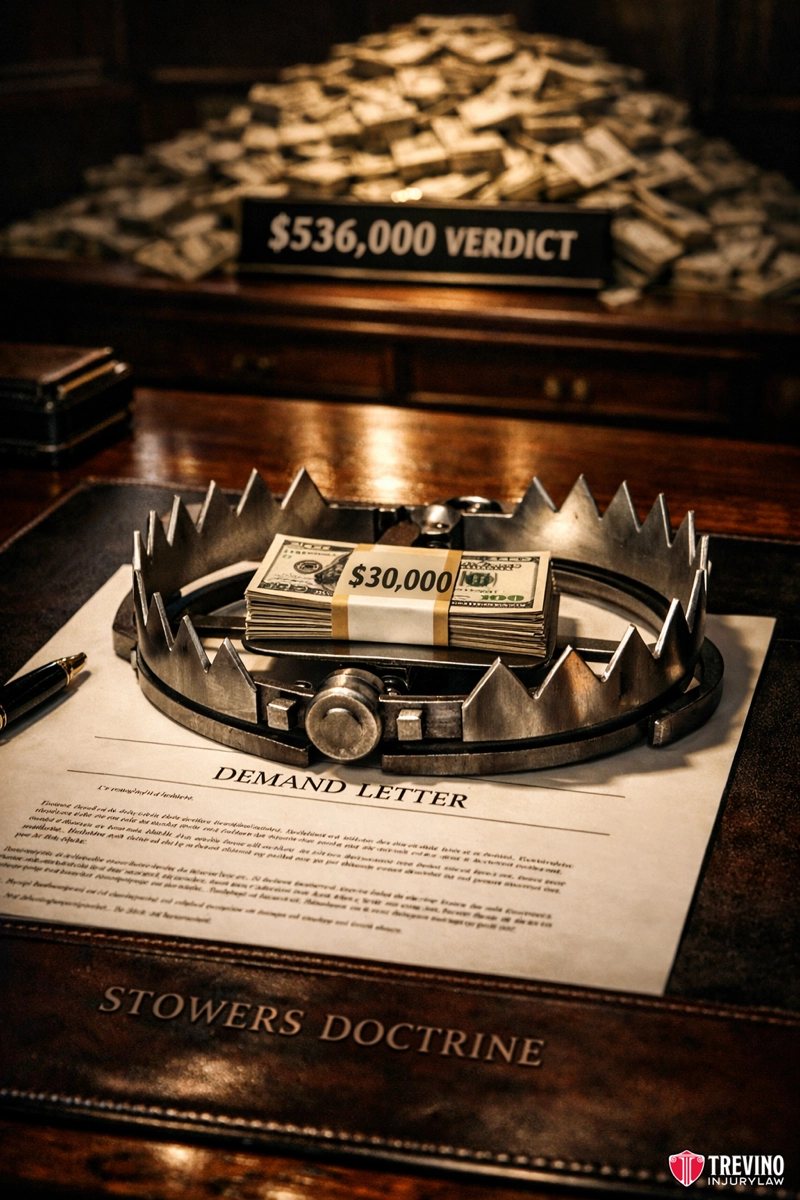
The Stowers Doctrine is a powerful Texas legal tool that allows us to send a deadline-driven demand letter offering to settle for the policy limits; if the insurer unreasonably rejects it and a jury later awards more, the insurer is liable for the entire verdict—even the amount exceeding the policy. This doctrine prevents insurance companies from gambling with their client’s financial future.
In G.A. Stowers Furniture Co. v. American Indemnity Co., the Texas Supreme Court established the rule that insurance companies must act reasonably when given a fair opportunity to settle within policy limits. The court held that when an insurer refuses a reasonable settlement demand and exposes its insured to an excess judgment, it can be held liable for the entire amount of the verdict. This matters because it flips the risk: instead of gambling with your case, the insurance company is forced to protect its own policyholder by paying what the claim is truly worth. We use this doctrine to create real financial pressure, turning a low-limit policy into a full-value recovery opportunity.
We set the “Stowers Trap” by providing the insurer with clear proof of liability and damages that exceed their policy limits, giving them a fair opportunity to settle. If they reject a $30,000 offer and we later secure a $536,000 verdict, the insurance company is responsible for the full amount because they acted in bad faith. This leverage is often the most effective way to stop “lowballing” and force an immediate tender of the policy limits in clear liability drunk driving cases.
When Should We Sue Non-Standard Insurers?
Negotiation with ‘non-standard’ insurers like Fred Loya requires more skilled and experienced legal representation than dealing with major carriers like USAA or State Farm, as these budget insurers often refuse to pay valid claims until a lawsuit is actually filed. Their business model relies on delay and denial to frustrate victims into accepting less.
- The “Delay” Tactic: Non-standard carriers often claim “coverage investigation” for months, stalling payments while you struggle with bills.
- The “Denial” Tactic: They search for minor technical exclusions, such as claiming the driver wasn’t listed on the policy, to deny the claim entirely.
- Our Response: We do not wait on hold; we take legal action and file suit in the Bexar County District Court to force them to the table, a strategy that resulted in the Coach DeLuna verdict, where we made Fred Loya pay four times the policy limit.
Securing the necessary funds is critical, but accurately projecting how much money you will actually need for lifetime treatment ensures the settlement lasts as long as your injuries do.
How Do We Prove the Value of Future Medical Care?
For catastrophic injuries, we utilize a Life Care Plan, a detailed economic report created by medical and vocational experts, to calculate the precise cost of every surgery, therapy session, and prescription you will need for the remainder of your life, adjusted for medical inflation.
This strategy is essential to maximize your recovery and ensure that your settlement covers not just today’s emergency room bills, but the knee replacement you might need in fifteen years. A Life Care Plan is comprehensive; it accounts for future surgeries, home modifications like wheelchair ramps, and ongoing physical therapy.
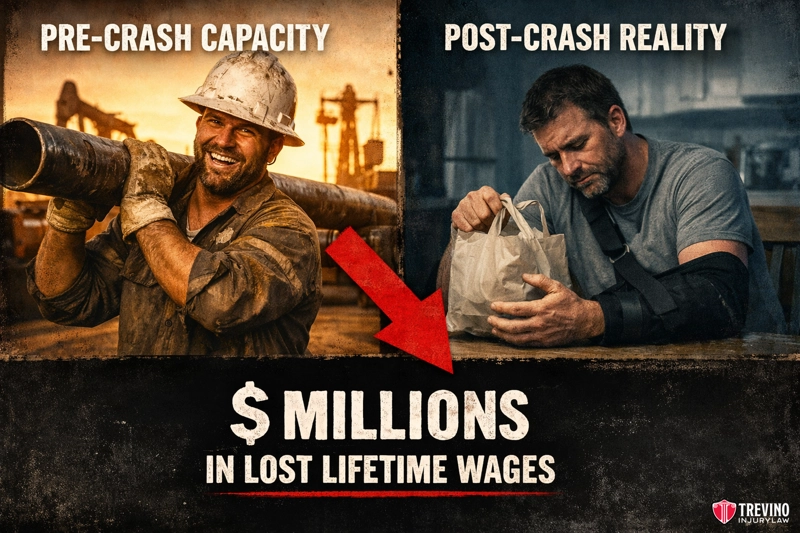
It also calculates “Lost Earning Capacity” and past lost wages if your injuries prevent you from returning to your previous job. For example, if an oilfield worker can no longer perform heavy lifting, the loss of income over a twenty-year career is massive and must be included in the claim.
We base these cost projections on local San Antonio medical rates at major systems like University Health or Methodist Hospital to ensure the figures are accurate and defensible in court.
Loss of Consortium and Bystander Claims
Texas law allows for Loss of Consortium claims, which compensate a spouse or child for the loss of companionship, affection, and household support resulting from the victim’s severe injury or fatality. This recognizes that the impact of a drunk driving crash extends beyond the person physically hit to damage the entire family unit.
- Spousal Claims: Compensation for the loss of intimacy and emotional support from a husband or wife.
- Parental/Filial Claims: Compensation for the loss of guidance and companionship between parents and children.
- Bystander Claims: If a family member witnessed the crash—common in school runs or family trips—they may have their own separate claim for mental anguish, even if they weren’t physically injured.
- Why It Matters: These claims act as separate “caps” on the insurance policy, effectively increasing the total available money for the family.
Calculating these lifetime costs provides a solid financial baseline, but the criminal nature of the crash introduces a unique legal leverage point that can dramatically accelerate the entire timeline.
How Does the Criminal DWI Case Affect My Civil Compensation?
While the criminal DWI case is separate from your civil injury claim, a conviction or guilty plea serves as a powerful “Judicial Admission” of fault that can fast-track your settlement and serve as irrefutable proof of Gross Negligence in alcohol-related crashes. This admission often forces insurance companies to abandon their liability defenses because they know a Bexar County jury will not look kindly on a convicted drunk driver.
We actively coordinate with the Bexar County District Attorney’s office to obtain critical evidence from the criminal file, including officer body camera footage and breathalyzer results, which form the foundation of our civil demand.
In some instances, the criminal judge may order “Restitution” as part of the driver’s sentence; we ensure this direct payment is structured so it does not conflict with or reduce your larger insurance settlement. Furthermore, if the driver attempts to “plead the 5th” during our civil deposition to protect their criminal case, we can use that silence to secure summary judgment on liability, effectively winning the civil case before it even reaches a jury.
Proving liability through the criminal courts strengthens our hand, but understanding the timeline for actually receiving your funds helps you plan for the financial road ahead.
The Timeline: How Long Does a High-Value DWI Settlement Take?

A high-value DWI settlement typically requires 9 to 18 months to resolve, primarily because we must wait for you to reach Maximum Medical Improvement (MMI) to accurately calculate future medical needs, such as spinal surgery.
The legal process begins immediately with a 6 to 9 month Discovery Phase, where we secure critical evidence like body cam footage and toxicologist reports before the two-year statute of limitations risks lost evidence. While many cases resolve in mediation, often via the Bexar County Dispute Resolution Center, we are prepared to proceed to trial in Bexar County District Court if insurers refuse fair payment.
This strategy is proven by results like Arriaga v. Montemayor, where we rejected a $5,000 offer to secure a $536,007 verdict, demonstrating that investing the necessary time yields significantly higher compensation.
Are Drunk Driving Settlements Taxable in Texas?
Generally, the IRS excludes settlements for “physical injuries or physical sickness” from gross income, meaning your compensation for medical bills and pain and suffering is tax-free, though punitive damages and interest are typically taxable. This distinction makes the specific language used in your settlement agreement critical to preserving your personal assets and wealth.
We draft the release language carefully to allocate the majority of funds to “compensatory” damages—which are tax-free—rather than “punitive” damages whenever legally possible.
This strategic structuring can save you thousands of dollars in federal taxes. It is also important to note that attorney fees and case expenses are deducted from the total settlement amount before the final distribution is made to you, ensuring all legal costs are covered without out-of-pocket expense.
Beyond taxation, there are specific coverage scenarios and compensation rules that frequently arise in these complex cases.
Can I get compensation if I was a passenger in the drunk driver’s car?
Yes, as a passenger, you have a valid claim against the driver’s insurance policy, and potentially your own UIM policy, regardless of your relationship to the driver.
Does Texas allow “Pre-Judgment Interest” on settlements?
Yes, if a lawsuit is filed, Texas law allows for the accrual of pre-judgment interest on your damages, which effectively increases the total payout the longer the insurance company delays.
Can I sue the bar if the driver had no insurance?
Yes, under the Texas Dram Shop Act, if the bar overserved an obviously intoxicated patron, they can be held jointly and severally liable for your damages, providing a crucial source of compensation.
While securing a large settlement is the goal, you must also be aware of the external claims that can threaten to reduce your net recovery.
What Expenses Can Eat Into My Final Settlement Check?
Hospital liens filed under Chapter 55 of the Texas Property Code and health insurance subrogation claims allow medical providers and insurers to legally demand repayment from your settlement funds before you receive a dime. Without aggressive legal intervention, these third-party claims can consume a significant portion of your compensation.
Hospitals like University Health often file liens to ensure they are paid the full “chargemaster” rate for emergency care, rather than the discounted insurance rate. Similarly, if your private health insurance or Medicare paid for your treatment, they have a “subrogation” right to be reimbursed from your settlement. We negotiate these liens and claims downward, often reducing them significantly, to ensure that the bulk of the settlement money goes into your pocket for your future needs, rather than back to big insurance systems.

Failing to manage these liens is costly, but settling too early results in a financial loss that can never be recovered.
What Happens If I Accept the Insurance Company’s First Offer?
Once you sign a release to accept an insurance company’s settlement offer, you cannot come back for more money, even if you discover new injuries or require unexpected surgery a year later. This finality makes accepting an early “lowball” offer the most dangerous financial mistake a victim can make.
Insurance adjusters often rush to offer a quick check within days of the crash, hoping to “buy” your claim before you realize you need a life-long Life Care Plan. By signing their release, you waive all future rights against the drunk driver. We protect you from this “too late” scenario by ensuring no document is signed until a doctor confirms you have reached Maximum Medical Improvement and we have accounted for every dollar of your future losses.
Contact a Bexar County Drunk Driving Injury Lawyer Today
You do not have to fight the insurance company, the hospital lienholders, and the legal system alone. At Trevino Injury Law, we specialize in maximizing compensation for victims of drunk driving crashes by uncovering every available dollar of insurance coverage and holding negligent drivers fully accountable.
Want to Protect the Full Value of Your Claim?
You’ve seen how this affects your case — but this is only one piece of the puzzle. Our Drunk Driving Accident Lawyer page breaks down what a trial-ready firm does differently.
Nationwide, a drunk-driving death occurs every 42 minutes (Source: NHTSA). That’s why you need a San Antonio injury lawyer to send immediate spoliation letters and preserve black box data before it vanishes.
We are ready to listen to your story, explain your rights, and begin the immediate work to file a claim and preserve evidence.
Call 210-TREVINO now to schedule a free consultation with an experienced attorney. We work on a strict contingency fee basis, meaning you pay zero legal fees unless we win your case. Se Habla Español.