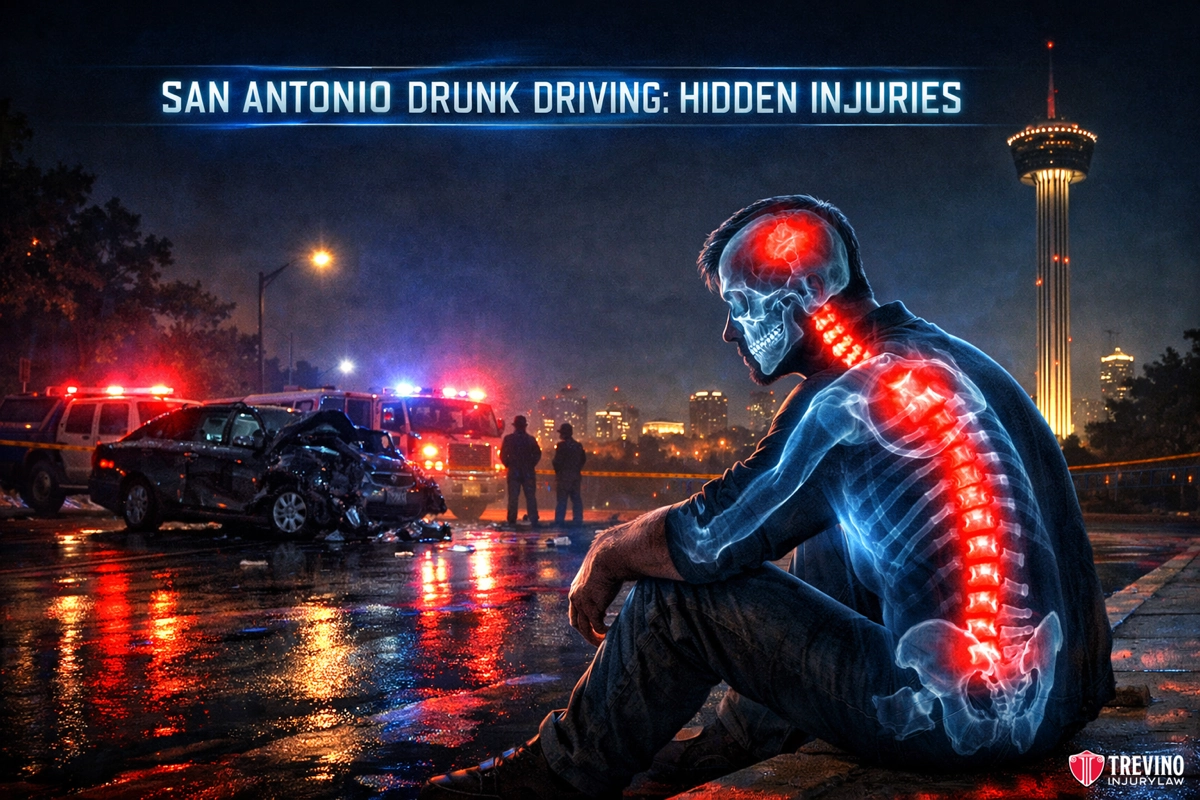
The most serious injuries following a San Antonio drunk driving crash hide behind an adrenaline mask. You must immediately check for traumatic brain injuries, internal bleeding, spinal disc herniation, and severe whiplash. The violent impact forces of an intoxicated collision on local highways tear ligaments and bruise internal organs, while your body’s survival response temporarily blocks the pain.
The insurance adjuster is already exploiting this biological delay, rushing to record your initial silence to legally sever your subsequent symptoms from the wreck. The Texas Department of Transportation recorded a DUI-alcohol crash occurring every 23 minutes in August 2025. The right steps to take after a drunk driving accident help connect delayed symptoms to the crash before the insurer rewrites your medical timeline.
What Could Your Drunk Driving Accident Case Be Worth?
Answer a few quick questions about your accident. Takes about 60 seconds.
See What My Case Might Be WorthThe insurance company offered less than $20,000. I ended up with over $1 million. — Jackie Galindo
Evidence of the driver’s extreme intoxication disappears rapidly. A Spoliation Letter, a legal demand that prevents the negligent party from destroying dash camera footage or vehicle data, must be issued immediately. Texas gives you exactly two years to file suit. After that, the claim is gone.
Trevino Injury Law drunk driving accident lawyers lock down this critical evidence before it vanishes and force the insurer to cover your full medical expenses. Call 210-TREVINO now for a free case review. You pay nothing unless we win. Se Habla Español.
Why Do I Feel Fine After Being Hit by a Drunk Driver?
You may feel fine after a drunk driving accident. This is because your body’s ‘fight or flight’ response floods your system with adrenaline and endorphins, which are powerful natural painkillers that mask the immediate symptoms of serious injuries.
This biological response is designed for survival, not diagnosis. It gives you the energy to get to safety, but it also temporarily hides the pain from soft tissue tears, spinal damage, or even internal injuries.
This adrenaline rush is a temporary mask, not a sign that you are uninjured. The shock and chaos of a high-speed collision, especially on major San Antonio highways like Loop 410, Loop 1604, or I-35, can keep you from feeling pain for hours.
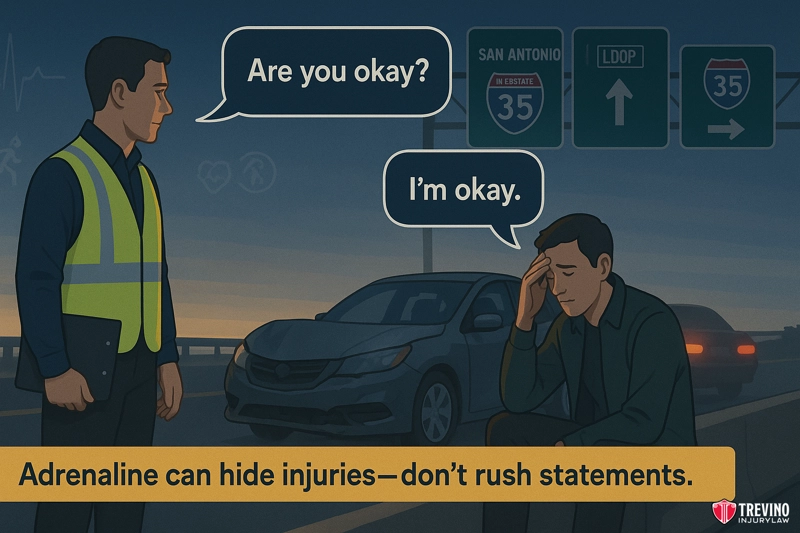
Insurance adjusters for companies like USAA or Progressive are aware of this. They will call you quickly, hoping to get a recorded statement while you’re still in shock. If you say, “I feel fine,” they will use that statement against you later to argue that your injuries aren’t related to the crash.
How Long Can Symptoms Take to Appear After an Auto Accident?
While some injuries like broken bones are obvious, symptoms for whiplash, concussions, or spinal injuries can take 24 to 72 hours, or even several weeks, to fully manifest after the initial adrenaline fades.
This latency period is medically normal. As foundational medical textbooks like Robbins and Cotran’s Pathologic Basis of Disease confirm, the body’s acute inflammatory response, the process that causes peak pain, swelling, and stiffness, often does not reach its maximum effect until 24 to 72 hours after the initial trauma. A herniated disc may only become agonizing once the inflammation fully develops, days later.
This medical delay can become legally problematic if not handled correctly, which is why it’s important to act quickly once you notice symptoms. An insurance company will point to the gap in time, from the crash to your first complaint of pain, as “proof” you were hurt somewhere else. This is a common tactic that a trial-ready attorney knows how to dismantle effectively with the help of medical expert testimony.
This delay makes it critical to know the specific, subtle symptoms of the most common hidden injuries.
What Are the Most Common Delayed-Onset Injuries After a DUI Crash?
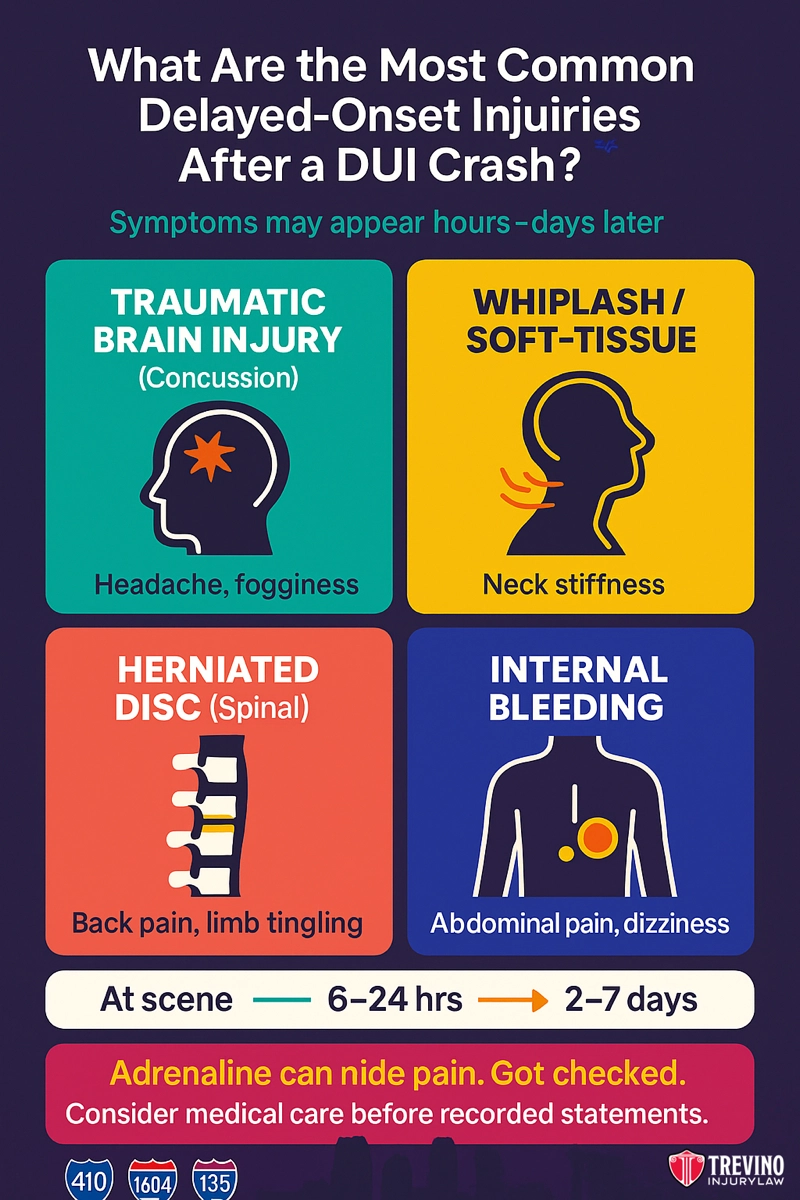
The most common delayed-onset injuries after a DUI crash are traumatic brain injuries (concussions), whiplash, soft tissue damage, herniated discs (spinal injuries), and internal bleeding. Because DWI wrecks often involve high speeds and a shocking lack of braking, the impact forces are incredibly violent, leading to severe internal harm that isn’t visible at the scene.
We have worked with many clients who were initially checked and released from the emergency room—even from San Antonio’s elite Level I Trauma Centers, such as University Hospital (the only Level I adult and pediatric trauma center in South Texas) or Brooke Army Medical Center (BAMC). This happens because delayed-onset injuries are often missed in initial ER evaluations, only to be diagnosed days or weeks later.
Our firm’s extensive experience handling complex spinal injury cases, including securing a $1.4 million settlement for a victim with a spinal injury from a DUI driving wreck, confirms these are the most frequently missed and most valuable injuries in a claim.
It is essential to recognize the specific symptoms of each of these hidden conditions.
What are the delayed symptoms of a Traumatic Brain Injury (TBI)?
Delayed symptoms of a Traumatic Brain Injury (TBI), or concussion, include persistent headaches, dizziness, confusion, nausea, sensitivity to light or noise, memory problems, and uncharacteristic irritability or mood swings.
A TBI, which stands for Traumatic Brain Injury, is one of the most serious and commonly missed injuries because you do not have to lose consciousness to have one. In fact, medical data published in the NIH’s StatPearls medical database confirms that loss of consciousness only occurs in about 10% of concussions.
A violent jolt from a collision is all it takes to cause your brain to slam into the inside of your skull, leading to bruising and swelling that worsen over time. These symptoms are often tragically dismissed as “stress” from the incident.
What are the signs of whiplash and soft tissue damage?
Common signs of whiplash include neck pain and stiffness, headaches that start at the base of the skull, shoulder pain, tingling or numbness in the arms, and difficulty rotating your head. These symptoms are caused by soft-tissue damage, including sprains or strains of the muscles, ligaments, and tendons in your neck.
Insurers often refer to this as a “minor” harm to justify a lowball offer. This is medically false. A landmark systematic review on the topic, published in the journal Spine, found that up to 50% of whiplash patients report ongoing pain and symptoms one year after their incident. Our trial-first approach proves to juries what the medical science confirms: these injuries are debilitating and often permanent.
Our trial-first approach demonstrates to juries the actual severity of these debilitating injuries. In one case, our client’s low back damage was dismissed by the insurance company, which offered only $5,000. We took them to trial and showed the jury the real impact, securing a $536,007 verdict, more than 100 times the original offer.
What are the signs of a herniated disc (spinal injury)?
Signs of a herniated disc include sharp, radiating pain (known as sciatica) that shoots down your leg, numbness or tingling in your extremities, muscle weakness in an arm or leg, and pain that worsens significantly with activities such as sitting, coughing, or sneezing.
The immense force of a DUI crash can be enough to rupture one of the spinal discs that cushion your vertebrae. This is not just “back pain”; it is a permanent trauma that often requires injections, therapy, and even surgery.
Our firm has secured significant results for clients with these exact injuries, including a $4 million settlement for a motor vehicle accident victim with a spinal injury and a $1.4 million settlement for a client who suffered a spinal injury in an intoxicated driving crash.
How do internal bleeding symptoms present?
Symptoms of internal bleeding can include severe abdominal pain (which may be delayed as blood slowly pools), deep purple bruising on your torso, dizziness or fainting, pale and clammy skin, and swelling or tightness in the abdomen.
This is a life-threatening medical emergency. It is most often caused by blunt force trauma from the seatbelt or steering wheel. Decades of trauma surgery data, including research summarized by the NIH, confirm that the spleen is the single most commonly injured organ in blunt abdominal trauma, followed by the liver. Because these organs are rich in blood, a rupture can be fatal if not treated immediately.
This is precisely why going to a top-level trauma center, like University Health, is non-negotiable after any serious crash, even if you “feel fine”.
Knowing these symptoms is the first step. The next step is to understand how to utilize this information to protect your health and legal rights.
How Does Failing to Get Medical Attention Affect My Personal Injury Claim?
Failing to get prompt medical care gives the at-fault driver insurance company its single most powerful argument: that you weren’t actually injured in the crash, or that your injuries were caused by something else that happened after the crash.
This is the core legal issue: “causation.” An adjuster’s entire job is to find ways to break the link between the intoxicated driver’s negligence and your trauma, and a delay in treatment is their number one tool. They will argue that if you were really hurt, you would have gone to the doctor immediately.
Texas law makes this issue clear. In Guevara v. Ferrer, 247 S.W.3d 662, 665 (Tex. 2007), the Texas Supreme Court held: “expert testimony is necessary to establish causation as to medical conditions outside the common knowledge and experience of jurors.”
In other words, once injuries are not immediately obvious, you must prove through medical evidence that the crash caused them. That is why delays in treatment are so damaging. They give the insurance company an opening to argue there is no reliable medical link between the collision and your condition, even when the injury is real.
Our firm’s 20+ years of experience, including time spent in insurance defense, means we are familiar with this playbook inside and out. We have had to defeat this exact argument in court. In Elma Jane Guerrero v. Benjamin Soloman, the insurance company refused to make a fair offer, minimizing our client’s neck and back injuries and offering only $25,000.
We took them to trial, proved the injuries were a direct result of the crash, and won a $291,550 jury verdict, more than 11 times the offer. This is why establishing an unbroken chain of medical evidence is so critical to support your claim and secure the full compensation you deserve from a drunk driving crash claim.
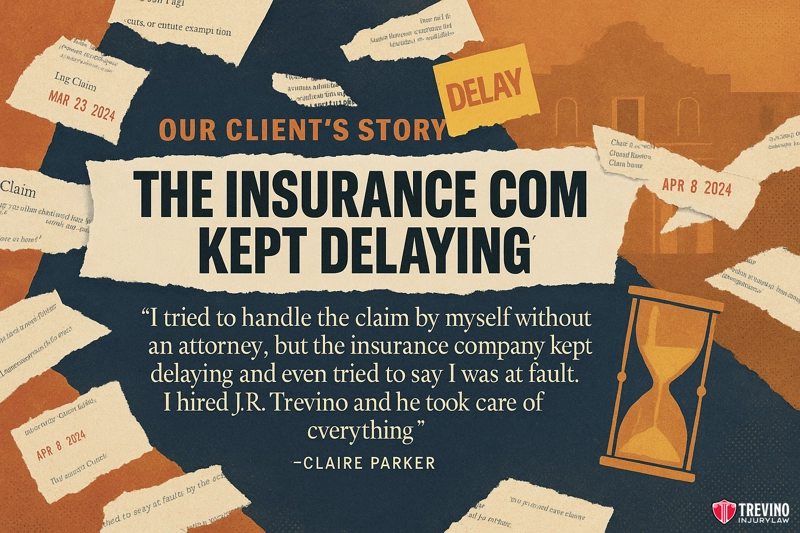
Our Client’s Story: “The Insurance Company Kept Delaying”
“I tried to handle the claim by myself without an attorney, but the insurance company kept delaying and even tried to say I was at fault. I hired J.R. Trevino and he took care of everything.” – Claire Parker.
What is a “Gap in Treatment” and Why Does It Matter in a Texas Personal Injury Case?
A “gap in treatment” is any significant delay, often just days or weeks, between the date of the accident and your first medical appointment, or any long, unexplained breaks between your follow-up appointments.
In Texas, this gap matters because it legally opens the door for the defense to argue a ‘new and independent cause,’ also known as an ‘intervening cause.’ They will suggest to a jury at the Bexar County Courthouse that you must have hurt yourself at home or at work during that ‘gap.’
We counter this by using your own testimony about the adrenaline mask and by presenting expert medical opinions that definitively link your trauma back to the crash. Still, it’s best to avoid this battle by seeking prompt care. This is a crucial step in the drunk driving accident claim process.
How Do I Prove Delayed Injuries to Get Compensation and Hold the Drunk Driver Accountable?
You prove delayed injuries by getting a definitive medical diagnosis (like an MRI or CT scan) as soon as symptoms appear. Your doctor must then provide a medical opinion that links these injuries, on a ‘more probable than not’ basis, directly to the crash.
This is all about building the “medical-legal” narrative. Your medical records are the most crucial evidence you have. We work closely with your doctors and other local San Antonio medical experts to write a formal causation report that explains why the symptoms were delayed (e.g., swelling, inflammation) and how the crash forces caused the specific damage.
This report, combined with the intoxicated driver’s apparent negligence, creates a powerful and undeniable claim for a jury, which is essential to secure fair compensation and a fair settlement.
This medical proof serves as the foundation for your case, but it’s just the first step in the practical process of determining what to do next.
What Kind of Doctor Should I See After a Texas Car Accident?
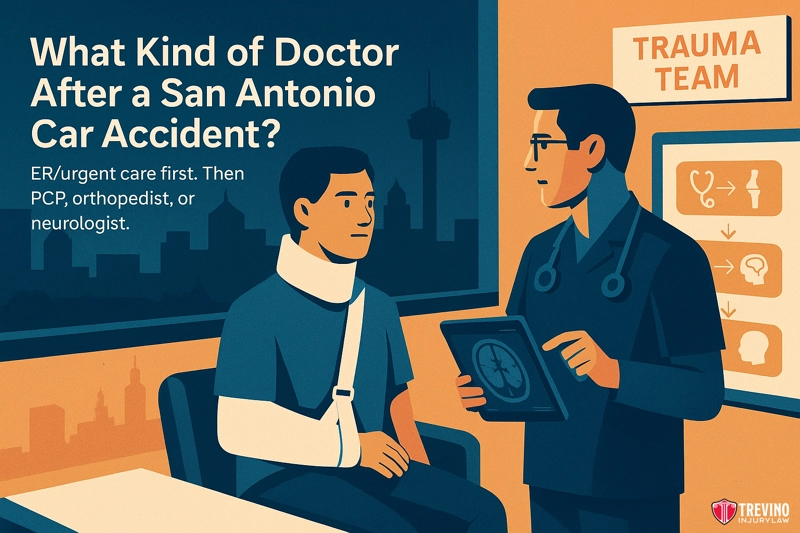
After a San Antonio car accident, you should first go to an emergency room or urgent care clinic for an immediate evaluation; afterward, you must follow up with your primary care physician or a specialist like an orthopedist or neurologist.
For severe impacts, this means going to a dedicated trauma center. As of 2025, University Hospital is the only Level I adult and pediatric trauma center in San Antonio and all of South Texas. Brooke Army Medical Center (BAMC) also operates as a Level I Trauma Center, treating civilian emergencies. These facilities are equipped for the most severe, life-threatening injuries (like internal bleeding), which is why a visit is so critical.
This visit, however, is not the end of your medical care. You must follow up with your Primary Care Physician (PCP), who serves as the “hub” for your care and can refer you to specialists.
Depending on your symptoms, this may include an orthopedist for bone and joint injuries or a neurologist for TBI and nerve-related symptoms. We advise all clients to use credible, established medical providers to build a strong case, as insurance companies will aggressively attack the credibility of “letter of protection” clinics that are known for litigation.
Getting the proper medical care is the first step to recovery. It lets you focus on healing while we prepare to get the correct legal answers.
What Emotional or Psychological Symptoms Should I Watch For?

Beyond physical injuries, it’s normal to feel overwhelmed and unsure. You must also watch for psychological symptoms like persistent anxiety, depression, insomnia, flashbacks, and a persistent fear of driving, which are all common signs of Post-Traumatic Stress Disorder (PTSD).
This is not a rare or minor claim. In fact, a foundational study published in the American Journal of Psychiatry found that 9.6%—or roughly 1 in 10—survivors of a serious motor vehicle accident develop significant PTSD.
Texas law allows victims to demand compensation for these ‘non-economic’ damages, which include pain and suffering, emotional distress, mental anguish, and loss of enjoyment of life.
However, the Texas Supreme Court, in the landmark case Parkway Co. v. Woodruff, set a high standard for this. A plaintiff must prove a ‘substantial disruption’ in their daily routine or provide direct evidence of the ‘nature, duration, and severity’ of their anguish.
This is why we take it so seriously. We use objective, scientific data like this to demonstrate to a jury that your experience is a documented medical reality, which helps us meet the high legal burden and recover the full compensation you deserve.
Can I still file a personal injury claim if I didn’t get immediate medical attention?
Yes, you can still file a personal injury claim in Texas if you did not go to the hospital immediately. Still, you must get a medical evaluation as soon as your symptoms appear to counter the insurance company’s ‘gap in treatment’ argument. While it makes the case more difficult, it is not fatal.
A trial-ready firm like ours knows how to use your testimony about adrenaline and medical expert opinions to prove the damage was directly caused by the crash.
Is whiplash a “serious injury” in a Texas personal injury lawsuit?
Yes, whiplash is legally considered a ‘serious injury’ in a Texas lawsuit when it results in chronic pain, medical bills, lost wages, and a diminished quality of life, despite what insurance adjusters may claim.
It is not the label of the damage that matters in court, but the impact it has on your life. We proved this in the Arriaga v. Montemayor case, where the defense offered only $5,000 for a soft tissue injury they called “minor”; we took them to trial and won a $536,007 jury verdict.
Will insurance pay compensation for delayed-onset injuries?
Yes, an insurance company is legally obligated to pay for delayed-onset injuries, but only if your attorney can successfully prove with medical evidence that the DWI crash was the direct cause of those specific injuries.
They will not pay for these injuries willingly; they will fight you and argue that your pain is unrelated to the crash. This is why you need an experienced car accident lawyer with a track record of winning in court over these exact disputes.
Does Texas law require me to see a doctor after a car accident?
No, Texas law does not legally require you to see a doctor, but failing to do so will severely damage your legal claim, as you will have no medical evidence to prove your injuries or their extent.
What Should I Tell My Doctor After a Drunk Driving Accident?
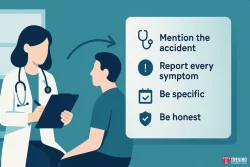
You must tell your doctor that you were in a car accident and describe every symptom you are feeling, no matter how minor, including pain, stiffness, dizziness, fogginess, or anxiety. Your medical record is one of the most critical pieces of evidence in your case, and it begins with this first visit.
Be Specific: Don’t just say “my back hurts.” Say, “I have a sharp pain in my lower right back that shoots down my leg when I sit.”
Mention the Accident: The doctor must note “motor vehicle accident” or “DUI crash” in the patient’s chart. This creates the primary evidence link that we need to prove causation.
Don’t Exaggerate, But Don’t Minimize: Be 100% honest. If you say “I feel fine” out of toughness, that will be written down and used against you. If you exaggerate, the defense will use it to destroy your credibility. Honesty is the only strategy.
Report All Symptoms: That “minor” headache you don’t mention could be the first sign of a TBI. That “bruise” could be a symptom of internal bleeding. Let the doctor decide what is minor and what is not.
While being precise with your doctor is essential for your claim, an imprecise statement at the crash scene can destroy it.
What Are the Biggest Mistakes & Steps to Take After Being Hit by a Drunk Driver?
The single biggest mistake is telling the police, the other driver, or an insurance adjuster, “I’m not injured” or “I feel fine” at the accident scene. This is a recorded admission that the insurance company will use against you relentlessly. Because of the adrenaline and shock masking your injuries, you cannot possibly know the true extent of the harm you’ve suffered in those first few moments.
The only safe answer is, “I’m shaken up, and I’m going to get checked by a doctor“. This statement is 100% truthful and protects your right to seek compensation for injuries that may appear later.
Delayed-injury questions fit into a larger post-crash sequence. The guide to what to do after a drunk driving accident in San Antonio brings the scene, police report, medical care, insurance contact, and evidence steps together in one place.
Should I Give a Recorded Statement Without My Accident Lawyer Present?
No, you should never give a recorded statement to the at-fault driver’s insurance company without the guidance of an experienced car accident attorney present to protect you.
The adjuster for the at-fault party is not calling to help you; they are calling to find evidence to deny your claim. They are professionally trained to ask leading, tricky questions designed to get you to contradict yourself or minimize your injuries, such as “So your back just started hurting today?” or “You felt fine at the scene, correct?”
Recorded insurer statements are one communication issue after a DWI crash; the accident scene creates another. See what to say to police after a drunk driving accident in Texas for the separate questions about factual reporting, apologies, and guesses when law enforcement responds.
When you hire Trevino Injury Law, we provide direct attorney access and handle 100% of all insurance communications. This is a critical part of how to deal with an insurance adjuster after a drunk-driving accident, and it is precisely how we prevent you from falling into these traps.
Why Hire a San Antonio Drunk Driving Accident Lawyer?
The villain is the adjuster who exploits your adrenaline to deny coverage, and the “settlement mills” that accept their first lowball offer. We don’t let them minimize your trauma. Trevino Injury Law forces insurers to pay for the full extent of your suffering, proving our resolve with a $1.4 million settlement for a client with severe spinal injuries caused by an intoxicated driver.
Want to Protect the Full Value of Your Claim?
You’ve seen how this affects your case — but this is only one piece of the puzzle. Our Drunk Driving Accident Lawyer page breaks down what a trial-ready firm does differently.
You need a San Antonio trial lawyer to secure the medical experts necessary to prove your injury before the defense destroys your credibility.
Call 210-TREVINO for a free case review. Se Habla Español. You pay no fees unless we win.