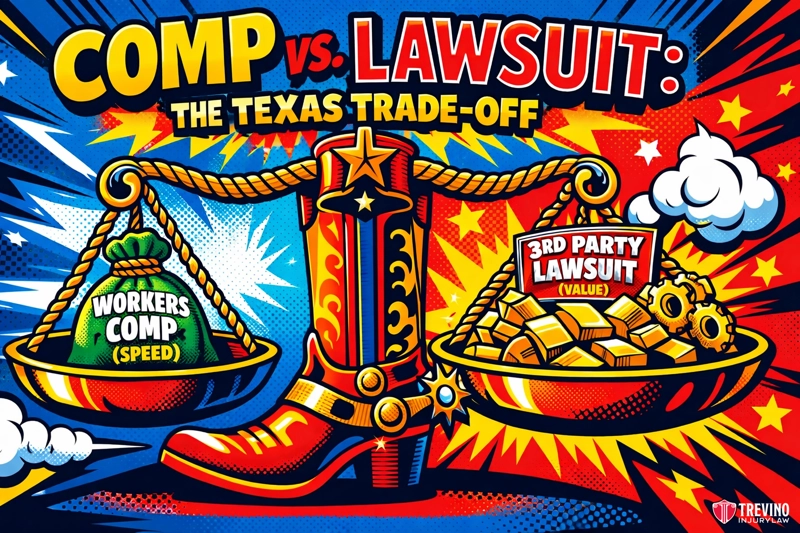
A third-party civil lawsuit secures full value for a Texas construction accident by unlocking lifetime damages that standard workers’ compensation completely excludes. The state system utilizes strict caps to keep you off welfare, not make you whole.
The Insurance Adjuster is already pushing you to accept a final impairment rating to close your file cheaply and block your access to third-party liability. According to the Texas Department of Insurance, Division of Workers’ Compensation, 16% of private-sector employers in the state’s mining, utilities, and construction industries operated as non-subscribers in 2022. A civil lawsuit bypasses the administrative system and forces negligent external contractors to pay.
What Could Your Construction Accident Case Be Worth?
Answer a few quick questions about your accident. Takes about 60 seconds.
See What My Case Might Be WorthThe insurance company offered less than $20,000. I ended up with over $1 million. — Jackie Galindo
To upgrade your claim, you must prove external negligence before the general contractor deletes the daily safety logs. A Spoliation Letter, a legal demand that prevents the property owner from destroying evidence, must be issued immediately. Texas gives you two years to file a third-party claim before your right to sue vanishes forever.
Trevino Injury Law construction accident lawyers will subpoena the site evidence and lock down your claim before the clock runs out. Call 210-TREVINO now for a free case review. You pay nothing unless we win. Se Habla Español.
The Financial Disparity: State Benefit Caps vs. Unrestricted Lawsuit Damages
State benefit caps in workers’ compensation insurance severely restrict your financial recovery. They limit weekly payouts to a strict maximum. Unrestricted lawsuit damages in a third-party claim allow San Antonio construction workers to recover full lifetime lost wages, complete medical treatment, and uncapped pain-and-suffering damages.
The Texas Labor Code imposes strict caps on workers’ compensation income benefits. For example, the maximum weekly limit is strictly capped regardless of your actual previous lost income. This contrasts heavily with the unrestricted nature of injury cases tried before juries in Bexar County courts.
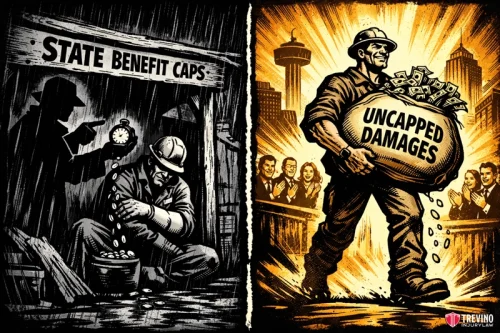
Furthermore, workers’ comp benefits abruptly stop when a doctor determines you have reached Maximum Medical Improvement. This is the clinical point where no further healing is expected. A local ironworker injured in a construction accident near the I-35 mixing bowl might find his compensation benefits capped out at a mere fraction of his normal union wage. Standard compensation leaves families financially devastated. Understanding exactly which types of claims are excluded from the state system and do not allow damages is critical for your survival.
Damages Completely Excluded from the Texas Workers’ Comp System
Texas workers’ compensation completely excludes compensation for past and future pain and suffering, emotional distress, physical impairment, loss of enjoyment of life, and punitive damages. You can only recover these through a civil lawsuit when negligence caused your injury.
The state workers’ comp system strictly separates economic and non-economic damages. It is entirely a receipt-based system. It is designed to keep injured workers off state welfare, not to make them whole after a catastrophic construction accident. The damages explicitly excluded from this system include:
- Past and future pain and suffering.
- Emotional distress and mental anguish.
- Loss of enjoyment of life and lasting physical impairment.
- Punitive damages intended to punish gross corporate negligence.
While securing these excluded damages requires you to pursue a personal injury claim, you do not have to wait for the trial to end to pay your immediate medical expenses.
You can legally pursue both systems simultaneously. You can receive benefits such as weekly compensation checks to cover your immediate living expenses. Meanwhile, your Plaintiff Trial Lawyer actively investigates the scene. We build a negligence lawsuit against the external contractor who caused your injury.
Many tradesmen share a common misconception. They believe filing a lawsuit instantly halts their weekly comp checks. This is false. The dual-track legal strategy lets you leverage both avenues to your advantage. Our legal team strategically manages the Insurance Adjuster to ensure your necessary surgeries at the South Texas Medical Center are fully approved and paid for.

While this immediate medical care is underway, we simultaneously build the civil case against a separate at-fault party. This could be a negligent scaffolding company or a defective heavy equipment manufacturer. However, because the workers’ compensation carrier is funding your immediate recovery, they legally secure the right to demand repayment if you win your personal injury claim.
How does a workers’ comp subrogation lien affect your third-party settlement?
A workers’ compensation subrogation lien legally requires you to reimburse the insurance carrier for the exact medical and wage replacement benefits they provided. However, a skilled trial lawyer aggressively negotiates this lien down at the end of your civil case. This maximizes your final take-home settlement. Under Texas Labor Code Section 417.001, the workers’ comp carrier has a statutory right to recover the money they spent on your claim directly from your third-party lawsuit earnings.
We do not let the Insurance Company take the lion’s share of your civil settlement. A trial-ready attorney aggressively negotiates this subrogation lien down at the conclusion of the case. This maximizes the actual cash that goes directly into the injured worker’s pocket. Successfully managing both the workers’ comp carrier and the third-party claim requires strict adherence to distinct legal timelines and burdens of proof.
The Trade-Off: No-Fault Speed vs. Proving External Negligence
The primary trade-off is that workers’ comp pays a capped amount faster without requiring you to prove fault. A third-party civil lawsuit demands proving another company’s negligence but ultimately yields a vastly higher financial payout. This payout accounts for your entire lifetime of damages. This core trade-off dictates your legal strategy. Workers’ compensation is a no-fault system. You get paid faster without having to prove someone else’s negligence caused the accident.
Conversely, a third-party lawsuit requires meeting the heavy burden of proof for negligence. This process takes longer but yields full damages. The administrative timelines of the Texas Division of Workers’ Compensation move differently than civil litigation timelines in the Bexar County District Courts.
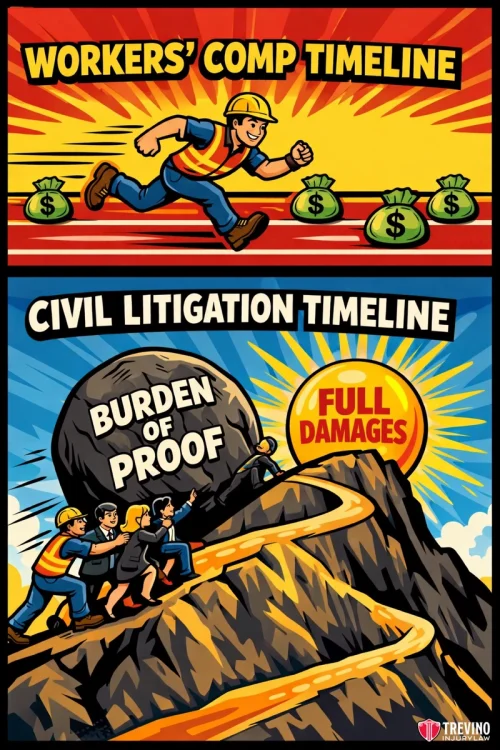
To illustrate the volume of these civil actions, in FY 2023, 11,024 new district-court cases were filed in Texas under “Other Injury or Damage.” This category explicitly includes construction damages. To bridge the gap between immediate administrative payouts and maximum civil justice, we must formally transition the evidence of your injury into a civil court action.
Crucial Evidence Needed to Upgrade a Claim into a Civil Lawsuit
Upgrading your claim into a high-value civil lawsuit requires us to definitively prove that an external party’s negligence caused your catastrophic workplace injuries. To do this, we subpoena the general contractor’s daily safety logs, extract black box data, and secure official OSHA citations. We build this evidence specifically to meet the strict liability standards affirmed in landmark cases like Lee Lewis Constr., Inc. v. Harrison, 70 S.W.3d 778 (Tex. 2001).
Under Harrison, a general contractor can be held fully liable for your injuries if the evidence proves they retained actual control over site safety protocols but failed to exercise that control with reasonable care. To successfully breach the exclusive remedy barrier of standard workers’ comp and prove third-party negligence, specific documentation is required. The most crucial evidence includes:
- Official OSHA citations and post-accident safety investigations.
- Subpoenaed general contractor safety logs and site inspection reports.
- Independent engineering reports regarding defective heavy machinery or collapsed scaffolding.
Gathering this critical evidence dictates exactly how and when your workplace injury case ultimately resolves financially.
Should you accept a workers’ compensation settlement before finishing your third-party lawsuit?
You should never accept a final workers’ compensation settlement or sign a Division of Workers’ Compensation impairment rating agreement before consulting a trial-ready attorney. Doing so can inadvertently terminate your ongoing medical care and severely devalue your separate injury lawsuit damages.
Insurance Adjusters routinely use the confusion between these two complex systems to trick San Antonio workers into prematurely signing away their rights. When an adjuster pressures you to accept a final DWC impairment rating, their primary goal is to close your file as quickly and cheaply as possible.
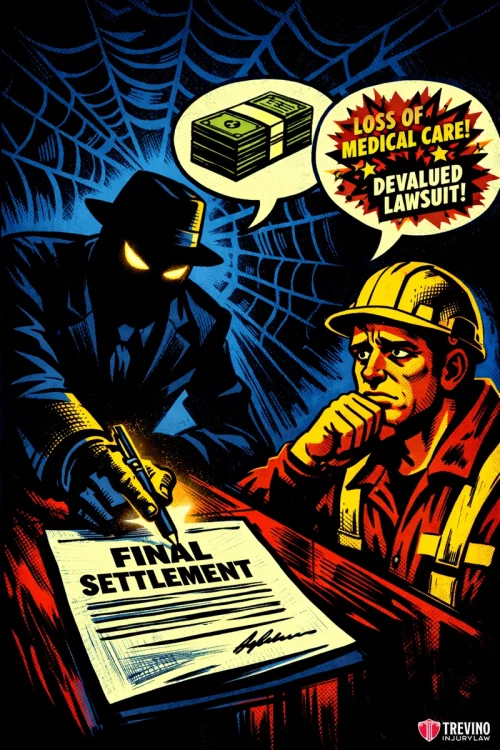
By accepting this inadequate administrative payout without legal counsel, you can inadvertently cap your future medical care. This permanently complicates the calculation of your lifetime damages in the ongoing civil suit against the negligent third party. Navigating the overlapping rules of these two legal systems requires precise answers to critical legal questions.
Comparing Attorney Fee Structures in Comp vs. Civil Cases
An injury lawsuit utilizes a strict contingency fee model. Injured workers pay nothing out-of-pocket and only pay if they win. This contrasts sharply with the difficulty of securing specialized representation for standard DWC administrative hearings. There, attorney fees are heavily restricted portions of your weekly income benefits.
By removing the financial risk for the plaintiff, the contingency model allows injured construction workers in South Texas to hire elite personal injury lawyers without paying upfront costs. Conversely, finding specialized legal representation strictly for standard Division of Workers’ Compensation administrative hearings is incredibly difficult. The state restricts attorney fees to a small percentage of your weekly income checks.
This fundamental difference means you can afford a premium Plaintiff Trial Lawyer to fight massive insurance companies in civil court. However, you may struggle to find someone to fight the DWC adjuster on administrative appeals alone. Because the financial mechanisms are distinct, injured workers frequently have direct questions regarding their legal rights under both systems.
Can you sue for pain and suffering under Texas workers’ comp?
No, you cannot sue for pain and suffering under standard Texas workers’ compensation. The system strictly limits recovery to medical expenses and wages.
Do you have to pay back workers’ comp if you win a third-party lawsuit?
Yes, Texas law dictates you must reimburse the workers’ compensation carrier for the medical and income benefits they provided once you secure financial recovery from a third-party claim.
Can a third-party lawsuit force an employer to improve job site safety?
Yes. Standard injury claims rarely change corporate behavior. Massive third-party jury verdicts routinely force construction companies to rewrite their safety protocols completely. The threat of litigation is a known driver of corporate behavior. In fact, 18% of subscribing Texas employers cite concern about lawsuits as a primary reason to carry workers’ comp insurance in the first place (Texas Department of Insurance, Division of Workers’ Compensation, 2022).
Settlement Valuation: DWC Impairment Ratings vs. Jury Verdicts
A Division of Workers’ Compensation impairment rating evaluates your severe injury as a mere clinical percentage worth a few thousand dollars. A civil jury verdict calculates the human cost of your inability to ever work in your chosen construction trade again. This results in a significantly higher, lifetime-adjusted financial payout.
The state’s administrative process relies on a clinical schedule that severely undervalues catastrophic injuries. For instance, a DWC schedule might assign a crushed foot a minimal impairment rating. This is worth a fraction of a worker’s lost earning capacity. However, a jury takes a human approach.
Our firm secured a $7.9 Million Verdict for Mario Mendoza after a work-related crushed foot and amputated toe. The jury understood the catastrophic impact on his life and ability to earn a living in his trade. This highlights the massive disparity between a clinical rating and true justice. Despite the clear financial advantages of an injury lawsuit, this path is not legally available to every injured worker.
What Happens If No Third-Party Negligence Exists on the Job Site?
If your catastrophic construction accident was a true, unavoidable mishap or entirely the fault of your insured direct employer, you cannot file a lawsuit. You are legally restricted to the strict financial caps and limited medical benefits of the state’s standard workers’ compensation system.
However, it is vital to verify your employer’s actual coverage status. 16% of private-sector employers in the Texas mining, utilities, and construction industries are non-subscribers to the state system who can potentially be sued directly (Texas Department of Insurance, Division of Workers’ Compensation, 2022).
This absence of third-party liability is exactly why our trial team launches an immediate, aggressive investigation into any incident on Eagle Ford Shale or San Antonio construction sites. We must definitely rule in or rule out external negligence. If no defective equipment manufacturer, negligent subcontractor, or outside vendor contributed to your injuries, the compensation available is limited to the inadequate administrative system. Even if a liable third party does exist, waiting too long to pursue them will legally destroy your case.
When Is It Too Late to Upgrade a Workers’ Comp Claim to a Lawsuit?
You must never let an adjuster’s delay tactics run down your legal clock. It is permanently too late to upgrade your claim into a civil lawsuit if you wait longer than the strict two-year Texas statute of limitations from the date you were injured on the job.
The Texas Supreme Court has strictly enforced that once a cause of action accrues and the limitations period expires, your legal right to sue a negligent equipment manufacturer or external subcontractor vanishes forever. This completely destroys your access to third-party financial damages.
The most fatal mistake injured tradesmen make is assuming that because they are still receiving weekly compensation checks, their lawsuit clock isn’t ticking. The administrative payouts do not pause the civil statute of limitations. Once that deadline expires, your right to sue the negligent scaffolding company or equipment manufacturer vanishes forever.
Do not let this critical window close while dealing with an Insurance Adjuster. Protect your family’s financial future by exploring all legal avenues.
Why Hire a San Antonio Construction Accident Lawyer Before Accepting Workers’ Comp?
You must hire a trial-ready San Antonio construction accident lawyer immediately. Accepting a standard workers’ compensation payout permanently caps the compensation you need. Our legal team aggressively investigates your job site to prove negligence caused your injury. We force external contractors to pay your uncapped lifetime damages in civil court.
Want to Protect the Full Value of Your Claim?
You’ve seen how this affects your case — but this is only one piece of the puzzle. Our Construction Accident Lawyer page breaks down what a trial-ready firm does differently.
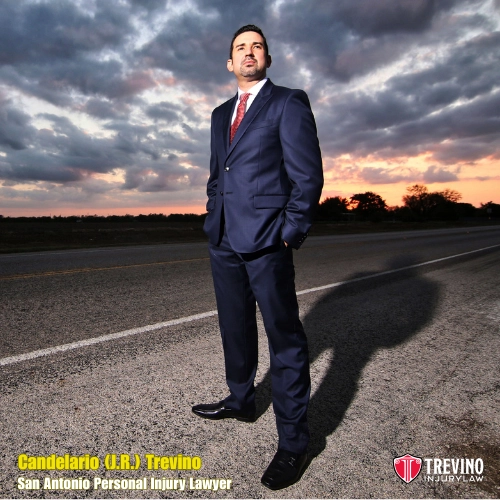
Standard administrative payouts protect corporate profit margins. Trevino Injury Law fights for injured tradesmen and actively litigates to a verdict. Our authority is proven at the Bexar County Courthouse, backed by a $7.9M verdict for work injuries.
To stop defendants from hiding evidence, we immediately issue aggressive spoliation letters when you retain a San Antonio personal injury accident lawyer. We operate on a strict No Win, No Fee promise. Call 210-TREVINO for a free case review. Se Habla Español.