
A catastrophic injury claim is the rigorous legal determination that you have reached Maximum Medical Improvement with permanent deficits preventing gainful employment. Your condition has stabilized; it will not improve with treatment, and you face a lifetime of diminished capacity.
The insurance adjuster is already using strict medical coding to reclassify your permanent disability as a temporary impairment. According to Texas crash data, work zones saw 823 suspected serious injuries in 2024. Behind every downgraded claim is an insurer maneuvering to avoid funding a lifetime Life Care Plan. This is a fight for survival.
What Could Your Catastrophic Injury Accident Case Be Worth?
Answer a few quick questions about your accident. Takes about 60 seconds.
See What My Case Might Be WorthThe insurance company offered less than $20,000. I ended up with over $1 million. — Jackie Galindo
A Spoliation Letter, a legal demand that requires the at-fault party to preserve evidence, must be sent immediately. You must then secure a Functional Capacity Evaluation to scientifically document your physical limits. If your injury is ruled non-catastrophic, the burden of funding lifelong home health care falls entirely on your family.
Trevino Injury Law’s catastrophic injury lawyers lock in your permanent status and force corporate defendants to fund your future. Call 210-TREVINO now for a free case review. You pay nothing unless we win. Se Habla Español.
What Distinguishes a Catastrophic Injury from a Severe Injury in Texas?
A catastrophic injury is legally distinguished from a severe injury by its permanence. While accidents are common, true catastrophic outcomes are legally distinct and rare events requiring specialized litigation. For instance, of nearly 28,000 work zone crashes in Texas in 2024, only 823 resulted in suspected serious injuries.
This places catastrophic victims in a unique legal category (top ~3%) where the issue isn’t whether an injury occurred, but whether the victim has reached Maximum Medical Improvement (MMI) without recovering their pre-accident capacity.
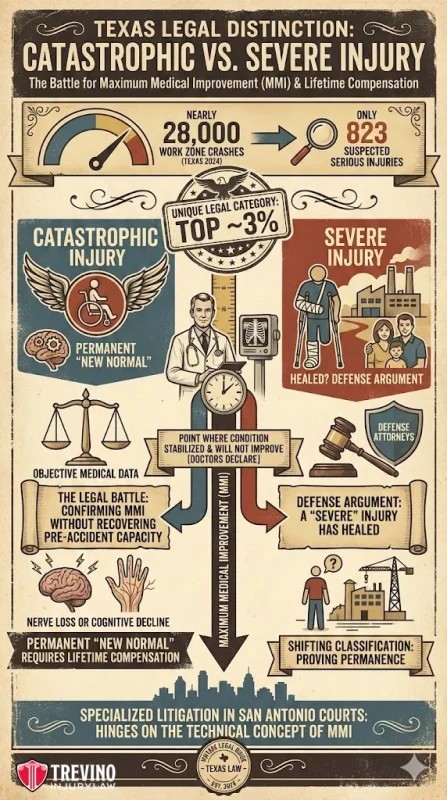
While the main hub covers the general types of injuries we litigate, the specific case in San Antonio courts often turns on the technical concept of Maximum Medical Improvement (MMI). This is the point where doctors declare your condition has stabilized and will not get better, even with further treatment.
If you reach MMI and still cannot return to your job or perform daily tasks, the legal classification of your claim shifts. Defense attorneys will argue that a “severe” injury has healed, but we use objective medical data to prove that the damage, whether it be nerve loss or cognitive decline, is a permanent “new normal” that requires lifetime compensation.
How Do Texas Courts Define ‘Permanent Disability’ Vs. ‘Temporary Impairment’?
Texas courts define permanent disability as a medical condition that persists after reaching Maximum Medical Improvement (MMI) and results in a lifelong reduction in earning capacity or physical function, whereas temporary impairment is a deficit that is expected to resolve with time and treatment.
The distinction is critical because “temporary” damages only cover your losses up to the date of trial, while “permanent” disability triggers the calculation of future damages for the remainder of your life expectancy.
In Bexar County, we must present clear physician testimony stating that, to a reasonable degree of medical probability, your impairment is fixed and stable, transforming your claim from a simple reimbursement request into a comprehensive, reliable life plan.
What Are the 3 Levels of Injury Severity Used in Claims?
Insurance adjusters typically categorize claims into three distinct severity levels: Level 1 soft tissue injuries like whiplash or sprains that resolve with conservative care, Level 2 surgical or orthopedic injuries involving fractures requiring hardware that eventually heal, and Level 3 catastrophic injuries involving spinal cord damage, TBI, or amputation that result in permanent functional loss.
Understanding this hierarchy is vital because the minimum policy limits of $30,000 often found in Texas auto policies are wholly insufficient for Level 3 claims. In 2024 alone, Texas work zones saw 5,191 Suspected Minor Injuries, compared with 217 Fatalities and 823 Serious Injuries.
Insurance algorithms are built to handle the thousands of ‘Minor’ claims quickly; they are not designed to voluntarily pay out the millions required for the small percentage of families facing permanent loss or serious impairment without a forensic legal fight.
Understanding how the legal system classifies the permanence of your condition is the first step, but we must next examine the specific medical metrics that validate these claims.
What Specific Medical Criteria Qualify an Injury as Catastrophic?
To qualify as catastrophic, medical records must typically document objective metrics like a Glasgow Coma Scale (GCS) score below 9, American Spinal Injury Association (ASIA) impairment grades, or third-degree burns covering a significant body surface area. These aren’t just medical observations; they are the forensic data points that define the value of your case in the eyes of a jury or insurance adjuster.
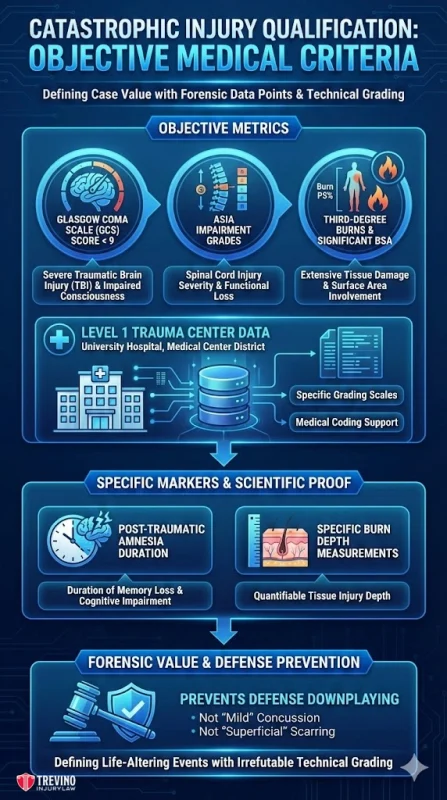
While our main overview lists common injuries such as TBIs and spinal injuries, qualifying a claim requires a drill-down into the specific grading scales used at Level 1 trauma centers, such as University Hospital in the Medical Center District. It is not enough to simply claim a “brain injury” exists; the medical coding must support the severity level.
We analyze your records for specific markers, such as the duration of post-traumatic amnesia or specific burn depth measurements, to scientifically prove the injury meets the catastrophic threshold. This technical grading prevents the defense from downplaying a life-altering event as a “mild” concussion or “superficial” scarring.
At What Point Does a Traumatic Brain Injury (TBI) Become a Catastrophic Claim?
A Traumatic Brain Injury (TBI) typically escalates to a catastrophic claim when it is classified as “moderate” or “severe” (Grade 2 or 3), characterized by a Glasgow Coma Scale score of 3-12, a coma duration exceeding 24 hours, or post-traumatic amnesia lasting longer than a week.
However, even a “mild” TBI can qualify as catastrophic if neuropsychological testing confirms permanent cognitive decline that prevents you from returning to your specific profession. We look for evidence of executive function loss, such as an inability to multitask or regulate emotions, which can destroy a career even if the individual appears “normal” to an outside observer.
What Percentage of Body Coverage Qualifies a Burn Injury as Catastrophic?
A burn injury is typically considered catastrophic when third- or fourth-degree burns cover more than 20% of the Total Body Surface Area (TBSA), or when severe burns affect critical functional areas such as the hands, face, or feet, regardless of the total percentage.
Using the “Rule of Nines,” medical experts estimate the extent of the damage to justify the immense cost of future skin grafts, contracture-release surgeries, and pain management.
In San Antonio, where many of our clients work in manual trades, a burn injury to the hands that prevents gripping tools is functionally catastrophic, triggering claims for total vocational disability even if the rest of the body is unharmed.
Establishing the medical grade of the injury provides the raw data, but translating that data into a courtroom victory requires a very specific type of expert testimony.
How Do You Prove an Injury Is Catastrophic in San Antonio Courts?
Proving catastrophic status requires a “Functional Capacity Evaluation” (FCE) and testimony from vocational experts who can scientifically demonstrate the injury’s impact on your specific ability to work in the San Antonio economy. It is not enough to tell a jury that you are in pain; we must show exactly how that pain physically prevents you from performing the essential duties of your trade.
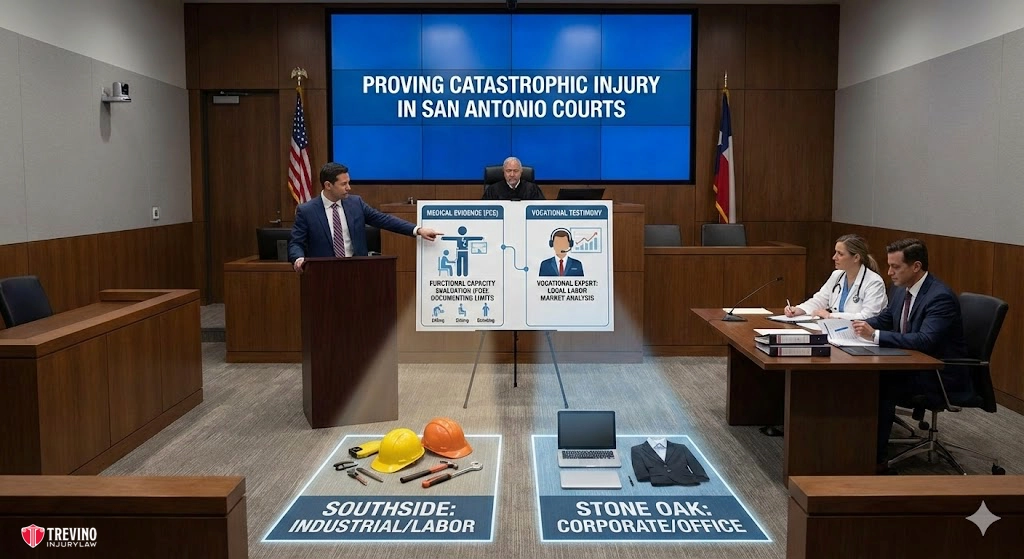
This section refines the general evidence discussion from our main hub by focusing exclusively on the “Vocational Expert” and medical-legal assessments. In San Antonio, where industries range from oil field labor in the Southside to corporate roles in Stone Oak, the definition of “disability” is relative to your specific job.
We use the FCE, a rigorous multi-hour physical test, to document your lifting, sitting, and standing limits. We then pair this with vocational testimony to prove that no reasonable accommodation exists for you in the local labor market, effectively locking in your claim for lost future earning capacity.
Why Is a ‘Life Care Plan’ Essential for Qualifying Your Claim?
A Life Care Plan is a comprehensive, itemized report created by medical and economic experts that details every medical need, therapy, medication, and home modification you will require for the rest of your life, along with their projected costs adjusted for inflation.
This document is essential because it moves your claim from abstract concepts of “suffering” to concrete economic damages, often totaling millions of dollars. Without a Life Care Plan, a jury is left guessing at your future needs; with one, we provide a mathematically defensible bill that the insurance company must pay to ensure your long-term survival and dignity. For the care categories and recurring costs that make up that projection, see long-term care for catastrophic injury victims in Texas.
How Does the ‘Eggshell Plaintiff’ Doctrine Apply to the Catastrophic Qualification?
The ‘Eggshell Plaintiff’ doctrine is a fundamental Texas legal principle rooted in cases like Driess v. Friederick, 73 Tex. 460 (1889), which holds that a defendant ‘takes the plaintiff as he finds him.’ This means the at-fault party is fully liable for the catastrophic consequences of their negligence, even if the victim’s pre-existing frailty or medical history made them more susceptible to severe injury than the average person.
The “Eggshell Plaintiff” rule protects you when your history makes you vulnerable, but understanding how the timeline of your recovery affects your claim is equally critical.
Can a ‘Serious’ Injury Turn into a ‘Catastrophic’ Claim Later?
Yes, an injury initially diagnosed as “serious” can be legally reclassified as “catastrophic” if life-altering complications arise or if you fail to reach Maximum Medical Improvement as predicted by your physicians, fundamentally changing the long-term value and necessity of your claim.
What might begin as a “routine” post-concussion syndrome after a wreck on Loop 1604 can evolve into a permanent seizure disorder months later, drastically altering your ability to drive or hold a job.
This potential for delayed progression is exactly why we advise against rushing into a settlement. Insurance adjusters are trained to pressure you into signing a release early, often within weeks of the crash, precisely to avoid paying for these complications.
While proper timing protects your right to fair compensation, consistent documentation is the only way to defend against the insurance company’s favorite tactic to deny it.
How Does the ‘Gap in Treatment’ Defense Affect Catastrophic Designation?
Insurance adjusters frequently exploit gaps in care to argue a ‘failure to mitigate damages,’ attempting to reduce their payout. However, in Moulton v. Alamo Ambulance Service, Inc., 414 S.W.2d 444 (Tex. 1967), the Texas Supreme Court clarified that while a plaintiff has a duty to treat their injuries, a failure to do so does not completely bar recovery; it only limits damages to those that were unavoidable, making consistent medical documentation essential to refute this defense.
Is a Broken Bone Considered a Catastrophic Injury?
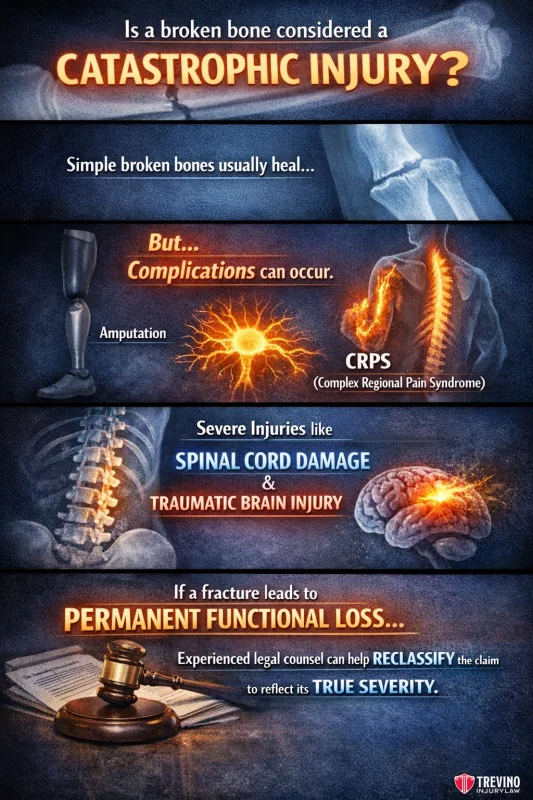
No, a simple broken bone is rarely considered catastrophic unless it results in permanent nerve damage, amputation, or complex regional pain syndrome (CRPS) that prevents future employment.
While catastrophic injuries are severe, often involving spinal cord injuries or traumatic brain damage, standard fractures typically heal. However, these injuries can lead to unforeseen complications; if a fracture results in permanent functional loss, experienced legal counsel can help reclassify the claim to reflect its true severity.
Does Surgery Automatically Make an Injury Catastrophic?
No, surgery alone does not qualify an injury as catastrophic. An injury often requires surgery to repair, but the determining factor is whether you face a permanent reduction in your quality of life after the procedure.
If someone else’s negligence has left you with chronic pain and suffering that prevents you from working, you need to seek financial compensation that covers your future needs, not just the past surgical bills.
Can I Claim Catastrophic Status for Emotional Trauma Alone?
Rarely, personal injury law in Texas typically requires a physical component (like a TBI) to anchor a catastrophic claim, rather than emotional distress alone. However, victims of catastrophic events often suffer profound mental anguish.
Don’t let insurance companies dismiss this trauma; with proper legal representation, we can prove that the psychological damage is a permanent “new normal” necessitating the compensation you deserve.
When Is It Too Late to Upgrade Your Claim to Catastrophic?
It is too late to upgrade your claim once you have signed a release of liability or accepted a settlement check, as these actions permanently close your case regardless of future medical decline.
Many victims make the mistake of accepting a quick offer from the insurance company while they are still in the hospital, thinking they can ask for more money later if complications arise.
Under Texas law, once that release is signed, you are barred from seeking additional compensation forever, even if a latent brain injury manifests years later or you require an unexpected amputation.
Catastrophic vs. Serious Injury Settlements: What’s the Difference?
The primary difference is that catastrophic settlements typically include “future damages” outlined in Life Care Plans, which often total millions of dollars, whereas serious injury settlements focus primarily on “past damages” and temporary lost wages. In a standard “serious” injury case, perhaps involving a leg fracture from a crash on I-35, the payout covers the surgery and three months of missed work.
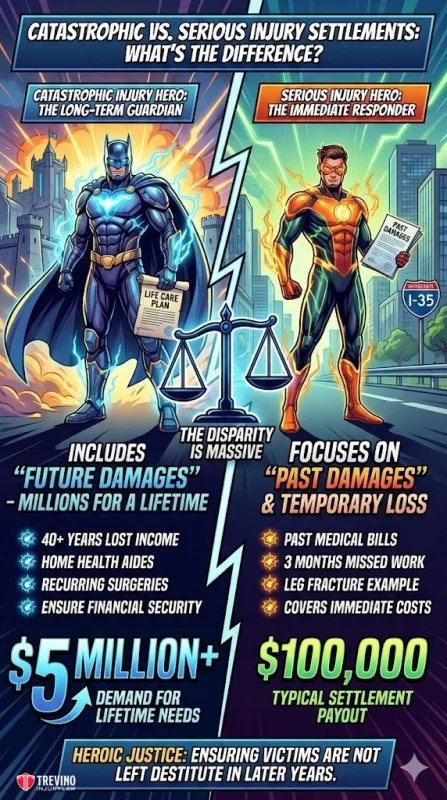
In a catastrophic case, the settlement must cover 40+ years of lost income, home health aides, and recurring surgeries. The disparity is massive; a serious injury claim might settle for $100,000, while a catastrophic claim for the same accident type could require a $5 million demand to ensure the victim is not left destitute in their later years.
What Happens If Your Injury Is Ruled ‘Non-Catastrophic’ by the Court?
If your injury is ruled non-catastrophic, your compensation will be limited to standard medical bills and lost wages incurred to date, likely excluding the multi-million-dollar future care costs necessary for long-term survival. This ruling effectively caps your recovery at a fraction of your actual needs.
For a paralyzed victim, this is a disaster; it means the cost of wheelchairs, accessible housing in Leon Valley, and daily nursing care will eventually fall on the family or the taxpayer once the limited settlement money runs out. Proving the “catastrophic designation” is the only firewall between a secure future and eventual bankruptcy.
Why Hire a San Antonio Catastrophic Injury Lawyer?
Your fight for a secure future does not end with a Maximum Medical Improvement diagnosis in Bexar County; it begins with securing fair and just financial compensation. Insurance adjusters ruthlessly downgrade permanent losses to temporary impairments, aided by settlement mills that fold before trial. At Trevino Injury Law, we fight for families and force corporate defendants to fund your entire future.
Want to Protect the Full Value of Your Claim?
You’ve seen how this affects your case — but this is only one piece of the puzzle. Our Catastrophic Injury Lawyer page breaks down what a trial-ready firm does differently.
We turn $20,000 lowball offers into over a million in lifetime care. Let us act as your San Antonio catastrophic personal injury attorney 24/7 and initiate a forensic qualification review to scientifically prove your permanent disability.
Call 210-TREVINO for a free case review. Se Habla Español. No Win, No Fee.