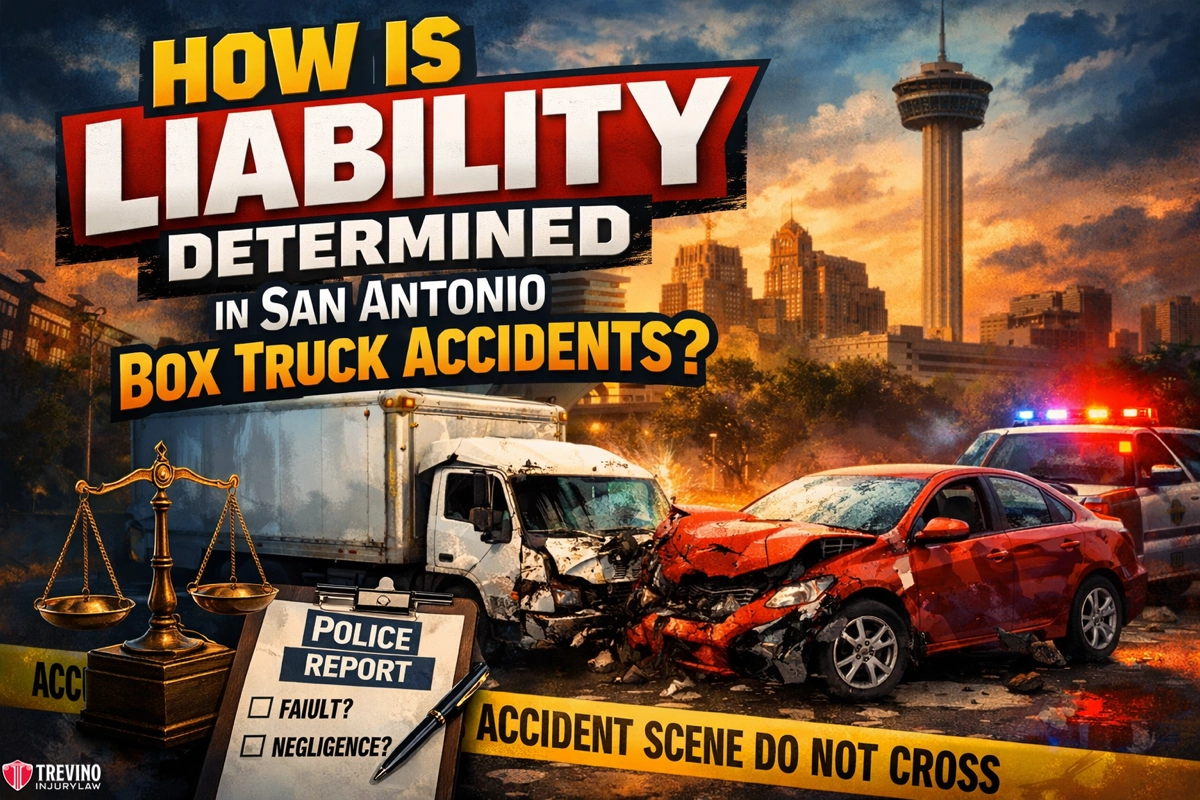
Liability in a San Antonio box-truck crash is allocated among the driver, the delivery service partner, and the parent corporation through a forensic investigation of corporate control. If the parent company dictates the delivery route and performance quotas, they own the resulting damage.
Commercial insurance carriers immediately deploy the unavoidable-accident defense to shield their multi-layered insurance towers, blaming the crash on an act of God even when black-box data proves the driver had ample time to react. According to local crash records, Bexar County saw 18 fatalities involving commercial vehicles in 2024. That is not an unavoidable tragedy; it is the direct result of federal hours-of-service violations and neglected cargo loading protocols.
What Could Your Box Truck Accident Case Be Worth?
Answer a few quick questions about your accident. Takes about 60 seconds.
See What My Case Might Be WorthThe insurance company offered less than $20,000. I ended up with over $1 million. — Jackie Galindo
Major carriers legally purge driver qualification files and shipping manifests just weeks after a collision. A Spoliation Letter, a legal demand that stops the trucking company from destroying evidence, must go out immediately to lock down the electronic control module.
Trevino Injury Law’s box-truck accident attorney subpoenas corporate logs and dismantles the defense. Call 210-TREVINO for a free case review. You pay nothing unless we win. Se Habla Español.
How Do San Antonio Courts Use FMCSA Violations to Determine Liability?
In San Antonio litigation, violations of the Federal Motor Carrier Safety Regulations (FMCSR) are often treated as negligence per se. This principle was significantly clarified in Supreme Beef Processors, Inc. v. Lipari, which holds that when a driver violates a safety-standard statute, such as federal Hours of Service regulations, the violation can serve as conclusive evidence of negligence, thereby streamlining the path to establishing fault.
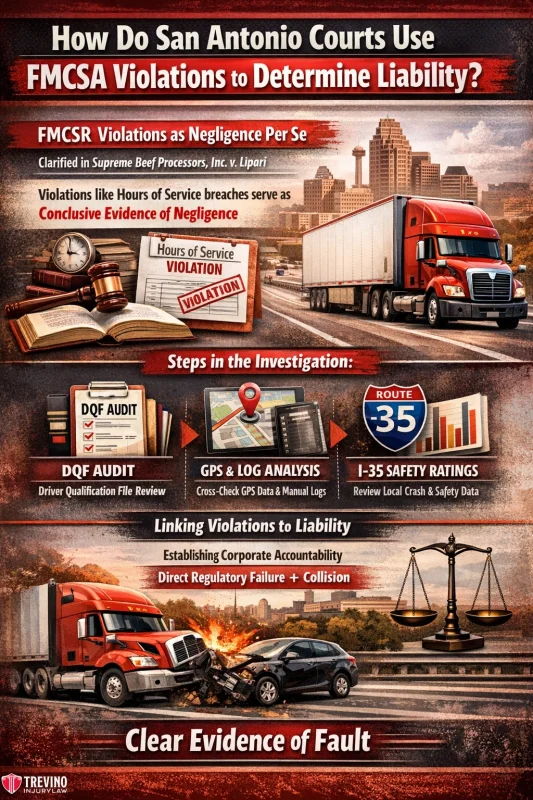
While standard investigations look for basic traffic errors, this specialized process involves a step-by-step DQF audit, cross-referencing GPS timestamps with manual logs, and analyzing local I-35 safety rating data. By establishing a direct link between a regulatory failure and the collision, we create a foundation for corporate accountability.
What Evidence Proves a Company Is Liable for Its Driver?
To hold a delivery carrier liable for a box truck wreck, we must satisfy the doctrine of respondeat superior by proving that the driver was acting within the scope of their employment.
Under the landmark Texas Supreme Court ruling in Goodyear Tire and Rubber Co. v. Mayes, the ‘Right of Control‘ is the determining factor; if the corporation dictates the details of the driver’s work, such as route monitoring and performance quotas, the company is legally responsible for the resulting damages.
This evidentiary process focuses on the employer-employee relationship (Respondeat Superior) to prove that the company’s operational demands contributed to the accident. Once we establish that a driver’s violation forms the basis for negligence, we must determine how that fault is apportioned when multiple vehicles are involved in a single wreck.
Who Determines Accident Liability in a Multi-Vehicle Pileup?
Accident liability is determined through police reports and the “proportionate responsibility” findings of a Bexar County jury, which is critical given that Bexar County saw 18 fatalities and 46 suspected serious injuries involving commercial vehicles in 2024.
This process uses forensic reconstruction techniques to analyze “Insurance Towers” from Loop 410 crashes, ensuring that liability is accurately identified when damages are life-altering.
Identifying these parties is only half the battle; we must then confront the specific methods insurance carriers use to shift blame back onto the victim.
How Do Cargo Loading Errors Create Third-Party Liability?
- Unsecured weight in medium-duty box trucks can shift the center of gravity, leading to rollovers.
- Freight brokers or independent loaders may be held liable if they fail to follow federal loading protocols.
- Loading violations often occur during rapid turnaround times at local distribution centers.
How Do Insurance Companies Figure Out Who’s at Fault?
Insurance companies determine fault by reviewing statements, vehicle damage patterns, and electronic data to assign a percentage of negligence to the victim, thereby reducing the payout under Texas law. In San Antonio, commercial carriers frequently use “unavoidable accident” defenses, even when “Black Box” (ECM) data shows the driver had ample time to react.
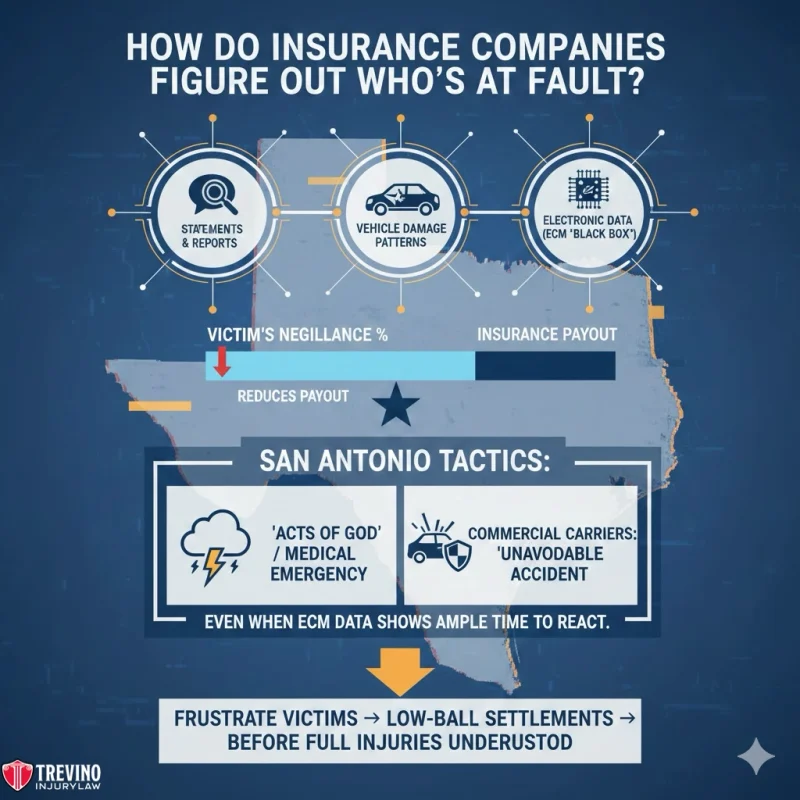
What insurance denies most claims? Insurance companies often invoke the “acts of God” or sudden medical emergency defenses to deny claims, though in San Antonio, commercial carriers frequently invoke the “unavoidable accident” defense to shield their policy limits. These tactics are designed to frustrate victims into accepting low-ball settlements before the full extent of their injuries is understood.
What Not to Say to an Insurance Claim Adjuster?
You should never provide a recorded statement to an insurance claim adjuster because these statements are designed to “lock” a victim into a version of events before the full medical extent of their injuries is known. Understanding these defense tactics prepares you for the next phase of the process: identifying exactly which policies will cover your medical bills and lost wages.
Who Pays for a Car Pile-up Involving a Commercial Box Truck?
In a commercial pileup, the “primary” liability coverage of the at-fault truck driver pays first, followed by the “excess” or “umbrella” policies of the parent carrier and any third-party logistics providers involved.
This hierarchy of the “Insurance Tower” is critical in San Antonio crashes where damages often exceed the minimum limits of a single policy. This financial hierarchy provides the necessary resources for your recovery, but accessing it requires navigating the specific evidence rules insurers use during the initial investigation.
How Do Insurers Determine Who Was at Fault in Bexar County?
In a commercial pileup, the “primary” liability coverage of the at-fault truck driver pays first, followed by the “excess” or “umbrella” policies of the parent carrier and any third-party logistics providers involved.
This hierarchy of the “Insurance Tower” is critical in San Antonio crashes where damages often exceed the minimum limits of a single policy. This financial hierarchy provides the resources necessary for your recovery, but accessing it requires navigating the specific evidentiary rules insurers use during the initial investigation.
Does Liability Mean Who Was at Fault in Texas?
Yes, in Texas, liability is the legal responsibility for damages resulting from being found at fault in an accident.
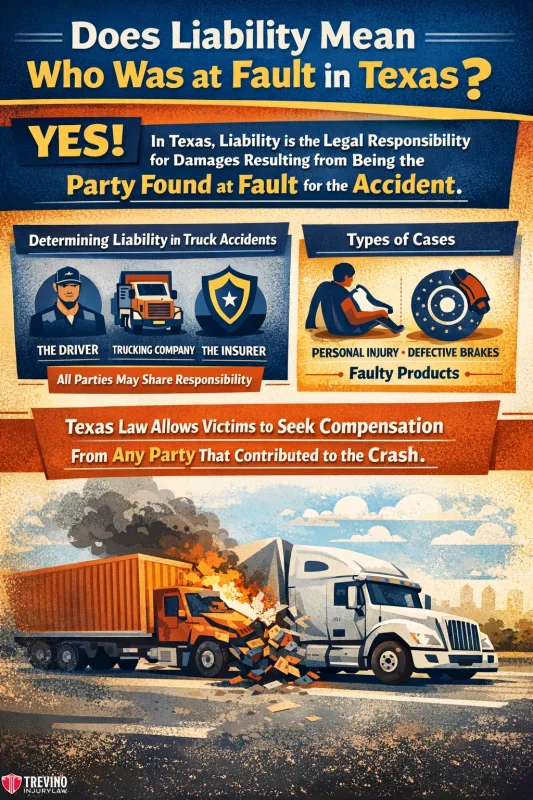
In truck accident claims, determining liability often involves identifying whether trucking companies and their insurers share responsibility alongside the driver. Whether the case involves personal injury or product liability due to faulty brakes, Texas law allows victims to seek compensation from any party that contributed to the crash.
Is It Illegal to Sleep in Your Box Truck While on Duty?
No, it is not illegal to sleep in the truck, but it is illegal to count that time as “off-duty” rest if the vehicle lacks a DOT-approved sleeper berth.
The Federal Motor Carrier Safety Administration (FMCSA) sets strict hours-of-service rules; if a truck driver falsifies logs to hide fatigue, the company may be held responsible for negligence. If a crash occurs, accident reconstruction experts often examine these rest periods to determine whether mechanical failure or driver exhaustion caused the incident.
DWI vs. Regular Negligence in Commercial Liability
| Negligence Type | Definition | Damage Impact |
| Regular Negligence | Failure to use ordinary care (e.g., speeding). | Standard economic and non-economic damages. |
| DWI/Gross Negligence | Extreme disregard for the safety of others. | Triggers punitive damages meant to punish the defendant. |
What Happens If You Don’t Prove Corporate “Right of Control”?
If you fail to prove the parent corporation maintained a “Right of Control,” you may be barred from suing the major carrier and limited only to the driver’s smaller personal insurance policy.
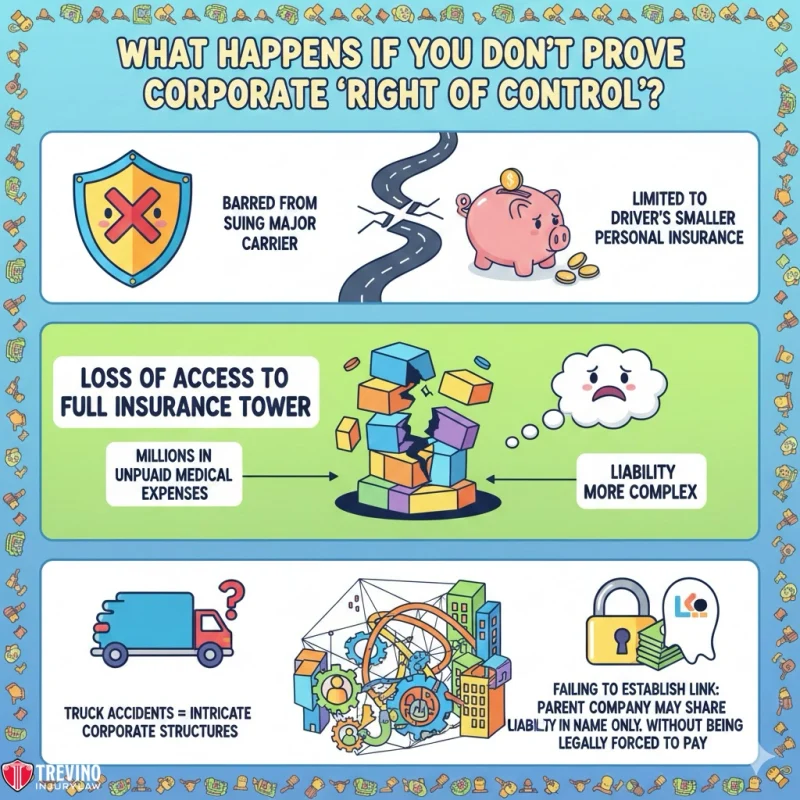
This loss of access to the full insurance tower can leave victims with millions in unpaid medical expenses, as liability is more complex when multiple entities may share liability for a single collision. Because truck accidents involve intricate corporate structures, failing to establish this link means the truck owner or parent company may share liability in name only, without being legally forced to pay.
When Is It Too Late to Identify Additional Liable Parties?
It is effectively too late to identify liable parties once the carrier has legally purged their driver qualification files and shipping manifests, which often occurs just weeks after the collision. Acting quickly ensures you can capture electronic data from the truck and verify whether the company failed to maintain it properly.
Once this evidence is destroyed, determining liability in truck accidents becomes significantly harder, as you lose the ability to prove how poor truck maintenance or a defective truck may have caused the crash. Furthermore, parties liable under product liability laws, such as part manufacturers, often go unnoticed if the physical evidence is not preserved immediately.
Why Hire a San Antonio Box Truck Accident Lawyer?
Failing to prove “Right of Control” leaves you stranded with a driver’s minimum policy while parent corporations escape accountability for Loop 410 crashes. Carriers purge records to bury the truth, and settlement mills easily fold under pressure. Trevino Injury Law fights for families, forcing negligent companies to pay fair financial compensation.
Want to Protect the Full Value of Your Claim?
You’ve seen how this affects your case — but this is only one piece of the puzzle. Our Box Truck Lawyer page breaks down what a trial-ready firm does differently.
We leverage a $17 Million truck accident settlement record to dominate the Bexar County Courthouse. Our San Antonio personal injury accident attorney immediately issues spoliation letters to freeze ECM “Black Box” data before it is erased.
Call 210-TREVINO for a free case review. Se Habla Español. You pay nothing unless we win your case