A San Antonio Slip and Fall Lawyer is a specialized premises liability advocate who establishes negligence against commercial property owners across Bexar County. The need for aggressive litigation is critical; 2024–2025 reporting from the National Safety Council indicates fall-related deaths among older adults surged by 53% over the last decade, with emergency visits rising by 43%. Unlike general firms, we overcome the complex “constructive notice” defenses used by major retailers like HEB and Walmart to deny liability.
San Antonio Slip and Fall Lawyer Litigation: Trial Lawyer Takeaways
- As your San Antonio Slip and Fall Lawyer, we establish negligence in commercial districts like Alamo Ranch and throughout Bexar County.
- Trevino Injury Law secured a $536,007 jury verdict by rejecting a lowball $5,000 offer and fighting insurers in San Antonio.
- We prove constructive notice by demonstrating the property owner violated their duty to inspect the premises before your injury.
- Your attorney sends immediate spoliation letters to stop retailers like HEB from destroying critical surveillance video of the fall.
Do You Qualify For Full Compensation?
“The insurance company offered less than $20,000. I ended up with over a million.” – Jackie Galindo
From the King William District to Alamo Ranch, we ensure property owners who prioritize profits over safety face accountability. When insurers try to delete video evidence or blame you, Trevino Injury Law counters with over 20 years of trial experience and multi-million dollar verdicts.
We know a fall is rarely an accident; it results from hazards that are ignored, such as spills, broken steps, or inadequate lighting. We build trial-ready cases that prove the owner knew of the danger, forcing them to pay for your medical bills, lost wages, and spinal injuries. “Store policy” is not the law. The floor was wet, the sign was down, and the store was on notice.
Call 210-Trevino for a free case review. Se Habla Español.
Who Is Liable for a San Antonio Slip and Fall Accident?
In Texas personal injury law, the property owner or manager is liable only if they knew or should have known about the dangerous condition and failed to fix it. Premises liability is the area of law that holds landowners accountable, but simply falling on someone’s property does not automatically guarantee compensation.
To win a case in San Antonio, we must prove the owner violated the “duty of care” owed to you as an invitee, a customer, or a guest invited onto the property for business purposes. Establishing this duty is the easy part; proving they breached it is where most claims fail.
How Do You Prove Constructive Notice in Texas?
You prove constructive notice by demonstrating that the hazard existed long enough for the store to have discovered and fixed it through reasonable inspection. This is the “time-to-clean” standard, which often serves as the central battleground in slip and fall litigation.
If a jug of milk spills and you fall ten seconds later, the store likely isn’t liable because they had no time to react. However, stores must also account for San Antonio’s specific conditions. For example, during sudden heavy rainstorms, businesses know customers track water onto polished concrete or Saltillo tile entryways. If they failed to place mats or warning signs despite knowing it was raining, they may be liable for “constructive notice” of the danger.
We use surveillance footage and maintenance logs to establish this “temporal proximity,” proving the danger was present long enough to be found. Even with proof, they will try to shift the blame to you.
Can You Sue If You Were Partially at Fault?
Yes, you can still sue and recover damages for a slip and fall in Texas as long as you are not more than 50% responsible for the accident. As codified in Texas Civil Practice and Remedies Code §33.001, a claimant may not recover damages if their percentage of responsibility is greater than 50 percent. Under this “Modified Comparative Negligence” rule, your compensation is reduced by your percentage of fault.
For example, if a jury awards you $100,000 but finds you were 20% at fault for looking at your phone, you would receive $80,000. However, if you are found to be 51% at fault, you are barred from recovering anything. To prevent them from assigning you 51% of the blame, we need undeniable proof.
The “No Sidewalk” Defense in North San Antonio
In areas like Helotes or Stone Oak, where sidewalks may end abruptly, insurance adjusters often try to blame pedestrians for walking on the road. However, TxDOT regulations explicitly state that if no sidewalk is provided, you must walk on the left side facing traffic.
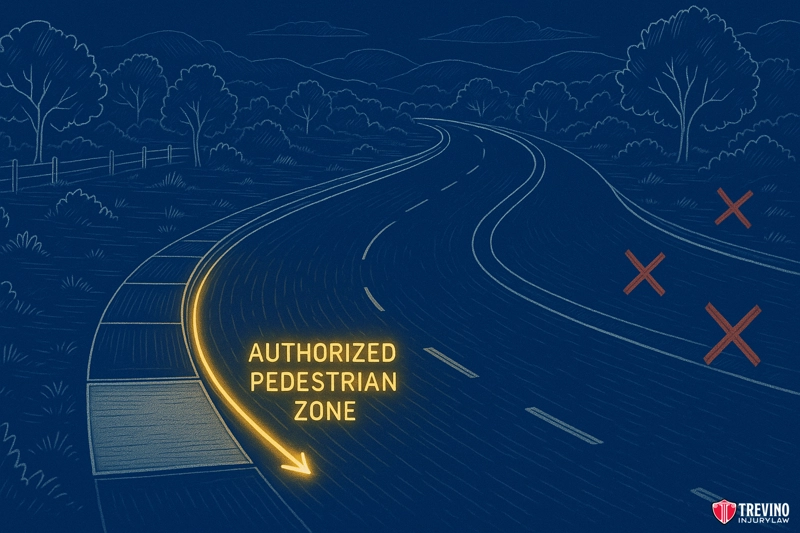
If you were following this rule and were struck or forced into a hazard, we use this regulation to dismantle their argument that you were “negligent” for being on the roadway.
What If the Store Claims They Didn’t Know About the Spill?
If the store claims ignorance, we aggressively seek evidence of “actual knowledge” or a pattern of negligence through employee depositions and internal reports. We look for evidence that an employee created the hazard themselves, which automatically establishes knowledge, or that similar incidents had occurred in the same location.
We subpoena “sweep logs” to see if inspections were actually performed or just signed off on paper. By proving they failed their own safety protocols, we dismantle the “we didn’t know” defense. Proving knowledge requires evidence that disappears quickly.
How Do Premises Liability Laws in Texas Affect Your Case?
Yes. As delineated in State Dep’t of Highways & Pub. Transp. v. Payne, 838 S.W.2d 235 (Tex. 1992), Texas law divides entrants into three categories, invitees, licensees, and trespassers, each with a different duty of care. Insurance adjusters often attempt to misclassify victims as ‘licensees’ to avoid the higher ‘duty to inspect’ owed to business invitees, making the correct legal classification of your visit the first priority of our defense.
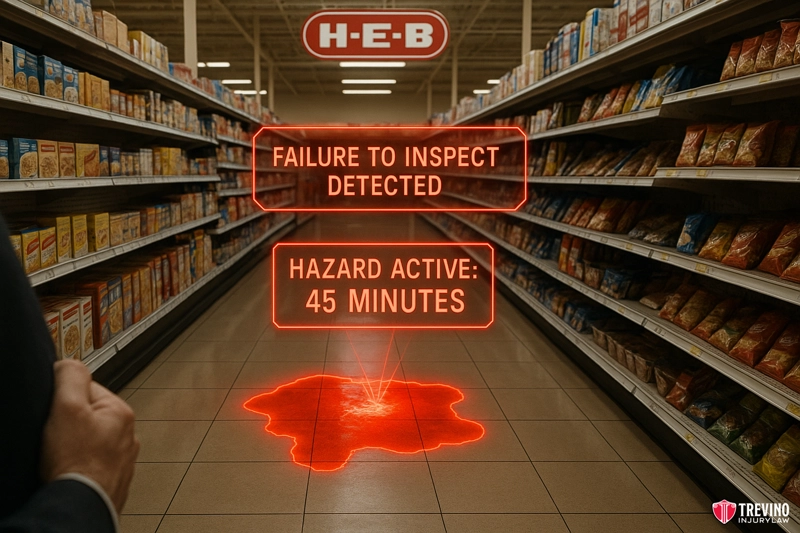
The “Invitee” Standard (Maximum Protection)
An Invitee is someone who enters a property for the mutual benefit of both parties. This includes shoppers at H-E-B or North Star Mall, diners at a River Walk restaurant, or clients visiting an office building.
- The Duty: Property owners owe Invitees the highest duty of care. They must not only fix known hazards but also actively inspect the premises to discover hidden dangers.
- The Argument: If you slip on a spill at a grocery store, we do not need to prove an employee saw it. We only need to prove that a “reasonable inspection” would have caught it. This “duty to inspect” is the most powerful weapon in slip and fall litigation.
The “Licensee” Standard (Limited Protection)
A Licensee is someone who has permission to enter but is there for their own benefit, not the owner’s. This often includes social guests at a friend’s house or a salesperson entering an office uninvited.
- The Duty: The owner only has to warn you of known dangers that are not “open and obvious.” They typically do not have a duty to inspect the property for you.
- The Risk: If you fall at an apartment complex where you are not a tenant or an invited guest, the defense may argue you were merely a Licensee, significantly raising the bar for proving negligence.
The “Trespasser” Standard (Minimal Rights)
A Trespasser enters without permission. Generally, owners owe no duty to trespassers beyond not intentionally harming them.
- The Exception: The “Attractive Nuisance” doctrine protects children. If a child is injured at an unsecured construction site in a growing area like Alamo Ranch or Stone Oak, the developer may still be liable because the site naturally attracts children who do not understand the danger.
Why Hire a San Antonio Personal Injury Lawyer for Your Case?
Hiring a trial lawyer is essential because insurance companies typically offer 40% less to “settlement mill” firms that are known to avoid the courtroom. Trevino Injury Law prepares every premises liability case as if it will go to trial, which is the only leverage that forces giants like Walmart or commercial insurers to pay fair value. A lawyer can help by immediately securing the evidence that stores try to hide. Volume-based firms often lack the resources to depose store managers or hire safety experts, leading them to accept lowball offers just to close the file.
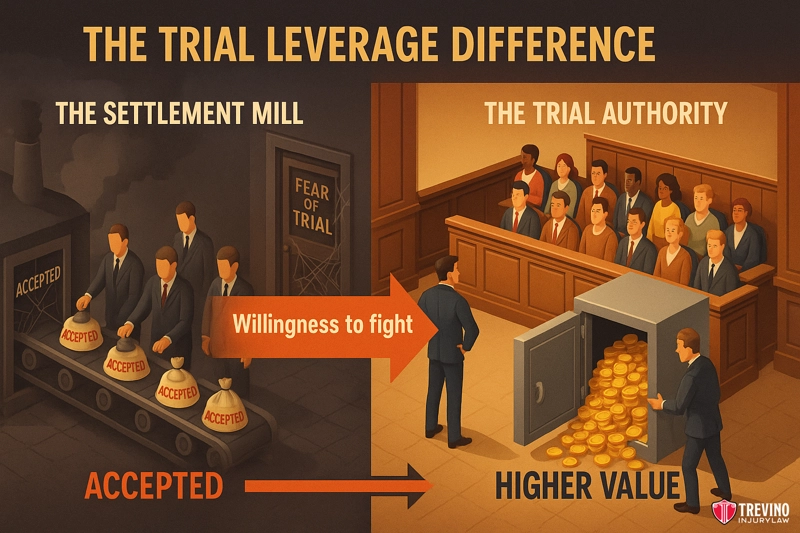
Our trial-readiness signals to the defense that we are willing to let a Bexar County jury decide the outcome, thereby dramatically increasing the value of your claim. The first sign of our trial readiness is how we aggressively secure evidence.
How Does a Spoliation Letter Protect Your Slip and Fall Case?
A spoliation letter is a formal legal demand sent immediately to the property owner requiring them to preserve all evidence related to your accident, including surveillance video and maintenance records. Without this letter, Texas stores are often legally permitted to delete video footage within 24 to 48 hours in the “ordinary course of business.”
Once that video is deleted, it is gone forever, leaving you with only your word against theirs. We send this demand via certified mail immediately upon hiring to lock down the “smoking gun” evidence needed to win your case. Securing this evidence costs money, which is why clients ask about fees.
Do Injury Lawyers in San Antonio Offer a Free Consultation?
Our San Antonio slip and fall lawyers work on a contingency fee basis, meaning you pay $0 upfront and we only get paid a percentage of the settlement or verdict we win for you. We advance all litigation costs, including court filing fees, expert witness payments, and deposition expenses. If we do not win your case, you owe us nothing for our time or these expenses. This model ensures that high-quality legal representation is accessible to everyone in South Texas, regardless of their financial situation. Because we invest our own capital, we fight for the highest possible return.
How Much Is a Personal Injury Claim Worth for Slip and Fall Victims?
The value of a slip and fall settlement depends primarily on the severity of your injuries, the clarity of liability, and the available insurance policy limits. A case involving a simple sprain might settle for medical bills plus a modest amount for pain, while a case involving a traumatic brain injury or spinal surgery can reach well into the six or seven figures.
We calculate the total value by combining “Economic Damages” (such as past and future medical bills and lost wages) with “Non-Economic Damages” (such as physical pain, mental anguish, and physical impairment). We don’t just guess at these numbers; we look at our track record.
How Our Trial Approach Maximized These Settlements
Rejection of lowball offers and willingness to go to trial yield significantly higher compensation, as proven by our actual jury verdicts in Bexar County.
- $536,007 Jury Verdict (Arriaga v. Montemayor): In this case involving a low back injury, the defense offered a mere $5,000 to settle. We took the case to trial and secured a verdict over 100 times that amount.
- $291,550 Jury Verdict (Guerrero v. Soloman): Facing a settlement offer of only $25,000 for low back and neck injuries, we fought in court and won a verdict more than 11 times the initial offer.
These results show that insurance companies often undervalue claims until they face a trial lawyer in court. As our client Coach DeLuna noted after we took his case to trial and won on appeal: “Mr. Trevino won the case and made them pay more than 4 times the policy.”
How Does an Accident Attorney in San Antonio Calculate Pain and Suffering?
Pain and suffering damages are often calculated by multiplying your economic damages (medical bills) by a factor of 1.5 to 5, depending on the severity and permanence of your injury. There is no fixed “calculator” in Texas law; instead, juries consider how the injury has affected your daily life, relationships, and mental health. Severe injuries like herniated discs or complex fractures that require surgery and limit your ability to work or play with your children typically warrant higher multipliers.

We document these impacts through daily pain journals and testimony from family members. While waiting for this settlement, you still need medical care.
Who Pays for Medical Bills While the Lawsuit Is Pending?
You can receive medical treatment without paying upfront through a “Letter of Protection” (LOP), which is an agreement between your attorney and the medical provider to pay the bill from your future settlement. This allows you to get necessary surgeries or therapy immediately, even if you don’t have health insurance.
We also coordinate with health insurance, Medicare, and major local providers such as University Health and Methodist Healthcare to ensure bills are paid, and then seek reimbursement for those costs from the at-fault party. This ensures your credit is protected while we fight for your compensation.
Documenting these injuries is crucial, especially for common fall-related traumas.
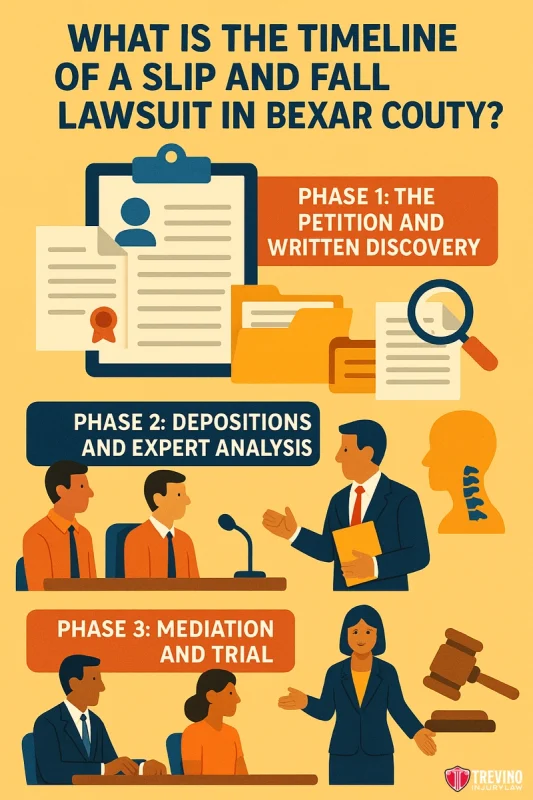
What Is the Timeline of a Slip and Fall Lawsuit in Bexar County?
Many victims worry that filing a personal injury lawsuit means spending years in court. While complex cases involving catastrophic injuries can take time, Trevino Injury Law follows a structured litigation process designed to apply maximum pressure on the defendant to settle fairly. We move your case through specific legal phases, each serving a strategic purpose.
Phase 1: The Petition and Written Discovery (Months 1-6)
If the insurance company denies liability or offers a lowball settlement, we file a formal Original Petition with the Bexar County District Clerk. This officially starts the lawsuit.
- Written Discovery: We serve the defendant with “Requests for Production,” demanding they hand over safety manuals, sweep logs, and internal emails. We often find that big box stores violate their own safety policies, which serves as powerful evidence of negligence.
- Medical Stabilization: During this time, you focus on reaching “Maximum Medical Improvement” (MMI). We cannot accurately value your case until your doctor confirms the full extent of your permanent impairment.
Phase 2: Depositions and Expert Analysis (Months 6-12)
This is the most aggressive phase of litigation. We conduct Depositions, putting the store manager, employees, and witnesses under oath in front of a court reporter.
- The Strategy: We ask specific questions to expose inconsistencies in their story. Did they actually walk the aisle as claimed? Why is the sweep log unsigned?
- Experts: For severe falls, we may retain biomechanical experts to prove how the fall caused your specific spinal or head injury, countering the defense’s claim that your pain is from “pre-existing conditions.”
Phase 3: Mediation and Trial (Months 12-18)
Most Bexar County judges require parties to attend Mediation before a trial date is set. A neutral mediator acts as a referee to help both sides reach a settlement.
- The Leverage: Because we prepare every case for trial, we enter mediation with a “trial-ready” file. Insurance companies know that if mediation fails, we are fully prepared to pick a jury.
- The Verdict: If they refuse to pay fair value, we proceed to trial. As noted in our case results, juries often award significantly more than the insurance company’s “final offer” when presented with clear evidence of negligence.
What Serious Injuries Commonly Result from Slip and Fall Injuries?
Slip, trip, and fall accidents frequently cause catastrophic orthopaedic and neurological injuries that require surgical intervention and long-term rehabilitation. Local data illustrates the scale of this problem: a study of San Antonio EMS records revealed 26,901 fall-related injuries over a three-year period, with nearly half involving older adults.
Whether caused by a wet floor or an uneven sidewalk, the sudden impact of hitting a hard surface like concrete or tile often results in more than just bruises; we routinely see Traumatic Brain Injuries (TBIs) from head strikes, spinal cord injuries, including herniated discs, and complex fractures of the hip, wrist, or ankle. In older victims, a hip fracture can permanently alter mobility and independence; according to 2025 CDC data, unintentional fall death rates for adults over 65 have reached 69.9 per 100,000, reflecting a substantial long-term upward trend in severity.
These injuries often occur at the most frequented locations in San Antonio.
Can a San Antonio Slip and Fall Attorney Help You Sue HEB or Walmart?
Yes, you can sue major retailers like HEB or Walmart, but these companies are typically “self-insured” and use aggressive, specialized teams to deny every claim from the start. Unlike a typical car accident, where an insurance adjuster might settle quickly, HEB and Walmart often force litigation, banking on the fact that most lawyers won’t take them to court.
We have the resources and experience to litigate against these corporate giants, demanding the production of their internal safety manuals and surveillance video to prove they failed to keep their aisles safe. While stores are private, falls on city property have different rules.
What Laws Apply to Falls on Public Sidewalks in San Antonio?
Suing for a fall on a public sidewalk in San Antonio requires navigating the Texas Tort Claims Act and strict “Notice of Claim” deadlines that are much shorter than standard negligence cases. In San Antonio, filing deadlines differ strictly based on who owns the property:
- Private Property (Stores/Homes): You have two years from the date of the accident to file a lawsuit.
- City Property (Public Sidewalks): Per Section 150 of the San Antonio City Charter, you must file a formal “Notice of Claim” with the City Clerk within just 90 days of the injury. Failure to meet this strict 90-day administrative deadline typically results in your case being thrown out. Furthermore, local ordinances (§§29-11) often place the burden on the adjacent property owner to keep sidewalks free from defects and obstructions, adding another layer of complexity to liability determination.

Failure to meet this 90-day administrative deadline typically results in your case being thrown out, regardless of how severe your injuries are.
Who Is Liable for Falls on the River Walk?
The San Antonio River Walk presents a complex legal challenge because liability often depends on exactly where you fell. If you slip on a public pathway, you may be able to sue the City of San Antonio (which triggers the strict 90-day notice rule). However, if you fall on a restaurant’s leased patio or a slippery ramp entering a business, the private owner is likely liable.
We use land surveys and lease agreements to identify the correct defendant immediately, ensuring you don’t miss the tighter deadlines for government claims.
What Is the Deadline to File a Personal Injury Case Under Texas Law?
In Texas, you strictly have two years from the date of your slip and fall accident to file a formal lawsuit against the negligent property owner, as established by Texas Civil Practice and Remedies Code §16.003. If you miss this non-negotiable deadline, you permanently lose your right to seek compensation for medical bills and pain and suffering, regardless of your injury’s severity.
While two years might sound like a long time, waiting is the most dangerous mistake a victim can make. The “statute of limitations” is merely the final cutoff for filing papers at the Bexar County Courthouse; the practical deadline for building a winning case is much shorter. As we established, corporate defendants often destroy video evidence within days under the guise of “ordinary business,” long before the two-year mark approaches.
Furthermore, physical evidence changes rapidly—a store might repair the broken tile or improve the lighting that caused your fall just days after the incident. If you wait months to contact an attorney, that physical proof of negligence is likely gone. We frequently encounter clients who waited too long, only to find that while they are technically within the two-year filing window, the critical evidence needed to prove the owner’s liability was erased months ago.
Knowing the absolute deadline is important, but taking specific actions in the first hour matters even more.
What Steps Should You Take After a Slip and Fall Accident Occurred?
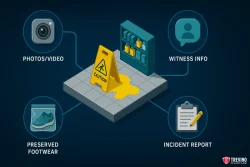
Collecting immediate evidence at the scene is the single most effective way to protect your future claim against a store’s denial of liability. Most commercial property owners in San Antonio will aggressively defend their bottom line by claiming the hazard didn’t exist or that you simply weren’t paying attention, making your initial documentation critical. To build a claim that survives the insurance company’s scrutiny, you must gather specific proof before leaving the premises:
Photos and Video: Take wide shots to show the location and close-ups of the hazard itself, whether it is a spill, a cracked sidewalk, or a loose handrail.
Witness Information: Collect names and phone numbers from any bystanders or fellow shoppers who saw the fall, as their independent testimony can override the store’s version of events.
Incident Report: Force the manager to document the event in writing and request a copy; if they refuse, take a photo of their report or record the conversation if possible.
Footwear and Clothing: Preserve the shoes and clothes you were wearing in a bag without washing them, as the defense may later argue your footwear was unsafe.
Do I Need a Police Report for a Slip and Fall?
No, police generally do not respond to falls on private property; instead, you must file an internal incident report with the store manager immediately.
Does a “Wet Floor” Sign Prevent Me From Suing?
Not necessarily. While Texas law generally relieves owners of the duty to remedy obvious hazards, the Texas Supreme Court in Austin v. Kroger Texas, L.P., 465 S.W.3d 193 (Tex. 2015), recognized key exceptions, such as when the use of the premises is necessary and the invitee has no choice but to encounter the risk. If a ‘wet floor’ sign is placed in an unavoidable path or the hazard is effectively inescapable, the owner may still be held liable despite the warning.
Are Pedestrian Accidents Considered Slip and Falls?
Often, yes. October 2024 was identified by TxDOT as the deadliest month for pedestrians, with 89 killed on Texas roads. If your fall or injury occurred due to unsafe walking conditions near a roadway, standard premises liability or negligence laws may apply, depending on the location.
Can I Sue if I Fell at a Friend’s Apartment Complex?
Yes, the property management company or landlord, not your friend, is typically the liable party responsible for maintaining safe common areas, such as stairs and walkways.
What If I Slipped While at Work?
If you fell while on the job, you may have a “Non-Subscriber” claim if your employer opted out of Texas workers’ compensation. This is a critical distinction in Texas, where 15% of all work-related deaths in 2020 were caused by slips, trips, and falls, according to the Texas Department of Insurance. We have extensive experience here, including securing a $7.9 million verdict for an injured worker, proving that employers must provide a safe environment for their staff, not just customers.
What Happens If You Don’t Send a Spoliation Letter Immediately?
If you fail to send a spoliation letter within days of the accident, the store is legally permitted to delete surveillance footage in the “ordinary course of business.” Without this critical legal demand, the “smoking gun” video that proves the store ignored a spill for 45 minutes can be erased forever, leaving you with only your word against the store’s employees. In Bexar County courts, proving “constructive notice” often hinges entirely on this footage to establish how long the danger existed.
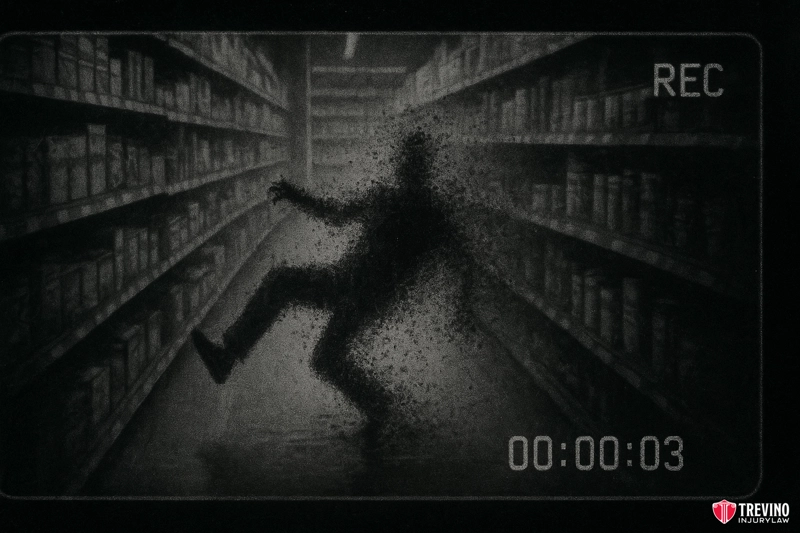
Once that digital evidence is overwritten, usually within 24 to 48 hours, it becomes exponentially harder to prove the property owner’s negligence, regardless of how severe your injuries are. Losing this evidence is damaging, but missing a legal deadline is fatal to your case.
When Is It Too Late to Sue for a Slip and Fall?
It is legally too late to sue once the two-year statute of limitations has expired, with very rare exceptions for minors or incapacitated victims. Once this two-year anniversary passes, your claim is forever barred, and no judge in Texas can reopen it, meaning you will bear the full financial burden of your future medical care.
Furthermore, if your fall occurred on government property, such as a sidewalk maintained by the City of San Antonio, you face an even stricter administrative deadline of just 90 days to file a formal notice. Failing to act within these strict timeframes results in a complete forfeiture of your rights.
Don’t Let Them Erase Your Case: Contact Trevino Injury Law
Property owners often delete video evidence within 48 hours to hide their negligence. Insurance adjusters deny liability, hoping you surrender. Settlement mills help them by accepting quick, cheap checks to avoid the courtroom. We refuse to fold. We preserve the evidence immediately and force corporate defendants to face a jury.
In Guerrero v. Soloman, the insurance company offered just $25,000 for our client’s injuries. A settlement mill might have accepted that lowball offer. We fought in the Bexar County Courthouse and secured a $291,550 jury verdict, more than 11 times their initial offer. We litigate to get the full value you deserve.
We only get paid when we win. Call 210-TREVINO for a free, confidential consultation. Se Habla Español.