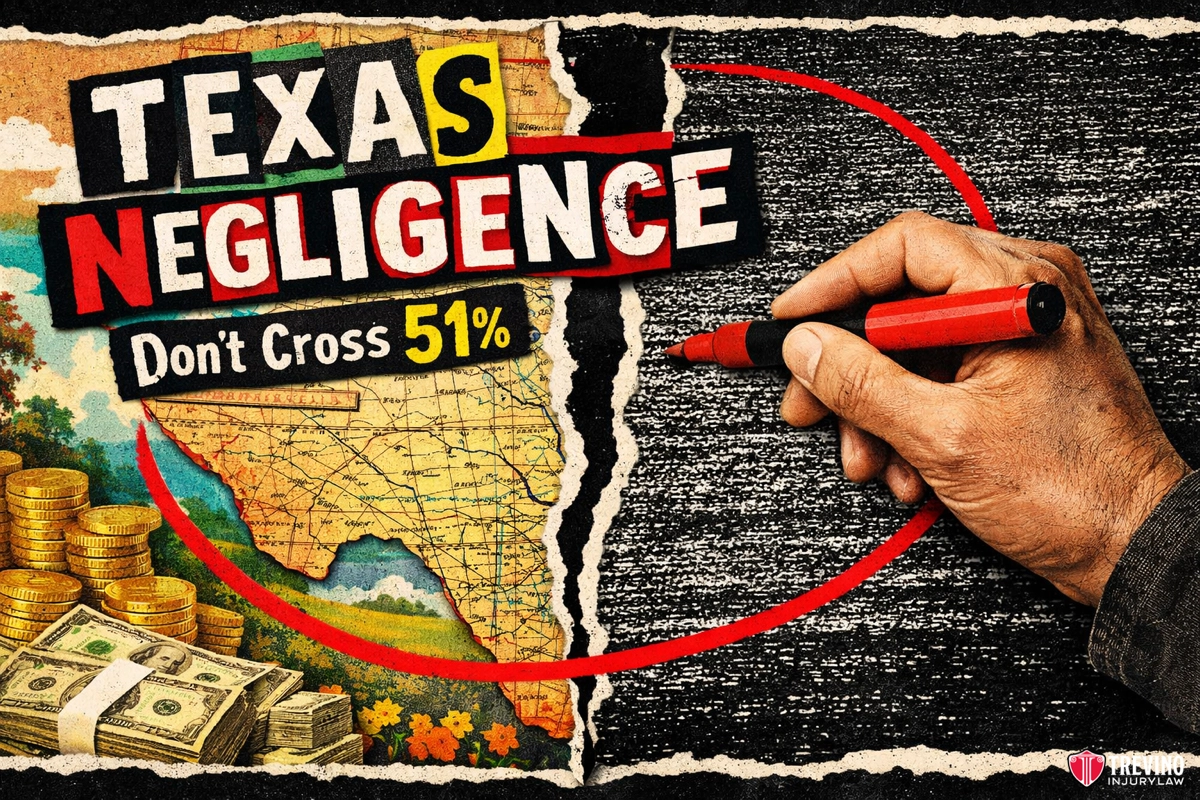
Texas Comparative Negligence Laws, specifically Texas’s 51% Rule (Proportionate Responsibility Act), are the legal statutes that determine if an injury victim can recover compensation based on their share of fault. This legal framework law bars recovery for any plaintiff found to be 51% or more responsible for their own injury.
Insurance adjusters often try to shift blame, manipulating facts to pin the blame on you so they pay nothing. Trevino Injury Law knows their playbook and uses strong evidence to prove the true fault lies with the negligent defendant.
San Antonio Comparative Negligence Litigation: Trial Lawyer Takeaways
- As your San Antonio personal injury lawyer, we stop insurance adjusters from pinning fault on you after crashes on corridors like Loop 410 in Bexar County.
- The Proportionate Responsibility Act bars recovery if you are 51% at fault, so we analyze black box data to prove the defendant’s negligence.
- Trevino Injury Law secured a $536,007 verdict in Arriaga by rejecting the insurer’s attempt to shift blame and deny the claim.
- Our team issues Spoliation Letters immediately to preserve evidence and prevent insurance companies from manipulating facts to save millions.
Do You Qualify For Full Compensation?
Fast, Free, and No Obligation
“The insurance company offered less than $20,000. I ended up with over a million.” – Jackie Galindo
This guide explains how comparative negligence works, how fault is determined in San Antonio courts, and why the difference between 50% and 51% fault is worth millions. We explore the math, the exceptions, and the defense strategies used to protect the compensation you deserve.
Don’t let an adjuster decide your degree of fault. Call us at 210-TREVINO today for a free consultation. Se Habla Español.
What Is the Texas 51% Rule in Personal Injury Cases?
The Texas 51% Rule, also known as the modified comparative negligence system, states that you cannot recover damages if you are found to be more than 50% responsible for the accident. Under Texas Civil Practice and Remedies Code Chapter 33, specifically the Proportionate Responsibility Act, the state operates under this system.
The statutory basis for this rule is codified in Section 33.001, which explicitly states that a claimant may not recover damages if their percentage of responsibility exceeds 50% (Texas Legislature Online, 2025). This framework was decisively reinforced by the Texas Supreme Court in Nabors Well Services, Ltd. v. Romero, 456 S.W.3d 553 (Tex. 2015).
In Nabors, the Court ruled that a plaintiff’s failure to use safety equipment (like seatbelts) is relevant evidence for a jury to consider when assigning fault for the accident. This means insurance adjusters can now use your own safety choices to push your liability over the 51% threshold and bar your recovery entirely.
If a Bexar County jury or insurance adjuster determines you hold 51% or more of the liability for a crash on Loop 410 or I-35, you are legally entitled to zero compensation—no matter how severe your accident and injuries are. This creates a high-stakes environment where a 1% difference in fault allocation determines whether you receive full justice or walk away with nothing.

Unlike “pure comparative” states, where a victim can recover even if they are 99% at fault, Texas follows a system that prioritizes personal accountability. Insurance adjusters know this statute intimately and often work backward to assign at least 51% of the blame to you immediately after a wreck.
They may twist innocent statements, like “I didn’t see him coming,” to argue you were distracted, pushing your liability over the threshold to deny your claim entirely.
How Does Texas Compare to Contributory Negligence States?
Unlike contributory negligence states that bar recovery for even 1% of fault, the law allows you to recover as long as you are not the primary cause.
It is important to understand that Texas’s comparative negligence law is fairer than the archaic “contributory negligence” systems used in states like Alabama or Virginia, where being even 1% at fault destroys your entire case. However, it is far stricter than “pure comparative” states like California or New York.
In Texas, you have a specific window of protection: as long as your responsibility does not exceed that of the defendants (essentially, as long as you are less at fault or equal to the defendant), you retain the right to seek financial recovery.
This balance protects victims of negligence while punishing those primarily responsible for their own harm.
Why Is the 51% Threshold Called a “Recovery Bar”?
The 51% threshold is called a recovery bar because crossing it by a single percentage point eliminates your right to any financial compensation whatsoever.
Think of the 51% rule as a cliff edge. At 50% fault, you are safe on the ledge and can still recover half of your damages. But at 51% fault, you fall off the cliff completely, and the value of your case crashes to zero.
Specifically, the law mandates that the court must reduce recoverable damages by a percentage equal to the claimant’s percentage of responsibility, provided that responsibility does not exceed the 50% bar (Texas Legislature Online, 2025). This “cliff effect” is why insurance companies fight so hard to shift blame.
They don’t need to prove they were innocent; they only need to prove you were slightly more at fault than they were. Once they push you over that 51% line, their financial obligation to you ends permanently.
This strict limit raises the practical question of how fault and compensation are calculated when you stay on the safe side of the cliff.
Your total compensation will be reduced by exactly the percentage of fault assigned to you by the insurance adjuster or jury. If you are found to be partially at fault for an accident but stay under the 51% bar, your payout is reduced proportionately.
For example, if a jury awards you $100,000 but finds you 20% at fault for speeding on Bandera Road, you forfeit 20% of the money, receiving a final judgment of $80,000. This reduction applies across the board to all comparative negligence cases, affecting damages for medical bills, lost wages, and pain and suffering.
This math reveals why fighting for every percentage point is critical. Statutorily, the “percentage of responsibility” must be stated by the trier of fact in whole numbers, meaning a single-digit shift from 50 to 51 changes the entire outcome (Texas Legislature Online, 2025). An insurance company that successfully argues you were 40% at fault instead of 0% at fault effectively keeps 40% of your settlement money in their pocket.

A Texas personal injury lawyer at Trevino Injury Law fights these allocations to minimize or eliminate the reduction.
Calculation Examples Under the 51% Rule
The following table demonstrates how damages based on your percentage of fault alter the final payout you receive.
| Total Damages Assessed | Your Assigned Fault | Compensation You Receive |
| $100,000 | 0% | $100,000 (Full Recovery) |
| $100,000 | 20% | $80,000 (Reduced Recovery) |
| $100,000 | 40% | $60,000 (Significantly Reduced) |
| $100,000 | 50% | $50,000 (Threshold Limit) |
| $100,000 | 51% | $0 (Barred from Recovery) |
Does the Rule Affect Passengers and Drivers Differently?
Passengers typically bear 0% fault in accidents, meaning they are entitled to 100% of their damages unless they actively interfered with the driver. In the vast majority of San Antonio car accidents, passengers are innocent victims. Because they were not in control of the vehicle, it is extremely difficult for an insurance adjuster to pin 51% (or even 1%) of the blame on them. Exceptions exist only in rare cases involving a passenger who knowingly rides with an intoxicated driver or physically grabs the steering wheel.
For drivers, however, the risk is constant. The risk is statistically significant in our area; in 2024 alone, 48,522 crashes were reported in Bexar County, each requiring a specific fault determination (TxDOT, 2024). You are the primary target for fault assignment, and adjusters will scrutinize your speed, lane changes, and evasive actions to find a way to reduce their payout.
This distinction leads to the adversarial reality of who actually decides these percentages and what evidence they use.
How Is Fault Percentage Determined in Texas Negligence Cases?
Fault percentage is initially estimated by insurance adjusters but ultimately determined by a jury at trial. In the early stages of a claim, the fault percentage is essentially an opinion held by the insurance company, an opinion designed to save them money.
They act as judge and jury, deciding you are 60% at fault to deny your claim. However, they do not have the final say. The true “Trier of Fact” in Texas is the jury. A Bexar County jury reviews the evidence presented in court and assigns a percentage of fault to every party involved, including the plaintiff and all defendants.
Legally, the trier of fact must assign these percentages to each claimant, defendant, settling person, and designated responsible third party (Texas Legislature Online, 2025).
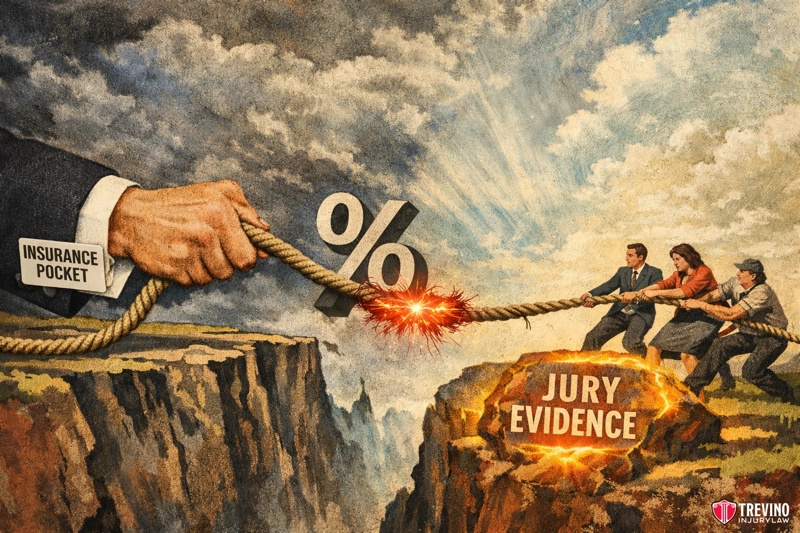
This is why Trevino Injury Law prepares every case for trial. We know that police reports are often incomplete and that insurance estimates are biased. By presenting strong evidence to a jury, we can overturn unfair insurance determinations and secure a verdict that reflects the truth.
What Evidence Can Reduce Your Assigned Fault?
To protect your claim, we must present undeniable evidence that proves the defendant’s negligence outweighed your own.
We utilize specific types of evidence to dismantle the insurance company’s liability arguments:
- Dashcam & Body Cam Footage: Visual proof that often contradicts the police report or the other driver’s story.
- Black Box (ECM) Data: Hard data from commercial trucks that reveals speed, braking, and steering inputs seconds before impact.
- Witness Testimony: Independent accounts from bystanders who saw the crash on roads like Culebra Road or Potranco Road.
- Forensic Accident Reconstruction: Scientific analysis of skid marks and debris fields to mathematically prove who caused the collision.
Case Results: How We Defeated Unfair Fault Allocations
This aggressive approach to evidence produces a favorable outcome for our clients, even when they were initially blamed.
Insurance companies often try to bully victims into accepting blame, but we fight back. In Jackie Galindo v. Jerry Word, the defense disputed liability, yet we secured a $1.25 million settlement. Similarly, in Roland Cardenas’s case, an 18-wheeler driver tried to claim our client was speeding and at fault.
We refused to accept that narrative, litigated the case, and settled for the maximum amount available. Perhaps most notably, in Jose Simon Arriaga Jr. v. Emily Montemayor, the defense offered a paltry $5,000, arguing our client wasn’t entitled to more. We took the case to trial, and the jury returned a verdict of $536,007, more than 100 times the initial offer.
This success leads us to use specific defense strategies to stop insurance companies from manipulating the system against you.
How Can a Lawyer Prevent Insurance Companies From Unfairly Blaming You?
An experienced injury attorney prevents unfair blame by using “Spoliation Letters” to save evidence and by deposing the at-fault driver to expose inconsistencies.
Insurance companies operate “Settlement Mills”, high-volume firms that process claims quickly and rarely fight fault allocations. They know which lawyers will fold and which will fight. Trevino Injury Law operates as a “Scholar Warrior.” We immediately issue Spoliation Letters to prevent the destruction of critical evidence, such as truck logs or surveillance video. We then aggressively litigate, deposing the at-fault driver to catch them in lies.

When an insurer knows a lawyer is willing to go to a verdict, they are far less likely to insist on a bogus 51% fault allocation.
What Is Joint and Several Liability in 51% Rule Cases?
Joint and several liability is a powerful legal tool that allows you to recover full damages from a single defendant if that defendant is more than 50% at fault.
Under Texas Civil Practice and Remedies Code § 33.013, if a defendant is found to be more than 50% responsible for your injuries, they can be held ‘jointly and severally’ liable for 100% of the damages. The Texas Supreme Court clarified the mechanics of this in F.F.P. Operating Partners, L.P. v. Duenez, 237 S.W.3d 680 (Tex. 2007).
In Duenez, the Court held that a jury must apportion responsibility among multiple parties, including the drunk driver and the bar that served them, to determine if a defendant crosses that 50% threshold. If we can prove that one party (such as a trucking company or corporation) is more than 50% at fault, Duenez confirms they must pay the entire bill, even if the other at-fault drivers are penniless.
This is critical in multi-vehicle crashes involving commercial trucks on I-10, where a trucking company with a large policy might try to blame a penniless car driver. If we prove the trucking company was more than 50% to blame, they must pay the entire judgment.
This mechanism becomes crucial in high-severity incidents, such as the 205 fatal crashes recorded in Bexar County in 2024, where total damages often exceed a single driver’s policy limits (TxDOT, 2024).
Can You Appeal a Fault Determination by the Police?
Yes, you can challenge a police report’s fault determination, as it is merely an officer’s opinion and not a final legal verdict. Many victims believe that if a police report says they are at fault, their case is over. This is false.
Police reports are often written by officers who did not witness the crash and may have missed key evidence. In court, the police report is just one piece of evidence, and it can be challenged.
We routinely cross-examine officers and present superior evidence, such as video or accident reconstruction data, that proves the officer’s initial assessment of responsibility for the accident was wrong.
Does the Texas 51% Rule Apply to Car Accident Claims?
Yes, the 51% rule applies to effectively all personal injury claims in Texas, including 18-wheeler crashes, premises liability cases, and motor vehicle collisions. This modified comparative negligence system serves as a strict recovery bar. It means that if a jury finds you more than 50% responsible for the incident, you are permanently barred from recovering any compensation. Because a single percentage point determines whether you receive a settlement or nothing at all, hiring a trial-proven San Antonio car accident lawyer is the most effective way to protect your claim from unfair fault allocations.
The Proportionate Responsibility Act is not limited to specific types of vehicles or scenarios. The scope of this issue is vast, considering that Texas saw 14,905 serious injury crashes and 4,150 traffic fatalities in 2024 alone. Whether you are involved in a multi-car pileup on Loop 1604, a truck collision in the Eagle Ford Shale, or even a slip and fall at a business in Alamo Heights, the same mathematical “bar” applies.
Defense attorneys and Texas injury lawyers across the board deal with this statute daily. The insurer’s goal is always to shift enough blame onto you, specifically 51%, to avoid paying a single dime.
However, a key legal distinction exists for workplace injuries. If your employer subscribes to Texas Workers’ Compensation insurance, the 51% rule generally does not apply to a claim against that employer for on-the-job injuries.
This is a complex area of law: a “non-subscriber” case versus a standard workers’ comp claim, which requires a specialized legal analysis to determine which rules govern your recovery.
While the 51% rule is a wall for most, it often crumbles in the workplace. If you were hurt on the job and your employer does not subscribe to Workers’ Comp, they may be barred from blaming you for your own injuries. To understand these complex “non-subscriber” cases, you should consult a San Antonio work accident injury lawyer who knows how to navigate these specific statutes to force a payout.
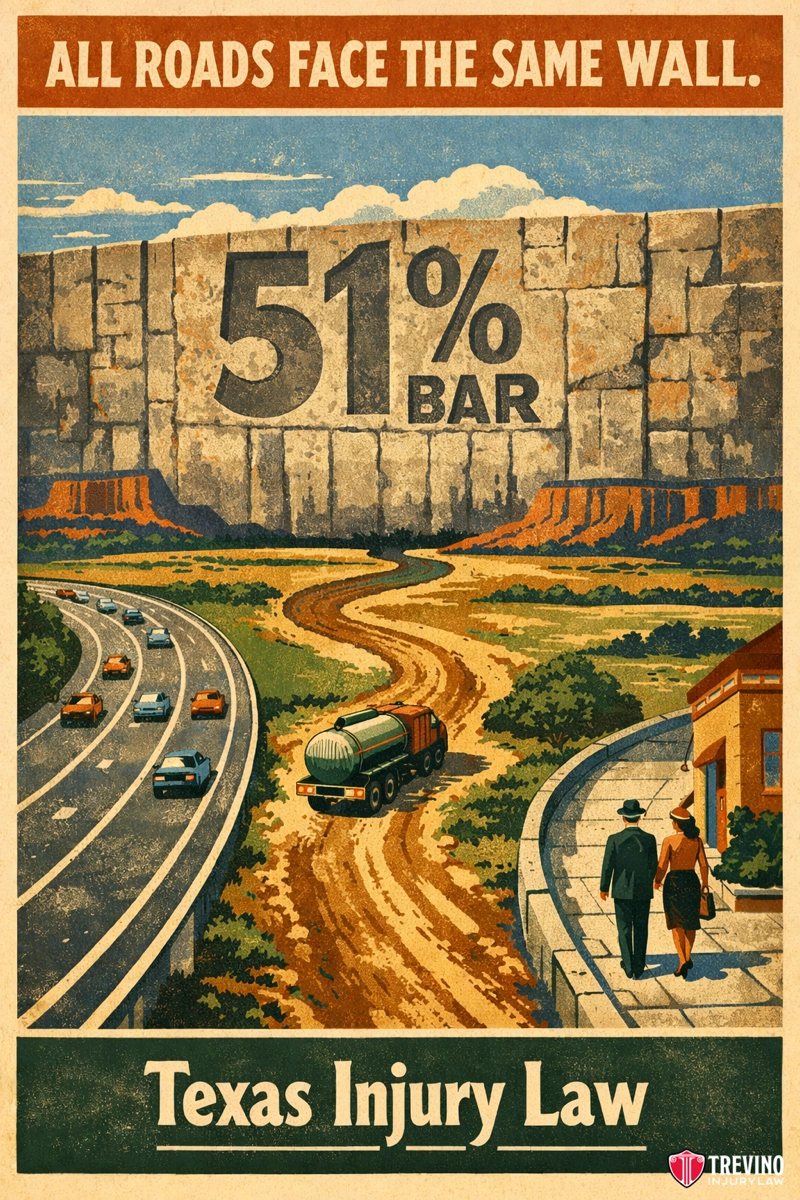
This broad application leads to the specific, practical steps you must take immediately to stop an Insurance Adjuster from successfully pinning that fatal percentage on you.
What Steps Protect Your Claim from Comparative Negligence?
To prevent insurance adjusters from using your own words to manufacture fault and trigger Texas’s 51% bar on recovery, you must strictly follow these three steps immediately after an accident:
- Refuse Recorded Statements: Decline any request for a statement without an attorney present; adjusters are trained to interpret polite apologies as admissions of distracted driving to push your liability above 50%.
- Document the Scene: Before vehicles are moved, capture photos of vehicle positions and skid marks to preserve the physical evidence needed to reconstruct accidents at complex intersections like SH-151 and Loop 1604.
- Delegate All Communication: Direct all phone calls and emails to a personal injury attorney immediately, ensuring that no “friendly” conversation can be twisted to deny your claim.
Can I Sue if I Am 50% at Fault in Texas?
Yes, if you are exactly 50% at fault, you can still recover damages, though your final payout will be reduced by half.
Can I Sue if I Am 51% at Fault in Texas?
No, if you are found 51% or more responsible for the accident, you are permanently barred from recovering any compensation under Texas’s law.
Does the 51% Rule Apply to Strict Liability Cases?
Yes, comparative negligence helps determine awards, even in strict liability cases such as product defects, potentially reducing them based on user negligence.
Contributory vs. Comparative Negligence: What Is the Difference?
Contributory negligence bars recovery if you are even 1% at fault, whereas comparative negligence allows recovery based on fault percentages up to a specific limit. Understanding negligence, defined by this legal distinction, highlights the stakes of your case.
In “pure” comparative negligence states like California, you could be 90% at fault and still recover 10% of your damages. In harsh “contributory” negligence states like Alabama, being just 1% at fault destroys your entire case.
Texas follows the middle ground with “modified comparative negligence.” This system is fairer than the strict 1% rule but requires vigilant defense of your liability. Because Texas draws a hard line at 51%, we must aggressively fight every percentage point of blame the insurance company attempts to assign you.
This distinction leads to the harsh reality of what happens when that specific percentage line is crossed.
What Happens If You Are Found 51% or More at Fault?
If you cross the 51% threshold, you receive zero dollars for your medical bills, regardless of how severe your injuries are.
This outcome is known legally as a “Take Nothing” judgment. It is the worst-case scenario for any person injured in an accident. Even if you have $100,000 in medical bills from a treatment at University Hospital and lost wages from missing work, a finding of 51% fault means the negligent driver walks away paying nothing.
You become solely responsible for your own financial recovery. This “all-or-nothing” consequence is why insurance adjusters are so motivated to push your liability from 40% to 51%; it saves them millions.
This warning raises the final question: what to do if the official record is wrong from the start?
What If the Police Report Incorrectly Assigns Fault?
An incorrect police report does not doom your case if your lawyer can produce superior evidence, like video or accident reconstruction data.
Police officers are often overworked and may arrive at a chaotic scene on Marbach Road long after the vehicles have been moved. They might rely on the statement of the first caller to 911, often the at-fault driver, who is trying to cover their tracks.
However, a police report is merely an opinion, not a final verdict. We can depose the officer to expose gaps in their investigation. We present “hard” evidence, such as surveillance footage or black box data, to prove that the officer’s initial assessment regarding responsibility for the accident was wrong.
Do not take this initial error lightly. When an officer or adjuster incorrectly assigns fault, it is not merely a clerical mistake—it is a tactical opening for the insurance company to deny your claim entirely.
In fact, a liability dispute is the single most urgent indicator of when and why hire a personal injury lawyer in San Antonio. Waiting even one day allows the insurer to cement this incorrect narrative, push your liability over the 51% threshold, and permanently devalue your case.
Demand the Best San Antonio Personal Injury Lawyer: Call 210-TREVINO Now
When adjusters manipulate the facts of a Loop 410 crash to push your fault past the 51% Rule, they expect you to get nothing. They rely on settlement mills that fold rather than fight. At Trevino Injury Law, we do not settle; we force them to pay. We fight for families, preparing every case for a Bexar County jury.
Want to Protect the Full Value of Your Claim?
You’ve seen how this affects your case — but this is only one piece of the puzzle. Our Personal Injury Lawyer page breaks down what a trial-ready firm does differently.
Our trial-first aggression secured a $536,007 verdict after the defense offered just $5,000. As your San Antonio personal injury attorney, we immediately issue Spoliation Letters to secure black box data.
Call 210-TREVINO for a free case review. Se Habla Español. We fight on a strict contingency basis: No Win, No Fee.