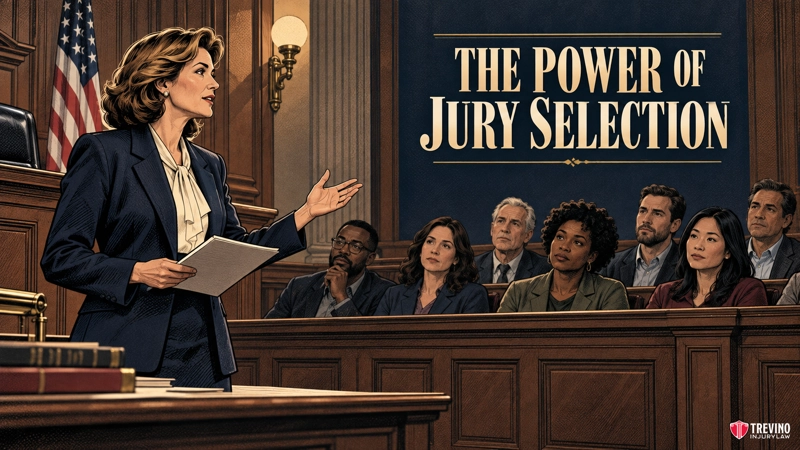
Barbara Allen Babcock (1938 to 2020) was a trial lawyer, the first director of the D.C. Public Defender Service, and the first woman on Stanford Law School’s regular faculty. She spent her career defending one idea: every person deserves a skilled advocate and a fair jury. Her 1975 article on jury selection, later cited by the U.S. Supreme Court, explains why jury selection remains one of the most important moments in any Texas injury trial.
Who Was Barbara Babcock?
Barbara Babcock was a Yale-trained trial lawyer who became one of the most influential legal educators of her generation. Born in Washington, D.C., in 1938, she graduated from Yale Law School in 1963, clerked on the U.S. Court of Appeals for the D.C. Circuit, and joined the trial firm Williams & Connolly.
Her career was a series of firsts:
- First director of the District of Columbia Public Defender Service (1968)
- First woman on Stanford Law School’s regular faculty (1972)
- Assistant Attorney General for the Civil Division of the U.S. Department of Justice (1977 to 1979)
- Founder of Stanford’s Women’s Legal History project, a research archive on pioneering women lawyers
At Stanford, she taught Civil Procedure and Criminal Law. She died in 2020 at 81.
What Is Fish Raincoats About?
Fish Raincoats: A Woman Lawyer’s Life is Babcock’s 2016 memoir, published by Quid Pro Books. It follows her path from the courtroom to the classroom: her years as a public defender, her “firsts” as a woman in the legal profession, and her work recovering the forgotten history of women lawyers.
Stanford describes a lawyer who defended both the powerless and “colorful mobsters,” and who inspired generations of students to look beyond billable hours. The book also documents the modern women’s movement inside the legal profession, and writers including Dahlia Lithwick and Emily Bazelon praised it. Stanford keeps a page on the memoir at Barbara Babcock’s Fish Raincoats.
Why Did Babcock Fight for Equal Representation in Court?
Babcock believed a courtroom is only fair when both sides have a skilled advocate. As the first director of the D.C. Public Defender Service, she built an office meant to give people who could not afford a lawyer representation equal to what private firms provided.
She traced the same idea through history. Her 2011 book, Woman Lawyer: The Trials of Clara Foltz (Stanford University Press), tells the story of the first woman admitted to the California bar. Foltz was the first to propose a public defender “to balance the public prosecutor.”
That principle of balance applies in civil court too. In an injury case, the other side is usually an insurance company with experienced trial lawyers on its payroll. An injured person deserves the same level of advocacy.
What Did Babcock Mean by the “Wonderful Power” of Voir Dire?
Voir dire is the questioning of potential jurors before trial, and Babcock argued it is one of the strongest tools for reaching a fair verdict. In her 1975 article, “Voir Dire: Preserving ‘Its Wonderful Power'” (27 Stan. L. Rev. 545), she defended each side’s right to question jurors and remove those who cannot be fair, including through peremptory strikes that need no stated reason.
The U.S. Supreme Court relied on that work. In J.E.B. v. Alabama (1994), Justice Sandra Day O’Connor cited Babcock’s article for this point:
“The principal value of the peremptory is that it helps produce fair and impartial juries.”
Five decades later, her argument still describes what happens on the first day of every jury trial.
How Does Jury Selection Work in a Texas Injury Trial Today?
Texas civil jury selection follows the Texas Rules of Civil Procedure, and the numbers are specific:
- A district court case has 12 jurors, as the Texas Constitution requires.
- Unlimited challenges for cause. You can remove any juror who shows bias that would prevent a fair verdict.
- 6 peremptory strikes per side in district court and 3 in county court (TRCP 233). The judge equalizes strikes when several defendants share the same interests.
- 10 of 12 must agree. The same 10 jurors must agree on every answer (TRCP 292).
- Punitive damages need all 12 (TRCP 292(b)).
There are limits. Race-based strikes are unconstitutional in civil cases (Edmonson v. Leesville Concrete Co., 1991), and Texas bars questions asking jurors to pledge how specific evidence will affect their verdict (Hyundai Motor Co. v. Vasquez, Tex. 2006). Our legal terms explained guide defines each of these terms.
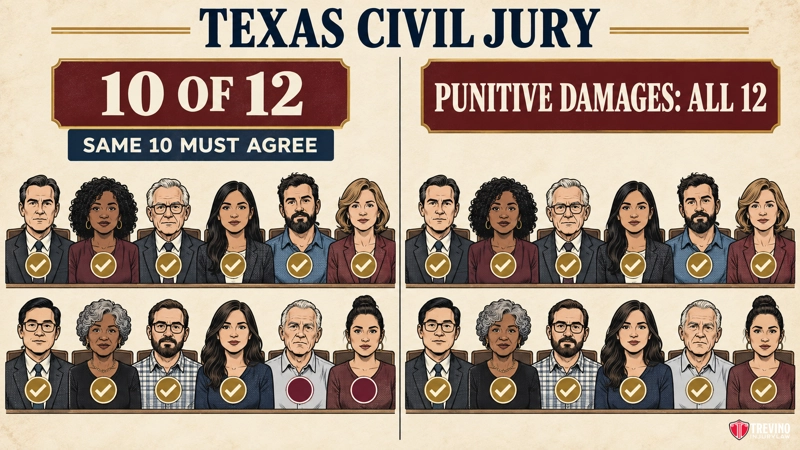
Because two biased jurors can block a verdict, and because under the Texas 51% rule a victim found more than 50% at fault recovers nothing, voir dire often shapes the outcome before any evidence is heard.
Why Does Jury Selection Matter Most in Truck Accident Trials?
Truck accident trials show Babcock’s point at its highest stakes. The defendant is usually a trucking company with a corporate defense team, the injuries are often catastrophic, and punitive damages may be on the table. Each of those raises the cost of seating one biased juror.
In an 18-wheeler case, the panel questions add topics such as:
- Experience driving near, or working around, commercial trucks
- Jobs in trucking, logistics, or fleet safety
- Beliefs about whether federal safety rules for truck drivers are “just paperwork”

A San Antonio truck accident lawyer uses these answers to strike biased jurors for cause and save limited peremptory strikes for the close calls. It also affects how catastrophic truck injuries are valued, because only a fair jury will weigh a lifetime of care honestly. If an 18-wheeler hurts you, the lawyer who picks your jury matters as much as the evidence.
How Does a Trial Lawyer Use Voir Dire Today?
A trial lawyer uses voir dire the way Babcock described: to find jurors who will hold a powerful defendant to the same rules as everyone else. That means asking open questions, listening for hidden bias, and building a record so biased jurors are struck for cause.
At Trevino Injury Law, attorney J.R. Trevino has taken more than 80 cases to trial and prepares cases for a Bexar County jury from day one. Insurance companies track which firms actually go to court, which is the difference between trial lawyers and settlement mills. Insurance giants have trial lawyers; injured people deserve them too.
If you need a San Antonio personal injury lawyer who is ready for trial, call 210-TREVINO for a free case review.
Frequently Asked Questions
Who was Barbara Babcock?
A trial lawyer, the first director of the D.C. Public Defender Service, and the first woman on Stanford Law School’s regular faculty. She died in 2020.
What is Fish Raincoats about?
It is Babcock’s 2016 memoir of her life as a pioneering woman lawyer, covering her years as a public defender, her teaching career, and the history of women in law.
What did Barbara Babcock write about jury selection?
In a 1975 Stanford Law Review article, she argued that voir dire and peremptory strikes are essential to fair juries. Justice O’Connor cited it in J.E.B. v. Alabama (1994).
How many jurors must agree to win a personal injury case in Texas?
Ten of twelve in district court, and the same ten must agree on every answer. Punitive damages require all twelve.
How many peremptory strikes does each side get in a Texas civil trial?
Six per side in district court and three in county court, adjusted by the judge when there are multiple parties.
This article is an independent tribute. Trevino Injury Law is not affiliated with Stanford Law School or the Babcock family.