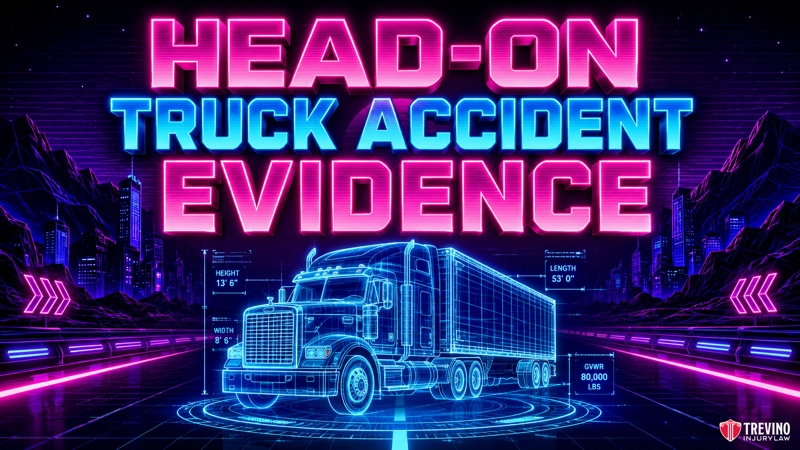
Electronic control module data, driver logbooks, and physical center-line crash geometry prove exactly why a commercial truck crossed into oncoming traffic. You cannot rely on a police report or subjective witness testimony to win this fight.
A rapid-response investigator from Progressive Commercial or Great West Casualty Company is already deployed to the crash scene to obscure liability and prepare the vehicle for repairs that overwrite the black box. According to TxDOT, head-on crashes killed 617 people across Texas in 2024. Behind most of these fatalities is a negligent corporate carrier pushing a fatigued driver to meet an impossible delivery schedule.
What Could Your Head-On Truck Accident Case Be Worth?
Answer a few quick questions about your accident. Takes about 60 seconds.
See What My Case Might Be WorthThe insurance company offered less than $20,000. I ended up with over $1 million. — Jackie Galindo
That critical digital evidence disappears the moment the semi-truck is returned to service. A Spoliation Letter, a legal demand that prevents the trucking company from destroying evidence, must be issued immediately. If you wait, the mechanical data proving sudden steering jerks and a lack of braking is permanently erased.
Trevino Injury Law head-on collision attorneys extract this digital footprint and lock the scene down before it vanishes. Call 210-TREVINO now for a free case review. You pay nothing unless we win. Se Habla Español.
What Evidence Is Most Important for Filing an Insurance Claim After a Head-On Collision?
The evidence needed for filing a commercial insurance claim after a head-on crash includes four key assets. You need the truck’s electronic control module (ECM) data, the commercial driver’s hours of service logged in electronic logging devices, unedited dashcam footage, and forensic scene analysis of the center line.
This hierarchy of powerful evidence is mandatory. Verbal testimony alone cannot prove why an 80,000-pound vehicle crossed into oncoming traffic. Securing these specific items mathematically proves driver fatigue, unsafe driving, or violations of federal safety rules. The data support this approach, as driver inattention was cited as a contributing factor in 81,101 crashes, and fatigue was noted in 7,983 incidents statewide in recent years (TxDOT, 2024).

Adversaries like Progressive Commercial or Great West Casualty Company aggressively deny fault. They fight especially hard for wrong-way crashes on dangerous corridors like the “Mixing Bowl” interchange. Trevino Injury Law uses a trial-first methodology. We prioritize seizing this digital and physical evidence immediately.
By locking down these assets before the truck is repaired, we prevent the insurance adjuster from deploying their standard blame-shifting playbook. In Bexar County alone, commercial motor vehicles were involved in 2,684 total crashes and 18 fatal crashes in a single year, underscoring the need for immediate, aggressive intervention (TxDOT, 2024).
Can You Provide a Checklist for Preserving Evidence After a Crash?
Yes, a complete checklist requires taking immediate, strategic action at the crash scene. However, your physical safety on dangerous roads like Loop 1604 must come first. Once you are safe from oncoming traffic, secure both physical roadway geometry and digital telematic proof of a center-line crossing before the trucking company destroys the data.
- Photograph the Center Line: Capture images of skid marks, gouge marks, and debris fields relative to the dividing yellow lines. This proves exactly where the frontal impact occurred. Capturing these details is essential, as failing to drive in a single lane was identified as a contributing factor in 42,588 Texas crashes recently (TxDOT, 2024).
- Document Frontal Crush Zones: Take wide-angle photos of the semi-truck’s cab and your vehicle’s resting positions. This establishes the critical angles of impact.
- Identify DOT Numbers: Record the commercial markings on the cab and cargo trailers. This immediately identifies the liable corporate entity.
- Refuse Recorded Statements: Do not speak to opposing insurance adjusters. They will twist your words to claim you drifted first.
How Do I Draft an Evidence Request Letter to the Trucking Company?
To properly draft an evidence request letter, your trial attorney must issue a formal spoliation letter. This legally mandates the trucking company to preserve all fmcsa regulations data, logbooks, and black box metrics relevant to the head-on impact. This is not a simple email. It is a binding legal demand drafted by a trial attorney. Additionally, inspection, repair, and vehicle maintenance records are only federally required to be retained for one year where the vehicle is housed, or just six months after the vehicle leaves the motor carrier’s control, so moving quickly is non-negotiable (FMCSA, 2024).
If a carrier operating in the Eagle Ford Shale destroys this data after receiving the letter, they face severe court sanctions. Executing this legal demand requires preserving the most critical digital asset: the truck’s electronic control module.
I Need Help Understanding How to Request Truck Black Box Data
You request truck black box data by having a truck accident attorney file an immediate spoliation letter or temporary restraining order. This legally forces the commercial carrier to download and surrender the Electronic Control Module (ECM) data before it is overwritten, a forceful maneuver supported by principles from In re Weekley Homes, L.P., 295 S.W.3d 309 (Tex. 2009), which governs the limits and allowances of compelling intrusive electronic evidence in Texas courts.
The public cannot access this data. It requires specialized extraction software and formal legal subpoenas. The ECM records vital pre-crash metrics necessary to prove liability, including sudden steering jerks and a lack of braking. Under federal standards, vehicle event data recorders can capture pre-crash data such as vehicle speed, throttle position, and service brake status from 20 seconds before impact to 0 seconds before impact, taking 10 samples per second (NHTSA, 2024).

A head-on collision occurs when the front ends of two vehicles traveling in opposite directions collide. This often happens when a driver drifts over the center line. By extracting ECM data, our accident reconstruction experts can determine exactly when a fatigued driver lost control on congested, two-lane roads like Potranco Road. We use this undeniable digital footprint to corner negligent trucking companies in Bexar County courts.
The power of extracting digital evidence cannot be overstated. As our client Jesus M. stated, “Despite clear dashcam evidence of an 18-wheeler driver’s fault, their insurance company denied responsibility until Trevino Injury Law secured maximum compensation”.
What ECM Metrics Prove a Commercial Truck Crossed the Center Line?
Accident reconstructionists analyze specific ECM metrics to mathematically prove that an 18-wheeler crossed into oncoming traffic. We rely on hard mechanical data rather than subjective witness testimony.
- Steering Angle Sensors: These document slow, continuous drifts (indicating driver fatigue) versus sharp, sudden jerks (indicating overcorrection or distracted driving).
- Speed and RPMs: This calculates the immense combined closing speed of both vehicles at the exact moment of frontal impact.
- Brake Application: This indicates whether the truck driver attempted to stop before the crash, often highlighting delayed reaction time or mechanical issues. This mechanical data is crucial, as failing to control speed contributed to 131,978 total crashes, and defective vehicle brakes were cited in 2,867 crashes statewide (TxDOT, 2024).
While the black box proves the vehicle’s internal mechanical actions, securing both digital telematics and physical scene geometry provides the required evidentiary foundation for litigation.
What Evidence Is Needed If I Am Planning to File a Lawsuit?
If you plan to file a lawsuit against a commercial carrier, you need a comprehensive evidentiary portfolio. This includes certified police reports, ECM digital downloads, FMCSA compliance audits, and advanced medical records and imaging.
Filing a formal complaint in a Texas state court requires a higher threshold of proof than a standard insurance claim. This documentation is time-sensitive; in Texas, law enforcement is required to submit a crash report to the state no later than the 10th day after a collision that results in injury, death, or at least $1,000 in property damage (TxDOT, 2024).

Settlement mills routinely fail to gather this level of evidence. They focus on rapid, lowball payouts. Trevino Injury Law has taken over 80 cases to trial. We prepare every case for the Bexar County Courthouse. Presenting the exact physics of the frontal impact strips the defense of their leverage. This rigorous preparation directly contributed to outcomes like our $17 Million settlement for an 18-wheeler wrongful death.
How Do We Document Catastrophic Injuries to Prove Damages?
We document catastrophic injuries by retaining specialized medical experts, neurologists, and life care planners. They translate complex physical trauma into undeniable, lifetime financial models.
The hardest injuries to prove are often closed-head traumatic brain injuries (TBIs) or complex spinal damage caused by rapid deceleration. To ensure every metric of your trauma is irrefutably documented, we connect victims with specialists in the South Texas Medical Center. Proper medical documentation forces adjusters to compensate for future medical care, aligning with our $7.9 Million verdict for a crushed foot and amputation. This impenetrable wall of evidence shifts power back to the victim.
How Does Trevino Injury Law Use This Evidence Against Negligent Trucking Companies?
Trevino Injury Law weaponizes preserved black box data and accident reconstruction evidence during aggressive litigation. We systematically dismantle insurance company defenses and force maximum financial compensation. We do not simply collect data. We actively use ECM metrics, driver logs, dispatch records, and advanced accident reconstruction to corner adjusters during mediation.
By proving we have the undeniable evidence required to win a jury trial, we permanently remove the insurance company’s ability to offer lowball settlements. Opponents like Swift Transportation or Progressive utilize specialized defense teams to delay and deny claims in South Texas. Because trial attorney Candelario (J.R.) Trevino prepares every single case as if a Bexar County jury trial is inevitable, our evidentiary portfolio neutralizes their standard playbook.

Successfully wielding this evidence requires a deep understanding of how fault is legally assigned. This level of preparation is absolutely necessary considering that truck-tractors and semi-trailers were involved in 430 fatal injury crashes across Texas in one year alone (TxDOT, 2024).
Who Is at Fault for a Head-On Collision?
Fault is determined by analyzing driver logbooks, physical scene geometry, and digital vehicle data. Our trial attorneys systematically build an evidentiary portfolio through a highly structured investigation:
- Extracting ECM Data: We immediately download black-box metrics to verify whether the driver was speeding, braking, or experiencing steering drift.
- Analyzing Scene Geometry: Accident reconstruction experts map out center-line gouge marks and debris fields to determine intersection points.
- Reviewing Hours-of-Service Logs: We audit driving logs to identify critical FMCSA fatigue violations and confirm that drivers were on duty for illegal durations.
- Deposing Safety Directors: We force corporate safety officers to testify under oath to expose negligent hiring practices.
Once those records and reconstruction findings establish what happened, the next issue is who can be liable for a head-on truck accident in Texas.
Are Police Reports Always Accurate in Commercial Crashes?
No, police reports are frequently inaccurate in complex commercial crashes. Responding officers often lack the specialized accident reconstruction training required to analyze 18-wheeler dynamics and high-speed frontal impacts.
Can I Still File a Claim if the Police Report Blames Me?
Yes, you can still file a claim. Because initial reports are often wrong, our accident reconstruction experts use digital black box data to override faulty findings.
Do Cops Actually Investigate Hit and Runs in Commercial Crashes?
Yes, police will investigate commercial hit-and-runs. However, your personal injury lawyer must independently subpoena nearby traffic cameras, surveillance, and weigh station data to definitively identify the fleeing trucking company.
Physical Scene Evidence vs. Digital Truck Data
While physical scene evidence shows the aftermath on the roadway, digital truck data reveals the exact mechanical inputs of the commercial driver moments before impact.
| Evidence Type | Key Characteristics |
| Physical Scene Evidence | Center-line gouge marks, yaw marks from evasive swerving, debris fields scattered in oncoming lanes, and fluid spills. |
| Digital ECM Data | Hard-braking event logs, drastic steering angle changes (overcorrection), RPMs, and throttle position indicate a lack of deceleration. |
By systematically combining both categories, Trevino Injury Law builds an airtight, trial-ready case in San Antonio courts. Marrying the physical reality of what happened with the digital confirmation of why it happened strips the adjuster of any leverage to deny liability. Both types of evidence share a critical vulnerability: time.
What Happens If You Fail to Send an Evidence Request Letter?
If you fail to send an evidence request letter, the negligent trucking company is legally permitted to destroy driver logbooks and maintenance records within six months. This is allowed under FMCSA Part 395 retention policies. Without this formal spoliation notice, victims lose their strongest leverage. Even more alarmingly, federal regulations allow trucking companies to discard driver vehicle inspection reports (DVIRs) just 3 months after the report was prepared (FMCSA, 2024).
The absence of this critical data severely cripples your negotiation power. You can no longer definitively prove driver fatigue, poor truck maintenance, or corporate negligence. This legal failure is immediately compounded by the permanent expiration of physical digital data.
When Does Black Box Evidence Become Permanently Unrecoverable?
Black box ECM evidence becomes permanently unrecoverable the moment the trucking company repairs the 18-wheeler’s front end and returns it to commercial service. New driving data overwrites the head-on crash metrics.
If your San Antonio personal injury lawyer does not file an immediate injunction to freeze the vehicle, the physical proof of the wrong-way collision is permanently erased. This expiration gives the insurance company clear grounds to falsely blame the victim and deny the claim.
Why Hire a Head-On Truck Collision Lawyer?
A head-on commercial crash destroys lives. The negligent trucking company’s rapid-response team is already working to erase the evidence. Hiring a trial-tested San Antonio personal injury accident attorney ensures your critical black box data is legally locked down before it disappears.
We know the insurance company’s delay-and-deny playbook. Our trial authority forces them to pay maximum compensation for your catastrophic injuries rather than offering a cheap settlement.
Want to Protect the Full Value of Your Claim?
You’ve seen how this affects your case — but this is only one piece of the puzzle. Our Head-On Truck Collision Lawyer page breaks down what a trial-ready firm does differently.
Do not let an insurance adjuster use your silence against you, and never give them a recorded statement. Protect your family and secure immediate legal representation on a strict contingency fee basis. You owe nothing unless we win your case. Call 210-TREVINO today for your free consultation. Se Habla Español.