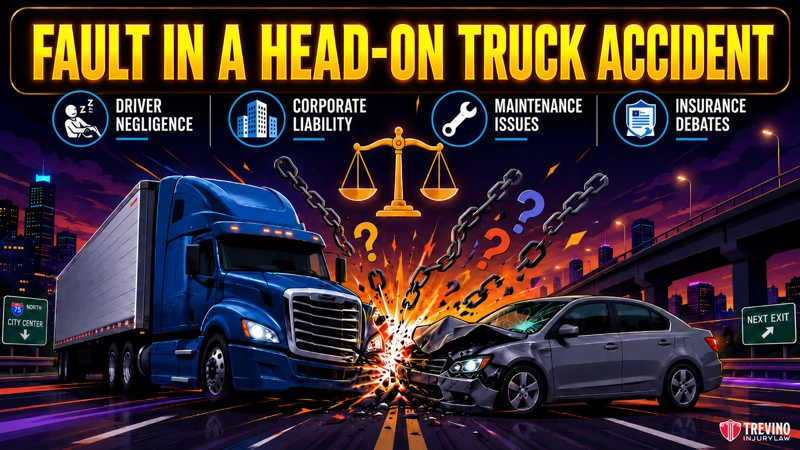
Fault extends beyond the driver who violently crossed the center line to the trucking company, the third-party maintenance contractor, and the freight broker. Liability follows the chain of corporate command that forced the unsafe dispatch and caused your injuries.
Rapid response teams from Progressive Commercial deploy to the crash scene immediately to shift the blame onto you. They overwrite electronic steering data and manipulate the narrative to fabricate a comparative negligence defense. According to the Texas Department of Transportation, 546 fatal commercial motor vehicle crashes resulted in 608 fatalities in 2024. This is a calculated strategy to protect corporate profits and deny your financial recovery.
What Could Your Head-On Truck Accident Case Be Worth?
Answer a few quick questions about your accident. Takes about 60 seconds.
See What My Case Might Be WorthThe insurance company offered less than $20,000. I ended up with over $1 million. — Jackie Galindo
Black box evidence disappears in the first week. Vital maintenance logs get shredded. You must immediately send a Spoliation Letter, a legal demand that stops the trucking company from destroying evidence. Texas gives you two years to file your lawsuit. After that, the strict window closes, and your claim vanishes.
Trevino Injury Law head-on truck collision lawyers subpoena this data and lock down the scene before the defense erases the truth. Call 210-TREVINO for a free case review. You pay nothing unless we win. Se Habla Español.
Who Is Liable When a Commercial Truck Hits You Head-On in Texas?
Liability in a Texas head-on commercial truck crash often extends far beyond one driver. Under the doctrine of respondeat superior, reaffirmed by the Texas Supreme Court in Painter v. Amerimex Drilling I, Ltd., 561 S.W.3d 125 (Tex. 2018), an employer can be held vicariously liable for an employee’s negligent acts committed within the course and scope of employment. This standard allows us to hold the negligent trucking company, along with freight brokers and third-party maintenance contractors, legally and financially responsible for the collision.
While the main hub covers how we hold negligent trucking companies accountable for FMCSA violations, understanding crossover crash liability requires a detailed analysis of vicarious liability, third-party maintenance contractors, and negligent hiring practices. When an 18-wheeler violently crosses the center line, fault is rarely isolated to a single steering overcorrection made by the driver.
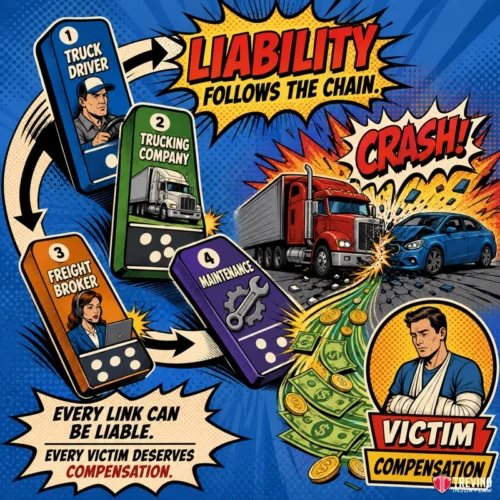
Legally, if a driver drifts into oncoming traffic or is traveling in the wrong lane of traffic, this violates Texas Transportation Code § 545.051, which explicitly requires operators to drive on the right half of a roadway of sufficient width (Texas Legislature, Current Texas statute). We investigate the entire corporate chain to establish liability; if trucking operators like Swift Transportation or J.B. Hunt Transport forced illegal schedules that led to a drowsy driver and a frontal drift, they share the blame. Federal trucking regulations dictate that corporate entities are financially responsible for the actions of their drivers’ and the safety of their fleet.
In San Antonio and Bexar County jurisdictions, identifying every liable party is critical for securing maximum compensation for the serious injuries, such as traumatic brain injuries and massive vehicle damage, caused by the combined velocity of a head-on impact. We analyze driver logs and corporate dispatch records to untangle the web of corporate protection. Settlement mills focus on quick payouts from the driver’s policy, but our trial-first strategy targets the corporate executives and freight brokers whose systemic failures caused crashes on roads like Culebra Road and Bandera Road. Identifying liability requires securing clear proof of negligence.
Entities Liable for a Head-On Truck Crash
Multiple corporate entities can be held financially responsible for a catastrophic commercial collision:
- The Truck Driver: For direct on-road negligence causing lane departure, such as fatigue, distracted driving, or impaired driving.
- The Trucking Company: For vicarious liability, negligent hiring, and forced dispatch.
- Freight Brokers: For contracting unsafe carriers with known safety violations.
- Maintenance Contractors: For deferred maintenance or mechanical failure leading to steer-tire blowouts or tie-rod failures that force the truck into oncoming traffic.
Defeating corporate defenses requires immediate access to specific electronic evidence.
What Evidence Proves the 18-Wheeler Driver Caused the Head-On Crash?
Black box data, dash camera footage, and physical roadway evidence are essential to mathematically prove the at-fault driver caused the accident and secure a superior financial outcome.
Expanding beyond what you must do in the first week after a San Antonio commercial truck crash, building an undeniable case involves a deep dive into the mechanics of accident reconstruction, combined velocity crush analysis, and Electronic Control Module (ECM) steering data. To prove fault conclusively, we extract data from the truck’s Electronic Control Module to show exact vehicle speed, lack of braking, and erratic lane position before the frontal impact.
Physical evidence disappears rapidly, so we deploy independent investigators to measure yaw marks, fluid spills, and pavement gouges. This creates an undeniable factual record that strips the trucking company of its ability to deny liability for crossing the median. Such objective proof is vital, given that state records cite “Wrong Side — Not Passing” as a contributing factor for 1,814 units in statewide crashes (TxDOT, 2024).
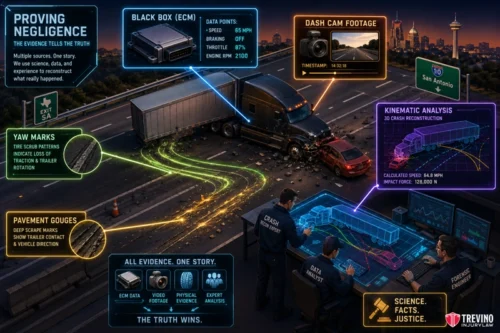
On high-speed South Texas corridors like I-10 and Loop 410, insurance companies’ rapid response teams arrive within hours to obscure the truth. By sending immediate Freedom of Information Act requests and Spoliation Letters, we legally freeze this digital and physical evidence. This aggressive, early evidence preservation is why Trevino Injury Law has secured multi-million dollar settlements, including a $17 Million Settlement in an 18-wheeler wrongful death case. Specialized experts then translate this physical evidence into legal proof.
How Do Accident Reconstruction Experts Determine Fault?
Reconstruction experts use physics, laser scanning, and vehicle crush analysis to map the exact sequence of events in a head-on collision.
- Scene Mapping: Utilizing 3D laser scanners to document the final resting positions of the vehicles.
- Combined Velocity Crush Analysis: Measuring vehicle deformation to calculate the extreme force and angle of a head-on impact.
- Data Integration: Overlaying ECM black box data with physical roadway markings.
- Kinematic Modeling: Creating mathematical models to definitively prove the 18-wheeler drifted across the center line or executed an unsafe passing maneuver first.
Despite this mathematical proof, corporate defendants will aggressively attempt to shift the blame onto you.
How Does Texas Proportionate Responsibility Apportion Fault?
Texas uses a proportionate responsibility framework, meaning fault for a head-on collision can be legally divided among multiple parties based on each party’s percentage of negligence.
Refining the discussion on what happens if the defense blames the weather, road conditions, or your driving, we must examine the statutory mechanics of shared fault and how the state’s stringent rules govern your final recovery. Under Texas proportionate responsibility laws, a jury evaluates the actions of all parties involved to assign a specific percentage of fault to each. If multiple corporate defendants—such as the trucking company and a third-party maintenance contractor—contributed to the crash, the court divides the financial liability accordingly.
Most critically, Texas follows the 51 percent bar rule, a legal threshold that bars anyone found to be 51% or more responsible for a collision from recovering compensation. This fundamental legal standard is formally codified in Texas Civil Practice and Remedies Code § 33.001 (Texas Legislature, Current Texas statute).
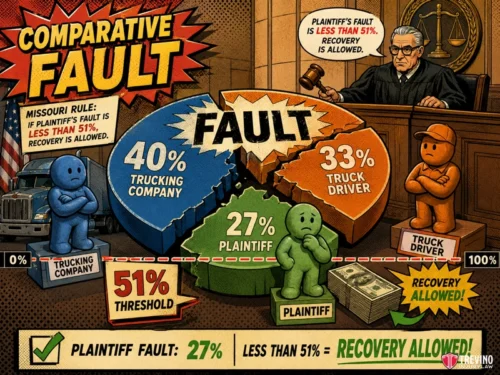
Because this law significantly affects financial recoveries in Bexar County courts, commercial insurers such as Allstate and Fred Loya Insurance actively seek ways to dispute liability. If the commercial truck driver attempts to argue shared fault, our car accident lawyers rely on aggressive accident reconstruction and black box data to prove the truck driver’s driving errors were the sole proximate cause, ensuring the corporate defendant bears 100 percent of the liability. Understanding this legal threshold directly affects how your compensation is calculated.
That threshold also affects how compensation is determined after a head-on truck collision in Texas.
Can I Still Recover Compensation If I Was Partially at Fault?
Yes, you can still recover compensation if you share a small percentage of fault, as long as your assigned responsibility is 50 percent or less.
If a jury awards $1,000,000 for a head-on crash but assigns you 10 percent of the fault for a minor traffic violation, your final recovery will be $900,000. Insurance companies manipulate this rule to routinely undervalue claims during early settlement negotiations.
By securing evidence immediately and drawing on our 80+ cases that went to trial, we force the insurance company to accept full liability and prevent them from unfairly reducing your financial recovery.
Forcing the insurance company to accept full liability requires a formal legal investigation.
How Is Fault Investigated During a Commercial Truck Lawsuit?
Fault is investigated in a commercial truck lawsuit through a multi-phase litigation process that includes immediate scene preservation, federal regulatory audits, and formal legal discovery to prove negligence mathematically. By aggressively securing this evidence before it disappears, your personal injury attorney forces the corporate defendant to accept full responsibility for your injury claim.
Transitioning from who is liable to how we analyze evidence in court requires moving far beyond the initial police report. The law firm files a formal complaint to initiate the Discovery Phase. We use subpoenas to compel the negligent trucking company to hand over highly protected documents, including third-party maintenance records, driver qualification files, and corporate dispatch communications.

By combining deep legal scholarship with aggressive courtroom advocacy, we construct a comprehensive timeline that exposes the root cause of the negligence. Understanding this process resolves common misconceptions about how fault is ultimately determined.
What is the Discovery Process for Proving Fault?
Proving fault requires executing a targeted legal sequence that strips the trucking company of its defenses and forces it to produce internal records. The discovery phase is the cornerstone of holding negligent trucking companies accountable for FMCSA violations in South Texas. By initiating this formal process to help you prove your case, we shift the balance of power back to the injured victim.
- Filing the Complaint: Initiating the lawsuit to file a claim in South Texas courts to gain subpoena power.
- Issuing Document Demands: Forcing the production of driver toxicological screens, hours-of-service logs, and ECM data.
- Taking Depositions: Forcing drivers and witnesses, safety directors, and corporate executives to answer questions under oath.
- Expert Designations: Presenting accident reconstruction models and Life Care Plans to establish both liability and lifelong medical costs.
This aggressive evidence gathering directly invalidates early assumptions made at the crash scene.
Is the trucking company at fault if they claim rain caused them to slide head-on into my lane?
No, weather is rarely a valid legal defense, because federal regulations explicitly require commercial drivers to reduce speed or halt operations during hazardous conditions. Insurance carriers often blame rain or slick roads when crashes involve center-line crossovers.
However, our accident reconstruction experts use black box data to prove the driver was traveling too fast for the conditions, overriding the weather defense and establishing 100 percent liability.
Does the Police Report Determine Who Is at Fault?
No, police reports are preliminary assessments that are often inaccurate in complex commercial crashes. While a police report establishes a foundational record of what officers document at the crash scene, it does not dictate the final outcome of liability.
Our accident reconstruction experts can override faulty initial findings in the report to prove true liability.
Is the Truck Driver Automatically at Fault in a Head-On Crash?
No. While a driver entering the wrong lane strongly indicates negligence, we must still prove the driver breached their duty of care and caused your specific injuries to secure a verdict.
Establishing that the commercial driver’s actions were the sole proximate cause of the collision is essential.
Driver Negligence vs. Corporate Liability
Driver negligence involves on-the-road errors, whereas corporate liability involves systemic failures by the company itself that enable those errors. Distinguishing between these two forms of fault is critical for maximizing your financial recovery following a catastrophic wreck.
When a commercial vehicle violently crosses a median, the immediate assumption is that the motorist is usually at fault; however, a deeper investigation frequently reveals a pattern of corporate negligence. In fact, fatigued or asleep drivers accounted for over 8,000 units in state crash reports; grueling corporate schedules often drive this dangerous exhaustion (TxDOT, 2024).
| Entity Focus | Examples of Fault | Impact on Litigation |
| Driver Negligence | Fatigue, intoxication, distraction, speeding. | Triggers the primary commercial insurance policy. |
| Corporate Liability | Negligent hiring, deferred maintenance, forced dispatch. | Opens access to larger corporate assets and supports punitive damages for gross negligence. |
Pursuing both avenues ensures that all responsible parties are held accountable for the accident they caused. Failing to document both types of liability immediately severely damages your case value.
What Happens If You Do Not Gather Fault Evidence Immediately?
If you do not gather evidence immediately, the trucking company will legally destroy crucial data, leaving you unable to prove they caused the crash. Without immediate attorney intervention, electronic logs are overwritten, and physical evidence at the scene washes away.
If you don’t send a Spoliation Letter, the trucking company is legally permitted to erase black box data and destroy driver logbooks in the normal course of business. This forces you to rely solely on the at-fault driver’s biased testimony or conflicting witness statements.
This reality is bound by strict, permanent legal deadlines.
When Is It Too Late to Prove the Trucking Company Was at Fault?
It becomes too late to prove fault once the two-year Texas statute of limitations expires or physical digital evidence is permanently overwritten. When physical evidence of the collision, such as dash-cam video, becomes permanently unrecoverable, holding the corporate entity accountable becomes incredibly difficult.
Why Hire a Head-On Truck Collision Lawyer?
Hiring a trial-tested personal injury attorney in San Antonio for robust legal representation is essential to immediately secure disappearing black box evidence, identify every liable corporate entity, and aggressively litigate against rapid-response adjusters who will try to minimize your catastrophic injuries and shift the blame onto you. With over 80 cases taken to trial, Trevino Injury Law has the proven courtroom experience required to take your case to trial and force negligent trucking companies to pay the maximum compensation your family deserves.
Want to Protect the Full Value of Your Claim?
You’ve seen how this affects your case — but this is only one piece of the puzzle. Our Head-On Truck Collision Lawyer page breaks down what a trial-ready firm does differently.
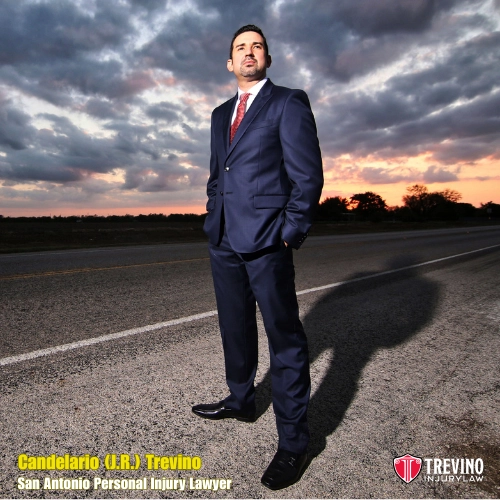
Do not give a recorded statement to the insurance company or let them manipulate the narrative of your crash. Protect your case and your family’s future by partnering with a firm that fights for economic justice and seeks compensation on a strict contingency fee basis, meaning you owe us nothing unless we win. Call 210-TREVINO. Se Habla Español.