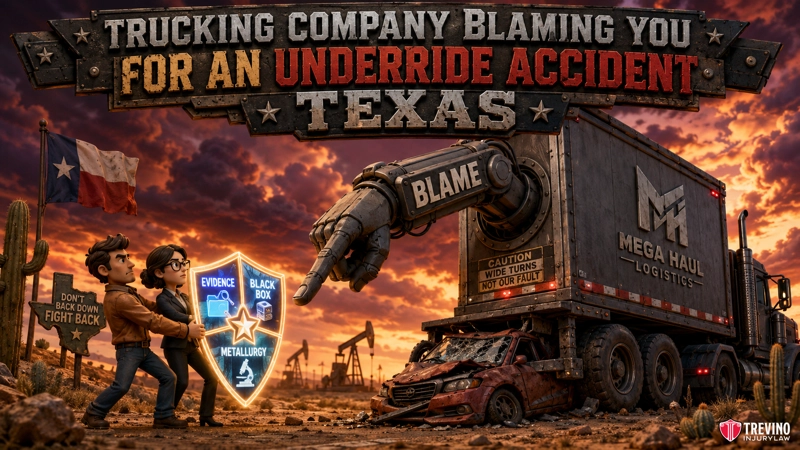
When a trucking company blames you for an underride accident, they are actively weaponizing Texas’s shared fault laws to erase your financial recovery.
Their rapid-response team is already manipulating the crash scene to protect their profits. They falsely claim your vehicle’s aerodynamic design caused the passenger compartment intrusion rather than their defective rear impact guard. This aggressive blame-shifting protects them from massive liability on congested local freight routes. According to TxDOT, commercial motor vehicles were involved in 2,684 crashes across Bexar County during 2024. Behind these wrecks is a corporate insurer actively attempting to excuse a catastrophic safety failure by pointing the finger at the victim.
Crucial electronic logging data and metallurgical proof of rusted welds vanish in the first week. You must immediately send a Spoliation Letter, a legal demand that stops the trucking company from destroying evidence, to preserve the tractor-trailer’s black box. Texas gives you two years to file suit. After that deadline passes, your claim is dead.
A Trevino Injury Law truck underride attorney will deploy independent biomechanical experts to expose these defense tactics and force negligent carriers to pay. Call 210-TREVINO now for a free case review. You pay nothing unless we win. Se Habla Español.
How Do Trucking Companies Try to Blame Victims for Underride Crashes?
Commercial insurance adjusters try to shift blame for truck accidents by aggressively claiming that the driver of the smaller vehicle was speeding, distracted, or failed to observe the trailer’s DOT reflective conspicuity tape before the impact. They deploy specialized rapid-response teams to manipulate the accident scene, attempting to argue that your vehicle’s specific low-profile aerodynamics actually caused the passenger compartment intrusion, rather than their defective Mansfield bar.
This aggressive blame-shifting is critical for corporate insurers in the trucking industry to mitigate their exposure, especially considering that nationwide, 70% of people killed in accidents involving large trucks are actually the occupants of the other vehicles, not the truck drivers.
This aggressive tactic is specifically designed to panic you into accepting a lowball settlement before you can secure legal representation to guide you through the process. While knowing why commercial trucking insurers call immediately after a crash establishes the timeline, understanding their specific aerodynamic and conspicuity tape defenses prepares you for the legal process ahead.

On dark, congested local freight routes like the Eagle Ford Shale corridors or the Mixing Bowl interchange, these corporate defense tactics are standard protocol. In side underride cases, they will falsely claim you had ample time to brake while their driver was illegally reversing or turning. To defeat them, we immediately lock down the crash scene to prevent the destruction of vital evidence.
Rear Underride Defense Tactics
- Claiming your impact speed exceeded the threshold of the Mansfield bar.
- Blaming the specific low-profile aerodynamic design of your car for the underride.
- Alleging failure to control speed or following the semi-truck too closely.
Side Underride Defense Tactics
- Arguing you had ample braking distance to stop for a turning commercial vehicle.
- Suggesting you ignored the reflective DOT conspicuity tape along the trailer’s side.
- Stating you failed to yield to a commercial trailer legally occupying the intersection.
What Happens When the Defense Uses FMVSS 223 and 224 Against You?
When the trucking company claims your impact speed exceeded the thresholds of Federal Motor Vehicle Safety Standards (FMVSS) 223 and 224, they are attempting to legally excuse the catastrophic failure of their rear impact guard by creating a false record of your excessive speed.
However, as reinforced by the landmark Texas Supreme Court decision in Werner Enterprises, Inc. v. Blake, 670 S.W.3d 562 (Tex. 2023), commercial motor carriers hold a fundamental duty of care to the public that cannot be evaded simply by blaming the victim for the carrier’s systemic safety failures.
Adjusters representing carriers like Progressive Commercial or Northland Insurance will argue that no federally mandated guard could have stopped your vehicle. They weaponize this standard procedure to create a false record of comparative fault, suggesting you were speeding excessively.
We intervene immediately, engaging biomechanical experts to demonstrate that the guard failed at a survivable speed due to pre-existing rust, defective welds, or third-party maintenance failures. The financial and human stakes in these trucking cases are incredibly high, as Texas saw 537 fatalities involving a trailer unit that heavily contributed to the crash in just a single year. Insurance companies manipulate several specific data points to build this defense:
- Impact velocity estimates that intentionally exaggerate your vehicle’s speed prior to the collision.
- Vehicle crush depth measurements are used to mathematically miscalculate the force of the impact.
- Driver reaction times ignore the practical invisibility of a rusted commercial trailer at night.
Because these accusations directly threaten your right to compensation, we must examine the specific Texas statutes they are attempting to exploit.
Yes, you can still recover financial damages if you share fault for a Bexar County truck crash, provided your percentage of responsibility is determined to be 50 percent or less by a jury or settlement agreement. If a jury determines you are partially responsible for failing to stop in time for a turning tractor-trailer, your final financial compensation will be mathematically reduced by your exact percentage of fault. The physical toll in our local area is severe, with Bexar County experiencing 34 CMV-involved, suspected serious-injury crashes in 2024 alone, making full compensation absolutely vital for your future care.
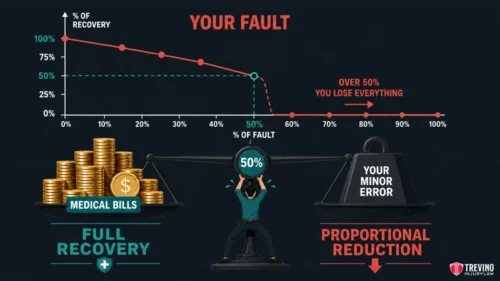
While understanding how Texas comparative negligence broadly impacts liability is important, seeing the exact mathematical reductions applied to your life care plan reveals the true financial stakes of your truck accident case. Understanding Texas tort law is critical when fighting a negligent trucking company in the Bexar County Courthouse. The defense will intentionally exaggerate minor driving errors, such as a supposed slight delay in braking, to shift a significant portion of the blame onto you, making aggressive legal pushback a financial necessity to cover medical bills and pain and suffering.
How Does the 51% Bar Rule Work in Texas Underride Claims?
The 51% bar rule in Texas strictly prohibits you from recovering any financial compensation if you are found to be 51 percent or more at-fault for the underride collision, making fault disputes the most critical battle of your case. This strict legal threshold is the primary reason high-volume settlement mills often drop complex side-underride cases, where liability is heavily contested. Defense attorneys will fiercely litigate to push your fault just over the 50 percent mark to completely avoid paying for your intensive care unit bills and life care plans. These claims are uniquely vulnerable to manipulation because side-underride collisions are vastly undercounted; in fact, NHTSA analysis indicates that actual side-underride fatalities may be 78% higher than the numbers officially reported in FARS data.
| Assigned Fault Percentage | Total Case Damages | Final Recovery Amount |
| 10% Fault | $1,000,000 | $900,000 |
| 49% Fault | $1,000,000 | $510,000 |
| 51% Fault | $1,000,000 | $0 (Barred from Recovery) |
To prevent the defense from reaching this 51% threshold and ensuring you are entitled to compensation, a trial lawyer must immediately secure objective, scientific proof of trailer failure.
What Evidence Disproves a Trucking Company’s Claim That You Caused the Underride?
A plaintiff trial lawyer disproves a trucking company’s false claims by conducting metallurgical testing on the sheared rear impact guard, securing the commercial vehicle’s black box data, and utilizing biomechanical engineering to demonstrate the trailer’s structural failure. You cannot defeat a multi-billion-dollar insurance company with just your spoken testimony. You need concrete, irrefutable evidence that the trailer’s steel was compromised long before the crash.

While knowing what to do immediately after a crash protects your health, understanding how we use metallurgical weld analysis and biomechanical engineering ensures your financial recovery is protected from false blame. To secure large settlements, such as our $17 million settlement in an 18-wheeler wrongful death case, we immediately issue spoliation letters and subpoenas. This locks down the physical wreckage and electronic logging devices before the motor carrier can conveniently dispose of the evidence after a catastrophic roof-shear crash on Loop 1604.
We focus on securing three primary pieces of forensic evidence:
- Metallurgical weld analysis to expose pre-existing rust or stress fractures in the guard.
- Electronic Control Module (ECM) data to verify the truck driver’s actual speed and braking inputs.
- Biomechanical modeling of the roof shear to prove how the passenger compartment intrusion bypassed your vehicle’s crumple zones. Securing this forensic evidence is paramount, as an estimated 409 light passenger vehicle occupants suffer serious injuries in side-underride crashes with tractor-trailers annually across the U.S.
Can Black Box Data (ECM) Prove the Truck Driver Made an Illegal Maneuver?
Yes, the Electronic Control Module (ECM) data provides a highly accurate, second-by-second digital record that can definitively prove that a commercial truck driver made an illegal lane change, abruptly slammed on the brakes, or initiated an unsafe U-turn. This digital footprint records vehicle speed, sudden deceleration, and steering input leading up to the impact. When the defense argues that you rear-ended their trailer due to inattention, we use ECM data to show that their driver actually cut you off, reducing your braking distance and making the catastrophic underride crash unavoidable.
As one of our clients, Jesus M., noted regarding dashcam and electronic evidence: “Despite clear dashcam evidence of an 18-wheeler driver’s fault, their insurance company denied responsibility until Trevino Injury Law secured maximum compensation”.
While forensic testing and ECM data provide objective truth, we must often use them to combat the subjective errors found in initial law enforcement documentation.
Why Do Insurance Adjusters Weaponize Police Reports After an Underride Collision?
Insurance adjusters weaponize preliminary police reports because responding officers frequently assign initial fault to the rear vehicle in an underride crash without recognizing the catastrophic failure of the commercial trailer’s safety guards, allowing the defense to immediately deny their liability. Adjusters use these hasty preliminary conclusions, which often default to blaming the trailing driver for a failure to control speed, to aggressively pressure vulnerable victims into abandoning their legitimate claims.
Law enforcement officers prioritize clearing the wreckage from congested corridors to restore traffic flow, not conducting exhaustive civil liability analyses regarding sheared welds on Mansfield bars. If a fatigued commercial driver lies to the police at the scene while you are being airlifted to University Health System, the initial accident report may incorrectly list you as the primary contributing factor.
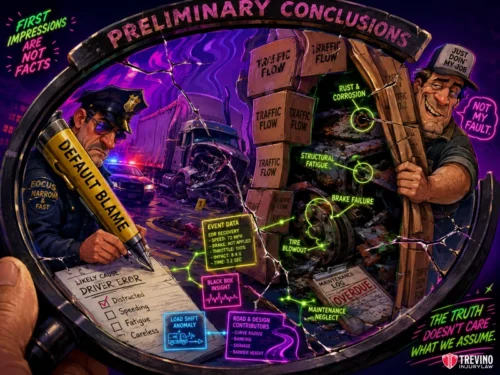
We utilize advanced litigation tactics to overcome these flawed preliminary reports before San Antonio juries. Because police reports are frequently inaccurate regarding structural engineering failures, we must rely on specialized scientific methodologies to prove liability and ensure the driver is responsible is held accountable. The reality of these wrecks is devastating, contributing to the 1,601 suspected serious injuries recorded in Texas CMV-involved crashes in 2024.
How Do Trial Lawyers Use Accident Reconstruction to Defeat Blame-Shifting?
Trial lawyers defeat blame-shifting by funding elite accident reconstruction experts who use 3D laser scanning and physics-based software to recreate the exact angle of the passenger compartment intrusion. High-volume settlement operations refuse to invest in these expensive engineering experts. However, to hold negligent parties accountable for traumatic brain injuries or decapitation risks, recreating how the trailer bed bypassed your vehicle’s crumple zones is mandatory. This scientific proof strips the insurance adjuster of their ability to manipulate the narrative.
We deploy a rigorous scientific approach involving three critical phases of underride reconstruction:
- Scene Mapping and Skid Mark Analysis to establish the commercial vehicle’s precise trajectory.
- Vehicle Crush Depth Inspection to mathematically quantify the catastrophic failure of the underride guard.
- Kinematic Modeling of Roof Shear to visually demonstrate the passenger compartment intrusion to a jury.
Can a trucking company be at fault for a side underride if side guards aren’t federally mandated?
Yes, a trucking company can still be held responsible for a side underride crash, despite the lack of a federal mandate, if we prove gross negligence in how the driver maneuvered the trailer across moving traffic.
Should you argue with the commercial insurance adjuster about fault over the phone?
No, you should never argue with the commercial insurance adjuster over the phone because they will secretly record your statements and twist your words to establish comparative negligence. You should avoid apologizing, as they will use it to claim you caused the collision.
Can you still win an underride lawsuit if the police report blames you for the crash?
Yes, you can still win because preliminary police reports are often inadmissible in Texas courts, allowing our forensic experts to override flawed opinions and prove the motor carrier’s actual negligence.
Recorded Statements vs. Forensic Evidence in Underride Claims
While recorded statements are highly subjective traps designed to elicit admissions of guilt, forensic evidence provides an objective, mathematically proven account of the motor carrier’s defective equipment. The insurance company desperately wants your recorded statement because it costs them nothing and frequently ruins your case. Conversely, forensic evidence, such as metallurgical testing on rusted steel underride guards, costs money to develop but serves as the ultimate weapon in the courtroom to secure maximum fair compensation.
| Defense Goal (Recorded Statements) | Plaintiff Truth (Engineering Data) |
| Trick you into admitting you looked away for a split second. | Use ECM downloads to prove the commercial driver abruptly braked. |
| Record you estimating your speed incorrectly. | Utilize 3D crush analysis to establish the exact impact velocity. |
| Force you to agree you could have avoided the crash. | Demonstrate through physics that the trailer’s turn made impact unavoidable. |
Understanding this difference is critical because failing to prioritize objective evidence over adjuster negotiations leads to devastating financial outcomes for your family.
What Happens If You Don’t Aggressively Fight a Comparative Negligence Claim?
If you do not aggressively fight a comparative negligence claim with a proven trial attorney, the insurance company will successfully shift the majority of the blame onto you and permanently deny your financial recovery. Failing to mount a ferocious legal offense allows the trucking corporation’s false narrative regarding conspicuity tape or your speed to become the accepted truth.
Unlike high-volume settlement mills, J.R. Trevino has taken more than 80 cases to trial. We fight back aggressively to prevent the insurance company from permanently denying your financial recovery. Without a plaintiff trial lawyer pushing back, you will be held financially responsible for your own catastrophic injuries, leaving your family to drown in overwhelming medical debt from facilities like the South Texas Medical Center.
The risk of catastrophic loss is undeniable, as there were 546 CMV-involved fatal crashes recorded across Texas in 2024, leaving hundreds of families devastated and vulnerable to these exact corporate tactics. Not only will inaction destroy your claim’s value, but waiting too long will permanently erase your legal right to file a lawsuit altogether.
When Is It Too Late to Dispute Fault in a Texas Underride Accident?
It is legally too late to dispute fault and file a lawsuit in Texas once the strict two-year statute of limitations expires, permanently barring you from securing justice against the negligent trucking company.
Because those first actions affect both evidence preservation and the defense narrative, use the steps to take after an underride truck accident in Texas as the practical sequence for documenting the scene, protecting evidence, and handling early insurer contact.
Furthermore, from a practical standpoint, it becomes almost impossible to dispute fault if you wait months to hire an attorney. Vital dash cam footage is overwritten, the compromised Mansfield bar is repaired, and the physical skid marks on I-10 disappear. You must contact Trevino Injury Law immediately so our lawyer can investigate and secure the forensic evidence required to protect your rights.
Why Hire a Truck Underride Accident Lawyer?
Hiring a trial-tested injury compensation attorney is the only way to stop commercial insurance adjusters from weaponizing comparative negligence laws against you. While negligent trucking corporations deploy rapid-response teams to falsely blame you for the crash, we launch independent forensic investigations, utilizing black box data and biomechanical engineering, to prove their gross negligence and secure your financial recovery.
Want to Protect the Full Value of Your Claim?
You’ve seen how this affects your case — but this is only one piece of the puzzle. Our Truck Underride Accident Lawyer page breaks down what a trial-ready firm does differently.
Do not let an insurance adjuster trick you into a recorded statement or pressure your family into a lowball settlement while you are fighting to recover. You must take the right steps and act immediately to lock down the evidence and protect your legal rights before the trucking company destroys it.
Call 210-TREVINO for a free consultation today. Se Habla Español.