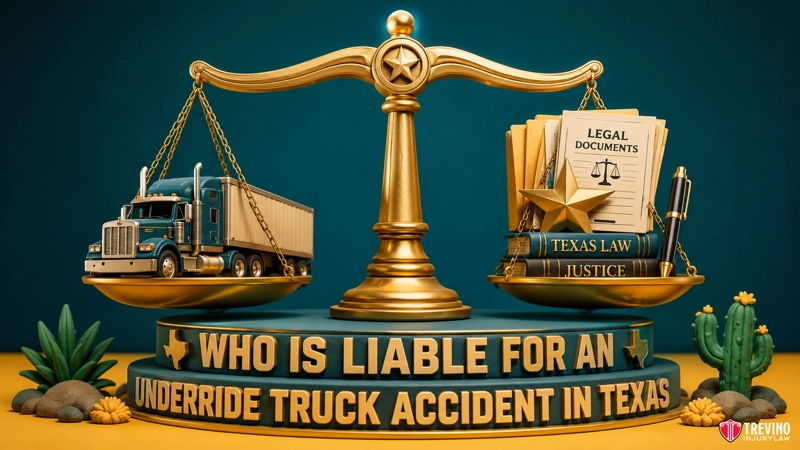
Liability for a Texas truck underride accident extends directly past the driver to the parent motor carrier, the freight broker, and the trailer manufacturer. When a commercial trailer shears through your passenger compartment, these distinct corporate entities share the financial liability.
The parent corporation is already shielding its massive commercial insurance policies. They are rapidly classifying the driver as an independent contractor to isolate liability and claiming the missing DOT conspicuity tape was a localized maintenance oversight.
The stakes are incredibly high, as Bexar County alone saw 18 commercial motor vehicle-involved fatal crashes in a single year (Texas Department of Transportation, 2024). Behind almost every fatal passenger compartment intrusion is a freight broker who forced an exhausted driver to stall a poorly marked trailer across dark highway lanes.
What Could Your Underride Truck Accident Case Be Worth?
Answer a few quick questions about your accident. Takes about 60 seconds.
See What My Case Might Be WorthThe insurance company offered less than $20,000. I ended up with over $1 million. — Jackie Galindo
Critical electronic logging data disappears in the first week. A Spoliation Letter, a legal demand that prevents the trucking company from deleting a commercial truck’s black box data, must be issued immediately. Texas gives you only two years to act before the claim vanishes forever.
Trevino Injury Law underride truck accident attorneys defeat the independent contractor defense and force negligent trucking companies to pay. Call 210-TREVINO for a free case review. You pay nothing unless we win. Se Habla Español.
How Does Vicarious Liability Apply to the Trucking Company?
Under Texas law, vicarious liability allows a truck accident lawyer to hold the parent trucking company financially responsible for catastrophic injuries. If the driver was operating within the scope of their employment, the corporation pays for the damages.
We use preserved commercial-trailer crash data to establish the driver’s course and scope of employment. This directly defeats independent contractor defenses. Respondeat superior is the specific legal doctrine that dictates a corporation can be held responsible for the negligent actions of its employees while on the job.
This duty was firmly established in Texas by landmark cases such as Painter v. Amerimex Drilling I, Ltd., 561 S.W.3d 125 (Tex. 2018), which holds that employers are vicariously liable for the torts of their employees committed within the course and scope of their employment.
This principle completely transforms your case value. It grants access to massive commercial insurance policies rather than relying solely on the driver’s limited personal coverage.
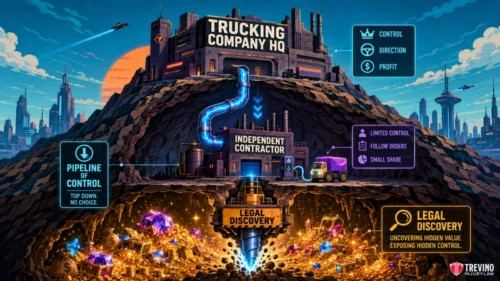
Companies like J.B. Hunt Transport or Swift Transportation routinely attempt to shield their assets after a devastating crash. They do this by quickly classifying drivers as independent contractors. An injury lawyer defeats this tactic by proving the company controlled the driver’s routes, loads, and schedule through the Eagle Ford Shale or along the I-35 trade corridor.
By demonstrating this level of corporate control, we force the parent company to take full financial responsibility as the responsible party. Our law firm has taken more than 80 personal injury law cases to trial. We know how to prove employment status in court to hold these corporations accountable.
Can You Sue the Motor Carrier for Negligent Hiring and Retention?
You can sue the motor carrier directly if they committed gross negligence during the hiring process. This occurs when a company hires a commercial driver with a documented history of safety violations or fails to conduct mandatory drug testing.
This establishes direct liability in Texas, distinct from vicarious liability. If the motor carrier bypassed Federal Motor Carrier Safety Administration (FMCSA) hiring protocols, they are directly liable.
Evidence of negligent hiring includes:
- Ignoring prior commercial DWI convictions.
- Failing to conduct mandatory pre-employment drug screenings.
- Forcing drivers to violate federal Hours of Service (HOS) regulations to meet delivery deadlines.
These violations lead directly to dangerous nighttime stalls across dark highway lanes. While the trucking company is liable for the driver’s actions and employment, the physical failure of the truck or trailer creates a separate corporate defendant.
When Is the Trailer Manufacturer Liable for a Defective Underride Guard?
A trailer manufacturer is strictly liable for your serious injuries if their rear impact guard failed to meet Federal Motor Vehicle Safety Standards 223 and 224. This engineering failure results in a fatal passenger compartment intrusion. It is important to note that upgraded federal rear-impact guard standards officially required compliance by July 15, 2024 (National Highway Traffic Safety Administration, 2024).
These federal safety rules mandate specific strength and energy absorption levels. The guard must prevent smaller vehicles from sliding underneath the commercial trailer. When corporations violate these rules by utilizing non-compliant or inferior steel during the manufacturing process, they are directly responsible for the resulting catastrophic trauma. Federal regulations specifically require these guards to extend to within 4 inches of the vehicle’s side extremities and sit no higher than 22 inches from the ground on covered trailers weighing 10,000 pounds or more (Federal Motor Carrier Safety Administration, 2026).
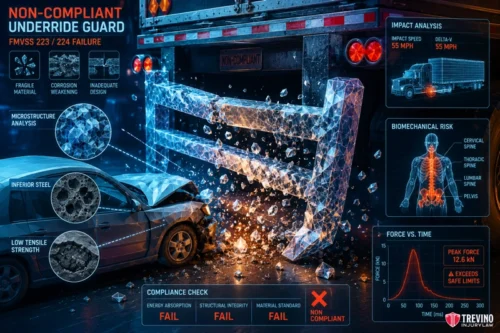
Passing a basic visual inspection does not excuse a manufacturer from deploying weak steel. To prove strict liability, we utilize biomechanical experts and metallurgists. These specialists physically measure the shear strength of the severed metal. They scientifically demonstrate that the bumper failed to absorb the required amount of kinetic energy upon impact.
If a collision occurs on high-speed arteries like US-90 or Culebra Road, we bypass the standard driver negligence defense. We pursue a third-party product liability lawsuit against the manufacturer. This ensures all liable parties are held fully accountable for the mechanical failure.
Are Maintenance Facilities Liable for Missing DOT Reflective Tape?
A third-party maintenance facility can be held liable for negligent repair if it inspected and approved a dangerous trailer. If a trailer were missing critical DOT-mandated conspicuity tape, it would become virtually invisible at night. Federal law requires a rigorous inspection of these commercial motor vehicles at least once during the preceding 12 months, ensuring that elements such as reflective tape are intact (Federal Motor Carrier Safety Administration, 2026).
Underride accidents frequently happen because a driver simply cannot see the side or rear of the trailer in the dark. Commercial trailers require rigorous upkeep to remain federally compliant. In fact, side-underride crashes with tractor-trailers account for an estimated 89 light-passenger-vehicle occupant fatalities annually nationwide, a number that safety officials believe is underreported by about 80% (National Highway Traffic Safety Administration, 2024).
If a third-party garage operating near the South Texas Medical Center signed off on a trailer with missing, covered, or severely degraded reflective tape, they share the blame. We will add them as defendants in the lawsuit for negligent maintenance. Identifying the manufacturer and maintenance facilities expands the defendant pool, but investigating the supply chain often reveals hidden third parties who set the dangerous events in motion.
Can Freight Brokers or Shippers Be Sued for an Underride Crash?
Yes, freight brokers and shippers can be held legally liable if they negligently hire an unsafe motor carrier. They are also liable if they pressured drivers to violate federal hours-of-service regulations, resulting in a fatigued driver stalling a poorly marked trailer across dark highway lanes or creating a dangerous jackknife situation.
Brokers act as the middlemen between the shipper and the trucking company. If they fail to vet the motor carrier’s safety rating, they share direct liability. Many brokers knowingly hire companies with a history of catastrophic accidents simply to save money.
When a truck underride accident occurs, it is uniquely tied to visibility and stalled or slow-moving trailers. When commercial truck traffic moves through the Mexico trade corridor, cut-rate brokers often push drivers to the point of exhaustion. The sheer volume of these massive vehicles makes this a critical issue, as truck-tractors and semi-trailers were involved in 26,281 total crashes across Texas in just one year (Texas Department of Transportation, 2024).
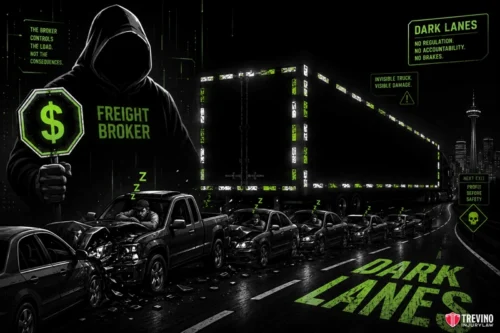
If a broker forces a driver to violate DOT hours, causing them to stall their invisible 18-wheeler across dark lanes near the “Mixing Bowl” interchange, a trial lawyer takes action. We identify these hidden defendants to add critical layers of insurance coverage from the commercial insurer. This funding is vital for your long-term medical recovery.
Can You Recover Compensation from Both the Trucking Company and the Broker?
Yes, truck accident victims can recover financial compensation from both the motor carrier and the freight broker simultaneously. We do this by targeting each corporation’s distinct commercial liability insurance policies.
High-volume settlement mills routinely settle for the first policy limit they uncover. This is often vastly inadequate for severe passenger compartment intrusions. Catastrophic injuries, such as spinal cord trauma or amputations, generate medical debt that quickly exceeds standard coverage.
Those coverage questions connect directly to documenting the medical and financial consequences of the collision. The guide to underride truck accident injuries and damages in Texas explains the injury, future-care, economic-damage, and non-economic-damage issues that shape that part of the claim.
By successfully holding both the trucking company and the negligent broker liable, a dedicated trial attorney unlocks stacked layers of excess and umbrella coverage. This aggressive approach works. Trevino Injury Law previously secured a $17 Million Settlement for a wrongful death case involving an 18-wheeler and multiple fatalities. We know how to uncover the funds necessary to cover your comprehensive Life Care Plan. Unlocking multiple corporate policies requires a court to officially apportion the financial responsibility between the at-fault companies.
How Does Texas Proportionate Responsibility Affect Multiple Corporate Defendants?
Texas proportionate responsibility laws and negligence rules mandate that the court divide the financial damages among all liable parties. This includes the driver, the trucking company, and the manufacturer, based solely on their respective percentages of fault.
Commercial Insurance Adjusters weaponize this standard by attempting to shift the blame entirely onto the passenger vehicle driver. However, a plaintiff trial lawyer uses this same legal framework to hold multiple corporations accountable simultaneously. This ensures you receive maximum compensation.
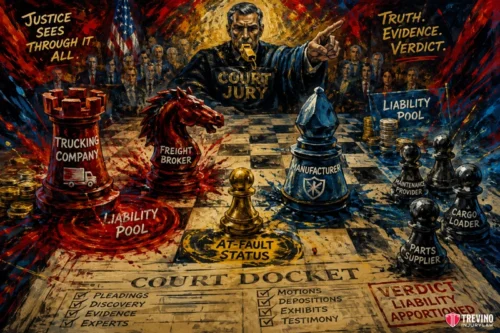
If a Bexar County Courthouse jury determines the motor carrier is 60 percent at fault for missing reflective tape and the manufacturer is 40 percent at fault for a defective underride guard, both must contribute to your recovery. This prevents any single corporation from escaping its financial obligation to your family when you file a personal injury lawsuit. Proving this exact percentage of fault requires unassailable forensic evidence preserved immediately after the crash.
What Evidence Proves Corporate Negligence After an Underride Crash?
Proving corporate negligence requires a trial lawyer to immediately execute a Spoliation Letter. This legal demand forces the company to preserve the commercial truck’s black box data, document missing reflective tape, and maintain the severed guard for inspection. By law, motor carriers are required to retain inspection, repair, and maintenance records for 1 year, plus an additional 6 months after the vehicle leaves their control, making early legal intervention critical to securing these records (Federal Motor Carrier Safety Administration, 2026).
To defeat the aggressive tactics of commercial carriers like Progressive Commercial or Great West Casualty Company, we must rapidly secure specific forensic data:
- Conspicuity Tape and Guard Inspections: Rapid deployment of metallurgists to measure the shear strength of the severed rear impact guard and document dirty DOT reflective tape before the trucking company hides the trailer.
- Electronic Logging Devices (ELDs): Prove hours of service violations that lead to fatigued drivers stalling across dark lanes.
- Dash Cam and Body Cam Video: Preserved via rapid Freedom of Information Act (FOIA) requests in the first week to establish undeniable fault regarding the trailer’s visibility.
The power of this evidence cannot be overstated. As our client, Jesus M., stated, “Despite clear dashcam evidence of an 18-wheeler driver’s fault, their insurance company denied responsibility until Trevino Injury Law secured maximum compensation.”
This critical evidence answers the most urgent legal questions injury victims face during the first week.
Can you sue if the commercial truck driver was an independent contractor?
Yes, you can successfully sue a commercial trucking company for an independent contractor’s negligence by proving vicarious liability and demonstrating that the corporation controlled the contractor’s daily routes and violated federal hiring protocols.
Do you need the truck’s black box data to prove liability for an underride accident?
Yes, securing the truck’s black box data is absolutely essential to proving liability, because it records the vehicle’s exact speed, braking application, and engine RPMs at the moment of the catastrophic passenger compartment intrusion.
Do you need a police report to file a commercial truck accident lawsuit?
Yes, you need a police report to file a commercial truck accident lawsuit because it officially documents the crash scene, identifies the responding officers, and establishes the initial foundation for determining corporate liability.
Federal FMCSR Violations vs. Standard Negligence
Violating Federal Motor Carrier Safety Regulations (FMCSR) constitutes negligence per se. This is a vastly more powerful legal claim for maximizing personal injury claims than standard driver error.
While standard negligence involves simple driving mistakes, federal violations prove systemic corporate disregard for public safety in South Texas:
| Negligence Type | Example Action | Legal Impact |
| Standard Negligence | Following too closely in heavy traffic on Loop 410. | Standard liability requiring proof of duty and breach. |
| FMCSR Violation | Operating a trailer without DOT conspicuity tape or utilizing rusted underride guards. | Negligence per se, establishing automatic fault and opening doors for punitive damages. |
Failing to aggressively pursue these specific federal legal avenues will destroy your case’s value.
What Happens If You Fail to Identify All Liable Parties Promptly?
If you fail to identify all liable corporate parties promptly, you will likely accept a lowball settlement from the driver’s insurance. This barely covers your initial emergency room visit, leaving you bankrupt from future medical costs.
High-volume settlement mills routinely sue only the truck driver to secure a fast, easy fee. This absence of thorough investigation allows the parent trucking company, the freight broker, and the trailer manufacturer to escape completely.
We do not accept lowball offers. In the case of Jose Simon Arriaga Jr. v. Emily Montemayor, the defense offered $5,000. We took the case to trial and secured a $536,007 jury verdict, more than 100 times the offer.
Without identifying well-funded corporate entities and preparing for trial, you cannot access the massive commercial insurance policies required to fund your ongoing surgical procedures, daily nursing care, and lost earning capacity. This catastrophic loss of compensation becomes permanent if you miss strict legal deadlines.
When Is It Too Late to Add a Corporate Defendant to Your Texas Lawsuit?
It is absolutely too late to add a corporate defendant, such as a trailer manufacturer or freight broker, to your lawsuit once the Texas two-year statute of limitations has expired.
The Texas statute of limitations strictly enforces a two-year deadline from the date of the crash to file a civil claim. If an inexperienced lawyer discovers a defective underride guard on day 731, your right to sue the manufacturer is permanently barred. Waiting to hire a trial-tested attorney allows critical evidence to vanish and risks the complete expiration of your civil rights.
Why Hire an Underride Accident Lawyer?
Hiring a trial-tested injury compensation attorney ensures you immediately preserve critical black box data. It allows you to defeat corporate independent contractor defenses and force negligent trucking companies to pay maximum financial compensation for your family’s future.
Want to Protect the Full Value of Your Claim?
You’ve seen how this affects your case — but this is only one piece of the puzzle. Our Underride Truck Accident Lawyer page breaks down what a trial-ready firm does differently.
The insurance company is already building its defense to protect its profit margins. Do not give them a recorded statement. We know their playbook, and we shut it down. You must act immediately to secure vital crash scene evidence before the motor carrier destroys it.
Call 210-TREVINO for a free consultation today. Se Habla Español.
